
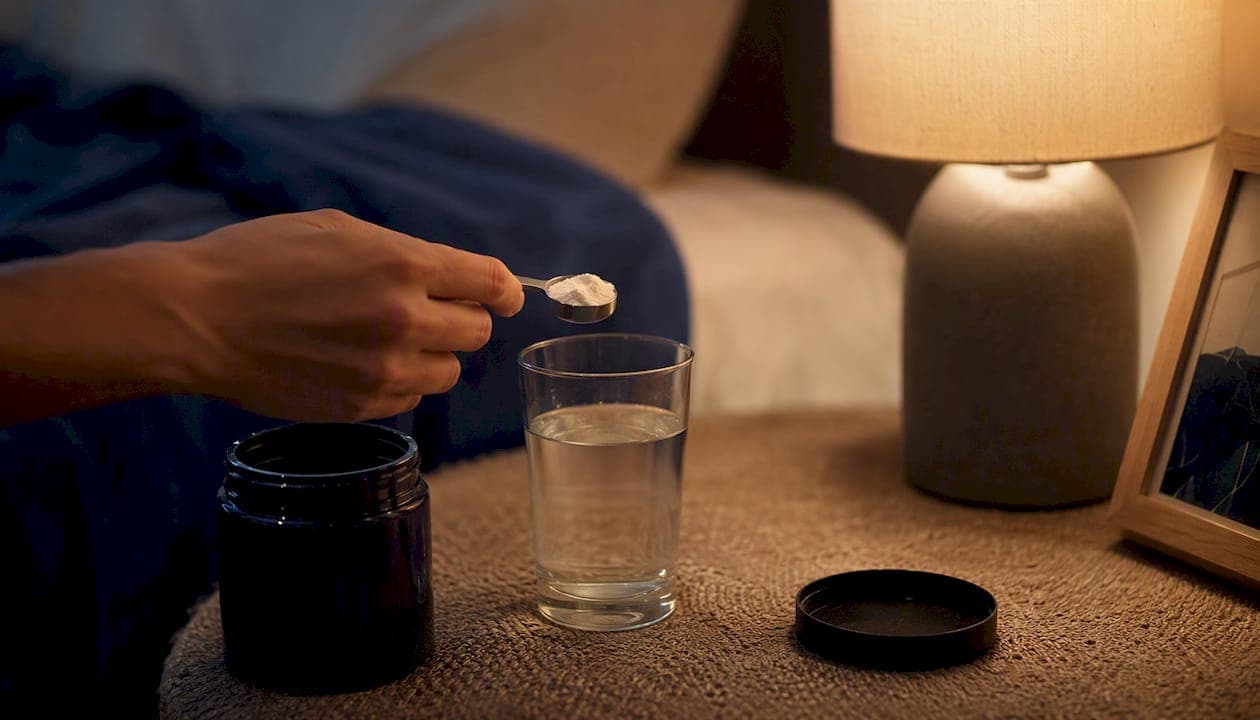
Glycine improves sleep. That's the short answer. Small but well-designed human trials show that 3 grams taken 30–60 minutes before bed shortens the time it takes to fall asleep, improves subjective sleep quality, and reduces next-morning sleepiness. The mechanism isn't sedation. Glycine works primarily by lowering your core body temperature through a pathway in the suprachiasmatic nucleus (SCN), which is the brain's circadian clock. That's a meaningful distinction from most sleep drugs.
A few things to know upfront:
- Trial dose: ~3 g orally, taken 30–60 minutes before bed
- Main mechanism: SCN-mediated vasodilation and core body temperature reduction
- Daytime benefit: Reduced sleepiness and improved cognitive performance the morning after dosing, reported in short-term trials
- Safety caveat: Generally well tolerated at 3 g; if you're pregnant, breastfeeding, have kidney disease, or take anticonvulsants or other CNS-active medications, talk to a clinician before starting
The evidence base is real but limited. Trials are small and short. What they show is promising enough to try, not definitive enough to call glycine a proven insomnia treatment.
Key Takeaways
Glycine taken at 3 g before bed shortens sleep onset, improves subjective sleep quality, and reduces next-morning sleepiness in small randomized trials, with a thermoregulatory mechanism that distinguishes it from sedating alternatives.
| Point | Details |
|---|---|
| Trial-backed dose and timing | 3 g of glycine taken 30–60 minutes before bed is the dose used in every positive human trial. |
| Core mechanism | Glycine activates NMDARs in the SCN, triggering vasodilation and a drop in core body temperature that signals sleep onset. |
| Evidence is real but limited | Small RCTs show consistent improvements; no large or long-term trials exist yet. |
| Safety and who to check with | Generally well tolerated at 3 g; consult a clinician if you have kidney disease, are pregnant, or take anticonvulsants or other CNS-active medications. |
| Nutrasmarts evidence tools | The Nutrasmarts glycine ingredient page and sleep supplement browser let you compare trial evidence and find third-party tested products. |
Table of Contents
- How does glycine actually change your sleep?
- What clinical trials show about glycine and sleep quality
- What dose and timing does the research use?
- Is glycine safe, and who should be careful?
- How to trial glycine safely and track whether it's working
- How does glycine compare to melatonin and magnesium for sleep?
- What the evidence still doesn't answer
- How to choose a glycine supplement using the Nutrasmarts evidence tools
- The Nutrasmarts take on glycine as a sleep aid
- Nutrasmarts has the evidence-rated guidance you need
- Sources
How does glycine actually change your sleep?
Glycine is a nonessential amino acid your body produces and obtains from food. Its role in sleep isn't about knocking you out. It's about nudging your physiology toward the conditions that make sleep easier to initiate and sustain.
The core mechanism runs through the suprachiasmatic nucleus. When you take glycine orally, it acts on NMDA receptors (NMDARs) in the SCN, the region of the hypothalamus that governs circadian timing. That receptor activation triggers peripheral vasodilation, meaning blood vessels near the skin dilate, heat dissipates from the body surface, and core body temperature drops. A falling core temperature is one of the body's primary signals that it's time to sleep. Animal and pharmacologic studies confirm that blocking NMDARs attenuates this vasodilation effect, which supports the pathway's role.
Key mechanistic points:
- Glycine activates NMDARs in the SCN, not broadly across the CNS
- The result is peripheral vasodilation and a measurable drop in core body temperature
- This mirrors the natural pre-sleep thermoregulatory process your body runs every night
- Glycine does not produce broad CNS depression the way benzodiazepines or sedating antihistamines do
That last point matters. Because glycine's action is relatively targeted, it preserves sleep architecture in trials. You're not trading sleep quality for sleep onset speed.
Pro Tip: The thermoregulatory mechanism is why timing matters. Taking glycine 30–60 minutes before bed aligns the temperature drop with the window when your body is already beginning its natural pre-sleep cooling. Taking it too early or too late may reduce the effect.
What clinical trials show about glycine and sleep quality
The human evidence for glycine as a sleep aid is built on a small but coherent set of randomized and crossover trials. The most-cited is a randomized single-blind crossover trial published in 2007, often called the Yamadera trial, which enrolled volunteers with chronic sleep complaints. Participants took 3 g of glycine or placebo within one hour of bedtime. The glycine group showed shorter latency to sleep onset, shorter latency to slow-wave sleep (SWS), improved subjective sleep efficacy, and reduced daytime sleepiness the following morning.
A separate study reported that participants taking 3 g of glycine before bed performed better on memory recognition tasks and reported lower fatigue the next day, suggesting the daytime cognitive benefits are real, not just a secondary effect of sleeping slightly longer.
| Trial / Year | Design | Dose | Main Outcomes | Limitations |
|---|---|---|---|---|
| Yamadera et al., 2007 | Randomized single-blind crossover | 3 g before bed | Shorter sleep onset latency, shorter SWS latency, improved subjective sleep quality, reduced next-day sleepiness | Small sample, short duration, self-reported complaints |
| Bannai et al., 2012 | Crossover, sleep-restricted volunteers | 3 g before bed | Reduced daytime sleepiness, improved memory recognition performance | Small sample, sleep restriction model may not reflect typical insomnia |
The clinical picture, taken together, is consistent: 3 g before bed improves sleep onset and subjective quality in people with mild-to-moderate sleep complaints. What the trials don't tell you is whether these effects hold over months, whether they generalize to people with diagnosed insomnia disorders, or how glycine performs in older adults with comorbidities.
Limitations worth keeping in mind:
- Sample sizes are small (typically under 20 participants per arm)
- Trial durations are short, usually under two weeks
- Populations are relatively healthy adults with sleep complaints, not clinical insomnia diagnoses
- No large-scale, long-term RCTs exist yet
That's not a reason to dismiss the evidence. It's a reason to treat glycine as a low-risk option worth a personal trial rather than a clinically established treatment.
What dose and timing does the research use?
The answer here is straightforward: 3 grams, taken 30–60 minutes before bedtime. Every human trial that showed meaningful sleep improvements used this dose and this general timing window. There's no evidence that higher doses produce better sleep outcomes, and doses above 9 g are associated with gastrointestinal discomfort in some people.
Practical dosing notes:
- Form: Trials used oral granules or powder dissolved in water. Capsules are available commercially and appear bioavailable, though the powder form used in research dissolves quickly and may act slightly faster.
- Dose per serving: Check the supplement facts panel. Some products list glycine as part of a blend without specifying the per-serving gram amount. You want a product that clearly states 3 g of glycine per serving.
- Timing: 30–60 minutes pre-bed is the evidence-backed window. This aligns glycine's thermoregulatory effect with your body's natural pre-sleep temperature decline.
- Starting out: Begin with a single-night test at the full 3 g dose. Glycine is not a drug that requires titration, but tracking your response from night one gives you a useful baseline.
Pro Tip: Mix glycine powder in 4–6 oz of water. It has a mildly sweet taste and dissolves easily. Keep a simple sleep log for the first two weeks: note the time you took it, roughly how long it took to fall asleep, how many times you woke up, and how you felt at 8 AM. That data will tell you far more than any subjective impression after a single night.
Is glycine safe, and who should be careful?
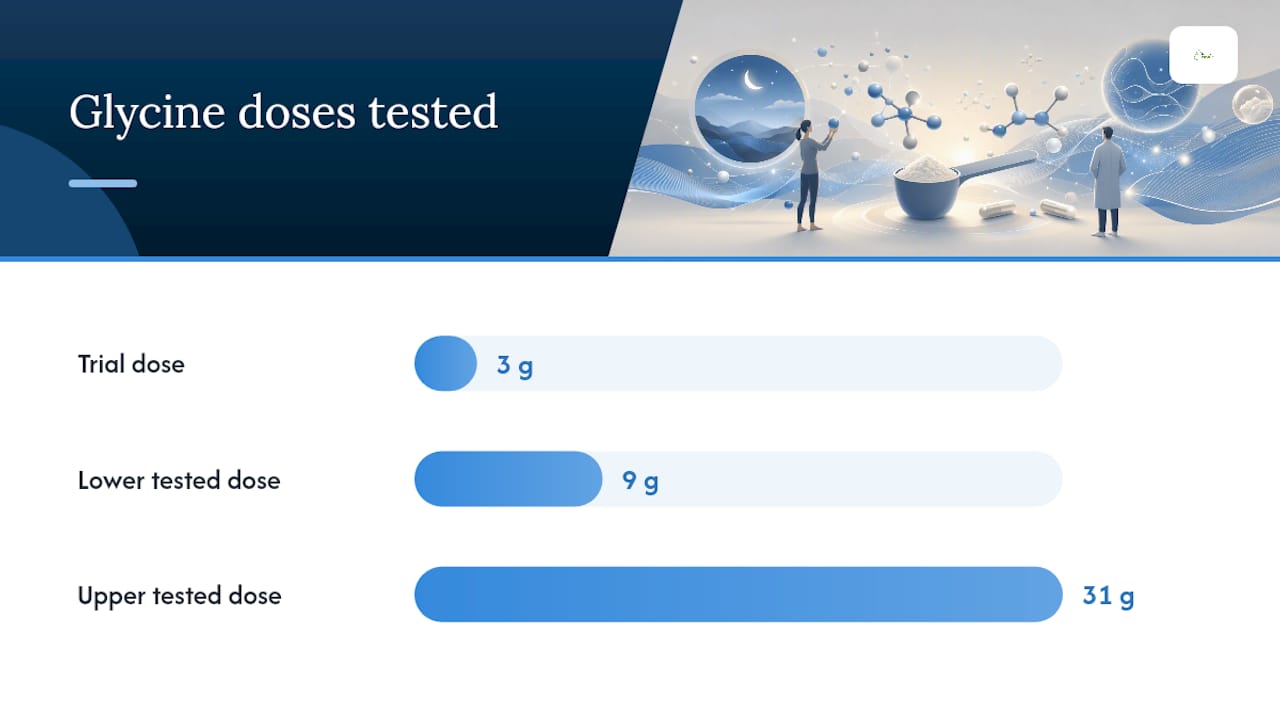
At the 3 g trial dose, glycine is generally well tolerated. Small safety studies have tested single doses up to 9–31 g in healthy adults without serious adverse events. The most common complaint at higher doses is mild, transient gastrointestinal upset, typically nausea or loose stools. At 3 g, GI side effects are uncommon.
That said, certain people should check with a clinician before starting:
- Kidney disease: Glycine is metabolized in the kidneys. Impaired renal function may affect clearance, and the safety data in this population is limited.
- Pregnancy and breastfeeding: No adequate human safety data exists for glycine supplementation during pregnancy or lactation. The precautionary default is to avoid it.
- Anticonvulsant medications: Glycine acts on NMDA receptors. There's a theoretical interaction with drugs that modulate glutamate or glycine signaling, including some anticonvulsants. The clinical significance is unclear, but it warrants a conversation with your prescriber.
- Other CNS-active medications: Sedating antihistamines, benzodiazepines, and other sleep aids taken alongside glycine haven't been studied in combination. Additive sedation is a theoretical concern, though glycine's mechanism is distinct from these agents.
Before starting any new sleep supplement, it's worth ruling out underlying causes first. Persistent sleep difficulty can be a sign of obstructive sleep apnea, a mood disorder, or a medication side effect. Glycine won't fix those, and treating the symptom without addressing the cause delays the right intervention. A clinician can screen for sleep apnea, review your medication list for sleep disruptors, and confirm whether a supplement trial makes sense for your situation.
How to trial glycine safely and track whether it's working
A 2–4 week trial is the practical standard for distinguishing a real effect from a placebo response. Here's how to run one properly.
Step-by-step:
- Screen first. If you snore loudly, wake gasping, or feel unrefreshed despite adequate sleep time, get evaluated for sleep apnea before starting any supplement. Glycine won't address airway obstruction.
- Review your medications. Check with your pharmacist or prescriber if you take anticonvulsants, sedating medications, or anything that affects the CNS.
- Set a start dose. Take 3 g of glycine dissolved in water, 30–60 minutes before your target bedtime.
- Keep a sleep log. Track nightly: time you took glycine, time you got into bed, estimated time to fall asleep, number of nighttime awakenings, wake time, and a 1–10 rating of how rested you felt in the morning.
- Note daytime function. Rate your afternoon alertness and any cognitive sharpness or fog. The daytime benefits reported in trials are worth tracking separately.
- Run the trial for 2–4 weeks. One or two nights tells you almost nothing. A consistent pattern over two to four weeks is meaningful.
What to track:
- Sleep onset latency (roughly how long it takes to fall asleep)
- Number of nighttime awakenings
- Morning sleepiness rating (a simple 1–10 scale works)
- Daytime alertness and mood
- Any GI symptoms
Interpreting results:
- Clear improvement by week two: continue and reassess monthly.
- No change after four weeks: glycine likely isn't the right lever for your sleep issue. Consider discussing CBT-I (cognitive behavioral therapy for insomnia) with a clinician, which has the strongest long-term evidence for chronic insomnia. You might also review whether magnesium or melatonin fits your specific pattern better.
- Partial improvement: discuss with a clinician whether combining glycine with another approach makes sense.
How does glycine compare to melatonin and magnesium for sleep?
Each of these three options targets a different part of the sleep problem. Knowing which one fits your situation is more useful than picking the most popular one.
A longitudinal cohort study of nearly 4,000 adults found higher magnesium intake associated with better sleep quality and lower odds of short sleep duration, though the authors called for RCTs to establish causality. The magnesium evidence is suggestive, not definitive. For magnesium glycinate specifically, the combination delivers both magnesium and glycine in one form, which is why it's popular as a sleep supplement. The magnesium glycinate dose for sleep typically mirrors the elemental magnesium targets above, but check the label for actual elemental content per serving, not just the compound weight.
Use-case guidance:
- Trouble falling asleep (normal circadian timing): Glycine is a reasonable first choice given its thermoregulatory mechanism.
- Delayed sleep phase or jet lag: Melatonin is better suited. See the melatonin evidence page for dosing detail.
- Frequent night awakenings with muscle tension or restlessness: Magnesium may address the underlying deficiency more directly. For a side-by-side breakdown, the melatonin vs. magnesium comparison covers the key differences.
What the evidence still doesn't answer
The existing trials are encouraging, but they leave real gaps that should shape how you use glycine.
- Sample sizes are small. Most trials enrolled fewer than 20 participants per arm. Effects that look consistent in small samples sometimes disappear in larger ones.
- Trial durations are short. The longest human trials run a few weeks. No one has studied glycine's sleep effects over six months or a year.
- Populations are narrow. Participants in published trials are generally healthy adults with subjective sleep complaints. Effects in older adults, people with diagnosed insomnia disorder, or those with comorbid conditions like anxiety or depression are unknown.
- Dose-response is unclear. All trials used 3 g. Whether lower doses work, or whether higher doses improve outcomes further, hasn't been tested in humans.
- Long-term safety data is absent. The short-term safety profile is reassuring, but no one has tracked glycine supplementation over years.
- Interaction data is thin. Glycine's interactions with common sleep medications, anticonvulsants, and other supplements haven't been formally studied.
These gaps don't make glycine a bad choice for a personal trial. They do mean you shouldn't treat it as a substitute for a clinical evaluation if your sleep problem is severe, persistent, or accompanied by other symptoms.
How to choose a glycine supplement using the Nutrasmarts evidence tools
Reading a supplement label correctly is the first practical step. The clinical dose is 3 g of glycine per serving. That number needs to appear explicitly on the Supplement Facts panel, not buried in a proprietary blend where the individual ingredient amounts are hidden.
A checklist for evaluating glycine products:
- Dose per serving: Confirm the label states at least 3 g of glycine per serving. Blends that list glycine without a per-ingredient gram amount make it impossible to know whether you're getting a therapeutic dose.
- Third-party testing: Look for a USP Verified, NSF Certified for Sport, or Informed Sport seal. These confirm that what's on the label is actually in the product.
- Form: Pure glycine powder or capsules are both acceptable. Avoid products that add unnecessary fillers or undisclosed proprietary blends.
- Sourcing transparency: Reputable manufacturers disclose the source and manufacturing standards for their amino acids.
Pro Tip: If you're formulating or evaluating a supplement product, Nutrasmarts's free FDA-compliant Supplement Facts label creator lets you build and check a label without spreadsheets. It's a fast way to verify that a 3 g glycine serving is accurately represented before you go to production or purchase.
Nutrasmarts maintains a detailed glycine ingredient evidence page that links directly to the clinical trials and mechanistic studies cited in this article. If you want to read the primary sources yourself or compare glycine's evidence rating against other sleep ingredients, that's the place to start. The sleep supplement top-picks list applies the same evidence-rating framework across 48 reviewed ingredients, so you can see how glycine stacks up against the full field.
The Nutrasmarts take on glycine as a sleep aid
Glycine occupies an unusual position in the sleep supplement space. The mechanism is genuinely interesting and physiologically plausible. The human trial data, while small, is consistent. And the safety profile at 3 g is about as clean as it gets for any supplement.
What tends to get lost in the enthusiasm is the distinction between "promising evidence" and "proven treatment." Glycine is the former. The trials that support it are real, but they're small, short, and conducted in relatively healthy adults. That's not a reason to avoid it. It's a reason to approach it the way the evidence actually supports: as a low-risk, evidence-informed option worth a structured personal trial, not as a replacement for a clinical evaluation or for CBT-I in people with chronic insomnia.
The supplement industry has a habit of taking a small positive trial and building a large marketing claim around it. Glycine deserves better than that. The honest version of the evidence is still pretty good: a physiologically coherent mechanism, consistent short-term improvements in sleep onset and quality, no meaningful safety concerns at trial doses, and a daytime benefit profile that sets it apart from sedating alternatives. That's a reasonable case for trying it. Just track your results, give it a full two to four weeks, and loop in a clinician if the underlying sleep problem is more than mild.
Nutrasmarts has the evidence-rated guidance you need
Sorting through sleep supplement claims takes time, and most sources either oversell the evidence or ignore it entirely. Nutrasmarts takes a different approach: every ingredient in the database is rated against the actual clinical trial data, with direct links to the studies so you can read the source yourself.
For glycine specifically, the Nutrasmarts ingredient evidence page gives you a structured summary of the trials, the mechanism, the dosing evidence, and the safety profile in one place. If you're comparing options, the sleep supplement browser lets you filter by symptom and evidence tier. And if you're building or evaluating a product label, the free Supplement Facts label creator handles the FDA-compliance side without a spreadsheet. None of this replaces a conversation with your doctor, but it gives you the evidence foundation to have that conversation well.
Sources
- Glycine ingestion improves subjective sleep quality in human volunteers, correlating with polysomnographic changes
- Glycine for Sleep: Benefits, Dosage, and Side Effects
- New Therapeutic Strategy for Amino Acid Medicine: Glycine Improves the Quality of Sleep
- Glycine - PubChem
- Magnesium intake and sleep outcomes — PMC
This article is general information, not a substitute for advice from a qualified doctor. Consult a qualified healthcare professional about your own circumstances before acting on anything here.