

The supplement aisle has never been more confusing. With over 95,000 products on the U.S. market and almost none of them subject to the same scrutiny as prescription drugs, your ability to identify high quality supplements comes down to knowing what to look for before you buy. Marketing claims are easy to print on a label. Actual potency, purity, and safety are not. This guide gives you the specific, science-backed criteria to cut through the noise and choose supplements that actually deliver what they promise.
Table of Contents
- Key takeaways
- How to identify high quality supplements: the regulatory reality
- Reading supplement labels the right way
- Why ingredient form determines whether a supplement actually works
- Safety considerations you cannot afford to skip
- Practical steps for choosing trusted supplement brands
- My honest take after years of watching this industry
- Find supplements you can actually trust with Nutrasmarts
- FAQ
Key takeaways
| Point | Details |
|---|---|
| FDA oversight is limited | Supplements are not pre-approved for safety or efficacy, so you must verify quality yourself. |
| Third-party certifications matter | Look for USP Verified, NSF, or ConsumerLab seals to confirm independent purity and potency testing. |
| Ingredient form drives absorption | Choosing the right chemical form, like magnesium glycinate over oxide, directly impacts how well a supplement works. |
| Avoid proprietary blends | Hidden dosages in proprietary blends often mean underdosed active ingredients and zero accountability. |
| COAs are your best verification tool | Lot-specific Certificates of Analysis confirm what is actually in the bottle, not just what the label claims. |
How to identify high quality supplements: the regulatory reality
Before you can evaluate any product, you need to understand the environment it comes from. The FDA does not pre-approve dietary supplements for safety or efficacy the way it does prescription medications. That means a brand can put almost anything on a shelf with minimal oversight, and the burden falls on you to verify what you are buying.
The consequences of this gap are real. Testing of 23 protein powders found that over 66% contained lead levels exceeding safe limits, with pea protein products being particularly problematic. That is not a fringe finding. It reflects a systemic quality problem across a largely unregulated industry.
Three issues show up repeatedly when products are independently tested:
- Inaccurate labeling: Products frequently contain more or less of an ingredient than stated on the label.
- Contamination: Heavy metals, pesticides, and undeclared pharmaceutical compounds appear in products that claim to be clean.
- Proprietary blends: These hide individual ingredient amounts, making it impossible to know whether you are getting a therapeutic dose or a trace amount.
"Transparency is not a marketing feature. It is the baseline standard that separates a supplement worth buying from one that is simply well packaged."
Trust is not built through celebrity endorsements or sleek packaging. It is built through verifiable data, third-party testing, and brands that make that information publicly accessible.
Reading supplement labels the right way
Most people scan a label for the ingredient name and move on. That approach misses the details that actually determine whether a product is worth your money.
Start with the Supplement Facts panel. Look at the serving size first, because some brands list impressive-looking amounts that only apply when you take four or five capsules. Then check the dosage per serving against what peer-reviewed research supports for that specific nutrient. For most vitamins and minerals, a Daily Value percentage between 50% and 150% is a reasonable target. Anything dramatically higher should prompt a closer look at whether excess intake carries risk.
Here is a step-by-step approach to reading any label critically:
- Confirm exact ingredient amounts. If the label lists a blend without individual dosages, that is a red flag.
- Check the ingredient form. "Magnesium" is not enough. You need to know whether it is glycinate, oxide, citrate, or another form.
- Look for third-party certification logos. USP Verified, NSF International, and ConsumerLab are the three most credible. These certifications confirm independent testing for purity and potency, though they do not validate efficacy claims.
- Scan the "other ingredients" list. This is where fillers, artificial colors, allergens, and unnecessary additives hide. Shorter is generally better.
- Request or search for a Certificate of Analysis. A COA provides batch-specific verification of what is actually in the product. Reputable brands make these publicly available or will send them on request.
Pro Tip: If a brand will not share a COA for the specific lot number on your bottle, treat that as a dealbreaker. Any brand serious about quality assurance in supplements will have this documentation ready.
Proprietary blends are one of the most common ways brands obscure underdosed ingredients. A blend might list ten ingredients with a combined weight of 500mg, but the most expensive active compound could represent only 5mg of that total. You have no way of knowing. Avoid them whenever a transparent alternative exists.
Why ingredient form determines whether a supplement actually works
Two products can contain the same nutrient and produce completely different results in your body. The difference comes down to the chemical form of the ingredient, and this is one of the most overlooked factors when people try to evaluate supplement effectiveness.

Take magnesium as the clearest example. Magnesium glycinate is significantly better absorbed and far less likely to cause digestive discomfort than magnesium oxide, which is the cheapest form and the one most commonly found in low-cost multivitamins. If you have ever taken magnesium and felt nothing, the form was likely the problem, not the nutrient itself. You can explore the glycinate vs. citrate comparison to see how these differences play out across the most common forms.
The same principle applies across multiple categories:
- Omega-3s: Triglyceride form absorbs significantly better than ethyl ester form, which is the cheaper version used in most mass-market fish oil products.
- Folate: Methylfolate (5-MTHF) is the bioavailable form. Folic acid requires conversion in the body, and a meaningful percentage of people have a genetic variant that reduces this conversion.
- Vitamin K2: MK-7 has a much longer half-life in the bloodstream than MK-4, making it more effective at lower doses.
- Curcumin: Standard curcumin has poor absorption. Look for forms paired with piperine or using phospholipid complexes for meaningful bioavailability.
| Nutrient | Lower quality form | Higher quality form | Key difference |
|---|---|---|---|
| Magnesium | Magnesium oxide | Magnesium glycinate | Better absorption, less GI distress |
| Omega-3 | Ethyl ester | Triglyceride | Higher bioavailability |
| Folate | Folic acid | Methylfolate (5-MTHF) | Bypasses conversion step |
| Curcumin | Standard extract | Phospholipid complex | Dramatically improved absorption |
Pro Tip: When the label just says "magnesium" or "omega-3" without specifying the form, assume it is the cheapest version. A brand confident in its ingredient choices will always name the form explicitly.
Ingredient bioavailability research consistently shows that the form of a compound determines both how much reaches systemic circulation and how well the body can use it. Paying more for a product that uses validated, well-absorbed forms is almost always worth it compared to buying a cheaper product that your body cannot effectively utilize.
Safety considerations you cannot afford to skip
The word "natural" on a supplement label means almost nothing from a safety standpoint. Many natural compounds interact directly with medications, and those interactions can be serious.
Supplements can interfere with blood thinners like warfarin, blood pressure medications, and antidepressants. St. John's Wort, for example, is one of the most documented cases of a "natural" supplement causing clinically significant drug interactions. Fish oil at high doses can increase bleeding risk. Even vitamin K affects anticoagulant therapy.
Beyond drug interactions, watch for these specific risks:
- Nutrient stacking: Taking multiple supplements that contain the same ingredient can push you well above safe upper limits. Fat-soluble vitamins like A, D, E, and K accumulate in the body.
- Contamination: Heavy metals, undeclared stimulants, and pharmaceutical compounds have been found in products marketed as clean and natural.
- Allergens: Many capsule shells contain gelatin. Some products use wheat-based fillers or soy-derived ingredients without prominent labeling.
- Megadoses: Some brands market extremely high doses as more effective. For many nutrients, doses above the tolerable upper intake level provide no additional benefit and carry real risk.
"If you take any prescription medication or have a chronic health condition, treating supplement selection as a medical decision, not a shopping decision, is the right approach. A pharmacist or physician can flag interactions before they become a problem."
The brands worth trusting invest in purity and stability testing that goes beyond the legal minimum. cGMP compliance is legally required, but adherence levels vary widely across manufacturers. Third-party audits and certifications are the best way to verify that a brand is actually following through on its manufacturing claims.
Practical steps for choosing trusted supplement brands
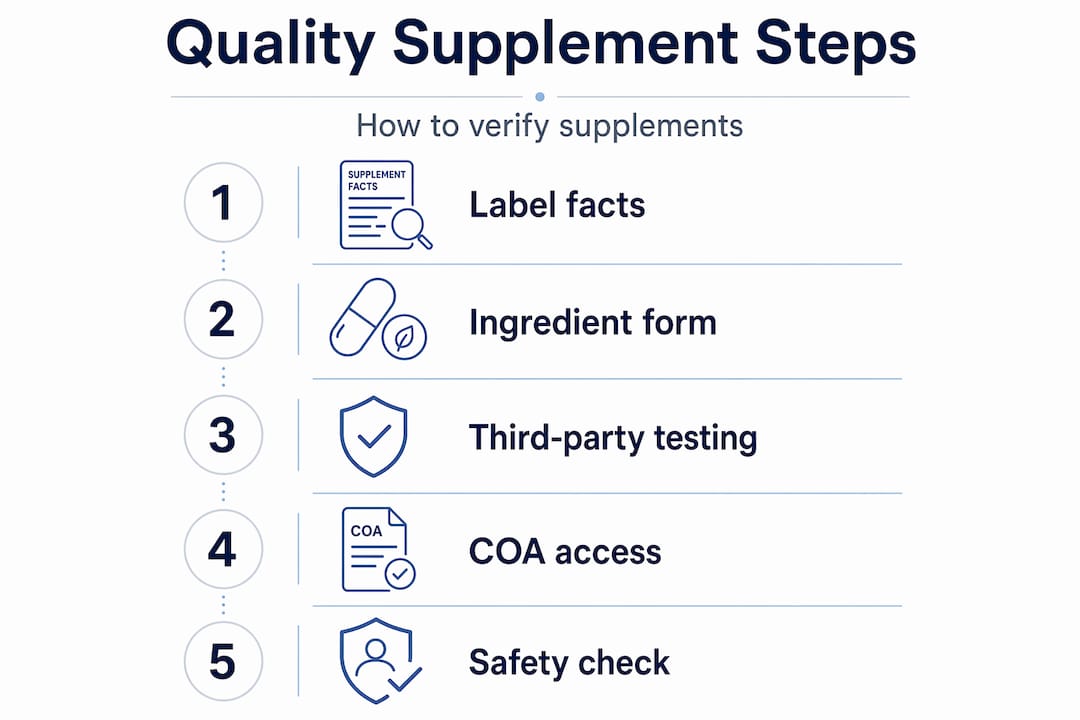
Knowing what to look for is only useful if you have a repeatable process for applying it. Here is how to move from research to a confident buying decision:
- Start with the label. Confirm exact dosages, named ingredient forms, and a clean "other ingredients" list. If any of these are missing or vague, move on.
- Check for third-party certification. USP Verified, NSF Certified for Sport, or ConsumerLab approval are the most credible signals of independent quality verification.
- Request the COA. Lot-specific COAs confirm identity, potency, and purity for the exact batch you are buying. This is non-negotiable for high-grade dietary supplements.
- Verify cGMP manufacturing. Look for explicit statements about manufacturing facility standards, ideally backed by third-party audit results.
- Cross-reference with independent databases. Tools like the Nutrasmarts ingredient database link ingredients to peer-reviewed studies and clinical trial citations, so you can verify whether a dosage is clinically relevant before you buy.
| Quality marker | What to look for | Red flag |
|---|---|---|
| Label transparency | Exact dosages, named ingredient forms | Proprietary blends, vague "complex" listings |
| Third-party testing | USP, NSF, ConsumerLab seals | No certification, self-certified only |
| COA availability | Lot-specific, publicly accessible | Not available or only on request after purchase |
| Manufacturing | cGMP facility, third-party audited | No manufacturing information disclosed |
| Dosage alignment | Matches clinical research ranges | Megadoses or token "fairy dust" amounts |
Avoid brands that lean heavily on testimonials, before-and-after photos, or vague claims like "supports wellness." Top rated vitamins and supplements from trusted brands let the data speak. They publish their testing results, name their manufacturers, and do not hide behind blends.
When managing your supplement routine, avoid stacking products that duplicate ingredients. Build from a foundation of documented deficiencies or specific health goals, and use symptom-based supplement guides to match products to your actual needs rather than marketing trends.
My honest take after years of watching this industry
I have reviewed hundreds of supplement products, and the single most reliable predictor of quality is not the price point or the brand reputation. It is whether the company makes its testing data easy to find.
Brands that are confident in their products put COAs on their website. They name the ingredient forms. They do not hide behind proprietary blends or vague "clinically studied" language that refers to a study on a different dose or formulation than what is in the bottle. When I see a brand doing all of those things, I take it seriously. When I see one that does not, no amount of polished packaging changes my assessment.
The biggest mistake I see consumers make is equating price with quality. Some of the most expensive supplements on the market use cheap ingredient forms and rely entirely on brand prestige. Meanwhile, some mid-range brands follow manufacturing and transparency standards that would satisfy any serious researcher.
My other observation: the industry is slowly improving. Consumer pressure for transparency, the growth of independent testing organizations, and platforms that make it easier to cross-reference ingredient research are all pushing brands toward higher standards. Your purchasing decisions are part of that pressure. When you consistently choose brands that prioritize transparent dosage disclosure over marketing buzzwords, you are rewarding the right behavior.
Be patient with this process. Evidence-based supplementation is not about finding a magic product. It is about building a routine grounded in verified ingredients, appropriate doses, and honest data.
— Nutrasmarts
Find supplements you can actually trust with Nutrasmarts
Sorting through thousands of products on your own takes time most people do not have. Nutrasmarts was built specifically to make this process faster and more reliable for health-conscious consumers who want evidence, not marketing copy.
Nutrasmarts gives you access to a database of over 800 ingredients, each linked to peer-reviewed studies and clinical trial citations. You can search by health concern, from joint pain to brain fog, and get metabolic health supplement recommendations grounded in clinical evidence rather than brand sponsorship. Every product review includes ingredient form analysis, dosage verification, and transparency scoring. If you want a starting point organized around your specific symptoms, the supplements by symptom tool gives you curated, evidence-backed options without the guesswork. This is what informed supplement selection actually looks like.
FAQ
What makes a supplement high quality?
High quality supplements disclose exact ingredient dosages and forms, carry third-party certifications like USP or NSF, and provide lot-specific Certificates of Analysis confirming purity and potency.
Why should I avoid proprietary blends?
Proprietary blends hide individual ingredient amounts, which allows brands to underdose expensive active compounds while still listing them on the label.
What is a Certificate of Analysis and why does it matter?
A COA is a batch-specific document from an independent lab that verifies what is actually in a supplement, including ingredient identity, potency, and the absence of contaminants.
Are expensive supplements always better quality?
No. Price does not reliably predict quality. Some premium-priced products use cheap ingredient forms, while mid-range brands sometimes follow stricter manufacturing and transparency standards.
Can supplements interact with my medications?
Yes. Natural supplements can interfere with blood thinners, blood pressure drugs, and antidepressants, among others. Always consult a pharmacist or physician before adding supplements if you take prescription medications.