

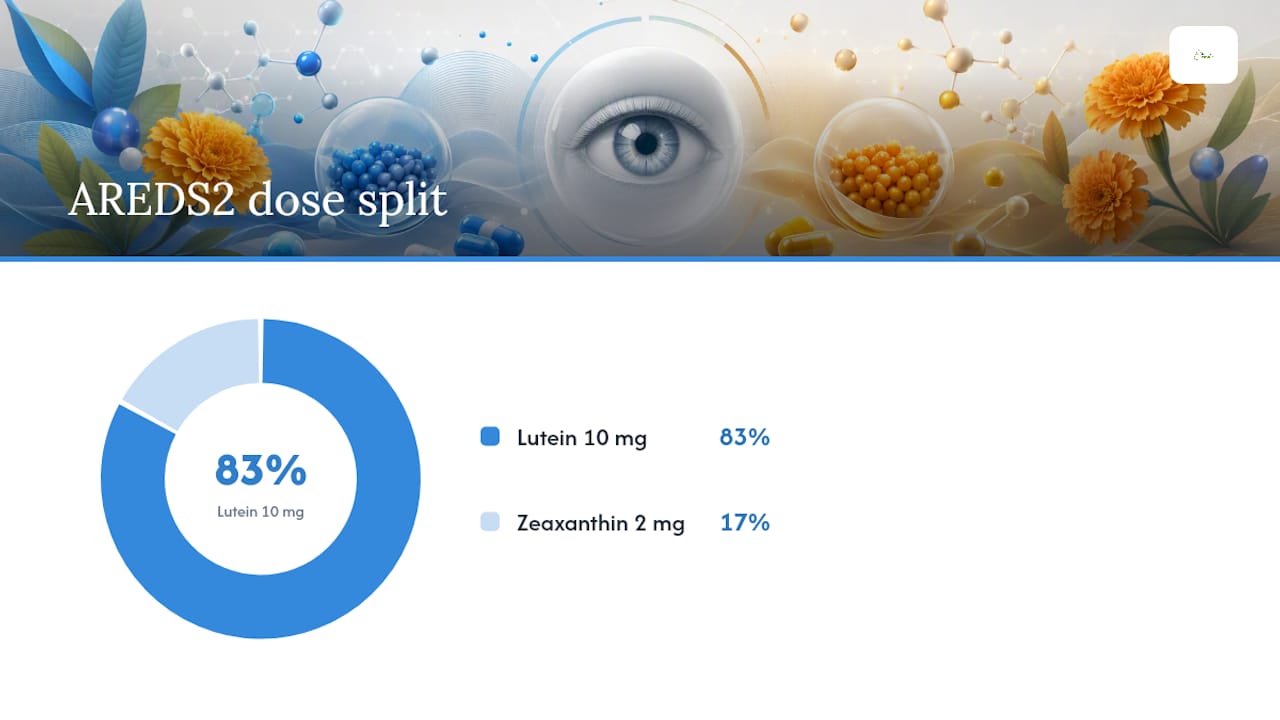
Zeaxanthin concentrates in the central fovea and shows stronger antioxidant activity, while lutein dominates the diet and the outer retina. Most clinical research doesn't pit one against the other. It combines them, commonly at 10 mg lutein plus 2 mg zeaxanthin, the ratio used in AREDS2-era trials. Both are safe at these doses for most adults; extremely high, years-long intake has rare links to skin yellowing or retinal crystal deposits.
TL;DR:
- The typical Western diet provides only 1 to 3 mg of lutein and zeaxanthin daily, far below the 10 mg and 2 mg doses used in clinical studies.
- Zeaxanthin concentrates in the fovea and offers stronger antioxidant protection, while lutein predominates in the peripheral retina, supporting different parts of the visual system.
- Supplementing with 10 mg lutein and 2 mg zeaxanthin, especially for those with low dietary intake, has been shown to increase macular pigment density and improve contrast sensitivity.
- The body's transport proteins route zeaxanthin mainly to the fovea and lutein to the peripheral retina, making it ineffective to replace one with more of the other.
- Consuming foods like cooked spinach, kale, corn, and eggs regularly, paired with fats, can help reach trial-dosed levels of these carotenoids naturally.
Table of Contents
- Lutein vs Zeaxanthin: What Sets These Carotenoids Apart
- How Do Lutein and Zeaxanthin Protect Your Eyes?
- What Does the Clinical Evidence Actually Show?
- Can Lutein and Zeaxanthin Support Brain Health Too?
- How Much Lutein and Zeaxanthin Should You Take?
- Should You Take Lutein and Zeaxanthin? A Practical Decision Guide
- How Nutrasmarts Researches Eye-Health Ingredients
- Why the "Which Is Better" Question Misses the Point
- Sources
Lutein vs Zeaxanthin: What Sets These Carotenoids Apart
Lutein and zeaxanthin belong to a small family of pigments called xanthophyll carotenoids, the yellow-orange compounds plants use to absorb light and manage oxidative stress. Structurally, they're nearly identical twins. Both are built from the same carbon backbone with oxygen groups attached at either end. The only real difference is where a double bond sits on one of the ring structures, a molecular detail so small that lutein and zeaxanthin are technically classified as isomers of each other.
There's a third player most people never hear about: meso-zeaxanthin. Your body doesn't get much of it directly from food. Instead, enzymes in the retina convert some absorbed lutein into meso-zeaxanthin on-site, which is one reason the eye's pigment composition doesn't perfectly mirror what's on your plate.
Where these three carotenoids end up in the retina is not random, and it matters enormously for vision.
- Zeaxanthin and meso-zeaxanthin dominate the fovea, the pinpoint center of the macula responsible for sharp, detailed vision, reading, faces, fine print.
- Lutein spreads out toward the peripheral retina, the wider ring of tissue that handles motion detection and side vision.
- Zeaxanthin sits at concentrations roughly 2.5 times higher than lutein in that central foveal zone in some analyses.
- This distribution pattern is consistent enough across studied eyes that researchers use it as a biological fingerprint of macular pigment.
Location determines function here. The fovea handles the most metabolically demanding visual work your eyes do, and it's also the tissue most exposed to concentrated light and oxidative damage from constant photoreceptor activity. Placing the more potent antioxidant exactly where the stress is highest looks less like coincidence and more like an evolved division of labor. Lutein, meanwhile, gets the job of protecting a much larger surface area where the demands are different but still real.
This is also why you'll rarely see "lutein or zeaxanthin" framed as a real choice in the research. They're doing complementary jobs in different zip codes of the same organ.
How Do Lutein and Zeaxanthin Protect Your Eyes?
Macular pigment works like a pair of built-in sunglasses sitting directly in front of your photoreceptors. Lutein and zeaxanthin absorb blue light in the 400 to 500 nanometer range, the high-energy, short-wavelength light most associated with oxidative stress in retinal tissue. That filtering role, combined with direct antioxidant activity that neutralizes free radicals generated by light exposure and normal metabolism, is the core mechanism behind reduced AMD risk and improved visual function tied to higher lutein and zeaxanthin status.
Zeaxanthin appears to do more per molecule. Its longer chain of conjugated double bonds gives it greater membrane-stabilizing and antioxidant capacity compared with lutein, meaning it's more effective at sitting inside photoreceptor cell membranes and keeping them structurally intact under oxidative pressure. Think of lutein as a broad, steady shield and zeaxanthin as a more concentrated, higher-potency version doing reinforcement work exactly where the membrane stress is greatest.
Statistic snapshot: Zeaxanthin's foveal concentration runs about 2.5 times higher than lutein's in some retinal analyses, a gap that tracks closely with its stronger antioxidant profile in mechanistic studies.
None of this happens by chance. Specific transport and binding proteins govern where each carotenoid ends up and how long it stays put:
- StARD3 (steroidogenic acute regulatory protein) binds zeaxanthin selectively and helps concentrate it in the fovea.
- GSTP1 (glutathione S-transferase P1) binds lutein and appears to assist its distribution to the peripheral retina.
- These binding proteins essentially sort incoming carotenoids by type and route them to different retinal zones.
- Without this sorting mechanism, you wouldn't get the sharp central versus peripheral distribution pattern seen in donor-eye studies.
This protein-level sorting explains something that trips up a lot of people comparing these nutrients: you can't simply eat more lutein and expect it to substitute for zeaxanthin's role in the fovea. The transport system is built to route them differently. That's the biological argument for supplementing with both rather than loading up on just one.
What Does the Clinical Evidence Actually Show?
AREDS2, the National Eye Institute's follow-up to its original Age-Related Eye Disease Study, is the reason 10 mg lutein plus 2 mg zeaxanthin became the de facto standard dose in eye-health formulations. That specific combination was tested as a replacement for beta-carotene in the original AREDS formula, partly because beta-carotene had been linked to increased lung cancer risk in smokers. Secondary analyses from AREDS2 found that participants who swapped in lutein and zeaxanthin, especially those with the lowest baseline dietary intake, saw a reduced risk of progression to advanced age-related macular degeneration.
Randomized controlled trials outside AREDS2 back up the mechanism-to-outcome pathway. Supplementation reliably raises macular pigment optical density, or MPOD, the standard clinical measure of how much protective pigment sits in your macula. That increase in MPOD correlates with measurable gains in contrast sensitivity and reduced glare disability, the kind of everyday visual complaints people notice when driving at night or reading in dim light.
Statistic snapshot: Trials consistently show rising serum carotenoid levels and macular pigment density track together, with improvements in contrast sensitivity and glare tolerance showing up in the same supplemented groups.
Prospective cohort studies and meta-analyses add a population-level layer to the picture:
- Higher dietary and serum lutein/zeaxanthin status is repeatedly linked to lower rates of advanced AMD.
- Similar inverse associations show up for cataract risk in several large cohorts.
- Effect sizes vary meaningfully by study design, population, and how carotenoid status was measured.
- A recurring limitation: most studies report lutein and zeaxanthin as a combined figure, not separately, which makes it hard to isolate which one is driving a given outcome.
That last point is worth sitting with. Despite everything researchers know about zeaxanthin's foveal concentration and stronger antioxidant profile, the human outcome data mostly can't tell you how much of the benefit is zeaxanthin doing extra work versus lutein doing broader work. The mechanistic case for zeaxanthin's potency is solid. The outcome data, for now, mostly speaks about the pair.
Can Lutein and Zeaxanthin Support Brain Health Too?
Your retina is technically an extension of your central nervous system, so it's less surprising than it sounds that lutein and zeaxanthin don't stop at the eye. Both carotenoids cross the blood brain barrier and accumulate in brain tissue, with lutein showing up at notably higher concentrations in brain regions than most other dietary carotenoids, including beta-carotene.
That accumulation pattern has led researchers to look at whether MPOD, since it's a lot easier to measure than actual brain tissue, might serve as a workable proxy for brain carotenoid status. Some studies do find a correlation between macular pigment density and lutein levels in brain tissue, which is part of why eye exams occasionally get framed as a window into broader neural health.
Where the evidence gets thinner is on functional cognitive outcomes:
- Observational studies link higher lutein status to better performance on some memory and processing-speed measures, particularly in older adults.
- A handful of intervention trials testing lutein supplementation, sometimes paired with zeaxanthin, report modest improvements in specific cognitive domains.
- Zeaxanthin's independent role in brain tissue is studied far less than lutein's, so most of what's known centers on lutein specifically.
- Researchers broadly agree this is a promising, mechanistically plausible area that hasn't yet produced the kind of large, consistent trial evidence available for eye outcomes.
If you're hoping for a confident "lutein sharpens your memory" claim, the honest answer is: not yet, not with the certainty AMD research already has. The biological plausibility is real. The proof is still catching up.
How Much Lutein and Zeaxanthin Should You Take?
Most eye-health formulations on the market mirror the AREDS2 combination: 10 mg lutein and 2 mg zeaxanthin daily. Some formulators lean toward a slightly higher zeaxanthin ratio, closer to 5:1 lutein to zeaxanthin, to better reflect the natural composition of macular pigment, but the AREDS2 ratio remains the most studied and most widely used benchmark.
Here's how to think through supplement use in practical terms:
- Start with your baseline diet. If leafy greens are a regular part of your meals, you may need less supplemental support than someone eating closer to the 1 to 3 mg average intake.
- Match the dose to the evidence, not the marketing. Products advertising 40 or 50 mg of lutein go well beyond what any major trial has tested for benefit.
- Take it with a meal containing fat. Carotenoid absorption depends heavily on dietary fat; taking supplements with your largest meal of the day meaningfully improves serum response compared with taking them on an empty stomach.
- Give it time before judging results. Serum and macular pigment levels typically rise over weeks, not days, and response often plateaus after a few months of consistent use.
Pro Tip: Pair your lutein and zeaxanthin supplement with the meal that has the most fat in it, not necessarily the biggest meal. A modest dinner with olive oil or avocado will outperform a large, low-fat lunch for absorption.
Safety at studied doses is well established. Clinical trials show lutein is safe at intakes up to 20 mg per day, and zeaxanthin at the doses used in combination formulas carries a similarly clean safety record. The rare exception worth knowing about: case reports describe retinal crystalline deposits in people taking roughly 20 mg of lutein daily for years, deposits that resolved after stopping supplementation. Skin yellowing, a harmless cosmetic effect called carotenodermia, can also show up at high sustained intakes.
Statistic snapshot: Trial data supports lutein safety up to 20 mg daily, with adverse effects confined mostly to rare, reversible cases tied to years of chronic high-dose use rather than typical AREDS2-level supplementation.
If you take other medications or supplements regularly, a quick check with a pharmacist or physician is a reasonable step before adding a new carotenoid product, mainly to rule out unnecessary duplication if a multivitamin already contains these nutrients.
Should You Take Lutein and Zeaxanthin? A Practical Decision Guide
Diet should be your first move, not your last resort. If a quick mental review of your week shows little to no spinach, kale, corn, or eggs, you're likely near that 1 to 3 mg average intake, and a supplement is a reasonable way to close the gap toward trial-level doses.
Certain groups have a stronger case for supplementing specifically:
- Adults diagnosed with early or intermediate AMD, where AREDS2 evidence directly applies.
- People with consistently low intake of leafy greens and carotenoid-rich produce.
- Anyone following a clinician's specific recommendation based on an eye exam finding.
- Adults concerned about long-term visual performance who want objective tracking, not just a supplement habit.
Monitoring doesn't require anything exotic. Macular pigment optical density and serum carotenoid testing are the two measures researchers rely on, and while they're not typically part of a routine eye exam, some optometry and ophthalmology practices offer MPOD testing. Expect gradual change; a meaningful pigment density increase generally takes months of consistent intake, not weeks.
Pro Tip: If you start a lutein and zeaxanthin supplement, give it at least three months before evaluating whether it's making a difference, and track it against something concrete like an annual eye exam rather than how your vision "feels" day to day.
Stop and check in with a healthcare provider if you notice unusual skin discoloration that doesn't fade, or if you've been taking significantly more than 20 mg of lutein daily for an extended period. Both are rare outcomes at typical doses but worth taking seriously if they show up.
How Nutrasmarts Researches Eye-Health Ingredients
The ingredient database is built around one working principle: recommendations should trace back to something you could go read yourself. For lutein and zeaxanthin, that meant prioritizing NEI-sponsored research like AREDS2, randomized controlled trials measuring macular pigment and visual performance, and meta-analyses pooling cohort data on AMD and cataract risk, over marketing claims or anecdotal product reviews.
That research is organized into ingredient-specific profiles rather than buried in generic "eye health" content:
- The lutein ingredient page breaks down dosing evidence, safety data, and citation links specific to lutein.
- The zeaxanthin ingredient page covers its distinct distribution pattern and antioxidant research separately.
- These pages sit inside a broader database of many ingredients, each linked to peer-reviewed studies rather than summarized secondhand.
- Readers comparing specific eye-health products can cross-reference dosing against the reviewed supplement list to see how commercial formulations line up with trial-level doses.
The goal isn't to replace a conversation with your eye doctor. It's to make sure that conversation starts from the same evidence a clinician would actually recognize.
Why the "Which Is Better" Question Misses the Point
The framing of lutein versus zeaxanthin as competitors is the biggest misunderstanding in this whole topic. The retina doesn't treat them as substitutes. It routes zeaxanthin to the fovea through dedicated binding proteins and spreads lutein across the periphery, and that division of labor shows up consistently enough in donor-eye studies that it's hard to argue against.

Where conventional advice falls short is treating the AREDS2 dose as a universal prescription rather than a starting reference point built for a specific population with a specific risk profile. Someone eating spinach four times a week and someone eating almost no leafy greens are not the same candidate for a 10 mg plus 2 mg supplement, even though most product labels don't make that distinction.
Prioritize diet first, honestly assess your baseline intake, and treat supplementation as a targeted correction rather than a default habit. That's a more defensible approach than chasing whichever carotenoid gets called "stronger" in a headline.
— Nutrasmarts
If you're weighing a supplement against dietary changes, the symptom-based supplement guide walks through evidence-rated options by health concern, including eye and cognitive support.
This article is general information, not a substitute for advice from a qualified doctor. Consult a qualified healthcare professional about your own circumstances before acting on anything here.
Sources
Most adults eating a typical Western diet get somewhere between 1 and 3 mg of combined lutein and zeaxanthin daily, well short of the 10 mg plus 2 mg combination used in eye-health trials. Closing that gap through food alone is doable, but it takes deliberate effort, since the richest sources are concentrated in a fairly narrow list of dark leafy greens and a few other standouts.
Cooked spinach stands out because a single cup, per USDA-linked food composition data, delivers close to three times the trial dose in one serving. Kale runs comparably high. Corn and peas contribute smaller but steady amounts and are easy to add daily.
Egg yolk deserves a special mention. It contains less total lutein and zeaxanthin than a serving of spinach, but the fat and protein matrix surrounding the carotenoids in yolk appears to support strong absorption, which matters more than the raw milligram count sitting on a label.
The practical strategy: build a rotation of two or three of these foods into meals several times a week rather than trying to hit the trial dose from a single food source. Pairing greens with a fat source, olive oil on a salad, avocado in a smoothie, closes the gap between what's on the plate and what actually reaches your bloodstream.
- AREDS2-related dosing and trial context (PubMed entry)
- Comparative distribution and roles in AMD (PMC review, 2022)