

Oral magnesium has real evidence behind it for migraine prevention, rated "probably effective" in guideline-level reviews, and most trials that worked used 400 to 600 mg of elemental magnesium daily. Higher amounts, up to 1,000 mg in some cases, show up in select protocols but bring more gastrointestinal trouble. Intravenous magnesium has a narrower, clinician-supervised role for acute attacks in specific patients. Anyone with kidney disease, heart rhythm issues, or interacting medications needs a doctor's input before starting.
TL;DR:
- Most successful trials used 600 mg of elemental magnesium daily, particularly in water-soluble forms like citrate and dicitrate, not cheaper, poorly absorbed oxide.
- Doses above 600 mg tend to cause gastrointestinal side effects, especially diarrhea, making gradual titration essential for tolerability.
- Magnesium requirements are formulation-dependent; citrate and pidolate absorb better and show more consistent benefits than oxide in clinical studies.
- People with kidney disease, heart rhythm issues, or on certain medications must consult a doctor before starting magnesium at any dose.
- IV magnesium is reserved for acute migraine attacks in clinical settings and is not suitable for self-treatment or outpatient use.
Table of Contents
- How Magnesium for Migraines Works in Practice
- What the Clinical Trials and Guidelines Actually Found
- Which Magnesium Form Actually Absorbs Best?
- How to Start and Titrate Magnesium for Migraine Prevention
- When Is IV Magnesium Used for Migraine Attacks?
- Who Should Be Careful With Magnesium Supplements?
- Reading a Magnesium Label the Right Way
- How Nutrasmarts Verifies Magnesium Claims
- Why Dosing Precision Matters More Than the Supplement Aisle Suggests
- Compare Magnesium Forms Before You Buy
- Sources
How Magnesium for Migraines Works in Practice
Here's the fast version for anyone who wants a starting point before reading the full evidence review below.
Oral magnesium citrate, magnesium pidolate, and magnesium glycinate (bisglycinate) show up most often in the supplements people actually tolerate long enough to see results. Magnesium oxide remains widely sold and was used in some trials, but it absorbs poorly compared to citrate and pidolate, and it tends to cause more stomach upset per milligram of elemental magnesium.
A reasonable starting plan looks like this:
- Start at 200 to 250 mg of elemental magnesium daily for the first week to gauge gut tolerance.
- Increase toward a target of 400 to 600 mg elemental magnesium daily, split into two doses if the stomach objects.
- Some protocols push toward 1,000 mg for patients who tolerate lower doses well and haven't seen benefit, though gastrointestinal side effects climb sharply past 600 mg for most people.
- For children, a pediatric trial used 9 mg per kilogram of body weight daily of magnesium oxide and reported fewer headache days, but pediatric dosing should always run through a pediatrician or pediatric neurologist first.
- Anyone with reduced kidney function should not self-dose magnesium at all, since the kidneys are what clear the excess.
- Anyone on certain antibiotics, heart medications, or diuretics should check with a pharmacist before adding a daily magnesium regimen.
That's the skeleton. The muscle is in why these numbers exist and what the trials actually found.
What the Clinical Trials and Guidelines Actually Found
The strongest evidence for magnesium and headache prevention comes from a handful of randomized, placebo-controlled trials, not from anecdote or tradition. Two of the most frequently cited studies used 600 mg of elemental magnesium daily, delivered as trimagnesium dicitrate or magnesium citrate, and reported statistically significant drops in attack frequency compared with placebo in adult patients. That 600 mg figure is why it shows up so often in patient handouts and clinician recommendations: it's the dose that actually got tested and worked, not a number pulled from a supplement label.
The 600 mg benchmark: Multiple randomized trials landing on the same elemental dose, 600 mg daily, is part of why magnesium carries a Level B "probably effective" rating for migraine prevention in headache treatment guidelines. That's a real signal in a field where most natural remedies never make it past small, uncontrolled studies.
Guideline bodies don't hand out that rating casually. A Level B classification means the treatment is supported by evidence from at least one well-designed clinical trial, without the volume of data needed for a Level A designation reserved for drugs like topiramate or propranolol. In plain terms: magnesium isn't as thoroughly proven as the leading prescription preventives, but it clears a real evidentiary bar, not just a folk-remedy one.
Systematic reviews add nuance the individual trials can't. When researchers pool results across multiple studies, efficacy turns out to be formulation-dependent: trials using water-soluble salts like citrate and dicitrate tend to show more consistent benefit than trials using less soluble forms. That heterogeneity explains a common source of reader confusion. Two people can both say "I tried magnesium and it didn't work," while one took 250 mg of oxide split once daily and the other took 600 mg of citrate divided across the day. Those aren't remotely comparable interventions, even though both bottles say "magnesium" on the label.
A few things about this evidence base deserve honesty rather than salesmanship:
- Sample sizes in most positive trials range from small to moderate, not the thousands-of-patients scale you'd see in a major drug trial.
- Measuring "why" magnesium helps is hampered by the fact that serum magnesium testing is an unreliable proxy for actual body magnesium stores, so researchers can't easily confirm deficiency was corrected in trial participants.
- Pediatric evidence is thinner still. A trial testing magnesium oxide at 9 mg/kg/day in children and teens aged 3 to 17 reported meaningful reductions in headache days, but the pediatric literature has far fewer participants and fewer replications than the adult research.
- Migraine itself is notoriously variable month to month, which makes any single trial harder to interpret without a solid placebo arm.
None of that erases the finding. It does mean magnesium belongs in the "well-supported, reasonable option" category rather than the "proven cure" category, and that framing matters when you're deciding how much hope to pin on it.
One clinically useful pattern from the specialist literature: magnesium tends to get recommended more readily for migraine with aura and menstrually related migraine, where the proposed mechanisms line up with what magnesium does physiologically. That's a reasonable filter for deciding whether it's worth a serious trial for your specific migraine pattern.
Which Magnesium Form Actually Absorbs Best?
Not all magnesium salts behave the same way once they hit your gut, and this is where a lot of people waste money on the wrong bottle. The difference between forms comes down to solubility and how much elemental magnesium your intestines can actually pull out of the compound before the rest passes through unabsorbed.
Magnesium citrate dissolves well in water and shows up repeatedly in positive migraine trials, which is why it's often the first form clinicians mention. Magnesium pidolate has been noted for relatively high bioavailability and good intracellular penetration, meaning more of it may actually reach the tissues where magnesium does its work rather than staying in the gut. Magnesium oxide, despite being one of the cheapest and most common forms on store shelves, has comparatively low bioavailability and a higher rate of GI side effects for the dose delivered, even though it was the form used in the pediatric trial mentioned earlier and in some active-comparator adult studies.
For people whose stomachs simply can't handle citrate's laxative tendency, magnesium glycinate (also called bisglycinate) and magnesium malate tend to be gentler, since the amino acid binding changes how the compound is handled in the intestine. Neither has the same depth of migraine-specific trial data as citrate, but they're reasonable substitutes when tolerability, not efficacy on paper, is the deciding factor. You can compare magnesium glycinate against citrate directly if gut sensitivity is your main concern.
Here's where label reading gets genuinely confusing for most shoppers:
- A bottle listing "magnesium citrate 1,000 mg" is describing the total weight of the compound, not the amount of elemental magnesium your body can use.
- Citrate is roughly 16% elemental magnesium by weight, so that 1,000 mg citrate serving delivers around 160 mg of actual elemental magnesium.
- Oxide is denser in elemental magnesium by percentage (about 60%) but absorbs a smaller fraction of what's there, which is the paradox that trips up a lot of buyers comparing labels side by side.
- Look specifically for the words "elemental magnesium" on the Supplement Facts panel. If a label only states the salt weight, you're doing the math yourself or guessing.
Pro Tip: Add up the elemental magnesium from your supplement and your diet before assuming you're under 400 mg. A magnesium-rich diet plus a supplement dosed for the salt weight, not the elemental amount, can put people closer to their tolerance ceiling than they realize.
Reading up on the magnesium citrate and magnesium oxide ingredient profiles before buying will save you from the single most common mistake in this category: paying for a big number on the front of the bottle that doesn't reflect what's actually inside.
How to Start and Titrate Magnesium for Migraine Prevention
Jumping straight to 600 mg on day one is the fastest way to quit magnesium in week one. Diarrhea is dose-dependent and largely avoidable with a slower ramp-up.
- Start low. Begin with 200 to 250 mg of elemental magnesium daily for the first three to seven days, taken with food to reduce stomach irritation.
- Increase gradually. Raise the dose by roughly 100 to 150 mg every three to seven days, watching for loose stools, until you reach a target somewhere in the 400 to 600 mg elemental range.
- Split the dose. Taking half in the morning and half in the evening, rather than one large dose, generally improves absorption and cuts down on GI symptoms compared with a single big serving.
- Consider timing around symptoms. Some patients take a slightly larger portion of their daily dose in the evening, since gut transit is slower at night, though this is more personal preference than a trial-established protocol.
- Commit to 8 to 12 weeks before judging results. Migraine prevention doesn't work on a two-week timeline. Most trials measured benefit over two to three months, so quitting at three weeks because "nothing changed" often means quitting before the drug had a fair shot.
- Track it properly. A simple headache diary, noting frequency, severity, and any triggers, gives you an objective record instead of a vague impression. Comparing month one to month three matters far more than comparing today to yesterday.
- Know when to switch forms instead of stopping. If diarrhea shows up before you reach an effective dose, switching to a gentler salt like glycinate or malate, or dividing the current dose further, usually solves the problem without abandoning the approach entirely.
When Is IV Magnesium Used for Migraine Attacks?
Intravenous magnesium sulfate belongs strictly in a clinical setting, and it treats a different problem than daily oral magnesium does. Where oral supplementation is a slow-burn prevention strategy, IV magnesium is aimed at stopping an attack already underway, and it's not something to request casually.

Trials and observational studies on IV magnesium, commonly dosed around 1 g of magnesium sulfate, report the strongest responses in specific subgroups: patients with migraine with aura and those with documented low ionized magnesium levels. Outside those subgroups, the response is far less predictable.
A few reasons IV magnesium stays a clinician-only decision:
- It requires monitoring for changes in heart rhythm and blood pressure during infusion, which isn't something to manage outside a supervised setting.
- Contraindications include significant renal impairment and certain existing heart conduction problems.
- The ionized magnesium testing that helps identify likely responders isn't part of routine bloodwork and usually happens in a hospital or specialty clinic.
- Many outpatient clinicians reasonably trial oral magnesium first and reserve IV infusions for refractory attacks or emergency department visits.
If a migraine attack comes with sudden neurological changes, confusion, a headache that feels distinctly different from a typical episode, or symptoms that don't respond to usual measures, that's a reason to seek urgent medical care rather than wait it out or self-treat.
Who Should Be Careful With Magnesium Supplements?
The most common side effect by a wide margin is diarrhea, and it's directly tied to dose and form. Magnesium that isn't absorbed in the small intestine pulls water into the colon by osmosis, which is the same mechanism that makes magnesium citrate a go-to laxative at higher doses.
Doses above roughly 350 to 400 mg from supplements alone start pushing many people toward loose stools, though the threshold varies by form and by individual. Citrate tends to trigger this sooner than glycinate or malate at an equivalent elemental dose.
Beyond the gut, a short list of medical situations calls for a conversation with a clinician before starting, not after:
- Renal impairment or kidney disease. The kidneys are the primary route for clearing excess magnesium. Reduced kidney function raises the risk of magnesium accumulating to dangerous levels, making this a genuine contraindication rather than a minor caution.
- Certain heart medications and rhythm conditions. Magnesium can affect cardiac conduction, and combining supplementation with existing heart rhythm medications needs medical oversight.
- Tetracycline and fluoroquinolone antibiotics. Magnesium binds to these antibiotics in the gut and reduces their absorption, meaning doses need to be spaced several hours apart at minimum, ideally under pharmacist guidance.
- Diuretics. Some diuretics increase magnesium loss through urine while others spare it, so the interaction depends entirely on which specific medication is involved.
- Osteoporosis medications like bisphosphonates. Similar to the antibiotic interaction, magnesium can interfere with absorption if taken too close together.
- Pregnancy. Magnesium is commonly used in obstetric care, but the type, dose, and reason should be directed by an obstetric provider rather than self-selected.
- Children. Pediatric dosing, such as the 9 mg/kg/day figure from trial data, should run through a pediatrician, not be extrapolated from an adult bottle's instructions.
The Office of Dietary Supplements draws an important distinction that's easy to miss: the standard recommended dietary allowance for magnesium is considerably lower than the therapeutic doses used in migraine trials. That gap is intentional. You're not just correcting an everyday nutritional shortfall; you're using magnesium at a dose closer to a treatment than a supplement.
Reading a Magnesium Label the Right Way
The math on a supplement bottle trips up more people than the dosing schedule does. Every label lists two numbers that matter, and only one of them tells you what your body can actually use.
The salt weight (like "magnesium citrate 1,000 mg") describes the whole compound. The elemental magnesium figure, usually listed just below it or in parentheses, tells you the actual magnesium content your body absorbs from. If a label only shows the salt weight without an elemental breakdown, that's a label worth skipping in favor of one that's transparent about the number that matters.
A short buying checklist:
- Confirm the elemental magnesium amount per serving, not just the salt weight, before comparing price per dose across brands.
- Look for third-party testing seals, such as USP or NSF, which verify that what's on the label matches what's in the capsule.
- Favor products with a plain, short ingredient list over ones hiding behind a "proprietary blend," since blends often obscure exactly how much of each ingredient you're getting.
- Match the form to your gut: citrate if you tolerate it and want the strongest trial backing, glycinate or malate if you're prone to GI upset.
- If you take other prescriptions, particularly antibiotics, heart medications, or osteoporosis drugs, ask a pharmacist about timing and spacing before adding a daily magnesium routine.
The general magnesium ingredient profile is a useful reference point when you want to see dosing ranges and research summaries side by side rather than piecing them together from five different product pages.
How Nutrasmarts Verifies Magnesium Claims
Nutrasmarts built its ingredient database around a simple problem: most supplement marketing describes what a product does, not what the evidence actually supports. Every entry across more than 1,300 evidence-rated ingredient profiles links back to the clinical trials and reviews behind it, so a claim about magnesium and migraine frequency traces directly to the study that produced it, not to a summary of a summary.
That's the same approach behind the dosing figures and formulation differences covered here. When a trial used 600 mg of citrate, or a pediatric study used 9 mg/kg of oxide, those specifics come from the primary research, not from rounding a commonly repeated number. The free Supplement Facts label creator exists for the flip side of that problem, helping anyone formulating or checking a product get the elemental magnesium math right instead of guessing.
Why Dosing Precision Matters More Than the Supplement Aisle Suggests
The gap between "magnesium helps migraines" and actually getting relief comes down to specifics most articles skip past. A reader who takes 200 mg of oxide once a day and a reader who takes 600 mg of citrate split twice daily are running two different experiments, yet supplement marketing treats magnesium like a single interchangeable product.
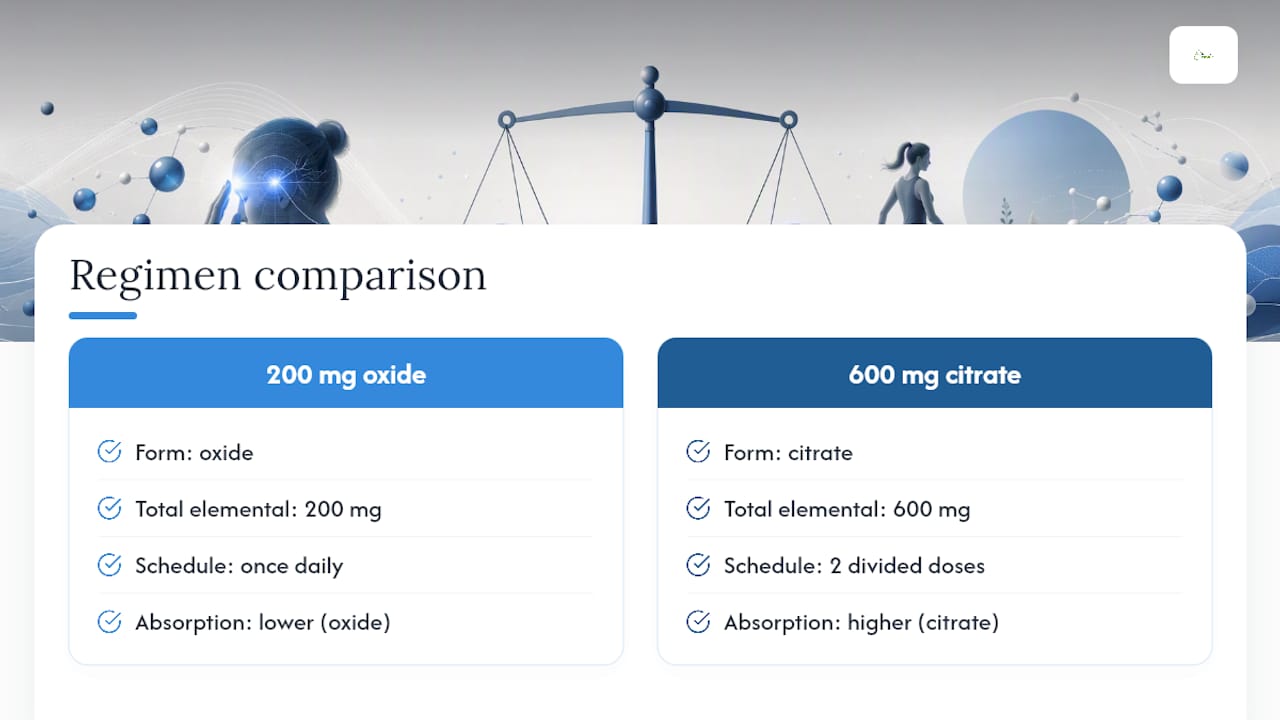
That imprecision does real harm. It sets people up to try magnesium at a dose too low to match trial protocols, conclude it "doesn't work," and abandon a supported option before giving it a fair test. It also undersells the flip side: at the upper end of the range, more isn't automatically better, since gastrointestinal tolerance becomes the limiting factor long before any ceiling on effectiveness. The sweet spot for most adults sits in that 400 to 600 mg elemental range, reached gradually, in a form the gut tolerates.
Magnesium also isn't positioned to replace prescription preventives for everyone. It fits best as a well-tolerated option for people who prefer to avoid standard pharmacological preventives, who've had intolerable side effects from prescription agents, or who want an evidence-backed adjunct alongside other treatment. Treating it as a stand-alone cure, or dismissing it as a placebo because a low, poorly absorbed dose didn't work, both misread what the trial data actually shows.
— NutraSmarts
Compare Magnesium Forms Before You Buy
There are other ways to research supplements, plenty of forums and product reviews claim to know which magnesium "works best." This platform offers recommendations that trace back to cited clinical trials or reviews, not marketing claims or anonymous forum posts.

Start with the magnesium citrate and magnesium oxide profiles to see the dosing and research differences side by side, or use the Compare Supplements tool to line up multiple forms against each other before you spend money on the wrong bottle. If you already have a product in hand and want to verify what its label is actually telling you, the free Supplement Facts label creator will show you exactly how the elemental magnesium math checks out.
Sources
- Magnesium for Migraine | American Migraine Foundation
- Magnesium and Migraine (review) - PMC
- Magnesium in headache - NCBI Bookshelf (NBK507271)
- Educational pearl: Magnesium clinical notes - UMaryland
This article is general information, not a substitute for advice from a qualified doctor. Consult a qualified healthcare professional about your own circumstances before acting on anything here.