
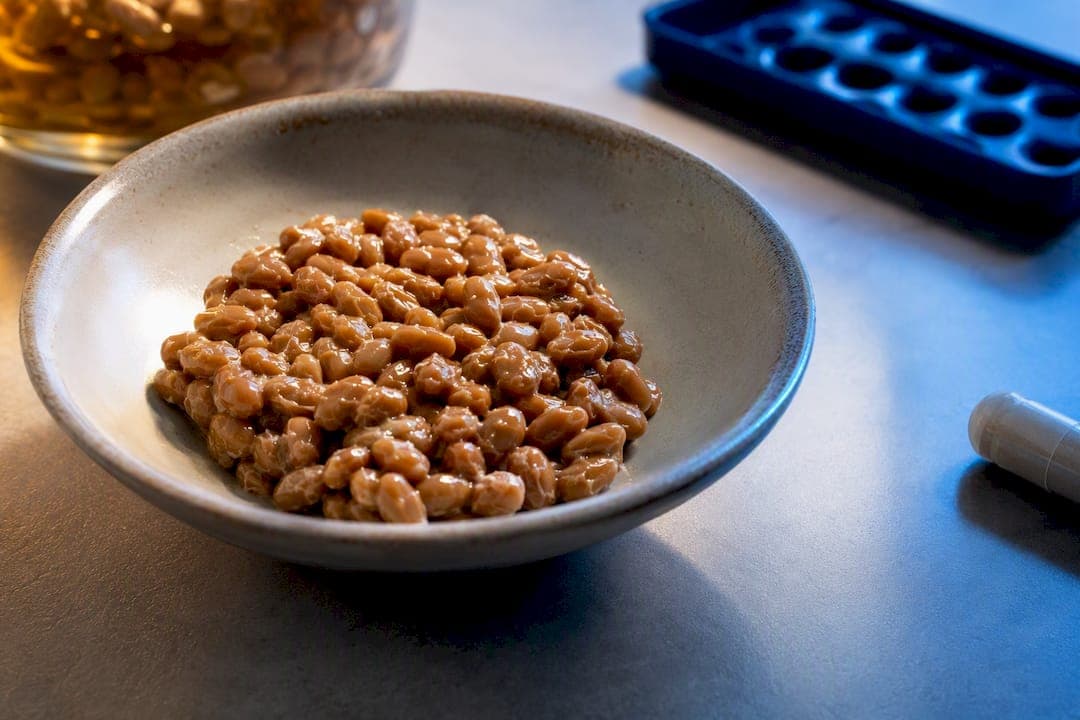
Nattokinase is the more evidence-supported choice for circulation and blood pressure goals, while serrapeptase is better suited to localized inflammation, mucus clearance, and scar tissue concerns. Both enzymes act like mild anticoagulants, so anyone on blood thinners or facing surgery should talk to a clinician before starting either one.
TL;DR:
- Nattokinase is best supported for improving circulation and reducing blood pressure, with typical doses around 2,000 fibrinolytic units per day.
- Serrapeptase is more suitable for inflammation, mucus, and scar tissue, requiring enteric-coated capsules to ensure enzyme survival through digestion.
- Both enzymes have blood-thinning effects, so consulting a healthcare professional is essential if you are on blood thinners or preparing for surgery.
- Clinical evidence for nattokinase shows modest blood pressure reductions, while serrapeptase has limited proof for cardiovascular benefits and more support for local anti-inflammatory uses.
- Claims that either enzyme dissolves arterial plaque are unproven in humans; focus on measurable outcomes like blood pressure and symptom improvement instead.
Table of Contents
- Nattokinase vs Serrapeptase: What Nattokinase Actually Is
- Does Nattokinase Actually Lower Blood Pressure?
- Nattokinase vs Serrapeptase: What Is Serrapeptase For?
- What Does the Clinical Evidence Say About Serrapeptase?
- Nattokinase or Serrapeptase: Which One Matches Your Goal?
- Dosing, Interactions, and Safety: What to Check First
- How to Verify Nattokinase and Serrapeptase Products Before You Buy
- An Honest Look at the Plaque-Dissolving Claims
- Research Your Options Before You Commit to Either Enzyme
- Sources
- FAQ
Nattokinase vs Serrapeptase: What Nattokinase Actually Is
Nattokinase comes from natto, the fermented soybean dish common in Japanese cuisine, and belongs to a class of enzymes called serine proteases. Researchers first isolated it for one specific talent: breaking down fibrin, the protein mesh that forms blood clots. That fibrin-dissolving action, called fibrinolysis, is the entire basis for nattokinase's reputation as a circulation supplement.
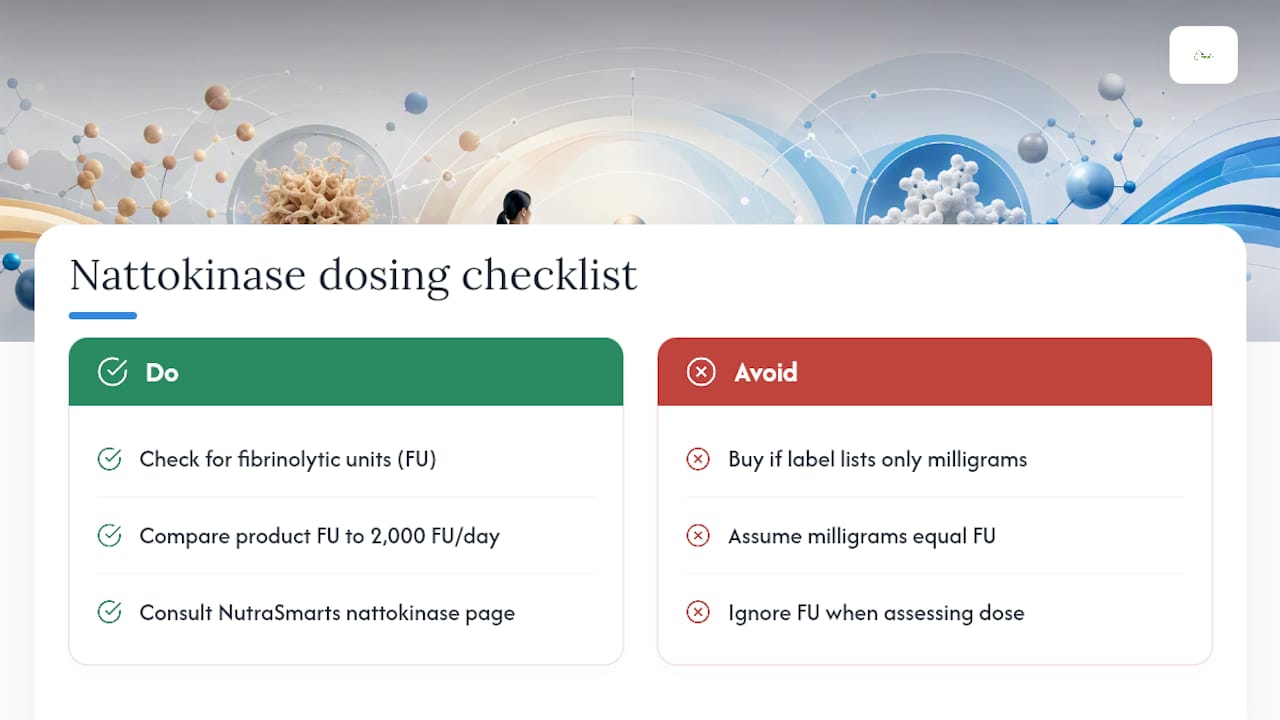
Dosing gets confusing fast because labels report it two different ways. Some list milligrams, others list fibrinolytic units (FU), and the two aren't interchangeable. Trials commonly use around 2,000 FU per day, and a milligram-only label without an FU equivalent makes it hard to know if you're getting a clinically relevant dose. People generally reach for nattokinase for blood pressure support, general circulation, or to address fibrin buildup they've read about online, and it's worth checking NutraSmarts' nattokinase page before buying to see how a specific product's units stack up against trial doses.
Does Nattokinase Actually Lower Blood Pressure?
The strongest human evidence for nattokinase comes from a 2023 systematic review and meta-analysis pooling six trials and roughly 546 participants.
Statistic callout: Pooled results showed systolic blood pressure dropped by about 3.45 mmHg and diastolic pressure by about 2.32 mmHg compared to control groups.
That's a real but modest effect, roughly in line with cutting a moderate amount of sodium from your diet. A few caveats matter:
- Only six eligible trials existed, and most had small sample sizes.
- Lipid outcomes across studies were inconsistent, with no clear pattern on cholesterol.
- Follow-up periods tended to be short, so long-term effects remain unknown.
The review's authors were explicit that trial heterogeneity and modest sample sizes limit how confidently anyone can generalize these findings.
Nattokinase vs Serrapeptase: What Is Serrapeptase For?
Serrapeptase originated in the gut bacteria of silkworms, though commercial versions today are produced through bacterial fermentation rather than harvested from insects. It's a proteolytic enzyme, meaning it breaks down proteins, specifically targeting non-living or damaged protein tissue rather than healthy cells.
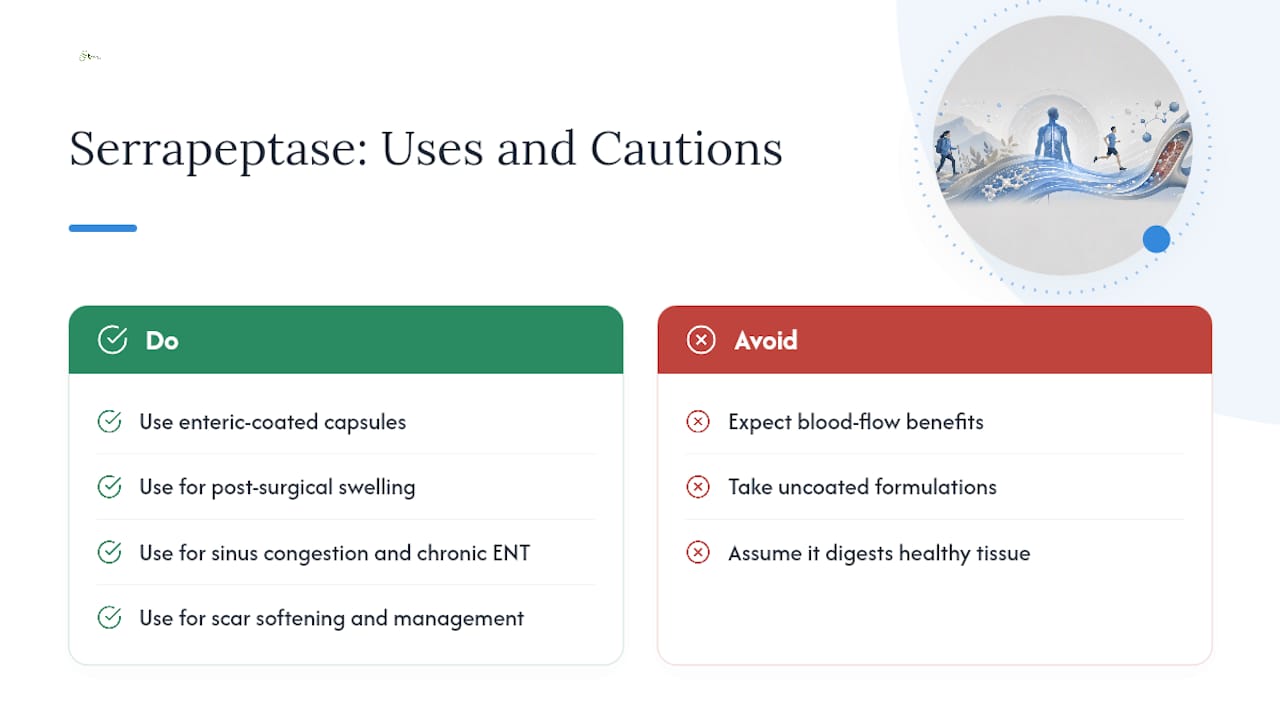
That mechanism explains why serrapeptase's reputation centers on inflammation and mucus rather than blood flow. Proposed anti-inflammatory and mucolytic effects make it a natural fit for post-surgical swelling, sinus congestion, and scar tissue softening. Doses are measured in serrapeptase units (SU), not milligrams, and formulation matters enormously here: stomach acid degrades the enzyme, so enteric-coated capsules are effectively non-negotiable if you want it to survive digestion intact. People typically use serrapeptase after dental extractions or minor surgery, for chronic sinus and ENT symptoms, or as part of a scar-management routine. NutraSmarts breaks down the evidence and dosing units in more detail on its serrapeptase ingredient page.
What Does the Clinical Evidence Say About Serrapeptase?
Serrapeptase's trial record is thinner and more mixed than nattokinase's, but it's not empty. Several small, double-blind trials have tested it against postoperative swelling and pain, particularly after dental and oral surgery, with some showing meaningful reduction in facial edema and others showing little difference from placebo.
Statistic callout: Regulatory monograph guidance lists adult dosing ranges of 30,000 to 120,000 SU per day for mucolytic and anti-swelling use, with explicit warnings around blood-thinning medications and surgical timing.
Where the evidence runs thin is cardiovascular health. Despite marketing that lumps serrapeptase in with nattokinase as a "circulation" enzyme, there's no solid trial data showing it affects blood pressure or arterial plaque. Trial quality across the board suffers from small participant pools and inconsistent dosing protocols, which is exactly the kind of gap NutraSmarts' compare tool is built to help readers spot.
Nattokinase or Serrapeptase: Which One Matches Your Goal?
The cleanest way to choose is to work backward from what you're actually trying to fix. Nattokinase's evidence base points toward blood pressure, circulation, and fibrin-related concerns. Serrapeptase's points toward localized swelling, ENT symptoms, and scar tissue. They're not interchangeable, and treating them as two flavors of the same product misses how differently they behave in the body.
- Nattokinase fits circulation, blood pressure, and fibrin-focused goals, dosed in FU and best tracked against the roughly 2,000 FU/day used in trials.
- Serrapeptase fits inflammation, mucus, and scar tissue goals, dosed in SU, and requires enteric coating to survive stomach acid.
- Both carry fibrinolytic, anticoagulant-like activity, meaning bleeding risk overlaps even though their primary uses don't.
- Labeling clarity differs: a nattokinase label without FU units, or a serrapeptase product without enteric coating, is a red flag for either one.
Before buying either, run through a short checklist: What's your primary goal? What medications are you currently taking? Do you have surgery scheduled in the next few weeks? Is the product's dose reported in a standardized unit you can actually verify? Answering those four questions eliminates most of the guesswork.
Dosing, Interactions, and Safety: What to Check First
Unit confusion is the single biggest practical problem with both enzymes. A nattokinase label in milligrams with no FU conversion, or a serrapeptase label with no SU count, tells you almost nothing about whether the dose matches what trials actually tested.
The bigger concern is bleeding risk. Both enzymes have fibrinolytic activity that mimics mild anticoagulant effects, and that risk compounds when combined with warfarin, DOACs, aspirin, NSAIDs, or other blood-thinning supplements like high-dose fish oil.
- Talk to a clinician before starting either enzyme, especially if you take any blood thinner or have a bleeding disorder.
- Stop supplementation at least one to two weeks before any scheduled surgery, on your surgeon's guidance.
- Choose products with third-party testing and standardized-unit labeling (FU for nattokinase, SU for serrapeptase).
- Watch for unusual bruising, prolonged bleeding from small cuts, or blood in urine or stool, and stop immediately if these appear.
Pro Tip: Keep a simple log of your blood pressure or symptom changes for two to four weeks after starting either enzyme. If a supplement isn't producing a measurable change you can point to, it's not doing its job.
How to Verify Nattokinase and Serrapeptase Products Before You Buy
Marketing copy rarely matches trial dosing, which is why checking the actual research behind a product matters more than the label's claims. NutraSmarts' ingredient pages for nattokinase and serrapeptase link directly to the clinical citations behind each enzyme's claimed benefits.
The compare tool lets you line up two products side by side to see whether their FU or SU counts, and enteric coating status, actually match what researchers used. If you formulate supplements yourself, the Supplement Facts label creator helps make sure your own labeling reports units clearly instead of burying them in vague milligram figures.
An Honest Look at the Plaque-Dissolving Claims
The claim that nattokinase or serrapeptase "dissolves arterial plaque" shows up constantly in marketing, and it's the single biggest overreach in this whole category. In vitro fibrin breakdown is real. Human plaque removal, confirmed in living arteries, is not something current trials have shown.
If you're using either enzyme, track something concrete: blood pressure readings, a specific symptom, a doctor's follow-up note. Product quality varies widely, so favor standardized-unit labeling and third-party testing over bold claims on the bottle.
— NutraSmarts
Research Your Options Before You Commit to Either Enzyme
Choosing between nattokinase and serrapeptase shouldn't come down to whichever bottle has the boldest label copy. Some supplement research platforms exist to pull back that curtain: every ingredient profile links to actual clinical citations behind it, not just marketing summaries.

Beyond the nattokinase and serrapeptase pages, the compare tool lets you check two products side by side for unit standardization and dosing before you spend money. If your circulation goals extend past enzyme supplements, the blood pressure supplement guide covers other evidence-backed options worth weighing. Start by pulling up the NutraSmarts database and checking whatever bottle you're considering against its actual trial data before it goes in your cart.
This article is general information, not a substitute for advice from a qualified doctor. Consult a qualified healthcare professional about your own circumstances before acting on anything here.
Sources
- Nattokinase Supplementation and Cardiovascular Risk Factors: A Systematic Review and Meta-Analysis of Randomized Controlled Trials
- Serrapeptase Uses, Benefits & Dosage
- NATURAL HEALTH PRODUCT SERRAPEPTASE monograph
- Serrapeptase: Benefits, Side Effects, and Dosage — Healthline
FAQ
Can I take serrapeptase and nattokinase together?
Some people combine them, but doing so raises additive bleeding risk since both enzymes have anticoagulant-like effects; combining them without medical oversight isn't advisable, especially if you take any blood thinner.
Is nattokinase better than serrapeptase?
Neither is universally "better." Nattokinase has more RCT support for blood pressure and circulation, while serrapeptase has modest support for post-surgical swelling and ENT symptoms, so the right choice depends on your goal.
Does serrapeptase remove plaque from arteries?
No reliable human trial data supports that claim. Proteolytic activity shown in lab settings hasn't been demonstrated to clear plaque inside living arteries.
Does nattokinase really dissolve arterial plaque?
Nattokinase's fibrin-breaking activity is well documented in lab and some clinical settings, but there's no solid human evidence it dissolves existing arterial plaque, despite that claim circulating widely in supplement marketing.