
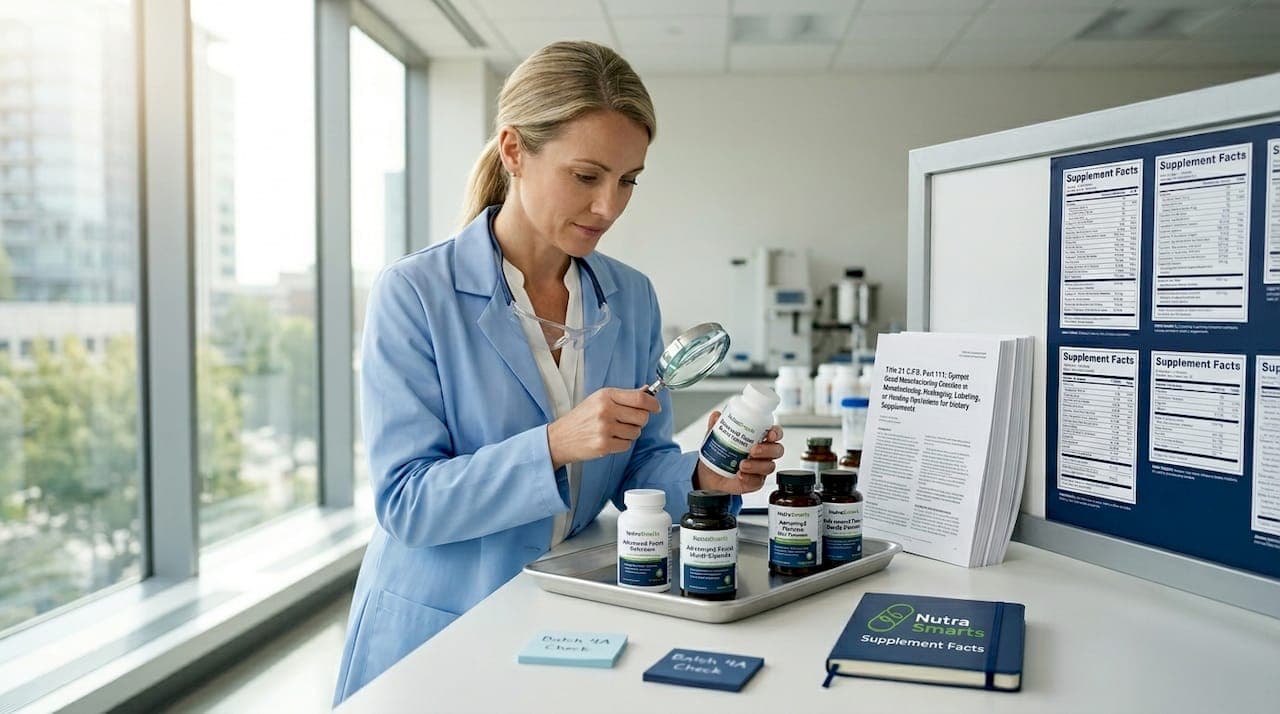
Dietary supplement labels are supposed to give you the full picture. Ingredients, dosages, claims, allergens. But an observational study found 81.39% of 403 supplement samples had non-compliant labeling, which means the odds are not in your favor when you grab something off a shelf. Recognizing examples of non-compliant supplement labels is not just an academic exercise. It is the difference between making a safe, informed choice and unknowingly consuming something that misrepresents its contents, hides allergens, or makes illegal health claims.
Table of Contents
- Key takeaways
- 1. Examples of non-compliant supplement labels: structural format errors
- 2. Misleading and prohibited health claims on labels
- 3. Allergen and ingredient declaration errors
- 4. Proprietary blend labeling violations
- 5. Botanical and ingredient naming errors
- 6. Real-world recalls and enforcement actions
- 7. How to spot red flags and evaluate labels yourself
- My take on why this problem is so persistent
- Find supplements you can actually trust
- FAQ
Key takeaways
| Point | Details |
|---|---|
| Non-compliance is widespread | Over 81% of tested supplements showed labeling violations, with protein products leading the problem. |
| Disease claims are illegal | Any label claiming to "cure" or "treat" a condition violates FDA rules and signals a non-compliant product. |
| Allergen gaps create real risk | Missing sesame, tree nut, or soy declarations can cause serious harm, especially post-2023 FASTER Act updates. |
| Formatting errors matter legally | Font size, ingredient order, and % Daily Value accuracy are not optional. They are regulatory requirements. |
| Verification tools exist | Cross-checking labels against FDA databases and trusted resources helps you catch violations before purchase. |
1. Examples of non-compliant supplement labels: structural format errors
The Supplement Facts panel is the backbone of any dietary supplement label. Get it wrong and the entire label fails compliance, regardless of how accurate the ingredient list might be.
Common structural violations include:
- Incorrect font size or line weight. FDA specifies minimum type sizes for the Supplement Facts panel. Labels that shrink text to fit more ingredients into a small container are a frequent violation.
- Improper ingredient ordering. Ingredients must be listed in descending order by weight. A label that places a minor ingredient above a dominant one is misrepresenting the product's composition.
- Outdated % Daily Value references. The FDA updated Daily Value reference amounts in 2016. Labels still using pre-2016 figures are technically non-compliant, and this is more common than most people realize.
- Missing or inaccurate net quantity. The net weight or volume on the label must match what is actually in the container. Discrepancies here can indicate underfilling or mislabeling.
- No manufacturer contact information. Compliant labels require the name and address of the manufacturer, packer, or distributor. Omitting this makes it impossible to trace the product.
Pro Tip: If you see a Supplement Facts panel where the text is barely readable or the layout looks compressed, that is a physical sign the label may not meet FDA formatting standards. Pull out your phone and zoom in before you buy.
2. Misleading and prohibited health claims on labels
This is where non-compliance gets genuinely dangerous. Claims on supplement labels fall into specific legal categories, and crossing those lines is not a gray area.
FDA rules allow structure-function claims. These describe how a nutrient affects normal body function, such as "calcium supports bone health." What they do not allow are disease claims. The moment a label says a product "cures arthritis," "prevents cancer," or "treats insomnia," it has crossed into drug territory. Prohibited disease claims like "cures insomnia" or "treats arthritis" are a leading cause of FDA warning letters.
The tricky part is that some labels blur this line deliberately. A product might say "supports healthy blood sugar levels already in normal range" as a structure-function claim, but another label might say "controls blood sugar" which implies treatment of a condition. That second phrasing is a disease claim and is illegal on a supplement.
Here are the most common misleading claim violations you will encounter:
- Explicit disease claims presented as if they are normal marketing language ("fights depression," "reverses diabetes").
- Missing DSHEA disclaimers. Any structure-function claim must be accompanied by the statement: "This statement has not been evaluated by the Food and Drug Administration. This product is not intended to diagnose, treat, cure, or prevent any disease." Missing or illegible DSHEA disclaimers appear regularly in FDA warning letters.
- Unauthorized nutrient content claims such as "high in protein" without meeting FDA's defined threshold for that descriptor.
- Implied disease claims through images or language that strongly suggests a therapeutic effect without stating it outright.
"The line between a legal structure-function claim and an illegal disease claim is often just a few words. Consumers should read claims skeptically and ask: is this describing normal body function, or is it promising to fix a medical problem?"
3. Allergen and ingredient declaration errors
Allergen omissions are among the most dangerous examples of misleading supplement labels because the consequences are immediate and potentially life-threatening.
The Food Allergen Labeling and Consumer Protection Act (FALCPA) and the FASTER Act together require disclosure of nine major allergens: milk, eggs, fish, shellfish, tree nuts, peanuts, wheat, soybeans, and sesame. Sesame became the ninth major allergen as of January 1, 2023, and many supplement manufacturers have been slow to update their labels.
Common allergen violations include:
- Failing to list sesame on products manufactured after January 2023, a widespread gap in the supplement industry.
- Using generic terms like "tree nuts" without specifying which nut (almond, cashew, walnut). FDA requires the specific common name.
- No cross-contact warnings for products made in shared facilities. While advisory statements like "may contain traces of peanuts" are technically voluntary, omitting them when cross-contact is a real risk creates serious liability.
- Undeclared soy in protein blends. Soy is commonly used as a filler or processing aid in protein supplements, and it does not always make it onto the label.
Supplement labels for allergen-sensitive consumers deserve extra scrutiny. Even one missing allergen declaration can trigger a recall, and the FDA has issued numerous warnings tied specifically to undeclared allergens in dietary supplements.
Statistic worth noting: Creatine-based supplements were 100% non-compliant in one observational study, and whey protein products came in at 97.82% non-compliance. If you use protein or performance supplements, your label is statistically more likely to have a problem than not.
4. Proprietary blend labeling violations
Proprietary blends are a legitimate label format, but they are also one of the most abused. A proprietary blend lists a group of ingredients under a single collective name and discloses only the total weight of the blend, not the individual ingredient amounts.

The problem is that manufacturers sometimes use this format to obscure how little of an active ingredient is actually present. FDA scrutinizes proprietary blend ingredient order closely. Even within a blend, ingredients must still be listed in descending order by weight. A label that lists an expensive active ingredient first within a blend, when it is clearly present in trace amounts, is a red flag for ingredient order manipulation.
Other proprietary blend violations include failing to disclose the total blend weight at all, listing ingredients under a blend that are also listed separately elsewhere on the label without explanation, and using invented trade names for blends that obscure what the ingredients actually are.
5. Botanical and ingredient naming errors
Botanical supplements have their own set of naming rules, and violations here are surprisingly common. Botanical ingredients require the Latin binomial name, the plant part used (leaf, root, seed), and standardization details if applicable.
A label that says only "elderberry extract" without specifying Sambucus nigra, the plant part, and the extraction ratio is technically non-compliant. This matters because different species of the same plant can have vastly different effects and safety profiles.
Non-standard ingredient names are another common violation. FDA maintains accepted common or usual names for ingredients. If a label uses a marketing name or a non-standard synonym that does not match FDA's accepted terminology, it creates a compliance issue and makes it harder for you to verify what you are actually taking.
6. Real-world recalls and enforcement actions
Documented enforcement cases show exactly what happens when supplement label violations reach the market.
| Violation Type | Example | Consequence |
|---|---|---|
| Hidden contamination | 2026 liquid B-Complex, Vitamin C, and Folic Acid recall | 4,196 units recalled, Class II recall |
| Undeclared allergens | Undisclosed soy in protein blends | FDA warning letters, mandatory reformulation |
| Prohibited disease claims | "Cures insomnia" on sleep supplement labels | Warning letters, product seizure |
| Proprietary blend errors | Incorrect ingredient order within blend | FDA correspondence, label correction orders |
The 2026 liquid vitamin recall is a clear example of how labeling failures connect to real safety risks. The product was flagged after-market, meaning consumers had already purchased and potentially used it before the problem was identified.
Pro Tip: Before purchasing any liquid supplement, check the FDA's MedWatch database and the recall section at FDA.gov. Liquid products have higher contamination risk than solid forms and are recalled more frequently.
7. How to spot red flags and evaluate labels yourself
You do not need a regulatory background to catch the most common supplement label red flags. A systematic approach works.
- Find the Supplement Facts panel first. If it is missing, illegible, or formatted like a nutrition facts label for food, that is an immediate red flag.
- Check for the DSHEA disclaimer. Any structure-function claim on the label must be paired with the FDA disclaimer. No disclaimer means the manufacturer either does not know the rules or is ignoring them.
- Read every claim critically. Ask whether the claim describes a normal body function or promises to treat a condition. Words like "cures," "treats," "prevents," or "reverses" applied to a named disease are illegal on supplement labels.
- Verify allergen declarations. Cross-check the ingredient list against the allergen statement. If you have a sesame allergy and the product was made after 2023, confirm sesame is explicitly addressed.
- Look up ingredient names. Use the NutraSmarts ingredient database to verify that the ingredient names on the label match recognized, accepted terminology.
- Check the manufacturer's contact information. A label with no address or only a website URL with no physical address is a compliance gap and a trust gap.
- Report suspicious products. You can submit a report through FDA's MedWatch Safety Reporting Portal. Health professionals can also flag concerns through state pharmacy boards.
Comparing products side by side using a resource like supplement comparison guides can help you quickly identify which products meet labeling standards and which ones fall short.
My take on why this problem is so persistent
I've spent years reviewing supplement labels, and the pattern I keep seeing is not malice. It is version control failure. A company reformulates a product, changes the serving size, adds an ingredient, and the label art simply does not get updated to match. Version control failures are one of the most common root causes of label non-compliance, and they are almost entirely preventable with the right internal processes.
What frustrates me most is the gap between regulation and enforcement. The FDA does not pre-approve supplement labels. That means non-compliant products reach consumers before anyone official reviews them. By the time a warning letter goes out, thousands of units may already be sold.
My honest advice: treat every supplement label as a document that needs verification, not a marketing brochure that deserves trust by default. The deficiency and supplement data available today makes it easier than ever to cross-check what a label claims against what the science actually supports. Use those tools. The burden of verification has shifted to the consumer, and pretending otherwise puts your health at risk.
— NutraSmarts
Find supplements you can actually trust
If spotting non-compliant labels feels like a full-time job, you are not wrong. That is exactly why Nutrasmarts was built.
Nutrasmarts maintains a database of over 800 ingredients, each linked to peer-reviewed studies and clinical trial citations, so you can verify what a label claims before you buy. If you are looking for products in high-risk categories, the best metabolic health supplements guide reviews 130 products with label accuracy and ingredient evidence as core criteria. For performance-focused consumers, the best athletic performance supplements list covers 131 reviewed options. Every recommendation on Nutrasmarts is filtered through the same question: does the label match the science?
FAQ
What makes a supplement label non-compliant?
A supplement label is non-compliant when it violates FDA formatting rules, contains prohibited disease claims, omits required allergen declarations, or misrepresents ingredient amounts. Over 81% of tested supplements in one study had at least one labeling violation.
Are disease claims ever allowed on supplement labels?
No. Disease claims such as "cures arthritis" or "prevents cancer" are not permitted on dietary supplement labels. Only structure-function claims describing normal body processes are allowed, and they must include the FDA disclaimer.
How do I know if allergen information is complete?
Check that the label addresses all nine major allergens including sesame, which has been required since January 2023 under the FASTER Act. If you have a known allergy, also look for cross-contact advisory statements related to shared manufacturing facilities.
Why are protein supplements so often non-compliant?
Observational research found whey protein products were 97.82% non-compliant and creatine supplements were 100% non-compliant. These categories have complex ingredient profiles, proprietary blends, and high reformulation rates that make label accuracy harder to maintain.
Where can I report a non-compliant supplement label?
You can report suspected violations through the FDA's MedWatch Safety Reporting Portal at fda.gov/safety/medwatch. Health professionals can also document concerns through their state pharmacy or health boards for additional follow-up.