

The strongest clinical evidence backs probiotics for preventing antibiotic-associated diarrhea, shortening acute infectious diarrhea in children, and preventing necrotizing enterocolitis in very low birth weight infants plus targeted relief for some IBS symptoms. Every one of those benefits is tied to specific strains at specific doses, not "probiotics" as a category, and trial quality varies enough that clinicians should treat most other claimed uses as unproven or preliminary.
TL;DR:
- Probiotics have the strongest evidence for preventing antibiotic-associated diarrhea and necrotizing enterocolitis in preterm infants, with specific strains and doses crucial for effectiveness.
- The quality of evidence varies greatly by condition, with robust support for certain strains in pediatric diarrhea and NEC, but limited or moderate proof for other uses like IBS, IBD, and metabolic health.
- Routine daily probiotic use appears safe for healthy adults, but higher-risk groups such as immunocompromised or critically ill patients face potential serious adverse events and should consult healthcare professionals.
- Clinical benefits depend heavily on matching exact strains and dosing used in trials with products available on shelves, which often lack transparent, verified labeling.
- Research is moving toward standardization, postbiotics, and personalized microbiome-based approaches, but current clinical practice should remain conservative and evidence-based.
Table of Contents
- What Does Probiotics Evidence Show Condition by Condition?
- Is It Safe to Take Probiotics Every Day?
- Why Doesn't a Strain That Worked in a Trial Guarantee the Bottle on the Shelf Works?
- How Should You Evaluate a Probiotics Study or Meta-Analysis?
- How Can You Verify a Product's Strain and Dose Against the Trial Evidence?
- Where Is Probiotics Research Headed?
- Verify Any Probiotic Claim Before You Trust the Label
- Sources
- FAQ
What Does Probiotics Evidence Show Condition by Condition?
Ask ten people what probiotics treat and you'll get ten different answers, most of them wrong in the details. The clinical trial data draws a much narrower picture than the supplement aisle suggests, and the strength of that data swings wildly depending on which condition you're asking about.
Acute infectious diarrhea
This is one of the better-established uses, particularly in children. Certain strains shorten the duration of acute diarrhea by roughly a day compared to placebo, according to the World Gastroenterology Organisation practice guideline. A day might sound modest, but for a toddler with rotavirus or a norovirus infection, cutting a five-day illness down by 20% is clinically meaningful, especially when it also reduces stool frequency and hospital stay length in some trial populations.
Antibiotic-associated diarrhea
Antibiotic-associated diarrhea, or AAD, has some of the most robust probiotic data available. Lactobacillus rhamnosus GG and Saccharomyces boulardii are the two most extensively studied organisms here, and multiple meta-analyses show meaningful reductions in AAD incidence when either is given alongside antibiotic therapy. The Advances in Nutrition review flags AAD prevention as among the most consistent findings in the entire probiotics literature.
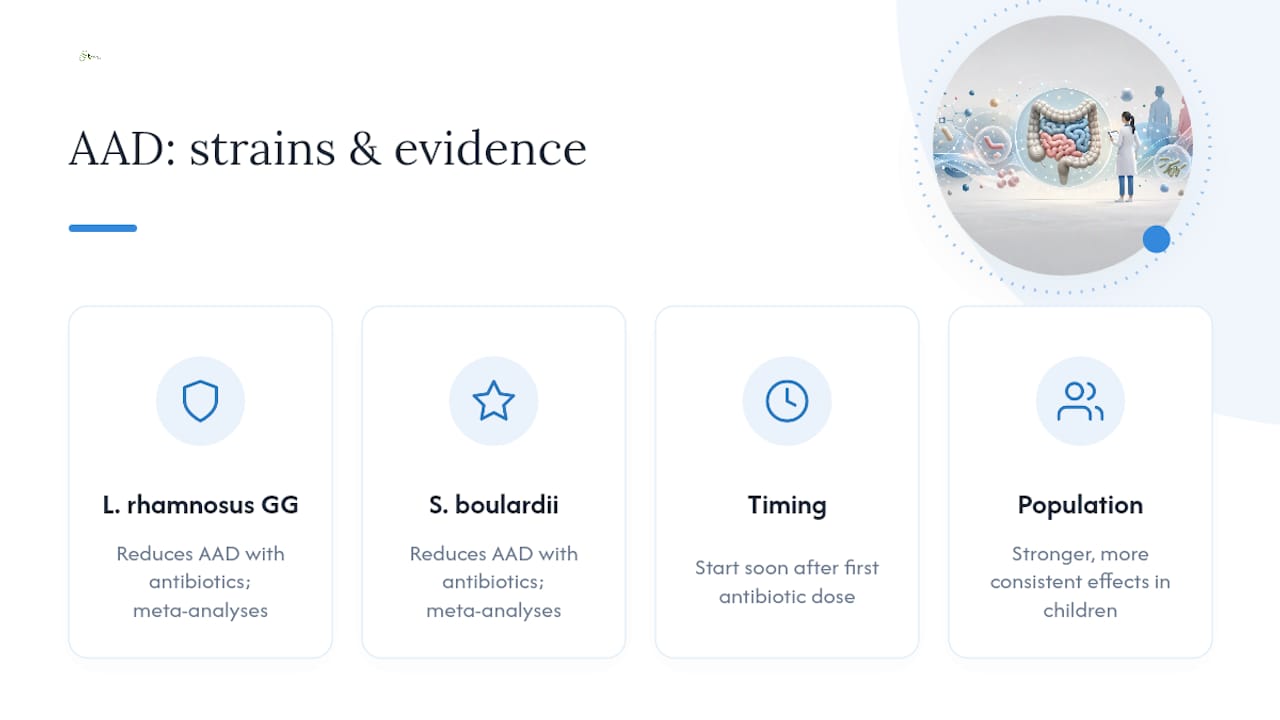
The catch is timing and population. Pediatric trials tend to show larger, more consistent effects than adult trials, and starting the probiotic early after the first antibiotic dose appears more effective than starting it later. Wait too long and you're treating a problem the strain wasn't tested to prevent.
Clostridioides difficile infection
For C. difficile-associated diarrhea specifically, the evidence is moderate-certainty at best. Meta-analytic pooling suggests a protective effect when probiotics, especially S. boulardii or select Lactobacillus strains, are co-administered with antibiotics in high-risk patients, such as older adults on broad-spectrum regimens. But the effect size shrinks and the confidence intervals widen once you exclude smaller, lower-quality trials, which is a recurring theme across this entire evidence base.
Necrotizing enterocolitis in preterm infants
This is arguably the single strongest signal in the entire field. An umbrella review synthesizing 128 systematic reviews and meta-analyses found consistent NEC prevention benefits in very low birth weight infants across multiple probiotic regimens. The effect holds up across different strain combinations and study populations in a way that few other probiotic indications do.
That consistency comes with a serious caveat. Implementing probiotics in a neonatal intensive care unit requires careful risk-benefit judgment, because the same immature gut barrier and immune system that make NEC prevention valuable also make preterm infants vulnerable to rare but serious infections from the probiotic organisms themselves. This is not a supplement decision a parent makes alone; it belongs in NICU protocol discussions with the care team.
Statistic callout: An umbrella review covering 128 systematic reviews found probiotics showed selective benefit for NEC prevention, glycemic and lipid improvements in some type 2 diabetes trials, and gynecologic and IBS-related outcomes, but cautioned that effects varied significantly by strain and population, according to the umbrella review.
IBS and inflammatory bowel disease
IBS is where "it depends on the strain" becomes almost a mantra. The NIH Office of Dietary Supplements fact sheet notes that certain probiotics can reduce specific IBS symptoms, such as bloating or abdominal pain, but stresses that not every product labeled "probiotic" has been shown to do anything for IBS at all. Bifidobacterium infantis has trial support for reducing abdominal pain and bloating in IBS patients specifically, while many other commercially available strains simply haven't been tested for this indication.
Inflammatory bowel disease tells a split story. The World Gastroenterology Organisation guideline reports probiotic benefit for pouchitis, the inflammation that can follow surgical pouch creation in ulcerative colitis patients, but explicitly notes no benefit for Crohn's disease. That's an important distinction: IBD is not one disease for probiotic purposes, and lumping ulcerative colitis, Crohn's, and pouchitis together in casual conversation obscures a real clinical difference.
Urinary and gynecologic health
Two strains dominate this corner of the literature: Lactobacillus rhamnosus GR-1 and Lactobacillus reuteri RC-14. Trials combining these two strains, usually taken together rather than individually, have shown signals for supporting vaginal flora balance and reducing recurrence of certain urogenital issues in women. The evidence here is real but thinner than the AAD or NEC data, built on a smaller number of trials with less consistent methodology.
Respiratory tract infections
Here's where the age gap really shows. The NCCIH summary points to trials in infants and children showing fewer and shorter upper respiratory infections with certain probiotic regimens. Adult evidence is considerably weaker and more inconsistent, which matters if you're fielding questions from adult patients who read a headline about probiotics and colds and assume it applies to them.
Metabolic health signals
Glycemic control and lipid profiles show up as a genuinely interesting but early area. Some trials in type 2 diabetes populations found improvements in blood sugar or lipid markers with specific probiotic regimens, per the umbrella review noted above. This is promising, not settled. The trials are smaller, the strains and doses vary widely between studies, and nobody should be substituting a probiotic for metformin based on current data.
Here's the condition-by-condition picture at a glance:
- Acute infectious diarrhea: Solid pediatric evidence, roughly one day shorter illness duration with select strains.
- Antibiotic-associated diarrhea: Strong evidence for L. rhamnosus GG and S. boulardii, timing matters.
- C. difficile-associated diarrhea: Moderate-certainty benefit, mainly in high-risk antibiotic patients.
- Necrotizing enterocolitis: Strongest and most consistent signal, specific to very low birth weight infants.
- IBS: Strain-specific symptom relief, especially with B. infantis, not a category-wide effect.
- IBD: Benefit shown for pouchitis, no benefit shown for Crohn's disease.
- Urogenital health: Signal from combined L. rhamnosus GR-1 and L. reuteri RC-14 use, smaller evidence base.
- Respiratory infections: Meaningful pediatric evidence, limited and inconsistent adult evidence.
- Metabolic markers: Preliminary, encouraging, needs larger trials before drawing conclusions.
Is It Safe to Take Probiotics Every Day?
For most healthy adults, yes. Daily probiotic use in generally healthy people has a solid safety track record across decades of trials, and the Advances in Nutrition review doesn't flag routine use as risky for the general population, even while stopping short of recommending it as a universal preventive habit.
The picture changes sharply for specific groups. Documented serious adverse events, including bloodstream infections and sepsis, have occurred in immune-compromised patients, critically ill ICU patients, and some preterm infants receiving probiotics. These are not common events, but they are real and reported in the medical literature, which is exactly why probiotics aren't a blanket "can't hurt, might help" recommendation for every patient a clinician sees.
Regulatory and surveillance gaps make the true frequency of these events hard to pin down. Because most probiotics are sold as dietary supplements rather than drugs, adverse event reporting is far less systematic than it would be for a prescription medication, which means published case reports likely understate real-world incidence.
Pro Tip: When a patient or client falls into a higher-risk category, don't rely on the supplement label's tone of reassurance. Ask specifically whether their care team has weighed in, and document that conversation, particularly for anyone immune-compromised, critically ill, or caring for a preterm infant.
A practical checklist for clinicians:
- Generally fine to recommend: healthy adults and children using well-studied strains for a matched indication, like AAD prevention alongside antibiotics.
- Proceed with caution: patients with central venous catheters, short bowel syndrome, or structural heart valve issues, where translocation risk is higher.
- Avoid or defer to specialist judgment: critically ill ICU patients, severely immune-compromised patients, and preterm or very low birth weight infants outside a monitored NICU protocol.
- Monitor for: unexplained fever, signs of infection, or clinical deterioration in any at-risk patient started on a probiotic, and stop use if those appear.
Why Doesn't a Strain That Worked in a Trial Guarantee the Bottle on the Shelf Works?
Because "probiotic" is a category, not a product, and the gap between a clinical trial and a store shelf is wider than most labels admit. A probiotic's full name has three parts: genus, species, and strain, written something like Lactobacillus rhamnosus GG. The first two parts tell you the broad family. The strain designation, that "GG" at the end, is the part that actually determines whether a specific clinical trial's results apply to what's in the bottle.
This is not a technicality. Lactobacillus rhamnosus GG has trial support for AAD prevention. A different Lactobacillus rhamnosus strain sold under a different code has not necessarily been tested for anything, even though it shares the same species name on the label. The same logic applies across the field:
- Lactobacillus rhamnosus GG — AAD prevention, acute pediatric diarrhea.
- Lactobacillus rhamnosus GR-1 and Lactobacillus reuteri RC-14 — urogenital and vaginal flora support, typically studied as a combination.
- Saccharomyces boulardii — AAD and C. difficile-associated diarrhea prevention; notable because it's a yeast, not a bacterium.
- Bifidobacterium infantis — IBS symptom relief, particularly bloating and abdominal pain.
- Lactobacillus plantarum — some IBS and general digestive comfort signals, though evidence here is thinner and more mixed than for the strains above.
The NHS guidance on probiotics points out a structural problem behind all of this: because probiotics are regulated as foods or supplements rather than drugs, manufacturers in most markets face no requirement to guarantee strain identity, viable cell counts at expiry, or dosing that matches what was actually used in clinical trials. In the United States, that means no FDA premarket approval process confirms a probiotic supplement does what its label implies.
CFU counts compound the problem. A label might state colony-forming units at time of manufacture rather than at expiration, and viability can drop substantially over a product's shelf life depending on strain hardiness, packaging, and storage conditions. A capsule that started at 10 billion CFU might deliver a fraction of that by the time it reaches a customer's medicine cabinet, especially if it sat in a hot warehouse for months.
| What the trial specifies | What to check on the product label |
|---|---|
| Exact strain (e.g., L. rhamnosus GG) | Strain designation listed, not just species |
| CFU dose used in the study | CFU guaranteed through expiration date, not manufacture date |
| Duration and timing of dosing | Matches or exceeds the studied protocol |
| Delivery format tested (capsule, powder, fermented food) | Same or comparable delivery matrix |
Practical steps worth taking before buying or recommending a product: look for the specific clinical strain name on the label, not just the genus and species; check whether the manufacturer cites published trials for that exact strain; favor products with third-party testing for potency and purity; and confirm the CFU count is guaranteed through the expiration date, not just at the time of manufacture.
How Should You Evaluate a Probiotics Study or Meta-Analysis?
A meta-analysis pooling ten trials of ten different strains at ten different doses isn't really answering one question. It's averaging ten different questions and calling the answer a single number, which is exactly why heterogeneity, not sample size, is often the biggest weakness in probiotics research.
Run any probiotic study or review through this checklist before trusting its conclusion:
- Confirm the exact strain tested, not just the genus and species. A review that lumps "Lactobacillus" trials together without strain detail is mixing data from organisms that may behave nothing alike.
- Check the dose and duration. A trial using 10 billion CFU for two weeks tells you nothing about whether 1 billion CFU for three days does anything.
- Identify the population and primary outcome. A pediatric diarrhea trial doesn't generalize to adult IBS, even if both papers say "probiotic" in the title.
- Look for randomization and a placebo control. Open-label or observational designs inflate apparent benefit.
- Check sample size and risk-of-bias reporting. Small trials (under 50 participants per arm) are prone to overestimating effect size, and industry-funded trials without independent oversight deserve extra scrutiny.
- Note timing relative to the intervention. For AAD prevention specifically, a probiotic started with the first antibiotic dose behaves differently than one started after diarrhea sets in.
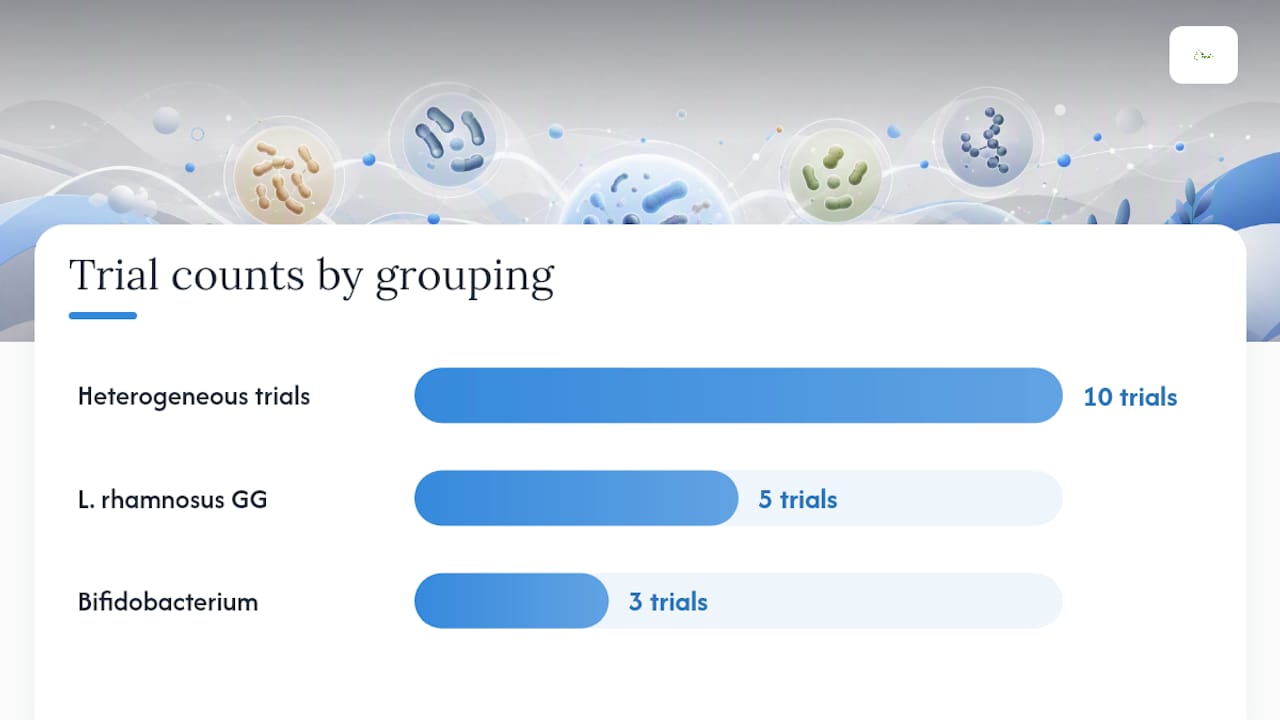
Here's why heterogeneity matters so much in practice: if a meta-analysis pools five trials of L. rhamnosus GG at 10 billion CFU with three trials of an unrelated Bifidobacterium strain at 1 billion CFU, the pooled effect estimate describes neither group accurately. It's a statistical average of two different interventions dressed up as one finding.
Pro Tip: Before trusting a meta-analysis headline, open the supplementary tables and check whether the included trials actually used the same strain and dose. If they didn't, treat the pooled effect size as a rough directional signal, not a number you'd bet a clinical recommendation on.
Applied to a representative AAD meta-analysis: a well-constructed one groups trials by strain (separating L. rhamnosus GG results from S. boulardii results rather than blending them), reports dose ranges, and flags studies with high dropout or unclear randomization. If a meta-analysis skips that step and reports one combined "probiotics reduce AAD risk" number, treat the headline figure with real skepticism.
How Can You Verify a Product's Strain and Dose Against the Trial Evidence?
Once you know which strain and dose actually carries trial support, the next problem is matching that to an actual product on a shelf. Nutrasmarts built its Probiotics (Multi-strain Blends) ingredient page specifically to close that gap, linking documented strains to their supporting clinical trial citations in one place rather than scattered across journal databases.
The practical workflow looks like this: search a strain by name, such as on the LactoSpore® page, and review the linked trial data for dose and indication. Then check that dose against what a product label actually states, using the Compare Supplements tool to line up two or more products side by side. Strain-specific pages covering organisms like Bifidobacterium lactis, Bifidobacterium longum, and Lactobacillus acidophilus follow the same format, so cross-referencing several products against their respective evidence bases doesn't require jumping between a dozen different sources.
For anyone formulating a product rather than just evaluating one, the Supplement Facts Tool generates an FDA-compliant label directly from the ingredients and doses entered, without spreadsheet workarounds. Certain platforms function as research references rather than diagnostic or treatment platforms, aiming to make underlying trial evidence easier to find and compare for informed decision-making.
Where Is Probiotics Research Headed?
The field's biggest structural problem isn't a lack of interest, it's inconsistency. Too many trials report vague "probiotic blend" interventions without full strain disclosure, which makes cross-study comparison nearly impossible. Strain registries and standardized reporting requirements, similar to what clinical trial registration already demands for drugs, would let future meta-analyses actually compare like with like instead of averaging unlike interventions into one number.
Two directions are gaining real traction. Postbiotics, meaning the metabolic byproducts of probiotic organisms rather than the live organisms themselves, are being tested as a way to get consistent effects without relying on bacterial viability through shipping and storage. Microbiome profiling is also pushing toward individualized probiotic selection, matching a person's existing gut flora to a strain most likely to help, rather than a one-size-fits-all recommendation.
For now, the responsible clinical approach stays conservative: recommend specific strains for specific, evidence-backed indications, flag the caveats honestly, and resist the pull toward blanket wellness claims the research doesn't yet support.
— Nutrasmarts
Verify Any Probiotic Claim Before You Trust the Label
Reading this far, you already know the hard part isn't finding a probiotic, it's finding the right strain at the right dose for a specific outcome, backed by an actual trial rather than a marketing claim. That's the exact gap Nutrasmarts' research tools were built to close: a database connecting over 1,300 ingredients, including probiotic strains, to more than 3,000 clinical trial citations, so you're comparing a product against real evidence instead of a label's promises.
Start with the Probiotics (Multi-strain Blends) page to see which strains carry documented trial support for the condition you care about. From there, a few concrete next steps: pull up a specific strain's trial citations and compare the studied dose to what's on a product label, run two products through the Compare Supplements tool side by side, or, if you're formulating your own blend, use the free Supplement Facts Label Creator to generate an accurate, FDA-compliant label without wrestling with spreadsheets. None of this replaces a conversation with a clinician for anyone in a higher-risk category, but it does mean you walk into that conversation already knowing what the evidence actually says.
This article is general information, not a substitute for advice from a qualified doctor. Consult a qualified healthcare professional about your own circumstances before acting on anything here.
Sources
- Efficacy and Safety of Probiotics, Prebiotics, and Synbiotics: An Umbrella Review
- Probiotics - Health Professional Fact Sheet (NIH ODS)
- Is There Evidence to Support Probiotic Use for Healthy People? (Advances in Nutrition, 2024)
- World Gastroenterology Organisation practice guideline (Probiotics and prebiotics, 2023)
FAQ
Is there real scientific evidence that probiotics work?
Yes, for specific indications. Clinical trials support benefits for preventing antibiotic-associated diarrhea, shortening acute pediatric diarrhea, preventing necrotizing enterocolitis in very low birth weight infants, and easing certain IBS symptoms, according to the World Gastroenterology Organisation guideline. The evidence doesn't support probiotics as a universal fix for digestive health in general.
Which probiotic strains have the strongest research backing?
Lactobacillus rhamnosus GG and Saccharomyces boulardii have the most consistent evidence, largely for antibiotic-associated diarrhea prevention. Bifidobacterium infantis shows support for specific IBS symptoms, while Lactobacillus rhamnosus GR-1 combined with Lactobacillus reuteri RC-14 has trial data for urogenital health, per the NIH ODS fact sheet.
Are probiotics actually worth taking?
For matched indications, like taking a documented AAD-prevention strain alongside a prescribed antibiotic, the evidence supports it. For general daily wellness with no specific target, the Advances in Nutrition review stops short of recommending unconditional use, since benefits are strain- and condition-specific rather than universal. Checking a strain's trial citations on a resource like the Nutrasmarts ingredient database before buying is a reasonable way to decide.
What's new in probiotic research right now?
Recent work is shifting toward postbiotics, which use bacterial metabolic byproducts instead of live organisms for more consistent effects, and toward microbiome profiling to match individuals with strains suited to their existing gut flora. An umbrella review of 128 systematic reviews also points to growing interest in metabolic health applications, though that evidence remains preliminary.
Can probiotics be harmful to anyone?
Documented serious adverse events, including bloodstream infections, have occurred in immune-compromised patients, critically ill ICU patients, and some preterm infants. Healthy adults and children generally tolerate well-studied strains without issue, but anyone in a higher-risk category should involve their care team before starting one, per NCCIH's safety summary.