
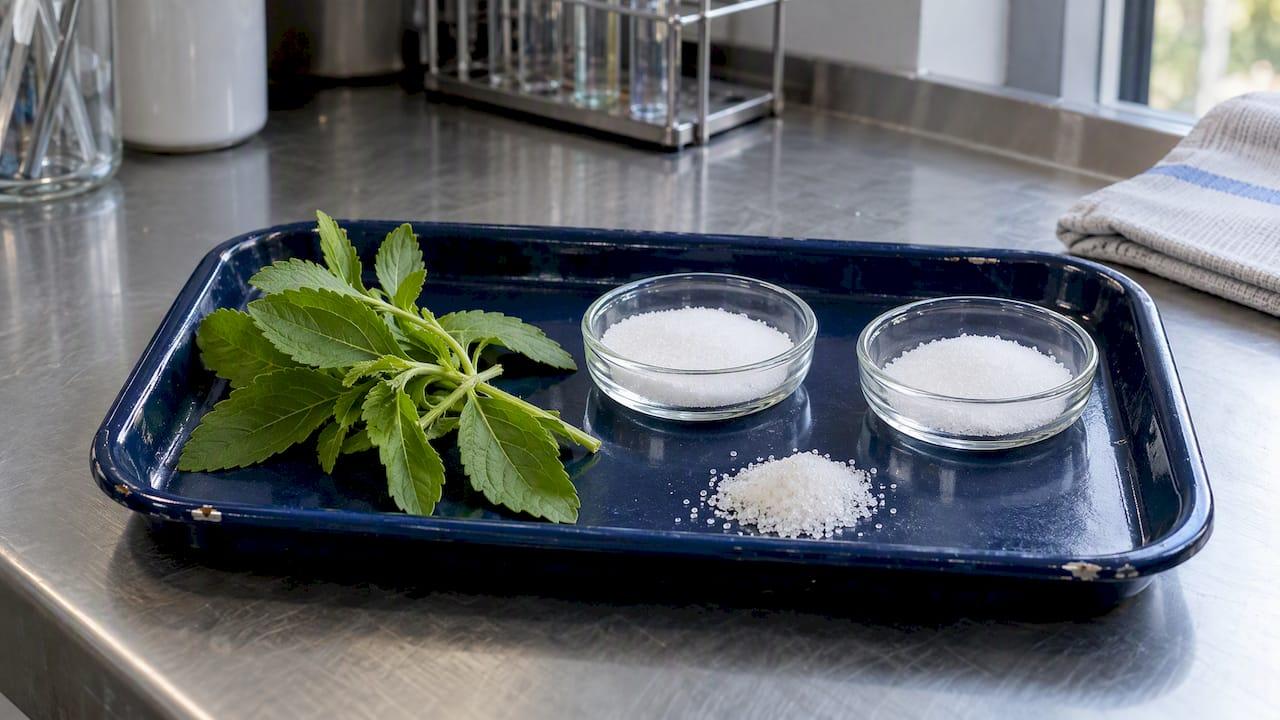
Neither sweetener wins outright. Stevia comes from a plant and may suit you better if you want a plant-derived option and watch your gut health. Sucralose is a lab-made sweetener that holds up better in baking and has the longer track record in processed foods. Both add practically no calories, and the FDA considers both safe at normal intakes. The better choice depends on what you are using it for, how it tastes to you and how much you use.
Below we compare them on the points that decide the question: where they come from, sweetness, daily limits, blood sugar, gut effects, weight, cooking and taste.
TL;DR
- Source: stevia sweeteners are purified steviol glycosides from the stevia leaf. Sucralose is a chemically modified form of sugar.
- Safety: the FDA allows both. The acceptable daily intake is 5 mg/kg of body weight for sucralose and 4 mg/kg (as steviol equivalents) for steviol glycosides.
- Baking: sucralose is heat-stable. Stevia works too, but usually needs blending and some trial and error.
- Evidence gaps: blood sugar and gut microbiome findings are mixed for sucralose and limited for stevia. Neither has proven weight-loss benefits.
- Pick by use: choose stevia if you prefer a plant-derived sweetener. Choose sucralose for baking or the lowest-cost option. Keep either one modest.
Table of Contents
- Stevia and sucralose at a glance
- Where each sweetener comes from
- Sweetness and calories
- How much is too much? Daily limits
- Safety: what regulators and researchers say
- Blood sugar: does sucralose raise it, and what about stevia?
- Gut health: a live question
- Weight management
- Cooking and baking
- Taste: the part that decides it for most people
- Perspective: how we read this comparison
- Which should you choose?
- Check the evidence yourself
- FAQ
- Sources
Stevia and sucralose at a glance
| Stevia (steviol glycosides) | Sucralose | |
|---|---|---|
| Origin | Extracted from the leaves of Stevia rebaudiana | Made from sucrose through chemical modification |
| Sweetness vs sugar | About 200 to 400 times sweeter | About 600 times sweeter |
| Calories | Practically none | Practically none |
| FDA status | High-purity steviol glycosides are GRAS | Regulated as a food additive |
| Acceptable daily intake | 4 mg/kg body weight (steviol equivalents) | 5 mg/kg body weight |
| Heat stability | Usable in cooking, often blended | Heat-stable, used in baked goods |
| Common taste complaint | Bitter or licorice-like aftertaste | Can taste slightly chemical to some people |
The sweetness figures and the regulatory status come from the FDA's page on sweeteners in food. The sections below explain what each row means in practice.
Where each sweetener comes from
Stevia: a plant extract
Steviol glycosides are natural constituents of stevia leaves. What you buy in a packet or a protein powder is not the raw leaf. It is a purified extract, most often rebaudioside A (Reb A) or the newer, better-tasting Reb M. The FDA has not questioned the GRAS conclusions for high-purity steviol glycosides under their intended conditions of use, according to the same FDA page.
Whole stevia leaf and crude stevia extracts are a different matter. They are not the high-purity products covered by those GRAS conclusions, so check that a product lists steviol glycosides or a specific Reb on the label.
Sucralose: modified sugar
Sucralose starts as sugar and is chemically altered so the body does not use it for energy. The FDA regulates it as a food additive. That means it went through a formal premarket review rather than a GRAS conclusion. You can read the research summary on our sucralose ingredient page.
"Natural" is a marketing word here, not a safety verdict. Plenty of natural substances are harmful and plenty of synthetic ones are well tolerated. What matters is the evidence at the amounts you actually eat.
Sweetness and calories
Sucralose is about 600 times sweeter than table sugar. Steviol glycosides are roughly 200 to 400 times sweeter, per the FDA. Both count as non-nutritive or low-calorie sweeteners that provide practically no calories.
Because they are so intense, you need only a tiny amount. That has two practical effects:
- Retail products usually add bulking agents such as maltodextrin or dextrose so the packet measures like sugar. Those carry a small amount of calories and carbs, which is why a packet can list a few calories even though the sweetener itself has none.
- Weighing or measuring pure powder is easy to get wrong. If you buy pure stevia extract or sucralose, follow the product's conversion chart instead of swapping spoon for spoon.
How much is too much? Daily limits
The FDA lists an acceptable daily intake (ADI) of 5 mg per kilogram of body weight per day for sucralose. For steviol glycosides the ADI is 4 mg/kg per day, expressed as steviol equivalents, a figure set by the Joint FAO/WHO Expert Committee on Food Additives. Both numbers are on the FDA's sweeteners page.
Here is the arithmetic for a 70 kg (154 lb) adult:
- Sucralose: 5 mg × 70 = 350 mg per day
- Steviol glycosides: 4 mg × 70 = 280 mg per day, as steviol equivalents
The stevia number looks lower, but it is not a like-for-like comparison. Steviol equivalents measure only the steviol part of the molecule, so the weight of actual extract you could eat is larger. The ADI also has a large safety margin built in. It is not a dose where harm begins. In practice, the FDA publishes a chart of sweetener packets that shows how many you would need in a day to reach the ADI. For sucralose that is 23 packets of the common tabletop product.
Most people drinking a couple of sweetened coffees will land far below either limit. Heavy users should add up sweeteners across diet drinks, protein bars, flavored waters and chewing gum, because small amounts in many products accumulate.
Safety: what regulators and researchers say
The FDA considers sweeteners safe for their intended uses, as laid out in its consumer update How Sweet It Is: All About Sweeteners. That covers both of these.
The World Health Organization sees it differently on one point. Its 2023 guideline recommends against using non-sugar sweeteners to control body weight or lower the risk of noncommunicable diseases, as reported by PAHO/WHO. That is a statement about long-term benefit, not an alarm about a specific sweetener. It applies to both stevia and sucralose.
So the honest summary is: at normal intakes, regulators regard both as safe, and no major health body says either one helps you lose weight or prevent disease on its own.
Blood sugar: does sucralose raise it, and what about stevia?
This is the question most people with diabetes or prediabetes are really asking.
The short answer is that sweeteners generally will not raise blood sugar the way sugar does, according to the FDA. The longer answer has more texture.
Sucralose. Research is contradictory. A review of trials on sucralose and aspartame found three studies that reported decreased insulin sensitivity after sucralose, while one reported an increase. The authors attribute the inconsistency to the different protocols the trials used. Another review of six randomized trials in 355 people with type 2 diabetes found no significant effect of non-nutritive sweeteners on blood glucose or insulin.

Stevia. Some research links stevia consumption with lower blood glucose, particularly in people with diabetes or hypertension. The overall quality of clinical evidence for that benefit remains low. It is a reason for interest, not a reason to treat stevia as a diabetes remedy.
If you take insulin or glucose-lowering drugs, talk to your doctor or a registered dietitian before you change your sweetener habits in a big way, and keep checking your own readings. Individual responses vary and the trial evidence cannot predict yours. If you want to explore what else the research says, our guide to the best supplements for blood sugar reviews the evidence behind each one.
Gut health: a live question
A 2026 systematic review suggests the two may differ in how they affect gut bacteria. It notes that some synthetic sweeteners such as sucralose may reduce microbial diversity, while steviol glycosides have been observed to preserve it. The same review stresses that regulators affirm the safety of approved sweeteners at established intakes, and that the long-term microbiome picture is still emerging.
We read that as a mild tilt toward stevia for people who use sweeteners daily, not as a verdict. The findings come from a review of varied studies, and what happens in a petri dish or a small trial does not automatically translate to your gut.
Weight management
Many people switch to a zero-calorie sweetener hoping to lose weight. The evidence is thinner than the marketing. A review in Nutrition Today found that studies of individual sweeteners were limited and did not support formal conclusions about weight-management efficacy. Its authors add that observational cohort studies have given mixed results on body fat, while clinical trials, which carry more weight, lean toward neutral or beneficial effects.
Put plainly: swapping a sugary soda for a diet one probably helps if the swap cuts total calories, but neither stevia nor sucralose burns fat. If weight is your goal, you can browse how ingredients stack up in our metabolic health supplement reviews. Many are heavily marketed, so we rate them by the quality of the trials behind them.
Cooking and baking
Sucralose is heat-stable and works as a sugar substitute in baked goods, per the FDA. That is its biggest practical edge. You can use it in cakes, cookies and sauces that cook at high temperatures without losing sweetness.
Stevia is also used in cooking and is common in beverages, yogurts and baked mixes. Home bakers should expect two things, based on how these products are built:
- Neither sweetener browns or caramelizes like sugar, and neither adds bulk or moisture. Recipes often need extra structure from eggs, fruit puree, or a bulking ingredient.
- Stevia blends are usually mixed with other ingredients to balance the flavor. Follow the conversion chart on the pack and test a small batch first.
If you want a sugar-like texture, you may also look at other sweetener types. Allulose, for example, behaves much more like sugar in baking. See our profile of Sukré, an ultra-pure allulose, or the monk fruit and allulose blend OnoSweet.
Taste: the part that decides it for most people
Taste is personal, and it is the most common reason people stop using a sweetener.
- Stevia tends to show a bitter, slightly licorice-like finish, especially with older Reb A products or when you use too much. Newer extracts such as Reb M and Reb BGG were developed to reduce that. You can read about two of them in our entries on SteviUp M2 and Vitosa.
- Sucralose has a clean, sugar-like first taste for most people, with a lingering sweetness. Some find a faint chemical note.
Try both in plain coffee or tea, where there is nothing to mask them. Give each a week, since your palate adjusts.
Perspective: how we read this comparison
We build NutraSmarts around one rule: show the evidence and its limits, not the hype. On this question, the evidence says both sweeteners are acceptable at normal intakes and neither is a health product. The gap between them is smaller than the internet argument suggests.

What we would tell a friend is this. If you use a sweetener occasionally, pick the one you like the taste of and stay well under the ADI. If you use one every day, the gut microbiome data and the plant origin give stevia a modest edge in our reading, but that data is early and we would not call it settled. If you bake a lot, sucralose is easier to work with. And if you are trying to lose weight or control blood sugar, the sweetener is a minor lever next to total diet, activity and medical care.
For formulators, the same discipline applies to labels: a sweetener has to be declared accurately, and our free tool helps with that (more below).
— NutraSmarts
Which should you choose?
| Your situation | Likely better fit |
|---|---|
| Occasional use in coffee or tea | Whichever tastes better to you |
| Daily use, you prefer a plant-derived ingredient | Stevia (look for Reb M or similar) |
| Baking at high heat | Sucralose, or a blend built for baking |
| You dislike bitter aftertastes | Sucralose, or a newer high-purity stevia |
| Managing diabetes | Either may fit, but confirm with your care team and monitor readings |
| Hoping to lose weight | Neither is proven to do it, so focus on overall intake |
Check the evidence yourself
If you want the studies behind these claims, our database has a profile for each ingredient with clinical citations and dosage benchmarks. Start with the entries for stevia and sucralose, then use the side-by-side comparison guides to see how related ingredients stack up.
If you make supplements or functional foods, our free Supplement Facts label creator lets you build an FDA-compliant label in your browser, with no spreadsheet and no sign-up.
Not sure how to read a trial? Our researcher's guide to clinical trial designs explains why some of the contradictory findings above happen.
FAQ
Is stevia healthier than sucralose?
Not proven. Both add practically no calories and the FDA considers both safe at normal intakes. Stevia has a slight edge in early gut microbiome research and some limited blood glucose data, but the quality of that evidence is low. Choose based on taste, use and tolerance.
Does sucralose raise blood sugar?
Generally, sweeteners do not raise blood sugar the way sugar does. Trials on sucralose and insulin sensitivity are mixed, with some showing a decrease and one showing an increase. If you have diabetes, monitor your own response and ask your doctor or dietitian.
Which is better for baking, stevia or sucralose?
Sucralose is heat-stable and is used in baked goods, so it is the simpler choice for high-heat recipes. Stevia can work, but expect to adjust the recipe, since neither adds the bulk or browning of sugar. Always follow the conversion guide on the product you buy.
How much sucralose or stevia is safe per day?
The FDA lists an ADI of 5 mg/kg of body weight for sucralose and 4 mg/kg, as steviol equivalents, for steviol glycosides. For a 70 kg adult that is 350 mg of sucralose or 280 mg of steviol equivalents. Most people stay well below these limits, but heavy diet-drink users should count every source.
Will either one help me lose weight?
The evidence does not support that on its own. The WHO's 2023 guideline recommends against using non-sugar sweeteners for weight control. Replacing sugar can lower calories, but the long-term benefit depends on your overall diet.
Sources
- Aspartame and Other Sweeteners in Food | FDA
- How Sweet It Is: All About Sweeteners | FDA
- Safe Levels of Sweeteners | FDA
- WHO advises not to use non-sugar sweeteners for weight control | PAHO/WHO
- Effect of stevia on blood glucose and HbA1C | ScienceDirect
- Effect of sucralose and aspartame on glucose metabolism | Nutrition Reviews
- Effect of non-nutritive sweeteners on blood glucose, review of six trials | URV repository
- Synthetic Versus Natural Impacts on Gut Microbial Diversity | Macrothink
- A Review of Low- and No-Calorie Sweetener Safety and Weight | Nutrition Today