

You've picked up a protein bar and a multivitamin and noticed their labels look completely different. That's not a mistake. Supplement facts vs nutrition facts explained as a single topic reveals something most shoppers never realize: these panels are governed by entirely separate FDA regulations, and confusing them leads to real misreads about what you're consuming. One label tells you how a product fits into your daily diet. The other confirms you're getting the right dose of a specific ingredient. Knowing which is which changes how you shop, stack, and supplement.
Table of Contents
- Key takeaways
- Supplement facts vs nutrition facts explained: the regulatory split
- What's actually on each label
- Reading %DV and ingredient amounts correctly
- When each label applies: real product examples
- My take on how most people misread these labels
- Use Nutrasmarts to go beyond the label
- FAQ
Key takeaways
| Point | Details |
|---|---|
| Two separate regulations | Supplement Facts fall under 21 CFR 101.36; Nutrition Facts fall under 21 CFR 101.9. |
| Label type follows product class | A product cannot carry both panels. Its legal classification as food or supplement determines the label. |
| Serving size rules differ | Nutrition Facts use standardized RACCs; supplement serving sizes are set by the manufacturer. |
| %DV means different things | On food labels it guides daily intake targets. On supplement labels, many ingredients carry no established Daily Value at all. |
| Read for dosage on supplements | Ignore %DV when it's absent on supplements. Focus on the exact mg, mcg, or IU listed against research-supported amounts. |
Supplement facts vs nutrition facts explained: the regulatory split
The difference between supplement facts and nutrition facts starts at the federal regulation level, not at the design department. The Supplement Facts panel is required by law for any product classified as a dietary supplement, regulated under 21 CFR 101.36. The Nutrition Facts panel applies to conventional food products under 21 CFR 101.9. A product cannot carry both panels at once. The legal classification of the product drives every label decision that follows.
That classification also affects the principal display panel. Dietary supplement products must use the statement "Dietary Supplement" or an equivalent description on their front label. This tells regulators and consumers immediately that the product is not food. It's a declaration that shifts the entire product into a different regulatory lane.
Why does this matter to you as a consumer? Because the rules governing what gets listed, how it gets listed, and what claims can be made are fundamentally different between the two lanes.
- Supplement Facts labels are highly format-sensitive, with strict FDA requirements on layout, math, footnotes, and type size. Improper formatting is one of the most common reasons the FDA cites manufacturers for non-compliance.
- Nutrition Facts panels follow a standardized template most people recognize from grocery shopping, with a rigid hierarchy of nutrients and mandatory line items.
- Supplement labels may also include structure-function claim disclaimers mandated by the FDA, such as "This statement has not been evaluated by the Food and Drug Administration." No equivalent disclaimer appears on conventional food labels.
- The Nutrition Facts panel exists to guide dietary patterns. The Supplement Facts panel exists to disclose ingredient dosing.
Pro Tip: If a product calls itself a "dietary supplement" on the front and shows a Nutrition Facts panel instead of a Supplement Facts panel, that's a red flag. Report it or skip it.
What's actually on each label
Understanding supplement labels gets a lot easier once you see what each panel is required to show, and what it deliberately leaves out.
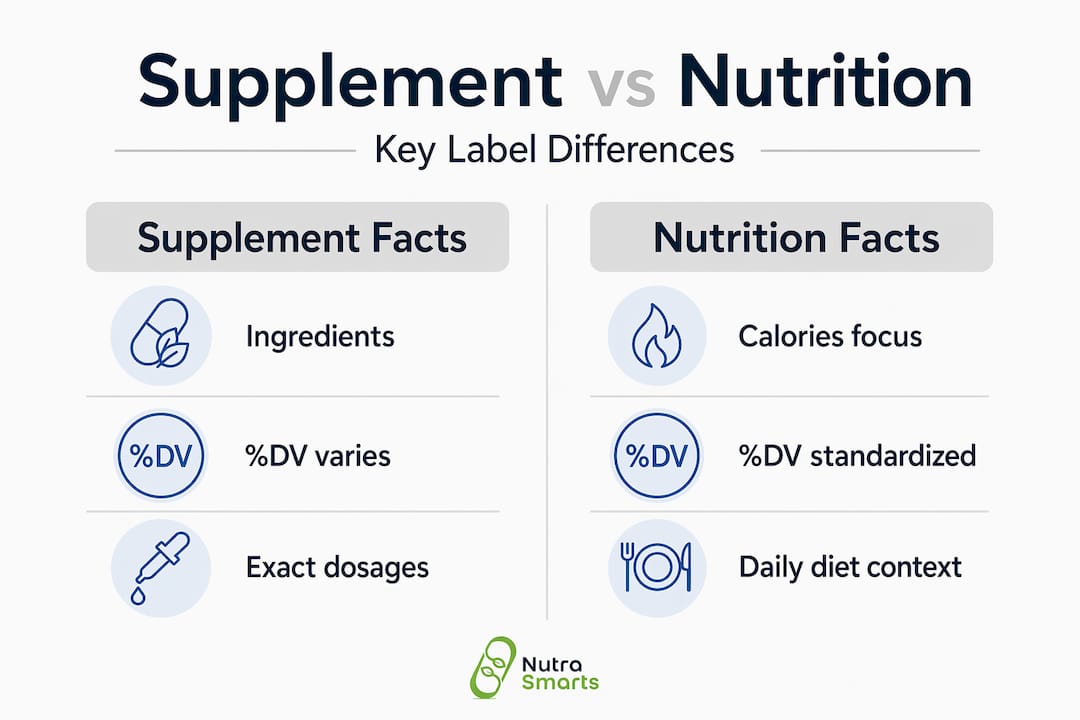
Supplement Facts: ingredients first, calories secondary
The Supplement Facts panel lists dietary ingredients, the serving size, and the amount per serving in exact units (mg, mcg, IU). Calories may appear but are not the focus. Ingredients with an established Daily Value list a %DV. Ingredients without one get a footnote that simply reads "Daily Value not established." According to labeling rules, ingredients with established Daily Values are listed first, followed by those without.
Proprietary blends are also permitted on Supplement Facts panels. The blend gets a total weight, but individual ingredient amounts within it don't have to be disclosed. This is a detail worth watching when you're evaluating a new product.
Nutrition Facts: daily diet framework
The Nutrition Facts label is built around the concept of daily dietary management. It lists calories prominently, followed by total fat, saturated fat, trans fat, cholesterol, sodium, total carbohydrates, dietary fiber, total sugars, added sugars, protein, and a set of vitamins and minerals. Every line item connects to a %DV framework.

Added sugars get their own disclosure because the FDA Daily Value for added sugars is 50 grams per day. Notably, there is no Daily Value for total sugars because no daily recommendation exists for sugar consumed naturally.
Serving size is another major difference. Nutrition Facts serving sizes are set by Reference Amounts Customarily Consumed (RACCs), standardized benchmarks based on how much of a food people actually eat. Supplement serving sizes are defined by the manufacturer based on intended use. A serving of a supplement could be one capsule, three tablets, or two scoops, and you won't find a government-standardized reference for that.
| Feature | Supplement Facts | Nutrition Facts |
|---|---|---|
| Regulatory basis | 21 CFR 101.36 | 21 CFR 101.9 |
| Calorie focus | Secondary | Primary |
| Serving size method | Manufacturer defined | RACC standardized |
| %DV coverage | Partial (many gaps) | Full for all listed nutrients |
| Proprietary blends allowed | Yes | No |
| Structure-function disclaimers | Required when applicable | Not applicable |
Pro Tip: When comparing two supplement products, ignore the %DV column if many rows show "Daily Value not established." You're comparison shopping by dose, not by percentage.
Reading %DV and ingredient amounts correctly
This is where a lot of health-conscious shoppers make a costly mistake. The %DV framework feels familiar from food labels, so people carry that same reading habit over to supplements. It doesn't transfer cleanly.
On a Nutrition Facts label, %DV works exactly as intended. If a food shows 20% DV for sodium, that tells you one serving covers one-fifth of your daily sodium budget. The system is coherent and complete because every nutrient listed has an established Daily Value.
Supplement Facts panels tell a different story. Many supplement ingredients, especially botanical extracts, adaptogenic herbs, and proprietary blends, have no established Daily Value. The %DV column either shows nothing or displays a footnote. Over-weighting the %DV figures that do appear on a supplement panel, while ignoring the gaps, skews your read of the product.
The right approach when reading supplement labels:
- Look at the exact amount per serving in mg, mcg, or IU for every ingredient.
- Cross-reference that amount against published research or clinical trial dosing for that specific ingredient.
- For ingredients with a %DV listed, use it as a secondary check, not your primary guide.
- When you see a proprietary blend, check the total blend weight and ask whether the dose is realistically therapeutic at that quantity.
- Flag any ingredients for which no amount is disclosed within a blend. You cannot assess efficacy without knowing the dose.
The practical difference is this: Nutrition Facts help you manage dietary patterns. Supplement Facts help you verify you're actually getting a clinically relevant dose of what the product claims to contain. These are genuinely different jobs, and conflating them leads to under-dosing or misplaced confidence.
When each label applies: real product examples
Knowing the theory is useful. Seeing it applied to actual product categories makes it stick.
-
Multivitamin capsules. These always carry a Supplement Facts panel. They're not food. You're taking them to fill specific nutrient gaps, and the label should show each vitamin or mineral by exact amount and %DV where established.
-
Protein bars. This one trips people up. Most commercially sold protein bars are classified as food, not supplements, so they carry a Nutrition Facts panel. Their protein content appears as a standard macronutrient, not as a dosed dietary ingredient.
-
Creatine monohydrate powder. Classified as a dietary supplement. Supplement Facts panel required. There's no Daily Value for creatine, so you'll see the "Daily Value not established" footnote. Focus on the gram dose per serving.
-
Fortified breakfast cereal. Food classification. Nutrition Facts panel. Added vitamins appear as a percentage of Daily Value within the standard food label format.
-
Collagen peptide powder marketed as a meal replacement. This gets complicated. If it's positioned and sold as food, it may carry Nutrition Facts. If it's marketed as a dietary supplement, it carries Supplement Facts. The front panel statement is your first clue.
Pro Tip: For diabetes-related food label reading and carbohydrate tracking, Nutrition Facts panels are the right tool. Added sugars %DV and total carbohydrate grams are both present and standardized.
The key principle is that manufacturers choose labels based on regulatory classification, not convenience or marketing preference. Misclassification is an FDA compliance violation.
My take on how most people misread these labels
I've worked with a lot of health-conscious people trying to decode supplement panels, and one pattern shows up constantly. They scan the %DV column looking for high numbers and assume that's where the value is. A supplement with a 500% DV for vitamin B12 looks impressive. One that lists 400 mg of ashwagandha extract with no %DV gets dismissed as vague.
That instinct is backwards. The ashwagandha label is telling you something specific and useful: the actual dose. A dose you can compare against clinical literature. The B12 label is telling you less than it seems, because megadosing B12 beyond absorption limits doesn't translate to proportional benefit for most people.
What I've found is that the Supplement Facts panel rewards readers who come prepared. You need to know the research-supported dose for the ingredient before the label becomes meaningful. Without that context, the panel is just a list of numbers. With it, you can immediately see whether a product is dosed to work or dosed to appear impressive on paper.
The nutrition label vs supplement label distinction also matters for stacking. If you're eating fortified foods and taking a vitamin D supplement, you could unknowingly double up on fat-soluble nutrients. Reading both labels with literacy, not just glancing at them, prevents that kind of accidental excess.
My strongest recommendation: use authoritative, evidence-backed ingredient databases before you buy, not after. The label tells you what's in the product. Research tells you whether that amount does anything.
— NutraSmarts
Use Nutrasmarts to go beyond the label
Label literacy is the foundation, but it only takes you so far without reliable data on what those doses actually do.
Nutrasmarts is built specifically for moments like this. The platform covers over 800 supplement ingredients, each linked to peer-reviewed studies and clinical trial citations. When you're staring at a Supplement Facts panel and wondering whether 300 mg of magnesium glycinate is actually a meaningful dose, Nutrasmarts gives you the research-backed answer. You can also compare supplements side by side to see how ingredient amounts stack up across products, a step that makes label reading genuinely useful rather than just informational. For those starting from symptoms rather than ingredients, the supplements by symptom tool points you toward evidence-supported options for specific concerns like joint pain, fatigue, or focus.
FAQ
What is the main difference between Supplement Facts and Nutrition Facts?
The Supplement Facts panel is required for dietary supplements under 21 CFR 101.36, while the Nutrition Facts panel applies to food products under 21 CFR 101.9. A product cannot legally carry both.
Can a protein bar have a Supplement Facts panel?
Most protein bars are classified as food and therefore carry Nutrition Facts panels. If a protein bar is explicitly marketed and classified as a dietary supplement, it would require a Supplement Facts panel instead.
Why do so many supplement ingredients show no %DV?
Many supplement ingredients, particularly botanical extracts and proprietary blends, have no FDA-established Daily Value. When that's the case, the label must note "Daily Value not established" rather than listing a percentage.
How should I read serving sizes differently on each label?
Nutrition Facts serving sizes follow standardized Reference Amounts Customarily Consumed set by the FDA. Supplement Facts serving sizes are defined by the manufacturer based on intended use, so you cannot assume any standard portion.
Is a high %DV on a supplement always a good sign?
Not necessarily. A high %DV reflects a large amount relative to an established daily reference, but for many supplement goals, the clinically relevant dose and the %DV have little connection. Always compare the actual ingredient amount to research-supported dosing, not just the percentage shown.