
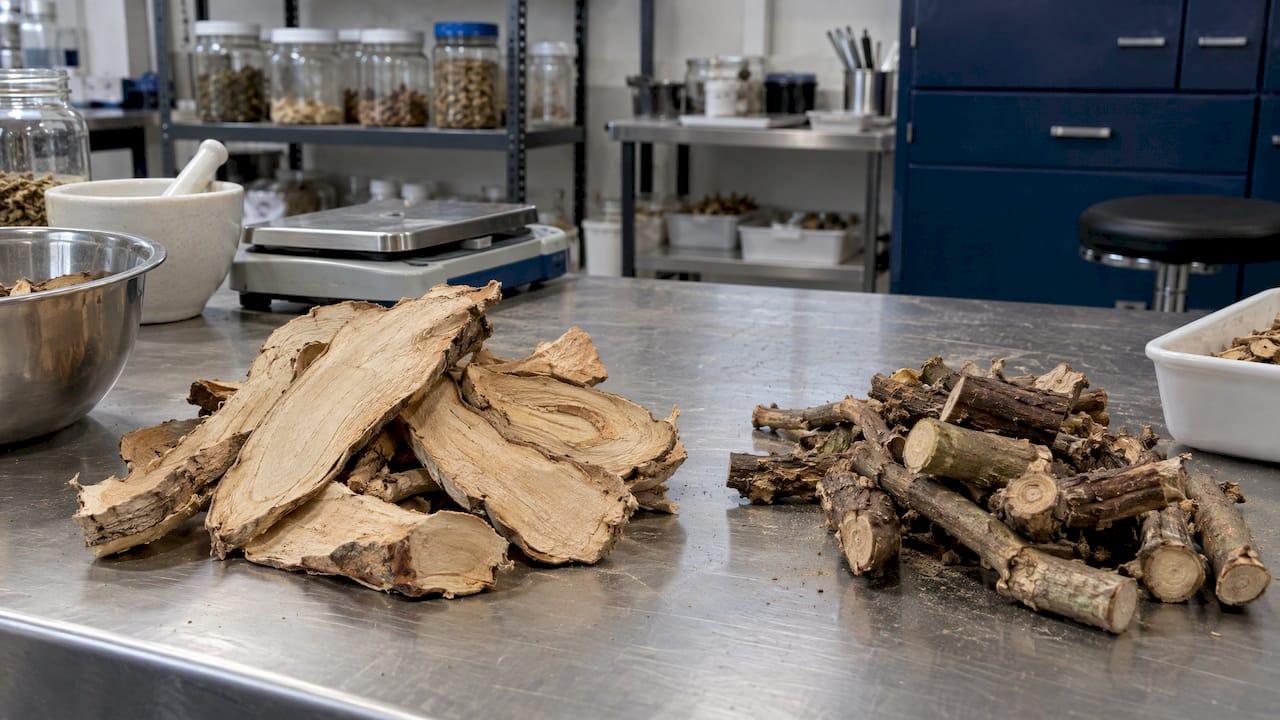
If you have to pick one, tongkat ali has the stronger case. It has human trials, including a pooled analysis of randomized studies, that point to higher testosterone, mostly in men who start low. Fadogia agrestis has rat data and little else. The two are often sold as a pair, but nobody has tested them together, so you can judge each on its own record.
TL;DR
- Tongkat ali (Eurycoma longifolia) has small, short human studies and a 2022 meta-analysis that found a statistically significant rise in total testosterone.
- Fadogia agrestis has testosterone data from rats only. The studies we found did not test it in people, so there is no established human dose.
- Rat studies of fadogia at higher doses reported changes in testicular and liver and kidney markers, so the safety questions are still open.
- No trial we found has tested the two together. "Stacking" is a marketing idea, not a researched protocol.
- Product quality matters for both. Choose products with third-party lab testing and check the label for the extract and amount.
Table of Contents
- What each ingredient is
- Tongkat ali vs. fadogia at a glance
- What the human evidence says about tongkat ali
- What we know about fadogia agrestis
- Safety: what to know before you take either
- Can you take them together?
- How to choose between them
- Our perspective
- Look up the research yourself
- FAQ
- Sources
What each ingredient is
Tongkat ali is a plant native to Malaysia and other parts of Southeast Asia. The U.S. military's Operation Supplement Safety (OPSS) program notes that it is marketed to boost testosterone, reduce stress, improve mood and enhance athletic and sexual performance, and that more evidence is needed to confirm those benefits. You will also see it called Malaysian ginseng or longjack. Supplements typically use a root extract, and the extract type matters, as we explain below.
Fadogia agrestis is a shrub from West Africa. Its stems are used in traditional medicine for sexual vigor. It became popular in supplement circles through podcasts and social media rather than through clinical research. Almost everything cited in its favor traces back to a handful of animal experiments.
That difference in evidence is the whole story of this comparison. The two ingredients are marketed with similar promises, but the research behind them is very different.
Tongkat ali vs. fadogia at a glance
| Question | Tongkat ali | Fadogia agrestis |
|---|---|---|
| Human trials on testosterone | Yes, several small and short studies | None identified in our review |
| Pooled analysis | 2022 meta-analysis of randomized trials | None |
| Typical study dose | 100 to 600 mg daily of extract | No human dose established |
| Main evidence base | Human studies, mixed quality | Rat studies |
| Safety data | Short-term tolerability in trials, long-term safety not established | Rat studies flagged testicular, liver and kidney concerns |
| Product quality concern | Reports of heavy metals and adulterants | Little product-quality data |
What the human evidence says about tongkat ali
The OPSS review describes the tongkat ali studies as generally small and short-term. Some suggest effects on testosterone, fertility, erectile dysfunction, libido or muscle strength. Studies have not shown a benefit for endurance performance.
The strongest single piece of evidence is the 2022 systematic review and meta-analysis by Leisegang and colleagues. It identified nine human studies of Eurycoma longifolia and pooled five randomized controlled trials. The pooled result showed a statistically significant increase in total testosterone (standardized mean difference 1.352, 95% CI 0.565 to 2.138, p=0.001).
That number is an effect size, not a promise. It does not translate into a fixed ng/dL gain for every person. The same research suggests the effect is more plausible in men whose testosterone is already low than in healthy men. Doses in those studies ranged from 100 to 600 mg a day for anywhere from 3 days to 6 months, and seven of the nine studies mainly used the same commercial water-extracted product, standardized to 0.8 to 1.5% eurycomanone. So the findings apply most clearly to that kind of extract, not to every tongkat ali powder on the shelf.
A 2024 systematic review of 52 studies covering 27 proposed testosterone boosters classified Eurycoma longifolia as possibly effective for men with late-onset hypogonadism and for healthy men, while concluding that most boosters on the market fail to raise total testosterone. Tongkat ali sat on the more encouraging side of that list.

The "37%" figure, in context
You may see a headline number from a 2013 randomized study of a standardized tongkat ali extract. It reported that testosterone status rose by 37% and cortisol exposure fell by 16%, with improvements in tension, anger and confusion scores. Those results came from that specific study, its participants and its product. Treat them as an example of what a trial found, not a guaranteed result.
Stress and mood
The same 2013 study is the reason tongkat ali is often paired with stress claims. It measured cortisol and mood scores in a stressed population. It is a reasonable signal and a reason for more research, but it is one study. For a fuller walkthrough of the testosterone, libido and stress findings, see our guide to tongkat ali for testosterone, libido and stress in men.
What we know about fadogia agrestis
The study most often cited for fadogia is a 2005 experiment in male albino rats. Researchers gave the animals an aqueous stem extract at 18, 50 or 100 mg/kg and reported dose-related increases in serum testosterone and sexual-behavior measures after days 1, 3 and 5.
That is the extent of the testosterone case. The study did not test humans, did not establish a human dose and did not show that testosterone rises in people. Rats and humans differ in physiology, and a rat dose in mg/kg cannot be converted into a trustworthy capsule dose.
A recent overview of the topic makes the same point from a clinical angle: compared with tongkat ali, fadogia has less evidence, and the trend is driven by social media rather than trials. Our own page on fadogia sums up the practical question in Fadogia agrestis: is it safe, and does it work?
Safety: what to know before you take either
Tongkat ali
OPSS states that human safety for tongkat ali has not been fully established. Short-term tolerability in selected studies should not be read as proof of long-term safety or of product quality. OPSS also warns that without laboratory testing there is no way to know a product's actual ingredients or their amounts, and that tongkat ali products have been reported to contain heavy metals or adulterants.
In practice, safe use means choosing products with independent lab testing, staying within the amount used on the label of a well-made product, and talking to a doctor before starting if you take prescription medicines, have a hormone-sensitive condition or are managing a health problem.
Fadogia agrestis
Two rat studies are the main reason for caution. A 2008 study gave rats 18, 50 or 100 mg/kg for 28 days and found adverse alterations in testicular-function indices. Recovery occurred mainly at the lowest dose, and the authors warned that the changes could impair testicular function. A 2009 study using the same dose range for 28 days found biochemical evidence consistent with disruption of liver and kidney cell-membrane integrity, even though there was no mortality or visible organ swelling.
These are animal findings, and we cannot say they will happen in people. They are still a reason to be careful, particularly for men concerned about fertility or with liver or kidney conditions. Speak with your physician before using fadogia, and do not assume that a long list of enthusiastic reviews replaces safety testing.
How supplements are regulated in the U.S.
In the United States, supplements are governed by the Dietary Supplement Health and Education Act of 1994. Under DSHEA the government bears the burden of proof in an adulteration proceeding, and the law addresses significant or unreasonable risk and inadequate safety information for new dietary ingredients. In plain terms, products are not approved before they go on sale. That puts more weight on the buyer to choose carefully. For a clinical view of what happens when testosterone is genuinely low, this overview of testosterone therapy for men, who it helps, risks and cost explains the medical route.
Can you take them together?
This is the question behind most of the searches, and the honest answer is that nobody knows. We found no trial that has tested tongkat ali and fadogia agrestis as a combination, in people or in animals. One recent review of the topic states directly that no trial has tested the combination, and that adding an unstudied partner does not strengthen tongkat ali's own evidence.
That has a practical consequence. Product pages describe the pair as "synergistic," but synergy is a claim that needs a study. What the evidence supports is two separate pictures: a modest, plausible human signal for tongkat ali, and animal-only data with safety flags for fadogia. If you want to explore the idea further, our breakdown of the tongkat ali and fadogia testosterone stack goes through what the combined products contain.

How to choose between them
Use these criteria rather than the marketing:
- Human evidence. Prefer the ingredient with controlled human trials. That is tongkat ali.
- Your starting point. The research is more encouraging for men with low testosterone than for men with normal levels. If you suspect low testosterone, ask a doctor for a blood test first, because symptoms such as low energy and low libido have many causes.
- The extract. Most of the pooled human data used a water-extracted product standardized to eurycomanone. Look for a label that states the extract type and the standardization, not just "tongkat ali root."
- Testing. Choose products with third-party testing for identity, strength and contaminants, given OPSS's warnings about heavy metals and adulterants.
- Dose. Stay within the range studied (100 to 600 mg a day of extract in the meta-analysis) rather than going higher in search of a bigger effect.
- Single ingredients first. If you try a supplement, start with one, so you can tell what it does and what it does not.
If you are comparing specific tongkat ali products, our ranked list of the best tongkat ali supplements shows how they stack up. You can also look at branded extracts such as ALIVEL and LJ100 on their ingredient pages.
Our perspective
We built NutraSmarts because ingredient pages should read like research summaries, not sales pages. Tongkat ali and fadogia agrestis are a good example of why.
On our database, every ingredient gets an honest evidence rating linked to the studies behind it. Tongkat ali has human trials we can cite and a clinical dose range we can state. Fadogia has rat studies, and we say so plainly, because a reader deciding what to spend money on deserves to see the difference between a human finding and an animal one.
Our approach is to show dosage benchmarks from the studies, link to PubMed, and let you compare ingredients side by side. That is how we think a decision like "tongkat ali or fadogia" should be made: on the evidence, one ingredient at a time, with a doctor involved if your testosterone may actually be low.
NutraSmarts
Look up the research yourself
You do not have to take our word for any of this. Our ingredient database lists clinical dosages and the study citations for each ingredient, and our side-by-side comparison tool lets you put two ingredients next to each other. You can read the full profiles for tongkat ali and fadogia agrestis, including dosages and the research behind them, with no sign-up and nothing to pay.
If you are searching by a concern rather than an ingredient, try supplements by symptom. And if you formulate products, our free Supplement Facts label creator builds an FDA-compliant label in your browser.
FAQ
Is it good to take tongkat ali and fadogia agrestis together?
There is no human or animal research on the combination, so no one can say it is better than either alone. Tongkat ali has human studies behind it. Fadogia has animal studies with safety flags. If you decide to try either, a single ingredient at a time is easier to evaluate, and a doctor can help if you take medication.
How much does tongkat ali increase testosterone?
It depends on the person and the product. A 2022 meta-analysis found a statistically significant pooled increase in total testosterone, but reported it as a standardized effect size rather than a fixed number. One 2013 trial reported a 37% increase in testosterone status with a standardized extract. The effect looks more plausible in men with low testosterone than in healthy men.
Is fadogia agrestis safe for humans?
Human safety has not been established. The animal studies we reviewed reported changes in testicular function markers and in liver and kidney cell-membrane markers after 28 days at the higher doses. Those were rat studies, but they are a reason to talk to a doctor before using it, especially if fertility, liver or kidney health is a concern.
Which one is better for testosterone?
On the evidence, tongkat ali. It has controlled human trials and a pooled analysis, while fadogia's testosterone data come from rats. Neither replaces testing and medical care if you think your testosterone is low.
How do I pick a tongkat ali product?
Look for a stated extract type and standardization, an amount within the studied range, and independent lab testing for identity and contaminants. OPSS notes that without testing there is no way to know a product's real contents.
Sources
- Tongkat Ali: Uses and Safety in Dietary Supplements (OPSS)
- Eurycoma longifolia (Jack) improves serum total testosterone: systematic review and meta-analysis, 2022
- Do "testosterone boosters" really increase serum total testosterone? Systematic review, 2024
- Effect of Tongkat Ali on stress hormones and psychological mood state, 2013
- Aphrodisiac potentials of the aqueous extract of Fadogia agrestis, 2005
- Effects of oral administration of aqueous extract of Fadogia agrestis on testicular function, 2008
- Mode of cellular toxicity of aqueous extract of Fadogia agrestis, 2009
- Dietary Supplement Health and Education Act of 1994
- Fadogia Agrestis: Testosterone Evidence and Safety Explained
- Testosterone Therapy for Men: Who It Helps, Risks and Cost