
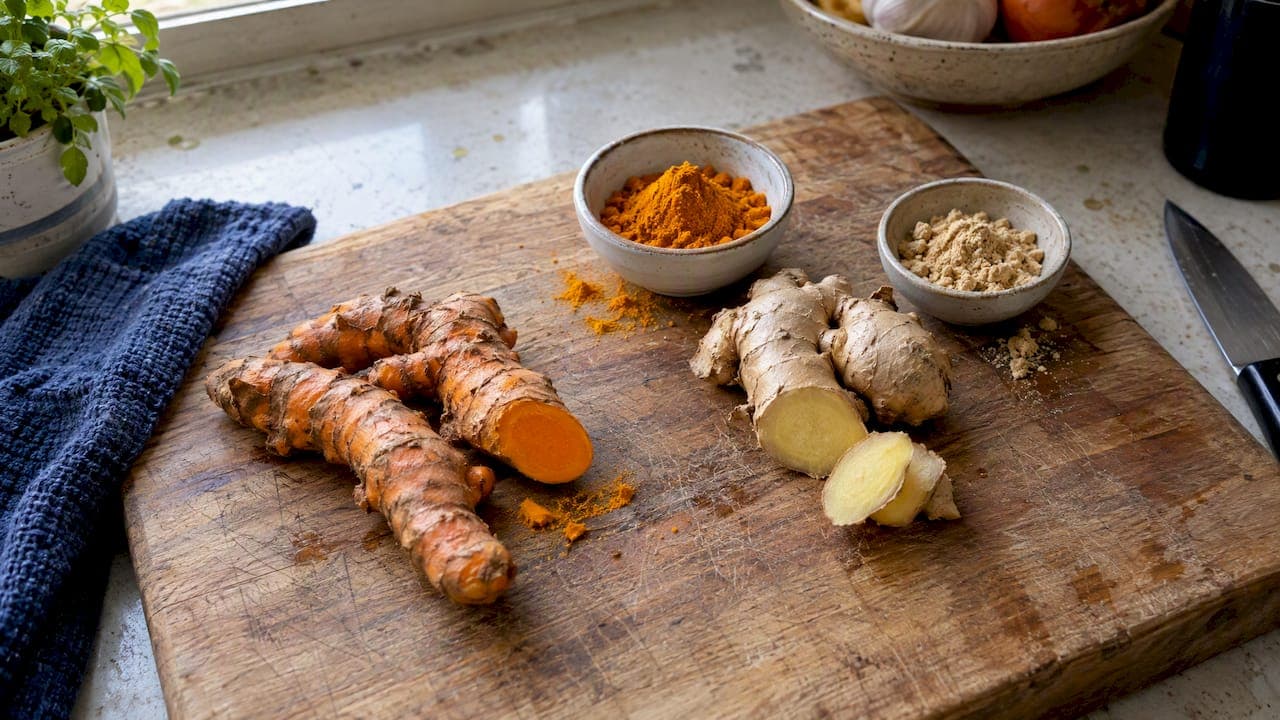
Turmeric, specifically its active compound curcumin, has the stronger evidence base for sustained anti-inflammatory relief, but mostly in clinical doses and enhanced formulations, not kitchen spoonfuls. Ginger wins for nausea and fast digestive comfort. Using both in cooking is common and generally safe, but concentrated supplement combinations deserve a conversation with a clinician, especially if you take blood thinners.
TL;DR:
- Clinical doses of curcumin with enhanced formulations are necessary for sustained anti-inflammatory benefits, as regular kitchen amounts are unlikely to deliver therapeutic effects.
- Ginger acts quickly to reduce nausea and improve digestion, often within minutes to hours, whereas curcumin’s anti-inflammatory effects require more than 12 weeks of consistent, higher-dose supplementation.
- Both roots can be safely used in cooking to add flavor and mild health benefits, but concentrated supplements require medical consultation, especially for those on blood thinners.
- Combining turmeric and ginger in cooking is reasonable and may enhance anti-inflammatory effects, but true synergy depends on specific extract ratios used in research, not just a pinch of each.
- Standardized supplements are best suited for targeted health goals, with labels indicating dose and active compound content, while culinary amounts mainly support flavor and general wellness.
Table of Contents
- Curcumin vs gingerols: the chemistry behind the difference
- What clinical trials actually show about pain and inflammation
- Cooking with turmeric and ginger: flavor, form, and smart swaps
- Who needs to be careful with turmeric and ginger
- Does combining turmeric and ginger actually work better?
- Choosing the right form and dose for your goals
- Evidence we drew on for this comparison
- How your body absorbs and processes each root
- A practical take on cooking versus supplementing
- Compare curcumin and ginger formulations before you buy
- Sources
- FAQ
Curcumin vs gingerols: the chemistry behind the difference
Turmeric's medicinal reputation rests on curcuminoids, a group of compounds dominated by curcumin. Ginger's active compounds are gingerols and shogaols, which concentrate differently depending on whether the root is fresh or dried. These two chemical families behave differently in the body, which explains why the two roots get used for different complaints.
Curcumin appears to act on inflammatory signaling pathways, including modulation of NF-kB activity, a process tied to how the body produces inflammatory proteins. The catch is absorption. Curcumin on its own is poorly absorbed, which is why many clinical trials use enhanced formulations such as Curcumin C3 Complex or Meriva, which pair curcumin with piperine or a phospholipid carrier to raise blood levels.
Gingerols and shogaols work partly by affecting gastric motility, which helps explain ginger's reputation for settling an upset stomach. Shogaols form as dried ginger ages or as fresh ginger is heated, which is part of why dried ginger tastes sharper than the fresh root.
- Onset: Ginger tends to act within minutes to hours on nausea and digestion.
- Onset: Curcumin's anti-inflammatory effects build over weeks, since trials showing benefit typically run longer than a few doses.
- Form matters: A standardized extract behaves differently in the body than the same ingredient eaten in food.
What clinical trials actually show about pain and inflammation
A 2022 systematic review and meta-analysis on nutritional supplementation found that both curcumin and ginger supplementation improved knee osteoarthritis symptoms compared with placebo. Curcumin's benefits were more consistent at doses of 1,000 milligrams per day or higher and when treatment ran longer than 12 weeks, according to the same meta-analysis. Curcumin did not outperform active NSAID comparators in that analysis, which matters if you are weighing it as a replacement rather than an addition.
The same review found ginger supplementation reduced pain scores and, in some trials, inflammatory markers like CRP and ESR, though sensitivity analyses sometimes shrank the measured effect once lower-quality studies were excluded. That is a meaningful caveat: the strength of the result depended heavily on which trials were included.
Trial doses varied by study. Curcumin trials often used 1,000 milligrams per day or more, while ginger trials commonly ranged from 250 milligrams to 1 gram per day. Small sample sizes, inconsistent formulations, and short durations limit how far these findings generalize, and higher-quality trials (measured by tools like the Jadad score) tended to produce more reliable results than lower-quality ones. None of this supports treating either root as a cure. It supports treating both as plausible, moderate tools with real limits.

Cooking with turmeric and ginger: flavor, form, and smart swaps
Fresh turmeric has an earthy, slightly bitter, almost peppery bite and stains everything it touches a deep yellow. Dried turmeric powder is milder and more convenient for curries, rice, and golden-milk drinks. Fresh ginger brings a sharp, citrus heat that mellows when cooked, while dried ginger (common in baking) is more concentrated and warming, with less of the bright top note.

Ginger can stand in for turmeric when you want warmth without the color or the curcumin-specific intent, but it will not replicate turmeric's golden hue or its particular health angle. Turmeric cannot replace ginger's zing in a stir-fry or its calming effect in tea. As a rough conversion, one tablespoon of fresh grated ginger or turmeric is roughly equivalent to one teaspoon of the dried, ground form.
Common ways to use both:
- Tea and infusions: Steep fresh slices in hot water for a mild digestive drink.
- Curries and stews: Combine both for depth, using turmeric for color and ginger for brightness.
- Smoothies: A small knob of fresh ginger adds kick without overwhelming other flavors.
- Marinades: Grated ginger tenderizes proteins while turmeric adds color and a subtle earthiness.
- Shots: Fresh-pressed combinations are popular, though effects are more about taste and ritual than measurable clinical dosing.
Who needs to be careful with turmeric and ginger
Both roots are pharmacologically active, which is why NCCIH's guidance on herb-drug interactions treats concentrated supplement use differently from ordinary food amounts. NCCIH's turmeric safety page notes that conventional oral turmeric is likely safe for up to two to three months, but enhanced-bioavailability curcumin products have been linked to rare reports of liver injury. NCCIH's ginger guidance points to common side effects like heartburn and gas, plus a potential interaction with anticoagulant medications.
- Stop and consult a clinician if you notice yellowing skin or eyes, dark urine, or unusual fatigue, which can signal liver stress.
- Be cautious combining either root's concentrated form with blood thinners, since both can affect bleeding risk.
- Flag use before any planned surgery, during pregnancy or breastfeeding, or if you have gallbladder disease.
Pro Tip: If you take warfarin or another anticoagulant, treat turmeric and ginger supplements as medications, not seasonings, and check with your prescriber first.
Does combining turmeric and ginger actually work better?
Combining the two is the dominant question in most comparisons, and the preclinical evidence is genuinely interesting. A Frontiers study on ginger and turmeric extracts found the combination produced stronger inhibition of several pro-inflammatory mediators in cell and animal models than either extract used alone, with some experimental ratios around 1:1 or 5:2 ginger to turmeric by concentration.
A small randomized trial on a combined herbal formulation pairing turmeric, black pepper, and ginger found effects on inflammatory markers comparable to naproxen over a short period, though the sample size and duration were limited.
Combined extracts required lower concentrations to inhibit inflammatory cytokines than either extract alone in several lab assays.
The practical takeaway: cooking with both is reasonable and enjoyable, but the synergy documented in research relies on specific extract ratios and formulations, not a pinch of each in your dinner.
Choosing the right form and dose for your goals
Fresh root works well for everyday cooking and mild digestive support. Dried spice is convenient for regular meals. A standardized supplement makes sense only when you have a specific, targeted goal, like joint discomfort, and want dosing that matches what trials actually tested.
- Look for a standardized extract with clear curcuminoid or gingerol content on the label, not just "turmeric powder."
- Favor products with third-party testing and avoid absorption claims with no supporting citation.
- Culinary amounts, a teaspoon or so daily, support flavor and general wellness but will not replicate trial-level doses.
Pro Tip: Check a product's curcumin and turmeric ingredient profile against the dose used in the trial you're trying to replicate before buying.
Evidence we drew on for this comparison
This comparison relies on human randomized trials, a systematic meta-analysis, and mechanistic preclinical research rather than marketing claims. Readers can cross-check specific ingredient data on NutraSmarts' curcumin and turmeric profile or ginger profile, both linked to clinical citations. Claims here stay within what the cited trials support.
How your body absorbs and processes each root
Curcumin's biggest limitation is poor natural absorption. Most of what you eat passes through the gut largely unchanged and is metabolized quickly in the liver and intestinal wall, which is why blood levels of active curcumin stay low after a typical meal. This is the reason clinical research so often relies on enhanced formulations, since pairing curcumin with piperine (black pepper) or a phospholipid carrier like Meriva raises how many reaches circulation.

Gingerols and shogaols absorb more readily, and shogaols in particular appear to persist longer in the body, which may partly explain ginger's faster, more noticeable digestive effects. Both compound families are processed primarily through the liver, broken down through conjugation reactions before being cleared. This matters for anyone on liver-metabolized medications, since competing for the same metabolic pathways is part of how herb-drug interactions happen.
Food matrix effects also shape outcomes. Cooking ginger changes its gingerol-to-shogaol ratio, while eating turmeric with fat, since curcumin is fat-soluble, can modestly improve absorption compared with eating it dry. None of this closes the gap between culinary exposure and trial-level dosing, but it explains why formulation, not just the raw ingredient, drives clinical results.
A practical take on cooking versus supplementing
Cook with both roots freely. The flavor payoff is real, and the mild digestive and antioxidant benefits are a reasonable bonus even without clinical-grade dosing. Save standardized supplements for specific goals, like joint discomfort, where the evidence is strongest, and loop in a clinician if you're on any medication. For ingredient-level citations before you buy anything, A supplement ingredient database is built for that kind of checking.
— NutraSmarts
Compare curcumin and ginger formulations before you buy
If you're weighing a curcumin extract against a ginger supplement, or wondering whether a combination product is worth it, the honest answer depends on formulation and dose, not marketing language. NutraSmarts' Curcumin/Turmeric ingredient page and Ginger ingredient page break down clinical dosing and evidence quality for each, and the Compare Supplements tool lets you set formulations side by side.

If you formulate your own products or just want label accuracy, the free Supplement Facts label creator handles FDA-compliant formatting without spreadsheets. Start by browsing the supplement ingredient database for the specific compound you're considering.
Sources
- A Meta-Analysis of the Impact of Nutritional Supplementation on Osteoarthritis Symptoms | PMC
- Synergistic inhibition of pro-inflammatory pathways by ginger and turmeric extracts in RAW 264.7 cells | Frontiers
- Herbal formulation 'turmeric extract, black pepper, and ginger' versus Naproxen for chronic knee osteoarthritis | Europe PMC
This article is general information, not a substitute for advice from a qualified doctor. Consult a qualified healthcare professional about your own circumstances before acting on anything here.
FAQ
Which is better to take, turmeric or ginger?
It depends on your goal: turmeric (curcumin) has stronger evidence for sustained anti-inflammatory and joint-related benefits, while ginger is better supported for nausea and digestive comfort. Neither outperformed active medications like NSAIDs in the osteoarthritis meta-analysis, so think of both as supportive, not replacement, options.
What happens if I eat ginger and turmeric every day?
Eating both daily in food amounts is generally well tolerated and may offer mild digestive and antioxidant support. NCCIH notes that conventional oral turmeric is likely safe for up to two to three months, though concentrated supplement combinations warrant more caution, especially with medications.
Can ginger replace turmeric?
Ginger can replace turmeric for warmth and digestive support in a recipe, but it will not replicate turmeric's color or its curcumin-specific anti-inflammatory research. If a recipe or health goal depends on curcumin specifically, swapping in ginger changes the intended effect.
What organ does turmeric affect?
Turmeric and its curcumin content are processed mainly through the liver, and NCCIH reports that enhanced-bioavailability curcumin products have been linked to rare cases of liver injury. Anyone noticing yellowing skin, dark urine, or unusual fatigue while taking curcumin supplements should stop and consult a clinician.