

Vitamin A is defined as the single most critical micronutrient for maintaining functional vision, from low-light sight to the integrity of the eye's outer surface. The role of vitamin A in vision health spans two distinct functions: powering the retina's light-sensing cells and protecting the cornea and conjunctiva from drying out. Without adequate vitamin A, the retina cannot regenerate the pigment it needs to see in dim light, and the eye's surface begins to break down. The American Academy of Ophthalmology confirms that most Americans meet their needs through diet alone, but specific groups face serious risk when intake falls short.
What is the role of vitamin A in vision health?
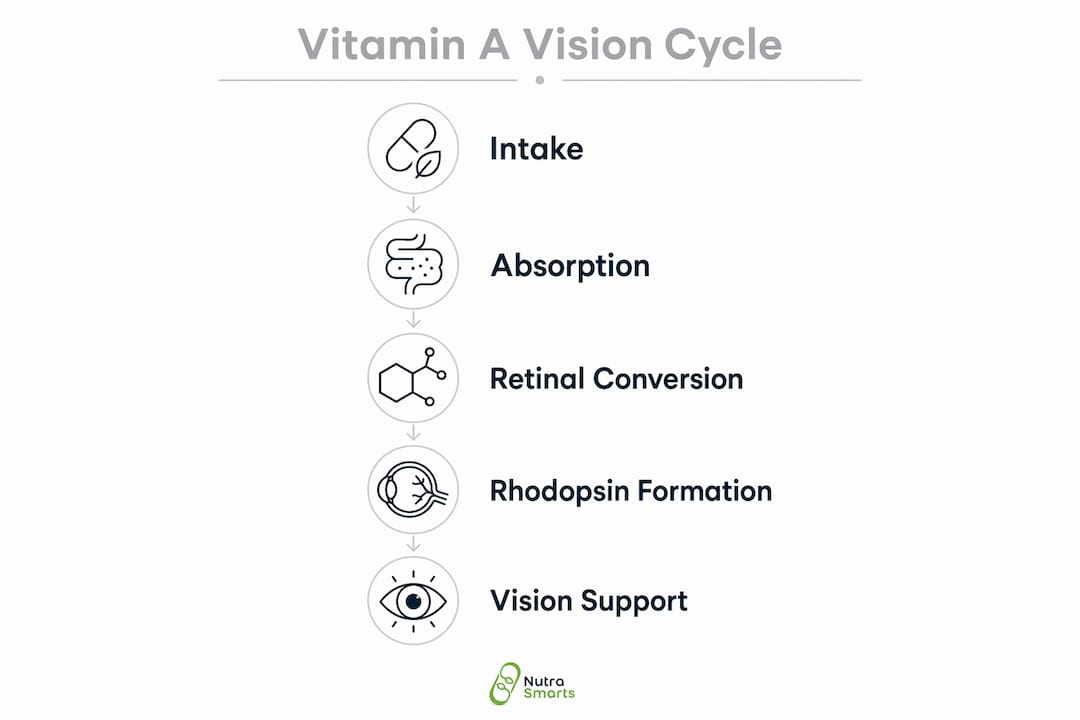
Vitamin A's core job in the eye is to produce 11-cis-retinal, a light-sensitive molecule that binds with a protein called opsin to form rhodopsin. Rhodopsin is the pigment packed into rod cells, the retinal cells responsible for seeing in low light. When light hits rhodopsin, it triggers a cascade of electrical signals that the brain reads as an image. This process is called phototransduction, and vitamin A is the raw material that keeps it running.
Rod cells cannot regenerate rhodopsin without a fresh supply of vitamin A. When levels drop, rod function degrades before cone function does. That is why night blindness, called nyctalopia, is the earliest and most recognizable sign of deficiency. Cones, which handle color and daytime vision, also rely on vitamin A derivatives, but they are less sensitive to early shortfalls.
Vitamin A also maintains the goblet cells that line the conjunctiva. These cells produce mucin, the base layer of the tear film. Without mucin, the tear film breaks down, the cornea dries out, and the eye becomes vulnerable to infection and scarring. This surface protection function is separate from the retinal visual cycle but equally important for long-term ocular health.
Pro Tip: Humans cannot synthesize vitamin A on their own. Every molecule your eyes use must come from diet as either preformed retinol from animal foods or beta-carotene from plant foods that the body converts.
| Visual cycle component | Role | Vitamin A form involved |
|---|---|---|
| 11-cis-retinal | Light-absorbing chromophore in rhodopsin | Retinaldehyde |
| Rhodopsin | Light receptor in rod cells | 11-cis-retinal + opsin |
| Phototransduction | Converts light to nerve signal | Triggered by rhodopsin activation |
| Retinal pigment epithelium | Recycles retinoids after light exposure | All-trans-retinol |
What are the signs of vitamin A deficiency vision problems?
Night blindness is the first symptom most people notice, but the eye damage that follows a prolonged deficiency is far more serious. The clinical progression moves from the retina outward to the eye's surface, affecting both the anterior and posterior segments.
Anterior segment signs include:
- Dry eye and conjunctival xerosis: The conjunctiva loses its moisture and takes on a dull, rough texture.
- Bitot's spots: Foamy, white deposits on the conjunctiva that signal keratinization of surface cells.
- Corneal ulceration: Open sores on the cornea that can lead to permanent scarring or perforation.
- Keratomalacia: Softening and melting of the cornea, the most severe anterior outcome and a direct cause of blindness.
Posterior segment involvement is less commonly discussed but clinically significant. Retinal dysfunction and optic neuropathy both occur in deficiency cases, and the symptoms can mimic inherited retinal diseases. This overlap leads to misdiagnosis when clinicians do not check serum vitamin A levels.
A 2026 study of patients with gastrointestinal and hepatobiliary disease found that the median serum vitamin A at diagnosis was 19.1 mcg/dL, well below the normal range of 38–72 mcg/dL. That gap explains why symptoms in this population are often severe by the time they are caught. The same study found that 84.6% of patients had anterior segment symptoms and 61.5% had posterior segment involvement, meaning most cases affect both parts of the eye at once.
Systemic conditions that drive deficiency include fatty liver disease, cirrhosis, Crohn's disease, and gastric bypass surgery. Each condition impairs either vitamin A absorption or storage. Patients with these diagnoses need proactive deficiency screening rather than waiting for visual symptoms to appear.
Pro Tip: Children with early night blindness rarely say "I can't see in the dark." Instead, watch for behavioral signs: fear of the dark, reluctance to move around at dusk, or bumping into objects in dim rooms.
Can vitamin A supplements improve your eyesight?
Vitamin A supplementation does not improve vision in people who already have adequate levels. The American Academy of Ophthalmology is direct on this point: supplementation is not a vision enhancement tool for well-nourished individuals. It is a corrective and preventive measure for those who are deficient or at high risk of becoming deficient.
The distinction between maintenance and therapeutic supplementation matters. For someone eating a balanced diet with regular servings of liver, dairy, eggs, and colorful vegetables, additional vitamin A supplements add no ocular benefit and carry a risk of toxicity at high doses. For someone recovering from gastric bypass surgery or managing cirrhosis, supplementation can prevent irreversible vision loss.
Therapeutic dosing for severe deficiency follows a specific protocol:
- Children older than 1 year: 200,000 International Units orally, repeated at 24 hours and again at 4 weeks.
- Infants aged 6 months to 1 year: 100,000 International Units orally on the same schedule.
- Adults with confirmed deficiency: Dosing is guided by serum retinol levels and the underlying cause of depletion.
These doses are medical interventions, not supplement regimens. Self-prescribing high-dose vitamin A without a confirmed deficiency is not safe. Preformed vitamin A from retinol accumulates in the liver and becomes toxic at sustained high intakes, causing headaches, bone pain, and liver damage.
Pro Tip: Beta-carotene from plant foods does not carry the same toxicity risk as preformed retinol. The body only converts as much beta-carotene to vitamin A as it needs, making plant sources a safer way to build reserves for most people.
What foods give you the most vitamin A for eye health?
Diet is the safest and most reliable way to maintain vitamin A levels for long-term eye health. Animal sources provide preformed retinol, which the body absorbs and uses directly. Plant sources provide provitamin A carotenoids, primarily beta-carotene, which the body converts to retinol as needed.
Best animal sources of preformed vitamin A
- Beef liver: One of the most concentrated sources of retinol available.
- Dairy products: Whole milk, cheese, and butter contain meaningful amounts of retinol.
- Eggs: Egg yolks provide retinol along with lutein and zeaxanthin, two other nutrients important for retinal health.
- Fortified foods: Many breakfast cereals and plant-based milks are fortified with retinol to help populations that eat little meat.
Best plant sources of beta-carotene
- Sweet potatoes: One of the richest plant sources of beta-carotene per serving.
- Carrots: The classic association with eye health is real, though the benefit applies to preventing deficiency, not improving vision beyond normal.
- Leafy greens: Spinach, kale, and collard greens provide beta-carotene alongside lutein.
- Cantaloupe: A practical fruit source of beta-carotene for people who eat few vegetables.
The single most overlooked factor in plant-based vitamin A intake is fat. Vitamin A is fat-soluble, meaning the body needs dietary fat present in the same meal to absorb it from plant foods. Eating a plain carrot salad with no dressing delivers far less usable beta-carotene than the same salad dressed with olive oil. This is not a minor detail. It is the difference between getting the benefit and wasting the food.
| Source type | Examples | Vitamin A form | Absorption note |
|---|---|---|---|
| Animal (preformed) | Liver, eggs, dairy | Retinol | High bioavailability, direct use |
| Plant (provitamin) | Carrots, sweet potato, kale | Beta-carotene | Requires dietary fat for absorption |
| Fortified foods | Cereals, plant milks | Retinol | Bioavailability similar to animal sources |
For people with conditions that impair fat absorption, such as inflammatory bowel disease or post-bariatric surgery, even a fat-rich meal may not guarantee adequate vitamin A uptake. These individuals need medical monitoring of their vitamin A status and may require supplementation under clinical guidance.
Key takeaways
Vitamin A supports vision through two mechanisms: powering rhodopsin production in the retina and protecting the eye's surface tissues, and deficiency in either function causes measurable, often reversible, vision loss.
| Point | Details |
|---|---|
| Rhodopsin production | Vitamin A forms 11-cis-retinal, the molecule rod cells need to detect light and enable night vision. |
| Surface protection | Vitamin A maintains goblet cells that produce the tear film's mucin layer, preventing dry eye and corneal damage. |
| Deficiency consequences | Low serum vitamin A causes night blindness, Bitot's spots, corneal ulceration, and retinal dysfunction. |
| Supplementation limits | Supplements correct deficiency but do not improve vision in people with adequate vitamin A levels. |
| Absorption requires fat | Beta-carotene from plant foods needs dietary fat in the same meal to convert to usable vitamin A. |
Nutrasmarts's take on vitamin A and eye health
The most common misconception I see is that eating carrots will sharpen your vision. Carrots support vitamin A status, and adequate vitamin A prevents deficiency-related vision loss. But if your levels are already normal, more carrots will not make your eyesight better. The benefit is real but bounded.
What concerns me more is the group of people who are quietly deficient without knowing it. Patients who have had gastric bypass surgery, people managing cirrhosis, or anyone with a chronic malabsorption condition are at genuine risk of vision-threatening deficiency. Their eye symptoms may appear years after the underlying condition develops, and by then, some damage can be permanent.
The reversibility point is worth emphasizing. When deficiency is caught early and treated with appropriate repletion, night vision and surface symptoms often improve significantly. That is a rare situation in medicine where a serious outcome is genuinely preventable with a straightforward intervention.
My practical advice: prioritize a varied diet with both animal and plant sources of vitamin A, always pair plant sources with healthy fat, and if you have any condition that affects fat absorption or liver function, ask your doctor to check your serum retinol level. Do not wait for night blindness to tell you something is wrong.
— Nutrasmarts
Nutrasmarts resources for vitamin A and eye health
Vitamin A is one of the most studied nutrients in ocular health, and understanding where you stand requires more than a general article.
Nutrasmarts maintains a database of over 800 supplement ingredients, each linked to peer-reviewed studies and clinical trial citations. The eye health supplement guide covers 24 reviewed options with evidence-based context for each. For readers managing a condition that affects nutrient absorption, the metabolic health supplement guide covers 130 reviewed products relevant to nutritional status and absorption. The vitamin and mineral deficiency resource maps symptoms to risk groups, so you can identify whether your situation warrants clinical screening before symptoms appear.
FAQ
What does vitamin A actually do for your eyes?
Vitamin A forms rhodopsin, the light-sensitive pigment in rod cells that enables night vision. It also maintains the eye's surface tissues, preventing dry eye and corneal damage.
What are the first signs of vitamin A deficiency in vision?
Night blindness is the earliest sign, followed by dry eye, Bitot's spots on the conjunctiva, and in severe cases, corneal ulceration. Children may show behavioral signs like fear of the dark before any verbal complaint.
Will taking vitamin A supplements improve my eyesight?
Vitamin A supplements do not improve vision in people with adequate levels. They correct deficiency-related vision problems, but the American Academy of Ophthalmology confirms they offer no benefit for well-nourished individuals.
Who is most at risk for vitamin A deficiency vision problems?
People with fatty liver disease, cirrhosis, Crohn's disease, or a history of gastric bypass surgery face the highest risk. These conditions impair vitamin A absorption or storage, often without obvious dietary shortfalls.
Does eating carrots really improve your vision?
Carrots provide beta-carotene, which the body converts to vitamin A. This prevents deficiency-related vision loss but does not enhance vision beyond normal levels in people who are already getting enough vitamin A.