

Coenzyme Q10, or CoQ10, gets labeled as "just an antioxidant" constantly. That framing undersells it badly. Understanding what does coenzyme Q10 do in cells reveals something far more interesting: a molecule that sits at the intersection of energy production and cellular defense, doing both jobs simultaneously. CoQ10 is present in nearly every cell, concentrated most heavily in the mitochondria, and its levels decline predictably with age and certain medications. If you take CoQ10 or are thinking about it, knowing exactly how it works inside your cells changes how you think about dosing, timing, and what to realistically expect.
Table of Contents
- Key takeaways
- What coenzyme Q10 does inside your cells
- CoQ10 as a cellular antioxidant
- How CoQ10 levels change over time
- What the research actually shows
- Practical tips for supporting cellular health
- My take on CoQ10 and what most people miss
- Explore CoQ10 and cellular health with Nutrasmarts
- FAQ
Key takeaways
| Point | Details |
|---|---|
| Dual cellular role | CoQ10 powers ATP production in mitochondria and defends cell membranes against oxidative damage at the same time. |
| Two active forms | Ubiquinone and ubiquinol are the oxidized and reduced states of CoQ10, and both are required for its full function. |
| Levels drop with age | Natural CoQ10 synthesis declines after your 20s, and statin medications accelerate that reduction further. |
| Supplementation restores, not supercharges | Research supports CoQ10 supplementation for restoring depleted levels, not for universally boosting energy in healthy people. |
| Bioavailability is the limiting factor | Raising blood CoQ10 is not the same as getting it into mitochondria. Formulation quality determines actual cellular impact. |
What coenzyme Q10 does inside your cells
The formal scientific term for CoQ10 is ubiquinone, a name that reflects its near-universal presence across human tissue. The coenzyme Q10 function in cells begins in the inner mitochondrial membrane, the site of the electron transport chain (ETC). Think of the ETC as an assembly line that converts nutrients from food into usable cellular energy in the form of ATP (adenosine triphosphate).
CoQ10's job on that assembly line is to carry electrons from one protein complex to the next. Specifically, CoQ10 transports electrons in the ETC, shuttling them from Complex I and Complex II to Complex III. Without that transfer, the chain stalls. ATP production drops. Every cell that depends on mitochondrial energy, which is essentially every cell in your body, starts underperforming.
Here is what makes CoQ10 particularly well-suited for this work:
- Lipid solubility. CoQ10 dissolves in fats, allowing it to move freely through the fatty inner mitochondrial membrane where the ETC operates.
- Redox cycling. CoQ10 cycles between ubiquinone and ubiquinol forms, accepting electrons in one state and donating them in another, which is the physical mechanism of electron transfer.
- Tissue concentration matches energy demand. Heart tissue stores approximately 114 mcg/g of CoQ10, the highest of any organ, because cardiac muscle runs continuously and cannot afford energy shortfalls.
The distinction between ubiquinone and ubiquinol matters practically too. You can read a deeper breakdown of how these two forms differ in clinical use at the ubiquinol vs CoQ10 comparison on Nutrasmarts.
CoQ10 as a cellular antioxidant
Here is where the story gets more interesting. The same electron transport process that generates ATP also produces reactive oxygen species (ROS), a byproduct of mitochondrial metabolism. Left unchecked, ROS damage proteins, lipids, and DNA. This is oxidative stress, and the mitochondria are both the primary source of it and the most vulnerable target.

CoQ10's position inside the inner mitochondrial membrane puts it exactly where oxidative stress originates. In its reduced form, ubiquinol, it donates electrons to neutralize free radicals before they cause membrane damage. This is not a coincidence of chemistry. It reflects how CoQ10's roles in energy synthesis and antioxidant protection are inseparable because the same process generates both ATP and oxidative byproducts.
The coenzyme Q10 antioxidant properties extend beyond mitochondria as well:
- CoQ10 regenerates vitamin E within cell membranes, extending that antioxidant's protective reach.
- It protects LDL cholesterol particles from oxidation in the bloodstream, a mechanism relevant to cardiovascular health.
- Studies show CoQ10 modulates lipid peroxidation markers, indicating membrane-level protection rather than just generalized free-radical scavenging.
This membrane-specific protection is what separates CoQ10 from water-soluble antioxidants like vitamin C. CoQ10 works where the damage actually starts.
Pro Tip: If you are evaluating CoQ10 for antioxidant support, look for products that specify the ubiquinol form. Ubiquinol is the reduced, electron-rich state that directly neutralizes free radicals, while ubiquinone must first be converted by the body.
How CoQ10 levels change over time
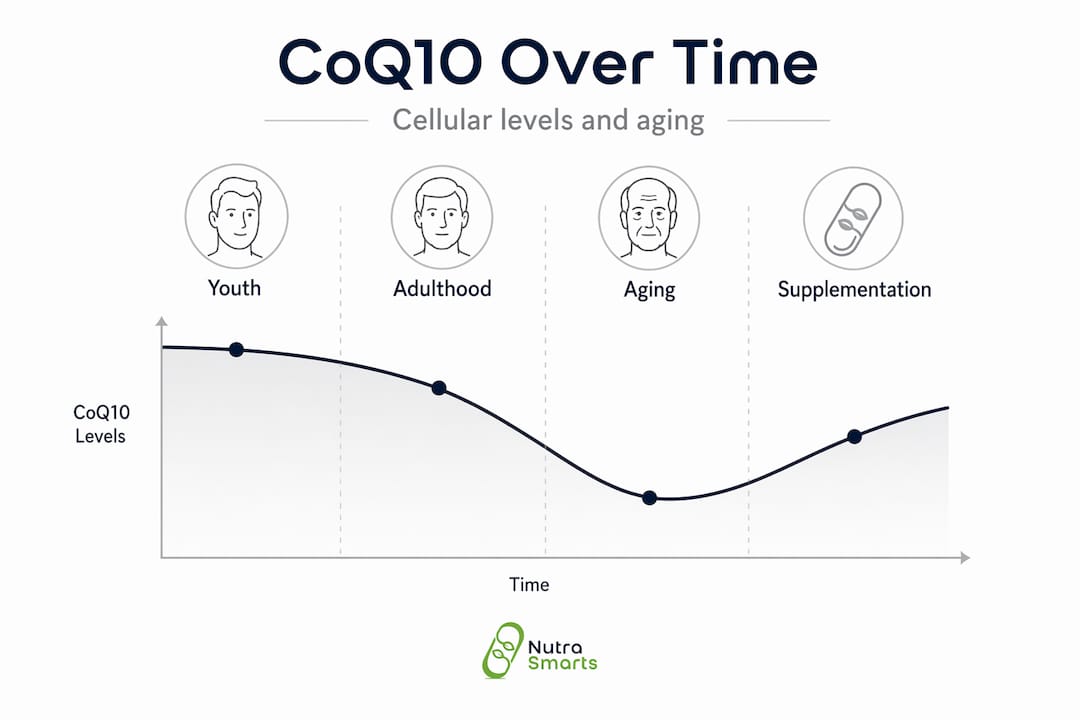
Your body synthesizes CoQ10 endogenously, meaning you produce it internally. Production peaks in your mid-20s and declines steadily after that. By the time you reach your 50s and 60s, cellular CoQ10 levels are measurably lower, which partly explains why fatigue and slower recovery become more common with age.
Several factors accelerate this decline:
- Aging. The biosynthetic pathway for CoQ10 becomes less efficient over time, reducing how much your cells can produce regardless of diet.
- Statin medications. Statins block the mevalonate pathway, which is shared by both cholesterol and CoQ10 synthesis. CoQ10 levels decrease with statin use, and this is one of the most clinically documented causes of CoQ10 depletion.
- Chronic disease. Conditions including heart failure, diabetes, and neurodegenerative disorders are associated with lower tissue CoQ10, though the causal direction is still being studied.
- Nutritional gaps. CoQ10 is found in organ meats, fatty fish, and some nuts, but dietary intake alone rarely replaces what a depleted body needs.
The practical implication is that supplementation is best viewed as restoring deficient CoQ10 in aging individuals or those on statins, not as a universal performance enhancer for people with normal levels. That framing matters for setting realistic expectations.
For a broader view of how CoQ10 fits into metabolic health support, Nutrasmarts has reviewed over 130 supplements in that category with clinical evidence attached to each.
What the research actually shows
The scientific evidence on CoQ10 supplementation is more nuanced than most supplement marketing suggests. A 2025 meta-analysis provides the clearest current picture.
| Outcome | Effect of CoQ10 supplementation | Evidence strength |
|---|---|---|
| Blood CoQ10 levels | Significant increase | Strong |
| Lipid peroxidation (MDA) | Reduced after exercise | Moderate to strong |
| Muscle damage (creatine kinase) | Reduced post-exercise | Moderate |
| VO2max / aerobic capacity | No consistent change | Weak |
| Anaerobic metabolism markers | No significant effect | Weak |
CoQ10 supplementation raises blood concentrations and reduces MDA, a well-established marker of lipid peroxidation and oxidative damage. That is a meaningful finding for anyone dealing with exercise-related cellular stress or aging-related oxidative burden.
The muscle protection data is also worth noting. Blood creatine kinase levels decline with CoQ10 supplementation, suggesting less structural muscle damage after intense physical activity. For athletes or people in physically demanding jobs, that translates to faster recovery and less soreness.
Where CoQ10 does not deliver is on raw performance metrics. Meta-analysis shows no significant change in VO2max or anaerobic capacity with supplementation. If you are hoping CoQ10 will make you faster or stronger, the evidence does not support that. If you are hoping it will protect your cells from damage and support recovery, the evidence is considerably better.
Pro Tip: Take CoQ10 with a meal that contains fat. Because it is fat-soluble, absorption increases significantly when consumed alongside dietary lipids. This single habit can meaningfully improve how much actually reaches your bloodstream.
Practical tips for supporting cellular health
Choosing a CoQ10 supplement well requires more than picking the highest milligram count on the shelf. Here is what actually matters:
- Form selection. Ubiquinol is generally better absorbed than ubiquinone, particularly in people over 40 whose conversion efficiency has declined. For younger, healthy individuals, ubiquinone is often adequate and less expensive.
- Dosage context. Most research on antioxidant and muscle protection benefits uses doses between 100 and 300 mg daily. Statin users often see recommendations at the higher end of that range.
- Formulation quality. Simply raising systemic CoQ10 does not guarantee mitochondrial uptake. Nanoparticle or liposomal delivery formats improve the odds that CoQ10 reaches the inner mitochondrial membrane where it actually functions.
- Complementary nutrients. CoQ10 works alongside other mitochondrial support compounds including alpha-lipoic acid, magnesium, and B vitamins. These nutrients support the same energy pathways and can amplify CoQ10's effectiveness.
- Avoid low-quality fillers. Many budget CoQ10 products use poor-quality excipients that reduce absorption. Look for third-party testing and transparent labeling.
For evidence-based guidance on cellular energy strategies that go beyond CoQ10 alone, the research on mitochondrial nutrition has expanded considerably in recent years.
My take on CoQ10 and what most people miss
I have spent years reviewing the research on mitochondrial nutrients, and the most consistent mistake I see is treating CoQ10 like a simple energy pill. People take it, feel nothing dramatic in two weeks, and conclude it does not work.
What I have learned is that CoQ10's value is mostly invisible in the short term. It is doing protective work at the membrane level, reducing the oxidative damage that accumulates over years. You do not feel that happening. You notice the absence of it only much later, when fatigue becomes chronic or recovery slows down noticeably.
The other thing I think gets missed is the mitochondrial targeting problem. Effective CoQ10 function depends on localization to the inner mitochondrial membrane, not just on blood levels. A cheap softgel that raises your plasma CoQ10 by 20% may not be doing much at the site that matters. Formulation genuinely changes outcomes here, and it is worth paying attention to.
My honest recommendation: if you are over 45, on a statin, or dealing with chronic fatigue, CoQ10 supplementation has a real evidence base behind it. If you are 28 and healthy, you are probably better served spending that money on sleep and resistance training. CoQ10 restores. It does not supercharge.
— NutraSmarts
Explore CoQ10 and cellular health with Nutrasmarts
Nutrasmarts is built specifically for people who want more than a label claim. The ingredient database covers over 800 compounds, each linked to peer-reviewed studies, so you can see exactly what the research says about CoQ10 dosing, forms, and interactions before you buy anything. If you are ready to find supplements matched to your specific health concerns, from fatigue and oxidative stress to cardiovascular support, the supplements by symptom tool lets you filter by clinical evidence rather than marketing copy. For those building or evaluating supplement formulations, the FDA-compliant supplement facts label creator removes the guesswork from accurate labeling. Real decisions deserve real data.
FAQ
What does CoQ10 do inside cells?
CoQ10 carries electrons through the mitochondrial electron transport chain to produce ATP, and simultaneously neutralizes free radicals generated by that same process. It functions as both an energy cofactor and a fat-soluble antioxidant within the inner mitochondrial membrane.
Does CoQ10 actually improve energy levels?
CoQ10 supports cellular energy production by enabling ATP synthesis, but research shows it does not consistently improve aerobic capacity or performance in healthy individuals. The clearest benefits appear in people with depleted CoQ10 levels due to aging or statin use.
What depletes CoQ10 in the body?
The main causes of lower CoQ10 are natural aging, statin medications that block the shared biosynthetic pathway, and certain chronic conditions including heart failure and diabetes. Diet alone rarely compensates for these losses.
What is the difference between ubiquinone and ubiquinol?
Ubiquinone is the oxidized form of CoQ10 that accepts electrons, while ubiquinol is the reduced form that donates electrons and acts as a direct antioxidant. The body converts between the two, but ubiquinol is generally better absorbed, especially in older adults.
How long does it take for CoQ10 supplementation to work?
Blood CoQ10 levels typically rise within two to four weeks of consistent supplementation. Cellular and antioxidant effects accumulate over a longer period, and protective benefits at the mitochondrial level may not produce noticeable subjective changes in the short term.