

Understanding what is supplement label audit process is something many manufacturers assume they already know. They don't. Most treat it as a final proofreading step before print, when it's actually a structured, risk-based compliance review that spans regulatory verification, claims substantiation, formulation alignment, and batch traceability. Get it wrong and you're not just facing a reprint. You're facing FDA warning letters, recalls, and the kind of reputational damage that doesn't wash off.
Table of Contents
- Key takeaways
- What the supplement label audit process actually covers
- How to audit supplement labels: a step-by-step workflow
- Verifying formulation alignment and batch documentation
- Best practices for sustained compliance and audit readiness
- My take on where supplement label audits actually break down
- How NutraSmarts supports your label compliance work
- FAQ
Key takeaways
| Point | Details |
|---|---|
| Regulatory foundation matters | Label audits must reference 21 CFR Part 101 and Part 111 to cover all required FDA labeling elements. |
| Claims carry legal obligations | Structure/function claims require a DSHEA disclaimer and a 30-day FDA notification after going to market. |
| Batch matching is non-negotiable | Label content must be verified against batch-specific Certificates of Analysis, not formula templates. |
| Version control prevents incidents | Label masters must be locked to specific SKUs and lots, with obsolete versions actively segregated. |
| Documentation is your defense | FDA does not pre-approve supplements, so manufacturers must maintain evidence of compliance at every step. |
What the supplement label audit process actually covers
The supplement label audit process, known in quality management circles as a label compliance review, is a systematic evaluation of every element on a dietary supplement label against applicable FDA regulations and internal quality standards. It is not optional, and it is not the same as graphic design approval.
The regulatory foundation sits in two places. FDA labeling requirements under 21 CFR Part 101 govern what must appear on the label and how it must be presented. Part 111 governs current Good Manufacturing Practice for dietary supplements, which includes labeling controls. Together, they define the audit scope.
A thorough dietary supplement labeling process covers these core elements:
- Supplement Facts panel: Serving size, servings per container, declared nutrients, daily values, and ingredient amounts must all be accurate and formatted correctly.
- Ingredient list: All ingredients must be listed in descending order of predominance by weight, including inactive ingredients and allergens.
- Claims language: Any structure/function claim must be truthful, substantiated, and paired with the required DSHEA disclaimer. Disease claims are prohibited without drug approval.
- Net quantity of contents: Must appear on the principal display panel in a specific location and format.
- Manufacturer information: Name, address, and contact information must be present and current.
- Warnings and contraindications: Any required safety language must appear in the correct location with the correct formatting.
The claims section deserves extra attention. Structure/function claims require a DSHEA disclaimer and a 30-day FDA notification after the product enters the market. This is a frequent enforcement focus, and many manufacturers treat the disclaimer as boilerplate when it actually needs to be audited for wording, placement, and legibility every time the label changes.
Pro Tip: Never audit claims language in isolation. Always cross-reference the claim against your substantiation file to confirm the science supports the exact wording on the label, not just the general concept.
How to audit supplement labels: a step-by-step workflow
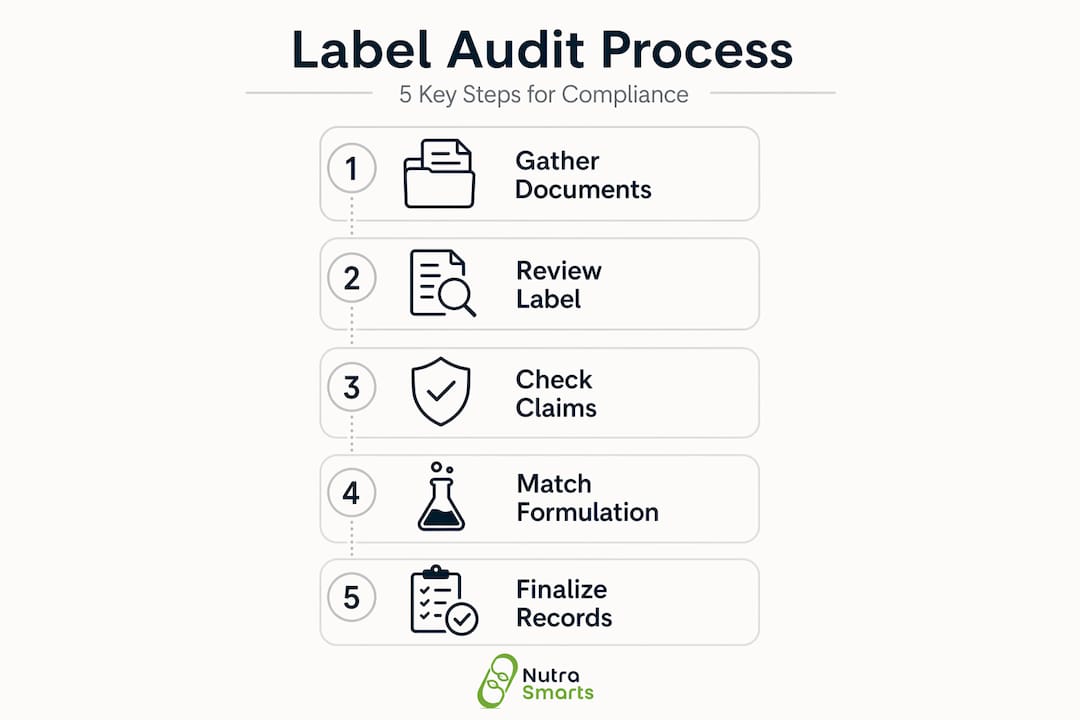
A label review process for supplements that actually protects you follows a defined sequence. Skipping steps or running them in parallel creates gaps that show up during FDA inspections.
-
Start with element verification. Pull the current approved label artwork and check every required element against the 21 CFR Part 101 checklist. Confirm the Supplement Facts panel format, font sizes, and required statements are all present and compliant.
-
Audit claims and disclaimers. For every structure/function claim, verify the DSHEA disclaimer is present, correctly worded, and positioned on the same panel. Confirm that the 30-day FDA notification was submitted and documented for each claim. This step is procedural, not just textual.
-
Cross-check against the formula master. Compare the declared ingredients and amounts in the Supplement Facts panel against the current approved formula. Any discrepancy between the label and the formula master is a critical finding.
-
Verify batch-specific documentation. Pull the Certificate of Analysis (COA) for the specific lot being labeled. Confirm that the tested values align with the label declarations. This is where most audits fail. Many teams check the formula template instead of the actual batch COA.
-
Confirm version control. Verify that the label artwork being used is the current approved version, tied to the correct SKU. Label version control requires locking label masters and artwork to specific lots, with obsolete versions actively removed from the production environment.
-
Execute line clearance and issuance controls. Before packaging begins, confirm that only the approved label version for that specific lot is present on the line. Remove any prior versions. Document the clearance.
-
Reconcile label usage. After packaging, reconcile the number of labels issued against the number used, damaged, and destroyed. Any unaccounted labels are a compliance gap.
-
Document everything. Every step generates a record. That record links the label version to the production batch, the COA, and the packaging event. This chain of documentation is what you present during an FDA inspection.
Pro Tip: Treat label issuance like a controlled substance. Every label should be numbered, tracked, and reconciled. If you can't account for every label issued to a packaging run, you don't have a compliant system.
Verifying formulation alignment and batch documentation
This is the section where most manufacturers discover their audit process has a structural flaw. The Supplement Facts panel on your label was probably built from a formula master created during product development. But the batch that actually goes into bottles was made from real raw materials that were tested and released. Those two things are not always identical.

Batch-specific COA verification requires checking identity, potency, and contaminant results against the lot number being packaged. A label that accurately reflects your formula master but not your actual batch is still a mislabeled product.
Common pitfalls that surface during nutritional label verification include:
- Outdated formula data in label artwork: When a formula is updated but the label artwork is pulled from an older template, the declared values no longer match the current product.
- Raw material substitutions not reflected on the label: A supplier change that affects ingredient identity or potency must trigger a label review before the new material is used in production.
- Finished product COA not reviewed before labeling: Some teams rely on raw material testing alone. Finished product testing can reveal potency losses, interactions, or contamination that raw material COAs don't capture.
- Lot number mismatches: The lot number on the label must correspond to the batch that was actually tested and released. This sounds obvious, but version control failures make it a real audit finding.
| Verification step | What to check | Common failure mode |
|---|---|---|
| Formula master vs. label | Declared amounts match approved formula | Label pulled from outdated template |
| Batch COA vs. label | Tested potency aligns with declared values | Only raw material COA reviewed |
| Lot number traceability | Label lot number matches batch record | Lot number applied from prior run |
| Finished product testing | Contaminants and potency within spec | Finished product testing skipped |
Because FDA does not pre-approve supplements before they reach the market, the manufacturer carries the full burden of proving compliance after the fact. Your batch documentation is your proof.
Best practices for sustained compliance and audit readiness
Passing a single audit is not the same as having a compliant labeling system. Regulatory compliance for supplements requires continuous controls, not periodic reviews.
The practices that separate consistently compliant manufacturers from reactive ones include:
- Formal change control for every label update. Any change to label content, format, or claims must pass through a documented change control workflow before the updated label is approved for use. This includes seemingly minor changes like font adjustments that affect disclaimer legibility.
- Mock audits on a defined schedule. Running internal mock audits against FDA inspection criteria at least annually exposes gaps before a real inspection does. Use the same documentation requests an investigator would make.
- Training tied to label roles. Anyone who touches label artwork, approves label content, or manages label issuance on a packaging line needs role-specific training documented in your quality system.
- Proactive regulatory monitoring. FDA guidance updates, warning letters to competitors, and changes to labeling regulations should be reviewed regularly. Supplement labeling best practices require integrating regulatory updates into your change control calendar, not waiting for an inspection to surface them.
- Hard gating at packaging. No batch should be released to packaging without a confirmed label clearance. This is a physical and documented control, not a verbal check.
Pro Tip: Review FDA warning letters issued to other supplement manufacturers every quarter. They are public, specific, and free. They tell you exactly what investigators are looking for right now.
My take on where supplement label audits actually break down
I've reviewed enough label compliance systems to know that the failures almost never happen where manufacturers expect them. The team that built a thorough 40-point label checklist still gets a 483 observation because nobody locked the label version to the lot number. The company that trained everyone on claims language still ships product with a disclaimer that's technically present but printed in a font size that fails legibility requirements.
What I've learned is that most label audits fail not from ignorance but from treating the process as a document review rather than a system control. A checklist is a tool. A compliant labeling system is a set of interlocking controls where each step creates evidence for the next.
The detail that separates manufacturers who pass inspections from those who don't is traceability. Specifically, the ability to pull any finished product lot and reconstruct exactly which label version was used, which batch it was applied to, how many labels were issued and reconciled, and what COA data supported the declarations on that label. That chain of evidence is what an auditor is actually building when they start pulling records.
The other thing I've seen consistently underestimated is the claims notification requirement. Manufacturers often file the 30-day FDA notification once and assume it covers all future label versions. It doesn't. Any material change to a structure/function claim requires a new notification. That's a compliance gap hiding in plain sight.
— NutraSmarts
How NutraSmarts supports your label compliance work
Staying current on supplement ingredients, claim substantiation, and regulatory requirements is a continuous job. Nutrasmarts was built to make that work faster and more defensible. The platform gives manufacturers and formulators access to a database of over 800 ingredients, each linked to peer-reviewed studies and clinical trial citations, so your claims substantiation files are built on real science rather than marketing copy.
When you're updating a label or evaluating a new ingredient, the supplement comparison guides at Nutrasmarts let you review ingredient profiles side by side with the clinical evidence attached. For manufacturers working across multiple product categories, the supplements by symptom catalog gives you a structured view of what the evidence actually supports for specific health targets, from joint health to cognitive function. That kind of specificity matters when your label claims need to hold up under scrutiny.
FAQ
What is the supplement label audit process?
The supplement label audit process is a structured, risk-based review of all required label elements, claims, formulation data, and batch documentation against FDA regulations under 21 CFR Part 101 and Part 111. It covers everything from Supplement Facts panel accuracy to version control and lot traceability.
How often should supplement labels be audited?
Labels should be audited any time a formula, ingredient source, or claim changes, and at minimum annually as part of a formal quality review. A change control workflow should trigger an automatic label review before any updated version is approved for production.
What makes a structure/function claim compliant on a supplement label?
A compliant structure/function claim must be truthful, substantiated, accompanied by the required DSHEA disclaimer on the same panel, and supported by a 30-day FDA notification filed after the product enters the market. The disclaimer must also meet placement and legibility requirements.
What is the biggest risk in supplement label audits?
The most common critical failure is verifying label content against a formula master rather than the actual batch COA. A label that matches the formula template but not the tested batch is still a mislabeled product under FDA standards.
Does FDA approve supplement labels before products go to market?
No. FDA does not pre-approve dietary supplement labels or products before they are sold. Manufacturers are responsible for maintaining compliance documentation and must be prepared to demonstrate it during inspections or in response to enforcement actions.