

If you've ever taken a supplement faithfully for months and felt nothing, dosage is likely the reason. Understanding why supplement dosage matters for outcomes is one of the most overlooked topics in the supplement space, yet it explains the majority of cases where people see no benefit. The gap between what clinical studies test and what ends up in consumer bottles is wide, and studies confirm this disconnect clearly. Getting dosage right means understanding dose-response relationships, bioavailability, safe limits, and formulation quality. This guide covers all of it.
Table of Contents
- Key takeaways
- Why dosage determines supplement effectiveness
- Bioavailability and why formulation changes outcomes
- Safe dosing: risks of too much and too little
- How to evaluate supplement dosage claims
- Practical tips for optimizing your dosage
- What working with supplement data taught me
- Find science-backed supplements with the right doses
- FAQ
Key takeaways
| Point | Details |
|---|---|
| Dose-response is real | Supplements only produce effects when the dose crosses a biological threshold — below it, nothing happens. |
| Formulation changes everything | Liposomal and micellar forms can increase absorption by 40% to 400% compared to standard forms. |
| More is not always better | Overdosing vitamins like D, B6, and A can cause serious harm, not extra benefit. |
| Label dose does not equal absorbed dose | Final formulated products often deliver far less bioactive compound than individual ingredient studies assume. |
| Personal factors shift the math | Age, health status, timing, and food intake all change how much of any dose actually reaches your tissues. |
Why dosage determines supplement effectiveness
The scientific term for what most people call "figuring out the right dose" is the dose-response relationship. It describes how biological effects change as dose increases. And it sits at the center of every debate about whether supplements work.
Here is the key point most people miss: clinical effects from supplements only occur once a dose crosses a specific biological threshold. Below that threshold, you may be taking something every day and experiencing zero measurable benefit. Consumer products frequently miss these thresholds, which is why your experience of "this didn't work" is often a dosing problem rather than a problem with the ingredient itself.
Dose-response curves are also not always linear. For some nutrients, doubling the dose does not double the effect. Vitamin C absorption is a classic example: the body absorbs smaller doses more efficiently and excretes excess amounts. For fat-soluble nutrients like vitamin D and vitamin A, the curve flattens and then reverses. At a certain point, more dose means more toxicity, not more benefit.
A few concrete cases where under-dosing consistently fails to produce results:
- Magnesium: Many sleep and stress products contain magnesium oxide, which has notoriously poor absorption. Even at 300 mg labeled dose, the amount reaching the bloodstream can be negligible compared to magnesium glycinate at the same label amount.
- Curcumin: Raw curcumin from turmeric powder has very poor bioavailability. Studies using standardized curcumin with piperine use doses that most "turmeric capsule" products never get close to delivering in usable form.
- Berberine: Standard oral berberine has low and variable absorption, which is precisely why formulation innovations matter so much for this ingredient.
Pro Tip: Before assuming a supplement "doesn't work for you," check whether the product dose actually matches the dose used in the clinical studies for that specific ingredient. Nutrasmarts links each of its 800+ ingredients directly to peer-reviewed citations so you can make that comparison in minutes.
Bioavailability and why formulation changes outcomes
Labeled dose and absorbed dose are two completely different things. Bioavailability refers to the fraction of an administered substance that actually reaches systemic circulation in an active form. Two products can share an identical label dose but deliver wildly different amounts of active compound to your tissues, depending entirely on formulation.
Liposomal and micellar delivery systems are the clearest examples. Liposomal berberine increases plasma concentration (Cmax) by 70% and overall systemic exposure (AUC) by 43% compared to the unformulated version of the same ingredient. That means two products at 500 mg labeled dose are genuinely not the same product from a physiology standpoint. For a deeper look at how these delivery mechanisms work, bioavailability and absorption is worth understanding before you buy.

Glutathione is an even more dramatic case. Standard oral glutathione has notoriously poor absorption because the gut breaks it down before it reaches the bloodstream. Micellar glutathione formulations show up to four times higher systemic exposure than standard forms at the same labeled dose. That is not a marginal difference.
Here is a quick reference for how formulation type and nutrient solubility interact:
| Nutrient type | Standard form absorption | Enhanced formulation | Absorption increase |
|---|---|---|---|
| Berberine | Low (variable) | Liposomal | ~40-70% higher Cmax |
| Glutathione | Very low | Micellar | Up to 400% higher AUC |
| Curcumin | Very low | Phospholipid complex | Up to 29x higher in some studies |
| Vitamin D | Moderate | Oil-based softgel | Significantly better vs. powder |
| Magnesium | Varies by salt | Glycinate/malate | Higher bioavailability than oxide |
Timing and food intake add another layer. Fat-soluble vitamins (A, D, E, K) absorb significantly better when taken with a fat-containing meal. Water-soluble vitamins like B12 and C can be taken on an empty stomach without major impact on absorption. Splitting a large dose across the day also improves total absorption for many nutrients, because the gut's transport capacity is saturable.
Pro Tip: Always check a supplement's delivery form, not just the ingredient name. If your product says "berberine HCl" with no mention of enhanced delivery, you are likely getting a fraction of what the studies tested. Nutrasmarts ingredient research flags formulation quality as part of every review.
Safe dosing: risks of too much and too little
The Recommended Dietary Allowance (RDA) represents the amount needed to meet basic nutritional requirements for most healthy people. It is not a therapeutic target. Safe upper limits, set by the National Institutes of Health, are the thresholds beyond which harm becomes a credible risk.
Vitamin D illustrates both sides of this problem clearly. The RDA is 15 mcg (600 IU) for adults under 70 and 20 mcg (800 IU) for those over 70. But doses above 100 mcg (4,000 IU) carry increased health risks for most adults without medical supervision. The problem is compounded by the fact that vitamin D is fat-soluble. Excess vitamin D accumulates in tissue rather than being excreted in urine like water-soluble vitamins, so toxic levels build slowly and are easy to miss. Worse, doses of 2,000 to 4,000 IU increase fall risk in older adults compared to more moderate doses of 250 to 1,000 IU. More vitamin D did not mean stronger bones or better balance. It made things worse.
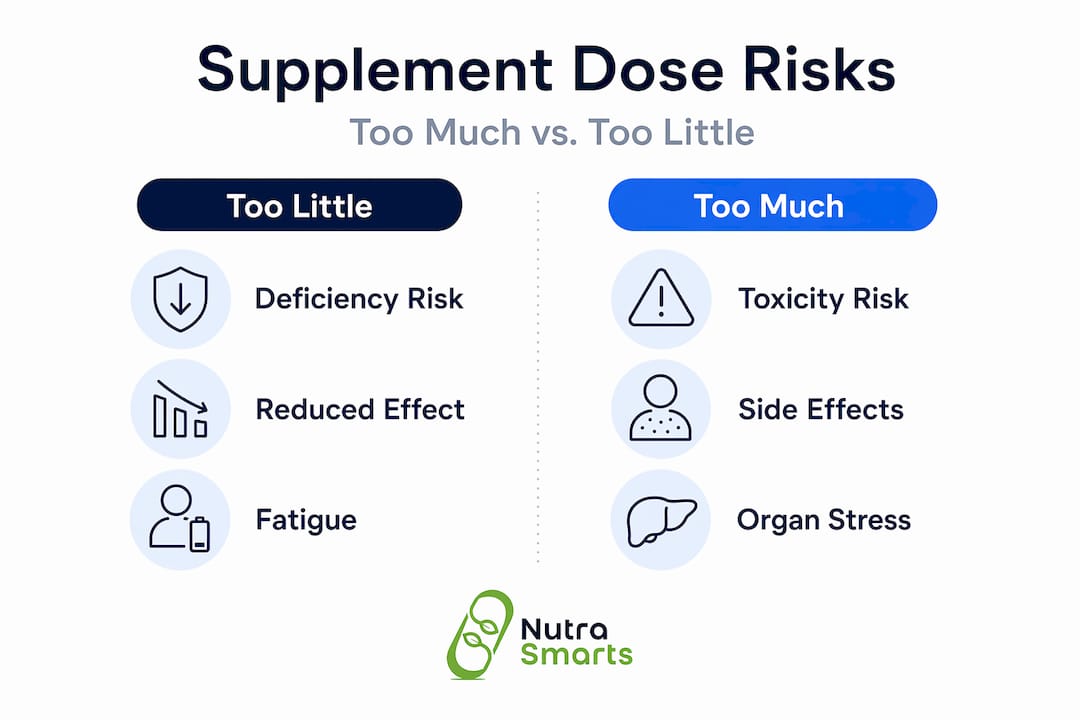
Vitamin D is not an isolated case. High-dose vitamin B6 can cause nerve damage, excessive omega-3 supplementation may trigger irregular heart rhythm, and excess vitamin A accumulates in the liver and causes toxicity over time. None of these outcomes show up immediately, which is part of what makes overdosing deceptive.
Key personal factors that shift your safe and optimal dosing range:
- Age: Older adults have different absorption rates, lower kidney clearance, and often higher baseline deficiency risk. Nutrasmarts has detailed breakdowns on dosing by age group for common nutrients.
- Existing deficiency: Someone with a clinically confirmed deficiency may need therapeutic doses that exceed standard recommendations, under medical guidance.
- Health conditions: Kidney disease, liver conditions, and certain gastrointestinal disorders all change how the body handles concentrated supplement doses.
- Current medications: Supplements can interact with drugs in ways that amplify or reduce the effective dose of both. Therapeutic dosing should always involve professional guidance.
If you want to understand where your personal risk sits, reviewing common vitamin and mineral deficiency risks by nutrient is a solid starting point.
How to evaluate supplement dosage claims
Knowing that dosage matters is half the battle. The other half is knowing how to read a product label and judge whether the doses inside actually match what research supports. Here is a practical process:
- Identify the key active ingredient and look up the dose used in the most cited clinical study for that ingredient. If a magnesium product uses magnesium oxide at 150 mg, compare that to the glycinate doses used in sleep research.
- Check for proprietary blends, which list all ingredients in one combined total dose. You cannot tell whether any individual ingredient meets its effective threshold inside a blend. This is one of the most common ways to deliver a technically accurate label with functionally sub-therapeutic doses.
- Look for the formulation type. "Vitamin C 1,000 mg" and "liposomal vitamin C 1,000 mg" are not equivalent. The delivery mechanism changes what reaches your bloodstream.
- Verify that study evidence applies to the final product. Studies on raw ingredients do not automatically translate to finished products with fillers, binders, and different particle sizes. Look for companies that have tested their actual formulated product.
- Use a comparison tool. Side-by-side reviews that include dosing information make this process much faster. Nutrasmarts' supplement comparison tool puts dose, formulation, and evidence side by side across reviewed products.
A note on multi-ingredient products: per-ingredient dosing review is non-negotiable. Multi-ingredient supplements can contain sub-therapeutic amounts of individual components even when the total blend looks substantial. Always verify each ingredient separately.
Practical tips for optimizing your dosage
Getting the most from your supplements does not require a degree in pharmacology. A few consistent habits make a real difference.
- Start at the lower end of the studied range and adjust based on your response over four to six weeks. This is especially relevant for compounds like melatonin, where more is frequently worse for sleep quality, not better.
- Split doses for better absorption. Timing and dose splitting improve outcomes and reduce the risk of side effects, particularly for magnesium and B vitamins.
- Track measurable markers. If you are taking vitamin D, measure your serum 25(OH)D level at baseline and after 90 days. Subjective feelings are not always reliable, but numbers do not lie.
- Pair nutrients that enhance each other. Vitamin D absorbs better with vitamin K2 and magnesium. Zinc and copper compete for absorption, so high zinc supplementation requires proportional copper intake to avoid imbalance.
- Consult a healthcare provider before high-dose or therapeutic supplementation. This is particularly important if you have any diagnosed health conditions or take prescription medications. Higher doses don't guarantee better results and can backfire without individualized guidance.
What working with supplement data taught me
I've reviewed hundreds of ingredients and seen the same pattern repeat itself constantly. Someone spends money on a supplement for three months, notices nothing, and concludes the ingredient is useless. Almost every time, the actual problem is that the product either missed the effective dose threshold or used a formulation that was never going to deliver meaningful bioavailability in the first place.
The myth that higher doses equal better outcomes is genuinely dangerous, not just wasteful. I've seen people self-prescribing vitamin D at 10,000 IU daily because they read one article about deficiency, without ever testing their baseline levels. That approach doesn't build health. It creates a different problem.
What I've learned from tracking clinical evidence against real product formulations is that quality and targeted dose matter more than quantity. A well-formulated product at the right dose, taken consistently with appropriate timing, outperforms a high-dose cheap product taken randomly in most evidence-based assessments.
My honest recommendation: treat your supplement approach the way you would treat any other health decision. Match doses to research, verify formulations, track your response, and adjust based on what you actually observe. That is what separates people who get results from supplements and people who don't.
— Nutrasmarts
Find science-backed supplements with the right doses
When dosage precision matters, you need resources that go beyond generic label claims.
Nutrasmarts reviews over 800 supplement ingredients and links each to peer-reviewed clinical evidence, so you can immediately compare the dose in any product against what studies actually tested. Whether you are focused on metabolic health supplements with clinically studied dosing or you need to browse supplements by symptom for a specific health concern, every recommendation on Nutrasmarts is built on the same foundation: what the research actually supports at what dose. Stop guessing and start making choices grounded in real evidence.
FAQ
What is a dose-response relationship in supplements?
A dose-response relationship describes how the effect of a supplement changes as the dose increases. Most supplements only produce measurable benefits once they cross a specific biological threshold dose.
Why doesn't a higher supplement dose always mean better results?
Many nutrients have a plateau or even a reversal point where excess dose causes harm rather than additional benefit. Fat-soluble vitamins like D and A accumulate in tissue and can reach toxic levels, while overdosing B6 or omega-3 can cause nerve damage or heart rhythm irregularities.
How does bioavailability affect supplement dosage?
Bioavailability determines how much of a labeled dose actually reaches your bloodstream. Formulation type has a dramatic effect. Liposomal berberine delivers 43% greater systemic exposure than standard berberine at the same labeled dose.
How do I know if a supplement product is properly dosed?
Compare the dose on the label against the dose used in peer-reviewed clinical studies for that specific ingredient and formulation type. Watch for proprietary blends that may hide sub-therapeutic per-ingredient amounts.
Should I consult a doctor before adjusting supplement doses?
Yes, particularly for fat-soluble vitamins, therapeutic doses above RDA levels, or any supplement taken alongside prescription medications. Personalized therapeutic dosing requires professional oversight to maximize benefit and avoid harm.