
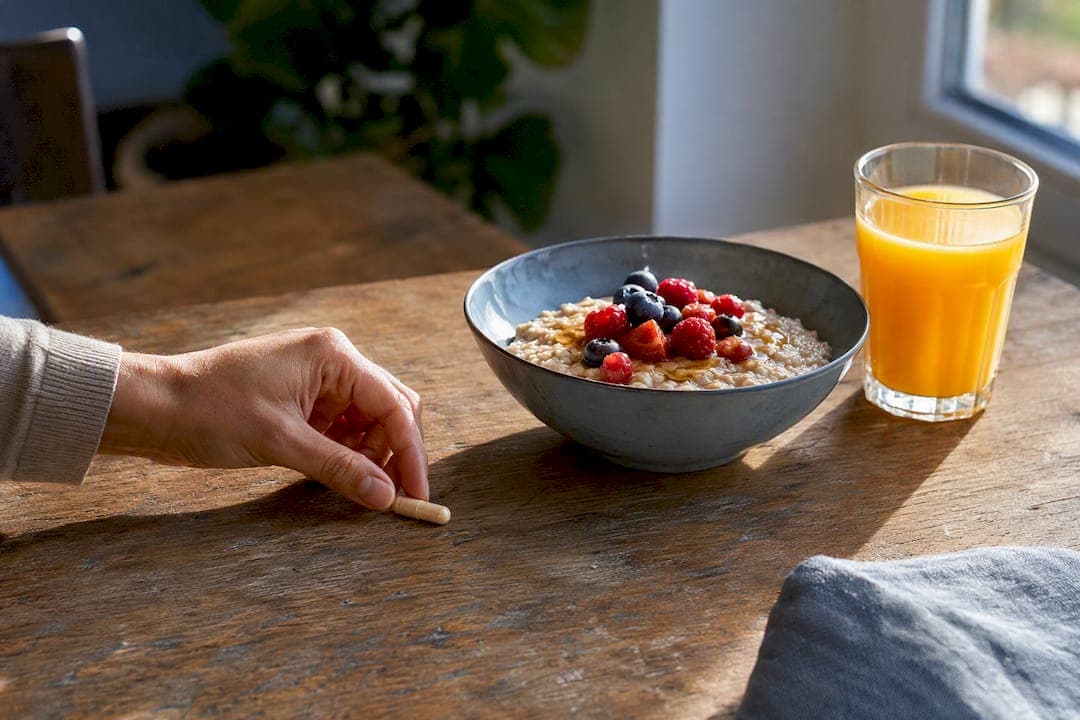
For most adults using berberine to support blood sugar and weight management, the practical starting point is 500 mg with breakfast and 500 mg with dinner, totaling a moderate amount per day, increasing the dose if you tolerate it and still need more effect. This mirrors what most clinical summaries recommend: split dosing taken with or just before meals, since higher single doses raise the odds of stomach upset without adding benefit.
The caveat matters as much as the number. Berberine lowers blood sugar through a mechanism that can stack with prescription diabetes medications, so anyone on metformin, insulin, or a sulfonylurea needs a doctor's input before starting, along with routine glucose monitoring.
The evidence backing this comes from real trial protocols, not guesswork:
- The foundational 2008 trial by Yin et al. dosed subjects at 500 mg three times daily for roughly 13 weeks.
- Most trials tracking berberine's effect on blood sugar ran between 8 and 13 weeks before measuring results.
- HbA1c, the standard marker for long-term blood sugar control, is the endpoint clinicians typically recheck every three months when monitoring effect.
The dose that shows up again and again in clinical research isn't arbitrary. It's 500 mg, taken with food, multiple times a day, for at least two months before you judge whether it's working.
Key Takeaways
Berberine works best at 500 mg taken two or three times daily with meals, following the same 8 to 13 week trial windows and lab monitoring the original research used.
| Point | Details |
|---|---|
| Standard dose range | 1,000 to 1,500 mg per day, usually split into two or three 500 mg servings. |
| Trial-proven schedule | 500 mg three times daily at meals for about 13 weeks is the most cited clinical protocol. |
| Meal timing rule | Take with or 15 to 30 minutes before eating to reduce GI upset and target post-meal glucose spikes. |
| Watch for interactions | Berberine can amplify glucose-lowering drugs; confirm with a doctor before combining. |
| Verify before you buy | Check dosing and third-party testing claims on the Nutrasmarts berberine page before choosing a product. |
Table of Contents
- How Much Berberine Should You Take and When?
- What Do Clinical Trials Show About Berberine Dosing?
- Why Meal Timing Affects How Berberine Works
- Who Should Be Careful With Berberine, and What Are the Risks?
- How to Start Berberine Safely and Track Results
- When Should You Take Berberine for Best Results?
- Should You Split Berberine Doses Evenly Through the Day?
- Before, During, or After Meals: Does Timing Change Effectiveness?
- Check Your Berberine Product Before You Start Dosing
- Sources
How Much Berberine Should You Take and When?
The dose range with the most consistent backing is 1,000 to 1,500 mg per day, almost always divided across two or three servings of about 500 mg each. Some trials pushed as high as 2,000 mg daily, but Cleveland Clinic's guidance notes that higher totals come with a real tradeoff: more digestive side effects, not necessarily more benefit.
Two dosing patterns dominate real-world use, and each fits a different lifestyle.
- Three times daily: This is the trial-proven pattern, dosed at the start of breakfast, lunch, and dinner. It's the gold standard because it's what the research actually tested.
- Twice daily: A pragmatic alternative when a midday dose isn't realistic, whether you're at work, skip lunch, or eat on an irregular schedule.
Here's the tradeoff most people miss: berberine's half-life runs about 4 to 5 hours, which means a twice-daily schedule leaves a real gap in coverage during the middle of the day. That's not disqualifying. It's just a tradeoff between convenience and consistency. If your main goal is blunting the glucose spike after your biggest meal, timing that dose around your largest carbohydrate load may matter more than hitting three doses on the clock.
Pro Tip: If you only eat two meals a day, don't try to force a third dose in. Match your berberine schedule to your actual eating pattern rather than a generic three-times-daily rule that assumes three meals.
For most adults starting out, 500 mg twice daily is the sensible entry point. Three-times-daily dosing is worth adding only once you know how your gut tolerates the ingredient, and only if you're not seeing the glucose response you want at the lower total.
What Do Clinical Trials Show About Berberine Dosing?
The trial that most modern berberine dosing recommendations trace back to used a straightforward protocol: 500 mg three times daily, taken at the start of major meals, for about 13 weeks. Researchers tracked fasting glucose, postprandial (after-meal) glucose, HbA1c, and lipid markers, and this is the regimen most later studies and clinical guidance echo.
| Trial Detail | Value |
|---|---|
| Dose | 500 mg, three times daily |
| Timing | At the start of each major meal |
| Duration | Approximately 13 weeks |
| Primary endpoints | HbA1c, fasting glucose, postprandial glucose, lipids |
| GI adverse events | Roughly 34.5% of participants |
That side effect rate is worth sitting with. Roughly one in three participants experienced gastrointestinal symptoms significant enough to note. Researchers managed this the same way you should: by dropping the dose.
- When GI symptoms became disruptive, investigators reduced dosing to 300 mg three times daily.
- Symptoms typically eased once the dose came down, without abandoning the regimen entirely.
- This dose-reduction pattern shows up across multiple trials, not just one isolated study.
The takeaway isn't that berberine is harsh. It's that the dose curve has a ceiling for a meaningful share of users, and clinical protocols already built in the fix.
Why Meal Timing Affects How Berberine Works
Berberine has notably low oral bioavailability. Most of an oral dose never reaches high concentrations in your bloodstream. Instead, pharmacokinetic research shows it distributes widely across tissues while plasma levels stay low, with a large share metabolized or excreted through bile and feces rather than absorbed intact.
That low bioavailability, paired with a roughly 4 to 5 hour half-life, is exactly why timing isn't cosmetic. A dose taken well before a meal has often started clearing before your blood sugar even rises. A dose taken with or just before food lines up peak gut-level activity with the window when postprandial glucose is climbing, which is also when GI tissue exposure is highest and stomach tolerance tends to be best.
Pro Tip: Think of berberine less like a pill that circulates through your bloodstream all day and more like a local intervention at the gut level, timed to meet your meal head-on.
Who Should Be Careful With Berberine, and What Are the Risks?
The most common side effects are digestive: nausea, diarrhea, gas, and abdominal cramping. In the landmark 13-week trial, these GI events affected about 34.5% of participants, and most cases eased within the first few weeks or resolved once researchers cut the dose to 300 mg three times daily.
The bigger concern for most readers is drug interactions, not stomach upset.
- Berberine can amplify the effect of prescription glucose-lowering medications like metformin or insulin, raising real hypoglycemia risk if doses aren't adjusted.
- It also interacts with drugs metabolized by liver enzymes, which affects how quickly certain medications clear your system.
- Some clinicians recommend spacing berberine roughly two hours apart from other oral medications if your provider advises it, to limit absorption interference.
- Long-term safety data beyond a few months of continuous use remains limited.
If you're on any prescription medication for blood sugar or metabolized through your liver, talk to your doctor before adding berberine, not after you notice symptoms.
None of this means avoid berberine. It means treat it the way you'd treat any compound with a real, measurable effect on blood glucose: with a monitoring plan, not blind trust in a supplement label.
How to Start Berberine Safely and Track Results
A rushed start is where most of the GI complaints come from. A gradual ramp gives your gut time to adjust and gives you a clean read on whether the supplement is actually helping.
- Get baseline labs first. Fasting glucose and HbA1c before you start give you something real to compare against later.
- Start with 500 mg once daily for several days, ideally with your largest meal.
- Move to 500 mg twice daily (breakfast and dinner) for about a week if you tolerate the first step.
- Add a third 500 mg dose at lunch only if you're tolerating twice-daily dosing well and want the full trial-proven regimen.
- Recheck fasting glucose at 4 to 8 weeks to catch early signals.
- Recheck HbA1c around 8 to 12 weeks, since this marker reflects longer-term blood sugar control and is the standard recheck interval clinicians use for glycemic supplements.
- Reduce your dose if GI symptoms persist, and stop and call your doctor if you notice symptoms of low blood sugar, like shakiness, dizziness, or unusual fatigue.
This isn't a lifetime commitment made on day one. For broader strategies on metabolic health and longevity, explore this free ebook on longevity and metabolic health. It's a measured trial with checkpoints built in.
When Should You Take Berberine for Best Results?
Take it with or within 15 to 30 minutes before the first bites of a meal. This single rule does double duty: it reduces the stomach irritation berberine can cause on an empty stomach, and it aligns the compound's activity with the moment your blood sugar starts climbing after eating.
If you're doing time-restricted eating or only eat within a compressed window, dose during that window rather than trying to squeeze in an extra dose outside it. Don't take a single large dose right before bed to "catch up" on a missed dose. A big nightly dose concentrates GI exposure at the one time of day you're not eating to buffer it, which is the fastest way to trigger cramping or diarrhea.
Most supplements come in 500 mg capsules, which is a convenient unit for meal-based dosing. Whether you buy a product with third-party testing matters here more than usual, since supplement quality and label accuracy vary significantly across brands, and a mislabeled dose undermines the whole timing strategy you're trying to follow.
Should You Split Berberine Doses Evenly Through the Day?
Yes, and the reasoning comes straight from berberine's pharmacokinetics. With a half-life around 4 to 5 hours and low overall bioavailability, a single large daily dose creates a spike-and-crash pattern: high local exposure right after dosing, then a long stretch with minimal coverage. Splitting the same total dose into two or three servings keeps exposure more level across your waking hours.
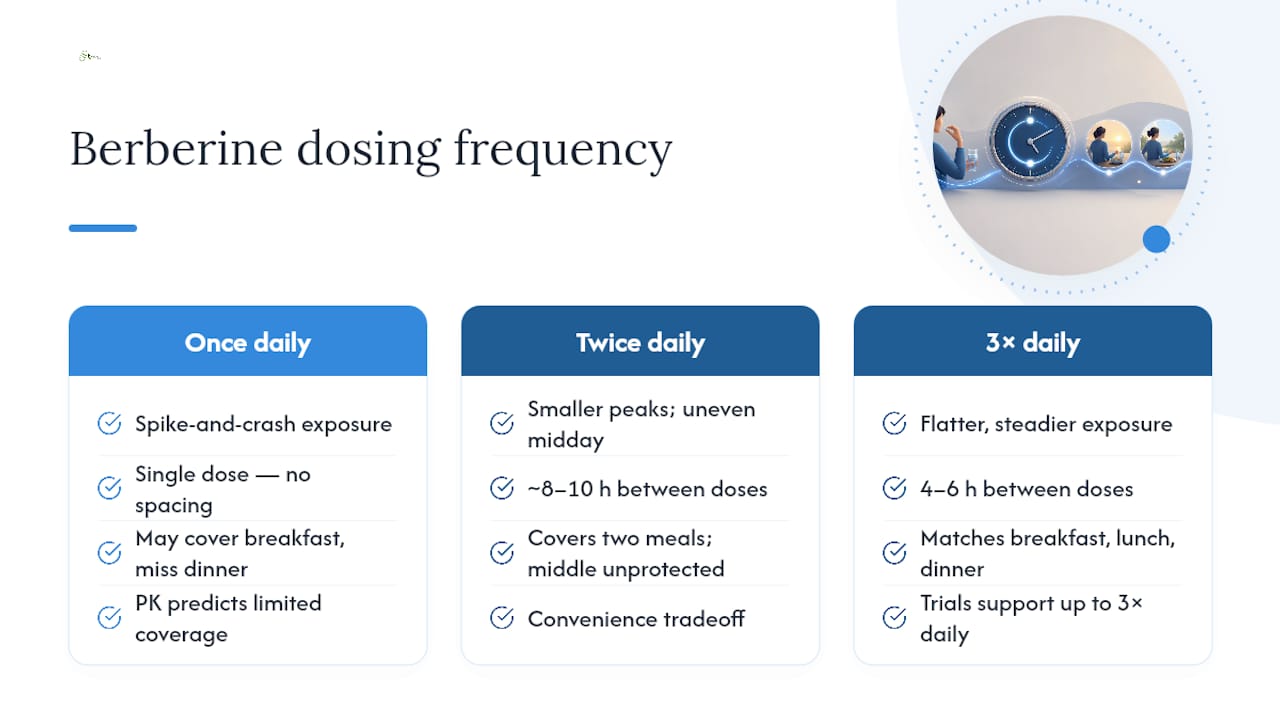
Evenly spaced dosing also means you're meeting more of your actual meals with active berberine on board, rather than covering breakfast well and leaving dinner unprotected. If you're on the three-times-daily protocol, spacing doses roughly 4 to 6 hours apart, ideally right at breakfast, lunch, and dinner, keeps each dose working close to when the next meal's glucose load hits.
For the two-dose approach, the gap between breakfast and dinner is inevitably longer than ideal, often 8 to 10 hours. That's the honest tradeoff of convenience dosing. You can partly offset it by making sure your largest, highest-carbohydrate meal falls closer to one of your two doses rather than in the unprotected middle stretch. If lunch tends to be your biggest meal, that's a reason to push toward the three-dose schedule instead of defaulting to twice daily out of habit.
There's no evidence that microdosing berberine more than three times a day adds meaningful benefit. The research base tops out at three doses daily, and stacking more frequent, smaller amounts hasn't been tested in the trials this guidance is built on.
Before, During, or After Meals: Does Timing Change Effectiveness?
The consistent guidance across clinical sources is to take berberine with or shortly before eating, generally within that 15 to 30 minute window. Taking it well before a meal, an hour or more ahead, means blood levels may already be declining by the time food arrives and glucose starts rising. Taking it well after a meal misses the window where blunting the postprandial spike actually matters.
"With" versus "just before" is a smaller distinction than people assume, and both work reasonably well in practice. What doesn't work well is taking berberine on a fully empty stomach far from any meal. Verywell Health's rundown of timing consensus points to the same pattern: pairing the dose with food serves two purposes at once, cutting GI irritation and syncing the compound's activity with your blood sugar curve.
If you're choosing between "right before" and "with the first bites," let your gut tolerance decide. Some people do better taking it a few minutes before eating so it's already moving through the stomach when food arrives. Others find taking it with the first forkful causes less nausea. Neither is wrong. What matters far more than the exact minute is consistency: picking a pattern relative to your meals and sticking with it long enough (that 8 to 13 week window trials used) to actually judge whether it's working.
A Straightforward Take on Berberine Dosing
Nutrasmarts recommends sticking close to what the trials actually tested: 500 mg with meals, two or three times daily, with lab monitoring rather than guesswork. Supplements aren't FDA-regulated for potency, so product quality varies more than most labels admit.
Check Your Berberine Product Before You Start Dosing
Knowing the right dose and timing only helps if the capsule in your hand actually contains what the label claims. That's the gap most berberine guides skip entirely.
Nutrasmarts built its berberine ingredient page specifically to close that gap: a consolidated evidence summary with the same trial citations referenced here, so you can verify dosing claims against the actual research instead of a marketing page. If you're shopping for a product, the Best Metabolic Health Supplements collection narrows the field to options that have been reviewed rather than guessed at. And if you're formulating a product yourself or comparing labels side by side, the free Supplement Facts label creator generates FDA-compliant labels without the spreadsheet headache. Start by pulling up the berberine ingredient page and checking your current product's dose against what the 13-week trials actually used.
Sources
- Cleveland Clinic — Berberine
- Efficacy of Berberine in Patients with Type 2 Diabetes - PMC
- YourHealthier — Best time to take berberine (2-dose protocol)
This article is general information, not a substitute for advice from a qualified doctor. Consult a qualified healthcare professional about your own circumstances before acting on anything here.