

Supplement quality is defined by the gap between what a label claims and what a product actually delivers. That gap exists because the FDA does not require pre-market approval for dietary supplements the way it does for prescription drugs. The result is a market where brands set their own standards, and those standards vary dramatically. Understanding why supplement quality varies brands is the first step toward making choices that actually support your health. The three root causes are inconsistent third-party testing, uneven manufacturing controls, and labeling that obscures more than it reveals.
Why does supplement quality vary so much across brands?
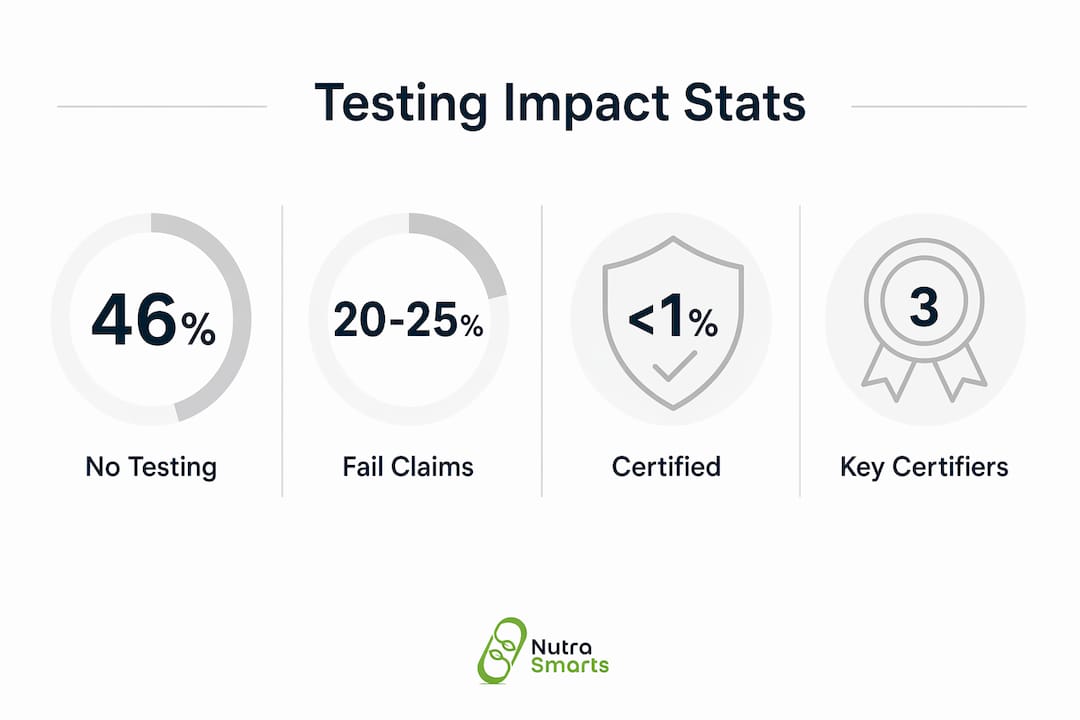
About 46% of 7,882 supplement brands analyzed in 2026 had no verified third-party testing. That means nearly half the brands on store shelves have never had an independent lab confirm that their products contain what the label says. The industry term for this problem is "quality assurance variability," and it shows up in every tier of the market, from budget bottles to premium labels.
Independent testing makes the problem concrete. 20–25% of supplements fail to meet their own label claims when tested by outside labs. Nutrient levels in failing products range from completely absent to more than 800% of the declared daily value. Both extremes are dangerous. Too little means you get no benefit. Too much can cause toxicity.

The core issue is structural. Supplement brands are not required to prove safety or efficacy before selling a product. They only face consequences after a problem surfaces. That regulatory gap is why brand choice matters so much, and why you cannot rely on a product being on a store shelf as proof that it works.
How third-party testing and certifications impact supplement quality
Third-party testing is the single most reliable signal of supplement quality. Organizations like NSF International, USP (United States Pharmacopeia), and Informed Sport independently verify that a product contains what the label claims, at the stated dose, without dangerous contaminants. Each organization uses different testing protocols, so their certifications are not interchangeable.
The numbers reveal how rare real verification is. Out of 7,882 brands analyzed, only 10 had USP verification and 75 had NSF Certified for Sport status. That is less than 1% of brands holding the most credible certifications. The scarcity of these marks is not because they are hard to find. It is because earning them requires investment, transparency, and consistent quality that many brands cannot or will not provide.
What third-party certification actually covers:
- Label accuracy: Confirms the stated ingredients and doses are present.
- Contaminant screening: Tests for heavy metals, pesticides, and microbes.
- Banned substance testing: Relevant for athletes using Informed Sport certified products.
- Disintegration standards: Verifies that tablets break down properly for absorption.
Pro Tip: Look for the certification seal directly on the product label, then verify it on the certifying organization's website. Counterfeit seals exist. NSF, USP, and Informed Sport all maintain public databases of certified products.
You can learn more about why third-party testing matters and what each certification actually covers before you buy.
How manufacturing practices affect product consistency and safety
Current Good Manufacturing Practices, known as cGMP, are FDA regulations that govern how supplements are produced. Every legal supplement manufacturer must follow them. The catch is that cGMP certification guarantees process adherence but not the potency or purity of the final product. A facility can follow every procedural step correctly and still produce a supplement that fails label claims.
The distinction matters because cGMP governs how a product is made, not what comes out. A manufacturer can set internal quality thresholds well below what a consumer would consider acceptable and still be fully cGMP compliant. Quality culture, the internal commitment to accuracy and safety beyond the minimum, is invisible from the outside without third-party testing.
Contract manufacturing adds another layer of risk. Many brands do not own their own facilities. They hire contract manufacturers who produce supplements for dozens of brands simultaneously. Batch variability is a real consequence. Final batch testing alone is insufficient because one clean sample from a drum does not guarantee the entire shipment meets the same standard. Reputable brands implement quality controls at every stage of ingredient sourcing and production, not just at the end.
Key manufacturing red flags to watch for:
- No disclosure of manufacturing location or facility certifications.
- No mention of in-house or third-party quality testing on the brand's website.
- Vague claims like "pharmaceutical grade" with no supporting documentation.
Pro Tip: "Made in the USA" is a marketing phrase, not a quality guarantee. The FDA does not pre-approve supplements regardless of where they are manufactured. A label claiming "FDA Approved" for a dietary supplement is factually incorrect. No supplement carries FDA approval.
How ingredient sourcing and labeling transparency affect effectiveness
The form of an ingredient determines how well your body absorbs it. Magnesium glycinate and magnesium oxide both appear on labels as "magnesium," but their bioavailability differs significantly. The same principle applies to B vitamins, iron, zinc, and dozens of other nutrients. Two products with identical label claims can produce completely different results in your body because the underlying ingredient form is different.
Front labels are where the confusion gets expensive. A turmeric supplement might advertise "1,500mg turmeric" in large print. The Supplement Facts panel reveals the active dose is 150mg of curcuminoids, the compound that actually drives the clinical benefit. The front label is technically accurate. It is also deliberately misleading. Consumers who do not read the Supplement Facts panel pay for a dose that sounds ten times larger than what they are actually getting.
Proprietary blends make this worse. A proprietary blend lists multiple ingredients under a single combined weight. You see the total, not the individual amounts. Brands use this format to protect formulas from copying, which is a legitimate reason. The problem is that it also hides whether any single ingredient reaches a clinically effective dose.
| Label Element | What It Shows | What It Can Hide |
|---|---|---|
| Front label weight | Total compound weight | Active ingredient fraction |
| Proprietary blend | Combined ingredient weight | Individual ingredient doses |
| Supplement Facts panel | Listed ingredients and amounts | Ingredient form and bioavailability |
| Serving size | Dose per serving | Number of servings needed for effect |
Full ingredient label transparency means every ingredient is listed individually with its specific form and dose. That is the standard worth holding brands to.
Does price predict supplement quality?
Price is a poor predictor of supplement quality. Analysis of supplement brands shows consistent misalignment between price and quality scores. Budget brands sometimes carry high certifications. Premium brands sometimes lack any independent verification. The price on the label reflects marketing spend, packaging, and distribution costs as much as it reflects what is inside the bottle.
Marketing claims deserve the same skepticism. Nutrition expert Emily Collins recommends ignoring "FDA Approved" claims entirely and focusing on labels verified by credible third-party organizations. The FDA does not approve dietary supplements before they reach the market. Any brand using that phrase is either misinformed or misleading you.
Reliable quality indicators that do correlate with actual product integrity:
- Third-party certification seal from NSF, USP, or Informed Sport, verified on the organization's website.
- Full ingredient disclosure with individual doses and ingredient forms listed.
- Published testing results or certificates of analysis available on request.
- No history of FDA warning letters or voluntary recalls, which are searchable on the FDA's website.
- Transparent manufacturing disclosures including facility name and cGMP status.
A brand that scores well on all five of these indicators is worth paying more for. A brand that scores well on none of them is not worth buying at any price.
How to choose high-quality supplements across brands
Choosing a quality supplement requires checking specific, verifiable facts rather than trusting packaging or price. Here is a practical sequence:
- Check for third-party certification first. Search the NSF, USP, or Informed Sport databases before you buy. If the product is not listed, the seal on the label means nothing.
- Read the Supplement Facts panel, not the front label. Identify the active ingredient form and dose. Compare that dose to published clinical research for the ingredient.
- Search the FDA's warning letter and recall database. A brand with multiple enforcement actions has a documented quality problem.
- Look for certificates of analysis. Reputable brands make batch-specific lab results available. If a brand refuses to share them, that is a clear signal.
- Research the ingredient, not just the product. Understanding what a clinically effective dose looks like for a specific ingredient helps you evaluate whether a product is worth buying. Nutrasmarts maintains a database of over 800 ingredients, each linked to peer-reviewed studies, so you can verify what the evidence actually supports.
Pro Tip: Use digital tools and ingredient databases to cross-reference label claims against clinical trial data. Nutrasmarts lets you search supplements by symptom so you can match ingredients to your specific health concern before you spend money on a product.
For a broader framework on how to identify high-quality supplements in the current regulatory environment, the process above is a solid starting point.
Key Takeaways
Supplement quality varies across brands because of differences in third-party testing rates, manufacturing culture, ingredient form, and label transparency, and no single factor tells the whole story.
| Point | Details |
|---|---|
| Third-party testing is rare | Under 1% of brands hold NSF or USP certification; always verify seals on the certifying body's website. |
| cGMP does not guarantee quality | Manufacturing compliance sets a process floor, not a quality ceiling; testing culture determines actual output. |
| Labels can mislead legally | Front-label weights often reflect total compound, not the active dose that drives clinical benefit. |
| Price signals nothing | Budget brands can outperform premium ones; certifications and transparency are better predictors than cost. |
| Ingredient form determines absorption | Two products with the same listed nutrient can deliver very different results based on the chemical form used. |
The uncomfortable truth about supplement quality standards
At Nutrasmarts, we have spent years reviewing the clinical evidence behind hundreds of ingredients, and the pattern is consistent. The supplement industry's quality problem is not primarily a fraud problem. Most brands are not deliberately selling empty capsules. The problem is indifference to verification. Brands that do not test independently often genuinely believe their products are fine. They trust their contract manufacturer. They trust their supplier. That trust is not evidence.
What I find most telling is the certification data. Fewer than 1% of brands hold a USP or NSF certification. That is not because the other 99% are all bad actors. It is because the market does not currently punish brands for skipping verification. Consumers buy based on packaging, price, and influencer recommendations. Until purchasing behavior rewards transparency, the incentive to invest in rigorous testing stays weak.
The practical implication is that you cannot outsource this judgment to the market. You have to do the work yourself, or use tools built to do it for you. The good news is that the information exists. Certification databases are public. FDA warning letters are searchable. Ingredient research is published. The gap between a well-chosen supplement and a wasted one is mostly a gap in consumer knowledge, not consumer access.
— Nutrasmarts
Nutrasmarts: science-backed tools for smarter supplement choices
Knowing what to look for is only useful if you have a reliable place to check. Nutrasmarts was built specifically for this problem.
The Nutrasmarts ingredient research database covers over 800 ingredients, each linked to peer-reviewed studies and clinical trial citations. You can verify whether an ingredient has real evidence behind it, and at what dose that evidence applies. For consumers who want to go further, the free Supplement Facts Label Creator generates FDA-compliant labels so you can compare what a product claims against what a properly dosed formula should look like. These tools put the verification process in your hands, where it belongs.
You can also get guidance on buying quality supplements online from vetted sources that prioritize transparency and clinical standards.
FAQ
What makes supplement quality differ between brands?
Supplement quality differs because brands vary in whether they use third-party testing, how strictly they control manufacturing, and how transparently they disclose ingredient forms and doses. The FDA does not require pre-market approval, so brands set their own standards.
How do I know if a supplement brand is trustworthy?
Check for a third-party certification from NSF, USP, or Informed Sport and verify it on the certifying organization's public database. Brands that publish certificates of analysis and disclose full ingredient details with specific forms and doses are the most reliable.
Does a higher price mean better supplement quality?
No. Analysis of supplement brands shows consistent misalignment between price and quality scores. Certifications, ingredient transparency, and independent testing results are better quality indicators than cost.
What is the difference between cGMP and third-party certification?
cGMP is an FDA manufacturing process standard that governs how supplements are produced. Third-party certification independently verifies the actual product, confirming that what is in the bottle matches the label. cGMP compliance does not guarantee label accuracy or potency.
Why do proprietary blends make it harder to evaluate supplements?
Proprietary blends list a combined weight for multiple ingredients without disclosing individual doses. This makes it impossible to verify whether any single ingredient reaches a clinically effective amount, which is the dose shown to produce results in published research.