

For most adults with a documented folate deficiency, oral folic acid at therapeutic doses (typically 1–5 mg daily under clinical supervision) is the standard first-line approach, with 5-MTHF/methylfolate reserved for those with MTHFR variants, folic acid intolerance, or a clinician's specific recommendation. Before starting any high-dose folate supplement, confirm your vitamin B12 status. High-dose folic acid can correct the blood picture of megaloblastic anemia while leaving an undetected B12 deficiency to cause irreversible neurological damage.
Key points to hold before reading further:
- The adult RDA is 400 mcg DFE daily; clinical correction doses run 1–5 mg daily.
- 5-MTHF is the bioactive form your cells use directly; folic acid requires enzymatic conversion.
- Hematologic recovery typically takes 2–4 months with consistent supplementation.
- Root causes (alcohol use, malabsorption, drug interactions) must be addressed or deficiency will recur.
Table of Contents
- Which folate supplement form is right for your deficiency?
- How to correct a folate deficiency: tests, doses, and monitoring
- Key Takeaways
- The case for slowing down before you supplement
- Nutrasmarts helps you verify what is actually in your folate supplement
- Authoritative sources and further reading
Which folate supplement form is right for your deficiency?
The choice between folic acid and 5-MTHF is the first decision most people face, and the answer depends on your genetics, tolerance, and clinical context.
Folic acid is synthetic vitamin B9. It is cheap, stable, and the form used in virtually all fortified foods and most clinical trials. The catch: your body must convert it to 5-MTHF through a multi-step enzymatic process. People with common MTHFR polymorphisms (C677T or A1298C) convert folic acid more slowly, which can leave unconverted folic acid circulating in the blood. Whether that matters clinically is still debated, but it is the main reason some clinicians now default to methylfolate for those patients.
5-MTHF (methylfolate) skips the conversion entirely. According to the NIH Office of Dietary Supplements, its bioavailability is equal to or greater than folic acid, though formal DFE conversion factors for 5-MTHF are not fully established and the FDA allows a conversion factor up to 1.7. On labels, you will see it listed as L-5-MTHF, levomefolate calcium, (6S)-5-methyltetrahydrofolic acid, or under trade names like Quatrefolic®. It costs more and is less studied at population scale, but for MTHFR carriers or anyone who has tried folic acid without improvement, it is a reasonable clinical switch.
Other forms exist. Folinic acid (5-formyl-THF, sold as leucovorin) is used medically to rescue patients on high-dose methotrexate and occasionally in malabsorption cases. It is not a standard over-the-counter choice for routine deficiency correction.

How to read the label: mcg vs. mcg DFE
Supplement Facts panels now require folate to be listed in mcg DFE (Dietary Folate Equivalents). For folic acid taken as a supplement, 1 mcg folic acid = 1.7 mcg DFE. A tablet labeled "1,000 mcg folic acid" therefore provides 1,700 mcg DFE. For 5-MTHF, the FDA permits the same 1.7 conversion factor, though the science is less settled. The Nutrasmarts Free Supplement Facts Label Creator lets you run these conversions directly and check whether a product's label math holds up.
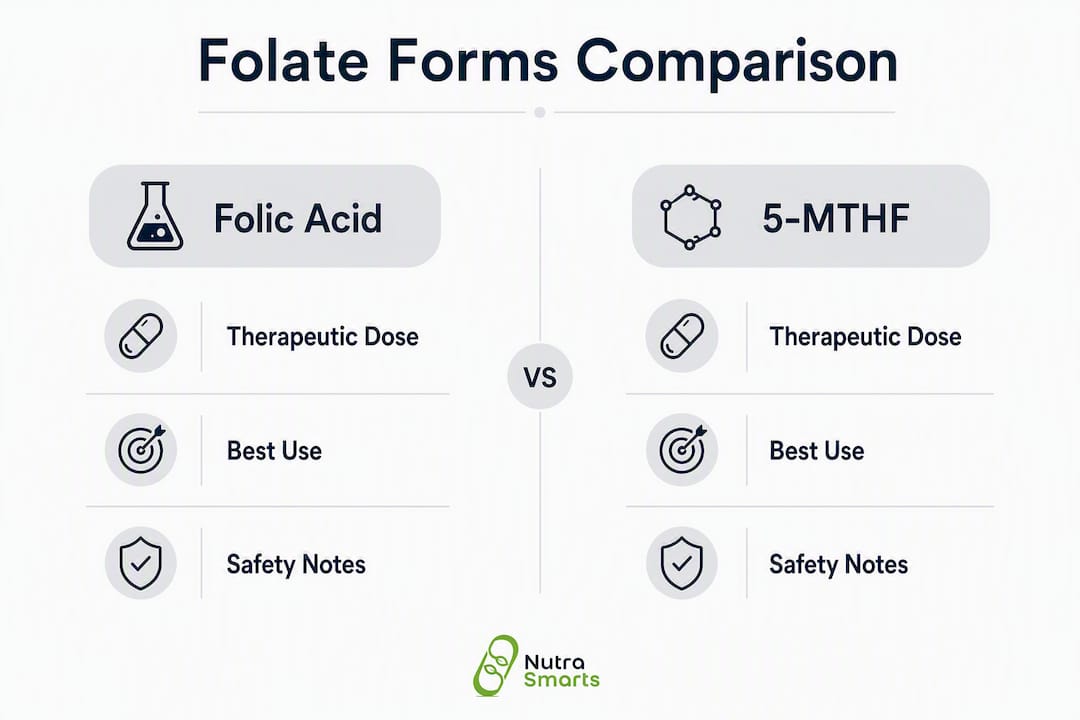
| Form | Typical therapeutic dose | Best-use cases | Label presentation | Key safety note |
|---|---|---|---|---|
| Folic acid | 1–5 mg/day (Rx); 400 mcg (OTC) | Standard deficiency correction, pregnancy, most adults | "Folic acid," mcg DFE required | Must rule out B12 deficiency first |
| 5-MTHF (methylfolate) | 400 mcg–1 mg/day (OTC); higher Rx doses | MTHFR variants, folic acid intolerance, malabsorption | L-5-MTHF, Quatrefolic®, levomefolate | Same B12 caveat; DFE conversion less established |
| Folinic acid | Clinician-prescribed only | Methotrexate rescue, severe malabsorption | Leucovorin (Rx) | Not for routine OTC use |
Common label warnings on methylfolate products, such as those from NOW Foods, advise users with low B12 or those on certain medications to consult a physician before use. That warning is not boilerplate; it reflects a real clinical risk.
Pro Tip: Check whether a product lists both the mcg amount and the mcg DFE amount. If only one appears, use the Nutrasmarts label comparison tool to cross-check the math before buying.
How to correct a folate deficiency: tests, doses, and monitoring
Correcting a deficiency is not just about picking a supplement. It is a short clinical protocol with a defined start, middle, and end.
Step 1: Confirm the diagnosis and check B12
- CBC with red cell indices — look for macrocytosis (elevated MCV) and hypersegmented neutrophils, the classic hematologic signature.
- Serum folate — reflects recent intake; can normalize within days of eating well, so a single normal result does not rule out deficiency.
- RBC folate — reflects tissue stores over the prior 2–3 months; more reliable for confirming true deficiency.
- Serum vitamin B12 — non-negotiable before starting high-dose folate. Skipping this step is the single most dangerous mistake in folate supplementation.
- Homocysteine (optional) — elevated homocysteine supports deficiency and can track treatment response.
Step 2: Start the right dose
For documented deficiency, clinicians typically prescribe 1–5 mg of folic acid daily, well above the 400 mcg DFE adult RDA. The Cleveland Clinic notes that most adults need roughly 400 mcg for maintenance, but active deficiency correction requires a higher therapeutic dose under supervision. If malabsorption is the root cause and oral therapy fails, intramuscular or intravenous folic acid is an option.
Step 3: Address root causes in parallel
Supplements fix the number; they do not fix the reason the number fell. Johns Hopkins Medicine identifies the most common culprits: alcohol use disorder, malabsorptive conditions (celiac disease, Crohn's, short bowel syndrome), and medications including methotrexate, anticonvulsants, and sulfasalazine. Failing to address these leads to recurrence once you stop supplementing.
Cooking also matters more than most people expect. Extensive cooking can destroy 50–95% of the natural folate in food, which is why dietary correction alone is too slow and unreliable for someone with active deficiency.
Step 4: Monitor and confirm recovery
| Timepoint | What to check | What to expect |
|---|---|---|
| 4 weeks | CBC, serum folate | MCV should begin normalizing; folate levels rise |
| 2–4 months | CBC, RBC folate | Full hematologic recovery expected per NHS guidance |
| Ongoing | Symptom review, B12 recheck if needed | Fatigue and cognitive symptoms typically improve with blood counts |
If labs do not normalize by 3–4 months, the workup should expand: consider malabsorption, concurrent B12 deficiency, or a hemoglobinopathy masking the picture. Specialist referral is appropriate when oral therapy fails or when the underlying cause requires it.
For readers who want to verify the clinical evidence behind specific folate and methylfolate dosing, the Nutrasmarts ingredient database links each profile to primary-source citations.
Key Takeaways
Oral folic acid at 1–5 mg daily under supervision is the evidence-based first-line treatment for folate deficiency, with B12 confirmation as the single most critical safety step before starting.
| Point | Details |
|---|---|
| Confirm B12 first | Always check serum B12 before starting high-dose folate to avoid masking neurological damage. |
| Therapeutic dose range | Clinical correction typically uses 1–5 mg folic acid daily, far above the 400 mcg DFE maintenance RDA. |
| Recovery timeline | Hematologic normalization takes 2–4 months; recheck CBC and RBC folate at 4 weeks. |
| Choose methylfolate when | MTHFR variants, folic acid intolerance, or clinician recommendation justify switching to 5-MTHF. |
| Use Nutrasmarts tools | The Supplement Ingredient Database and label comparison tool help verify folate form, dose, and DFE conversions on any product. |
The case for slowing down before you supplement
Most people who discover a folate deficiency want to fix it fast, and that urgency is understandable. But the single most common error is not choosing the wrong supplement form. It is skipping the B12 check entirely.
Folic acid is genuinely good at one thing: restoring red blood cell production. That is also what makes it dangerous when B12 is low. The blood test normalizes, symptoms of anemia ease, and the underlying B12-driven nerve damage continues undetected for months. By the time neurological symptoms appear, some of that damage is permanent. The Merck Manual is unambiguous on this point, and it is the reason every credible clinical source lists B12 confirmation as a prerequisite, not a suggestion.
The second thing people underestimate is the difference between correcting a deficiency and preventing recurrence. A 4-month course of folic acid will restore your labs. It will not stop the deficiency from returning if the root cause is still there. Alcohol use, an unmanaged malabsorptive condition, or a medication that depletes folate will undo the correction within months of stopping supplementation.
On the supplement form debate: 5-MTHF is a legitimate clinical choice, particularly for MTHFR carriers, but it is not automatically superior for everyone. The NIH ODS notes that bioavailability is equivalent or better, but population-level guidance from the CDC still centers on folic acid. For most people correcting a documented deficiency under medical supervision, folic acid at the right dose works. The form matters less than the dose, the duration, and whether you have ruled out B12 deficiency first.
Pro Tip: If you are comparing folate products, use the Nutrasmarts side-by-side comparison tool to check whether a label lists the active form (L-5-MTHF vs. folic acid) and whether the DFE math is correct before purchasing.
Nutrasmarts helps you verify what is actually in your folate supplement
Choosing a folate supplement is straightforward once you know what to look for. The harder part is confirming that a product's label actually delivers the form and dose it claims. Nutrasmarts gives you the tools to do that without guesswork.

The Supplement Ingredient Database includes detailed profiles for both folate and methylfolate, each linked to clinical citations so you can check the evidence behind any dosing claim. The Compare Supplements tool lets you place two product labels side by side to spot differences in form, dose, and DFE conversion. The Free Supplement Facts Label Creator handles the mcg-to-DFE math directly, so you can verify whether a manufacturer's label arithmetic is accurate. If you are still mapping symptoms to possible deficiencies, the symptom-to-supplement search is a practical starting point. No sign-up required for any of these tools.
Authoritative sources and further reading
- Folate — Health Professional Fact Sheet | NIH Office of Dietary Supplements — Primary reference for RDA, DFE conversions, bioavailability comparisons, and MTHFR context.
- Folate-Deficiency Anemia | Johns Hopkins Medicine — Root-cause management, drug interactions, and malabsorption context.
- Folate deficiency: Symptoms, causes and prevention | Cleveland Clinic — Practical clinical framing of folic acid dosing and dietary guidance.
- Vitamin B12 deficiency — Merck Manual Professional Version — The authoritative source on B12-masking risk from high-dose folic acid.
- Folate Deficiency — Merck Manual Consumer Version — Accessible overview of causes, treatment, and special populations.
- Folate-deficiency anemia | MedlinePlus Medical Encyclopedia — NIH-curated summary of diagnosis, treatment routes, and dietary sources.
- Folate — Drugs and Supplements | Mayo Clinic — Balanced guidance on when diet is sufficient versus when supplementation is warranted.
- Folate ingredient profile | Nutrasmarts — Clinical dosing context and citations for folic acid in supplement form.
- Methylfolate ingredient profile | Nutrasmarts — Research summary on 5-MTHF, MTHFR relevance, and dosing evidence.
- Compare Supplements — Side-by-Side Guides | Nutrasmarts — Tool for comparing product labels, active folate forms, and DFE calculations.