
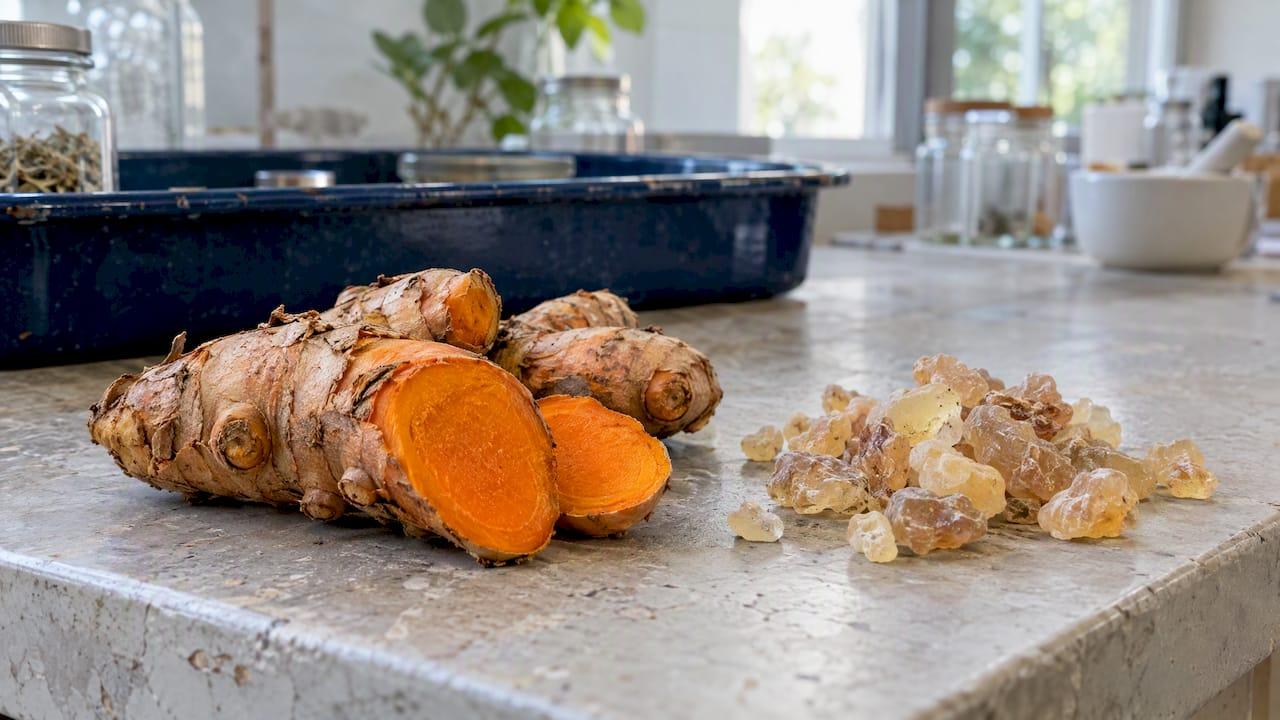
Boswellia and turmeric are not rivals so much as two different plants with two different proposed mechanisms. Turmeric (and its main compound, curcumin) is the better studied of the two and has the longer safety record in food. Boswellia has some of the more consistent trial results for knee osteoarthritis. Neither has evidence strong enough to call it a clear winner, and the quality of the product you buy matters as much as the choice of herb.
Below we compare them on what they are, how they appear to work, what trials show, who should be careful, and how to read a label.
TL;DR
- Turmeric is a spice plant, curcumin is one compound in it, and boswellia is a tree resin extract. They are different ingredients.
- In knee osteoarthritis trials, both curcuminoid and boswellia formulations beat placebo, but the evidence is rated low quality.
- They are thought to act on different inflammatory pathways, which is why many products combine them. Human proof that the combination beats either alone is thin.
- Curcumin can interact with blood thinners such as warfarin, and some high-absorption turmeric products have been linked to liver injury. Talk to your doctor first.
- Label quality varies widely for both. Check species, extract type and measured active content before you compare prices.
Table of Contents
- What each ingredient actually is
- How they are thought to work
- What the clinical trials show
- Does taking them together make sense?
- Safety, side effects and interactions
- Why the product matters as much as the herb
- Choosing between them
- Our perspective
- Compare the evidence yourself
- FAQ
- Sources
What each ingredient actually is
The names get mixed up constantly, so it helps to separate them.
Turmeric is a plant in the ginger family, Curcuma longa. Its rhizome is used as a spice and in traditional medicine, according to the National Center for Complementary and Integrative Health (NCCIH). Curcumin is a major component of turmeric and gives it its yellow color.
Curcumin is also not the only active compound. A 2022 peer-reviewed review describes curcumin as the main member of a group called curcuminoids, alongside demethoxycurcumin and bisdemethoxycurcumin. So turmeric is the plant material, curcuminoids are a group of compounds in it, and curcumin is the principal one. If you searched "boswellia vs curcumin" or "curcumin vs boswellia," you are asking about the same comparison, just with the isolated compound instead of the whole root. Most joint studies use concentrated curcuminoid extracts, not kitchen turmeric powder.
Boswellia (Boswellia serrata) is a branching tree native to mountainous regions of Northern Africa, India and the Middle East. Per NCCIH, boswellia supplements are extracts of the gum resin or bark, and the same resin is the source of frankincense. Its active constituents are boswellic acids.
One more point for people who typed "tree turmeric" into a search box: that is a different plant name sometimes used for other species, and it is not the same thing as Curcuma longa. When you shop, go by the Latin name on the label.
You can read our full profiles for Boswellia serrata and curcumin/turmeric, including dosage ranges used in studies.
How they are thought to work
The two ingredients are proposed to calm inflammation through different routes.
| Turmeric / curcumin | Boswellia | |
|---|---|---|
| Source | Rhizome of Curcuma longa | Gum resin of Boswellia serrata |
| Key actives | Curcuminoids | Boswellic acids |
| Proposed targets | COX-2, lipoxygenase, NF-κB pathways | 5-lipoxygenase, leukotriene signaling |
| Main absorption issue | Poor bioavailability, often paired with piperine or special formulations | Varies by extract and boswellic-acid content |
| Best-studied use | Knee osteoarthritis pain | Knee osteoarthritis pain and function |
The 2022 review reports that curcumin downregulates pathways including COX-2, lipoxygenase and NF-κB, while boswellic acids are associated particularly with inhibition of 5-lipoxygenase and leukotriene-related signaling. The same review is clear that these mechanisms rest largely on laboratory, preclinical and limited clinical evidence. A systematic review of knee osteoarthritis trials frames it the same way: curcuminoids inhibit COX-2 and boswellic acids inhibit 5-lipoxygenase.
In plain terms, mechanism studies suggest the two do not duplicate each other. That is a hypothesis worth knowing about, not proof that either one will work for you.
What the clinical trials show
Knee osteoarthritis: the main battleground
Most head-to-head interest comes from knee osteoarthritis, because both ingredients have been tested there.
A systematic review of randomized trials with evidence up to March 2018 found both curcuminoid and boswellia formulations more effective than placebo for pain and function. For curcuminoids, there were no statistically significant differences in efficacy compared with NSAIDs, and people taking curcuminoids were significantly less likely to have gastrointestinal adverse events. The authors rated the evidence low quality and called for larger, higher-quality studies. That caveat matters: a low-quality evidence rating means the true effect could be quite different from what these trials found.
A more recent network meta-analysis, using data through December 2024, compared nutritional supplements for knee osteoarthritis. Against placebo, boswellia showed significant improvements in WOMAC pain, stiffness and function scores. WOMAC is a standard questionnaire used to measure knee and hip osteoarthritis symptoms.
So which one wins?
On the published evidence, honestly, neither. Both beat placebo in pooled analyses. Both come with low-quality ratings in the older review. Trials used different extracts, doses and durations, so you cannot reliably rank them against each other. If someone tells you one is clearly superior, they are going beyond the data.
What can be said:
- Turmeric/curcumin has the extra advantage of a comparison against NSAIDs in trials, with fewer stomach side effects reported.
- Boswellia has recent pooled evidence for pain, stiffness and function, and its NCCIH safety summary for oral use is reassuring (more below).
- Both are best viewed as options to discuss with a clinician, not replacements for diagnosed-condition care.
For a wider view of what is backed by trials for joints, see our roundup of joint support ingredients with clinical backing and our joint pain supplement reviews.
Does taking them together make sense?
Many commercial formulas pair the two, so the question is fair. The evidence for the combination is mostly early-stage.
- In preclinical models, boswellic acids and curcumin showed additive activity, and the 2022 review says clinical studies suggested synergy. Human pharmacokinetic and clinical studies it covered reported no major safety concerns when the two were combined.
- In lab work on human cartilage cells, turmeric and boswellia extracts modulated different, complementary gene pathways, and combinations were more effective at lowering pro-inflammatory genes such as IL-6 and ADAMTS. The researchers noted that curcumin showed earlier gene expression changes in Nrf2 pathways, while boswellia worked on slower-acting Nrf1 and PPARα pathways.
Those are cell studies. They show why the pairing is plausible, not that a capsule will outperform either herb alone in your knee. Pairing also makes it harder to tell which ingredient is helping, and adds to the number of things that can interact with your medications. A reasonable approach, if your doctor agrees, is to try one ingredient at a time for a defined period and track your symptoms.
If you are exploring other non-supplement options for stiff, painful joints at the same time, some people look at approaches such as red light therapy for arthritis. Whatever you add, keep your care team informed.
Safety, side effects and interactions
Both ingredients are widely used, and both have caveats.
Boswellia. NCCIH considers boswellia likely safe by mouth. Clinical trials used up to 1,000 mg daily for up to 6 months, and 2,400 mg for 1 month, and reported no major safety concerns.
Turmeric and curcumin. NCCIH says conventionally formulated oral turmeric or curcumin is likely safe in recommended amounts for up to 2 or 3 months. Side effects can include gastrointestinal symptoms, and liver injury has been reported with some enhanced-bioavailability formulations. That last point is the one most label-readers miss: the "7x absorption" or "10x absorption" products are not automatically safer or better. If you have liver disease, or notice dark urine, yellowing skin or persistent abdominal pain on any turmeric product, stop and call your doctor.
The WHO has set an acceptable daily intake for curcumin as a food coloring additive at 0 to 3 mg/kg, and the FDA classifies curcumin as generally recognized as safe, according to a 2023 review. Those figures apply to food use, so they do not translate directly into supplement doses.
In the randomized trials reviewed for knee osteoarthritis, the systematic review found no significant differences in safety profiles between curcumin or boswellia and placebo.
Medications. The Arthritis Foundation notes that curcumin may interact with blood thinners such as warfarin and advises checking with a doctor before trying supplements, since some can interfere with medications. NCCIH gives the same general advice for herbal products: talk to your health care provider first, especially if you already take medication. If you take warfarin or another anticoagulant, ask your prescriber or pharmacist before starting turmeric or curcumin, and before adding boswellia too.

Why the product matters as much as the herb
The evidence discussed above comes from specific extracts at specific doses. The bottle on your shelf may not match.
NCCIH says evidence on turmeric is insufficient for definitive conclusions, that oral products vary in curcumin content, and that many include piperine, which can improve bioavailability.
The variation is larger than most shoppers expect:
- Turmeric. A 2021 NIH/USDA-supported analysis of 54 turmeric supplements found that among products labeled at the common 500 mg turmeric-per-day level, measured total curcuminoids ranged from 16 to 554 mg. Of products making voluntary curcuminoid claims, 63% fell within 10% of what they claimed.
- Boswellia. A 2016 survey of 17 U.S. and European boswellic-acid products found only five disclosed the Boswellia species, plant part and boswellic-acid content, and 41% did not comply with their label declarations.
Researchers Janet Funk and Claus Schneider make a related point in a peer-reviewed perspective: botanical trials are hard to translate across products because studies use different proprietary formulations, incomplete curcuminoid information and varying bioavailability. Evidence is strongest when the studied product, dose, composition and pharmacokinetics are clearly specified.
A practical label checklist
- Latin name. Curcuma longa for turmeric, Boswellia serrata for boswellia.
- Extract, not just powder. Look for standardized curcuminoids or a named boswellic-acid percentage, not only "turmeric root powder."
- Branded, studied extracts. Trials usually test a specific branded extract. Our ingredient pages cover such forms, including Boswellin, 5-Loxin and AKBAMax for boswellia, and a standard curcumin vs Meriva comparison for curcumin.
- Added ingredients. Piperine changes absorption, and multi-ingredient blends make it hard to know what is doing the work.
- Dose per serving. Compare mg of active compound, not mg of "proprietary blend."
- Your medications. Run the full ingredient list past a pharmacist.
If you are also weighing turmeric against another kitchen herb, our piece on turmeric vs ginger walks through the same dose-focused logic.
Choosing between them
There is no universal answer, but a few situations point in different directions.
- You want the option with a comparison against NSAIDs and fewer reported stomach effects: the curcuminoid evidence speaks to that, though it is low quality.
- You take warfarin or another blood thinner: the curcumin interaction warning is the reason to involve your prescriber before anything else.
- You have liver concerns: avoid enhanced-absorption turmeric products unless your doctor says otherwise.
- You want a resin-based option with recent pooled evidence for knee pain, stiffness and function: boswellia fits, again with your clinician's approval.
- You have already tried one and want to try the other: switch rather than stack, and give each a fair trial period so you can tell what changed.
No supplement should delay evaluation of persistent joint pain, swelling, or morning stiffness. See a doctor or rheumatologist for a diagnosis first.
Our perspective
When we build ingredient profiles, the same pattern repeats with boswellia and turmeric: the headline is rarely the real story. The real story is which extract, at what dose, in which trial, and how confident the researchers were. Both ingredients have encouraging results, and both have a low-quality evidence caveat. We think readers are better served by seeing that plainly than by a ranking that picks a winner.
Our practical advice is to compare products by studied extract and measured active content, to change one thing at a time, and to bring the full ingredient list to a pharmacist. Our database cites PubMed-indexed studies and clinical trials, and our evidence ratings are meant to tell you when a result is promising and when it is thin.
— NutraSmarts
Compare the evidence yourself
NutraSmarts is a free, research-focused database with no sign-up. You can look up boswellia, curcumin and 1,300+ other ingredients, see the clinical studies behind each, and browse supplements by symptom, from joint pain to brain fog. If you are deciding between two ingredients, our side-by-side comparisons put dose ranges and evidence ratings next to each other.
Start on the NutraSmarts homepage, or go straight to supplements organized by symptom. If you formulate products, the free Supplement Facts label creator runs in your browser.
FAQ
Is boswellia or turmeric better for inflammation?
Neither is clearly better. A systematic review found both curcuminoid and boswellia formulations beat placebo for knee osteoarthritis pain and function, while rating the evidence low quality. Product quality and your own health situation matter more than the choice of herb.
Can I take boswellia and turmeric together?
Human studies reviewed so far reported no major safety concerns with the combination, and lab studies suggest the two act on complementary pathways. Direct proof that the pair beats either alone is limited. Check with your doctor or pharmacist first, especially if you take blood thinners.
Is curcumin the same as turmeric?
No. Turmeric is the plant, Curcuma longa, and curcumin is one principal compound within a group called curcuminoids. Supplements studied in trials typically use concentrated curcuminoid extracts, which are not the same as cooking turmeric.
Is boswellia safe to take every day?
NCCIH considers oral boswellia likely safe, with trials using up to 1,000 mg daily for up to 6 months reporting no major safety concerns. That does not cover every product or every person. Talk to your health care provider, especially if you take medication.
Sources
- Turmeric: Usefulness and Safety, NCCIH
- Boswellia: Usefulness and Safety, NCCIH
- Potential complementary and/or synergistic effects of curcumin and boswellic acids (2022 review)
- Efficacy of Curcumin and Boswellia for Knee Osteoarthritis (2018 systematic review)
- Comparative Effectiveness of Nutritional Supplements in knee osteoarthritis (network meta-analysis)
- Curcuma longa and Boswellia serrata extracts, Frontiers in Pharmacology (2022)
- 12 Supplements for Osteoarthritis, Arthritis Foundation
- The therapeutic potential of curcumin and its related substances (2023)
- Comparison of Label Claims, Measured Curcuminoid Content (2021)
- Survey on the Quality of the Top-Selling European and American Botanical Dietary Supplements Containing Boswellic Acids (2016)
- Perspective on Improving the Relevance, Rigor, and Reproducibility of Botanical Clinical Trials, Frontiers in Nutrition (2021)