

The most reliable signs of choline deficiency are not brain fog or vague tiredness. They are measurable: a fatty liver, elevated liver enzymes, and muscle damage marked by rising creatine kinase. Frank deficiency is uncommon in healthy adults because the body makes some choline on its own, but the margin is thin, and certain groups fall short often enough that clinicians treat this as a real, testable condition rather than a symptom checklist.
Here's the split that matters most:
- Objective markers (worth acting on): fatty liver detectable on imaging, elevated AST/ALT, elevated creatine kinase.
- Subjective complaints (worth noting, not diagnosing from): fatigue, low mood, trouble concentrating. These overlap with dozens of other conditions and mean little on their own.
If you're pregnant or lactating, on long-term total parenteral nutrition (TPN), or dealing with unexplained fatigue plus a diet very low in eggs, meat, or fish, that combination is worth a conversation with a clinician about liver enzyme testing.
Quick stat check: Population surveys cited by the National Institutes of Health suggest roughly 90% of people in the U.S. consume less choline than the Adequate Intake. That sounds alarming, but it doesn't mean 90% of people have clinical deficiency. It means the average diet runs light on choline, and the people who tip from "light" into "deficient" are almost always the ones with an added risk factor: pregnancy, restrictive diets, or a metabolic condition that raises their personal requirement.
Key Takeaways
Choline deficiency is confirmed through objective markers, fatty liver, elevated liver enzymes, and elevated creatine kinase, not through fatigue or mood symptoms alone.
| Point | Details |
|---|---|
| Trust objective markers first | Fatty liver, AST/ALT, and creatine kinase are the evidence-backed signs; fatigue alone proves little. |
| Know your risk group | Pregnancy, TPN, PEMT variants, and vegan diets raise deficiency risk well above the general population. |
| Test before you supplement | Ask a clinician about liver enzymes and creatine kinase if risk factors and symptoms overlap. |
| Match supplement form to goal | Phosphatidylcholine suits liver correction; citicoline and alpha-GPC suit brain-targeted protocols. |
| Use evidence-rated resources | Nutrasmarts' ingredient database and Supplement Facts tool help verify forms and doses before you buy. |
Table of Contents
- What Choline Does and Why Low Levels Show Up in the Liver First
- Evidence-Backed Signs and Symptoms of Choline Deficiency
- Who Is Most Likely to Become Choline Deficient
- How Clinicians Test for Choline Deficiency
- Choosing a Choline Supplement: Forms, Evidence, and What to Check on the Label
- Common Confusions About Choline, Cleared Up
- When to See a Clinician About Choline
- What the Evidence Actually Supports, and What It Doesn't
- Compare Choline Forms and Check Your Supplement Facts
- Primary Sources and Further Reading
- Frequently Asked Questions
- Sources
What Choline Does and Why Low Levels Show Up in the Liver First
Choline's clinical importance comes down to one job: it's a building block for phosphatidylcholine, the phospholipid the liver needs to package fat into very low-density lipoprotein (VLDL) and ship it out into the bloodstream. No phosphatidylcholine, no export. Fat backs up in liver cells instead, and that's the mechanical reason choline deficiency causes fatty liver rather than, say, a skin rash or a vitamin-deficiency-style rash.
Choline has a second role that matters for the nervous system: it's the direct precursor for acetylcholine, a neurotransmitter involved in muscle control and memory. That's where the nootropic hype comes from, and it's also where the evidence gets thinnest, but the liver pathway is the one with decades of controlled-diet data behind it.
The chain is simple enough to sketch out: dietary choline gets converted into phosphatidylcholine, phosphatidylcholine gets packaged into VLDL particles, and VLDL carries triglycerides out of the liver and into circulation. Break any link, and fat accumulates where it shouldn't.
Two measurements matter most in this whole picture:
- Plasma choline, a direct but imperfect measure of circulating choline status, mostly used in research settings.
- Liver enzymes (AST and ALT), the practical, widely available markers clinicians actually check first.
By the numbers: In controlled feeding trials described by the Linus Pauling Institute, removing choline from the diet produced measurable fatty liver and rising organ-damage biomarkers in study participants within weeks, and those changes reversed once choline was reintroduced. That reversibility is the clinically useful part. This isn't a condition that leaves permanent damage if it's caught early.
Evidence-Backed Signs and Symptoms of Choline Deficiency
Start with what's actually measurable, because that's what separates a real diagnosis from a guess.
Objective signs: liver and muscle
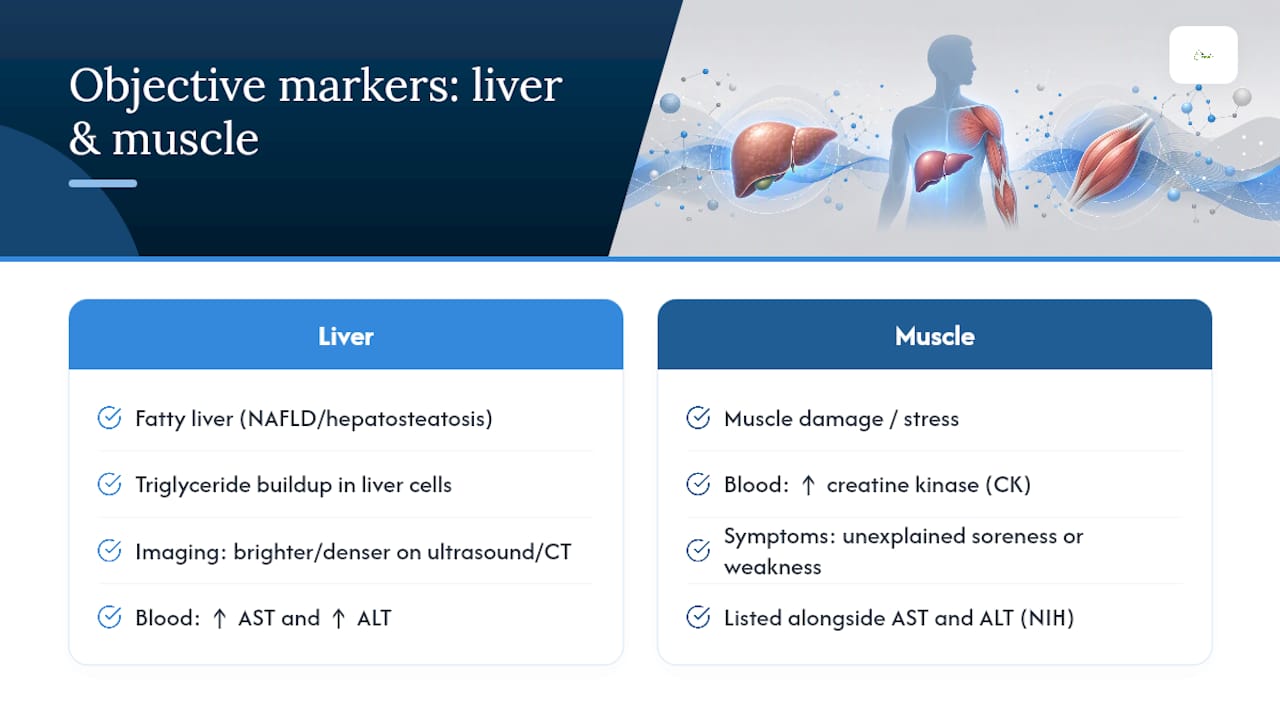
Fatty liver, also called nonalcoholic fatty liver disease (NAFLD) or hepatosteatosis when it shows up on imaging, is the single most documented consequence of low choline intake. It develops because the liver can't export fat efficiently without enough phosphatidylcholine, so triglycerides accumulate inside liver cells. On an ultrasound or CT scan, this looks like a liver that's brighter or denser than it should be. On a blood panel, it usually shows up first as a rise in AST and ALT, the two enzymes doctors check whenever they suspect liver stress.
Muscle damage is the second well-documented sign, and it's less talked about than the liver angle. Creatine kinase (also called creatine phosphokinase) rises when muscle tissue is under stress or breaking down, and the NIH's health professional fact sheet on choline lists it directly alongside AST and ALT as a recognized clinical marker of deficiency. A person with true choline deficiency might notice unexplained muscle soreness or weakness that doesn't track with recent exercise, alongside lab values that confirm it's not just a strained muscle.
Both of these markers share something important: they resolve with repletion. Add back adequate choline, whether through diet or supplementation, and liver enzymes plus creatine kinase typically normalize over subsequent weeks. That reversibility is part of why doctors treat these as diagnostic rather than incidental findings.
Subjective symptoms: real, but not proof of anything
Choline deficiency fatigue, mood changes, and reports of mental fog get repeated constantly in wellness content, and they're not fabricated complaints. People with genuinely low choline status sometimes do report feeling foggy or drained. The problem is specificity. Fatigue alone shows up in iron deficiency, thyroid dysfunction, sleep disorders, depression, and a dozen other common conditions. If you're trying to figure out whether your tiredness has a nutritional cause, iron deficiency symptoms in adults, and iron deficiency symptoms in women specifically, are actually a more common culprit worth ruling out first, since low iron is far more prevalent than low choline in most populations. Fatigue by itself, without an objective marker attached, is not enough to diagnose choline deficiency.
Choline status is a liver story before it's a brain story. The organ shows measurable strain through impaired fat export long before anyone can point to a cognitive symptom and say with confidence, "that's choline." Objective markers earn their place in a diagnosis. Subjective complaints earn a follow-up question, not a conclusion.
How deficiency tends to progress
Deficiency doesn't arrive all at once. It tends to move through stages, at least in the controlled research settings where this has actually been studied:
- Early stage: Liver enzymes (AST/ALT) begin drifting upward on routine bloodwork, often with no symptoms at all.
- Moderate stage: Imaging starts to show detectable fat accumulation in the liver, sometimes alongside mild creatine kinase elevation.
- Advanced stage: Sustained fat accumulation raises the theoretical risk of progressing toward nonalcoholic steatohepatitis (NASH), a more serious inflammatory form of liver disease, if the underlying shortfall goes uncorrected for a long stretch.
In the controlled-diet trials referenced by the Linus Pauling Institute, a meaningful share of participants developed measurable fatty liver changes within just a few weeks of choline restriction, and susceptibility varied noticeably based on genetics and sex. That timeline is short enough to make one thing clear: this isn't a decades-long slow burn like some nutrient deficiencies. It moves quickly once intake drops far enough below need.
Who Is Most Likely to Become Choline Deficient
Deficiency risk isn't evenly distributed. It clusters around a handful of predictable situations.
- Pregnant and lactating people. Choline demand rises sharply because the placenta and fetal brain both draw heavily on maternal choline stores for development. The NIH fact sheet notes that most prenatal vitamins contain little or no choline, and an estimated 90 to 95 percent of pregnant women consume less than the Adequate Intake.
- People on long-term total parenteral nutrition (TPN). Standard parenteral formulas historically lack choline, and patients who depend on IV nutrition for extended periods can develop measurable liver abnormalities and low plasma choline as a direct result.
- People with PEMT gene variants. The body can synthesize some choline internally through the PEMT enzyme pathway, but common polymorphisms in that gene raise a person's dietary requirement substantially. Women without estrogen stimulation, including postmenopausal women, are particularly susceptible since estrogen boosts PEMT activity.
- Strict vegans and vegetarians with low intake. The richest dietary sources, eggs, liver, and meat, are excluded from these diets by definition, and while soy and certain vegetables provide some choline, hitting the Adequate Intake without animal products takes deliberate planning.
- Older adults with generally low intake. Reduced appetite and smaller portion sizes can push total nutrient intake, including choline, below what's needed even without a specific medical condition driving it.
Nutrasmarts breaks down risk by population group in more depth if you want to see how pregnancy, age, and other factors stack up against each other.
The pregnancy numbers deserve a second look: 90 to 95 percent of pregnant women below the AI isn't a rounding error, it's most of the population. Pregnant people don't just eat like everyone else and fall short. Their requirement climbs while their prenatal supplement, in most cases, does nothing to close the gap.
How Clinicians Test for Choline Deficiency
Testing follows a logical sequence rather than a single blood draw. A clinician typically starts with your history, not a lab order.
- Dietary and risk-factor history. Are you pregnant, on TPN, following a vegan diet, or dealing with unexplained fatigue plus another risk factor? This step decides whether further testing is even warranted.
- Baseline blood work. AST, ALT, and creatine kinase are the standard, widely available tests that flag liver or muscle stress.
- Imaging if liver enzymes are elevated. Ultrasound or CT can confirm fatty liver and rule out other causes of enzyme elevation, like alcohol use, viral hepatitis, or medication side effects.
- Plasma choline in select cases. This measurement is mostly used in research or when a clinician wants to confirm choline specifically as the driver, rather than one of the many other causes of elevated liver enzymes.
- Trial of dietary repletion. If choline deficiency is suspected and other causes are ruled out, increasing dietary choline (or, under supervision, adding a supplement) and rechecking labs in several weeks often confirms the diagnosis retroactively, since the markers should improve.
| Test | What it measures | What it tells you |
|---|---|---|
| AST / ALT | Liver enzyme leakage into blood | Elevated levels flag liver cell stress, often the first sign of fatty liver |
| Creatine kinase | Muscle enzyme leakage into blood | Elevated levels flag muscle damage or breakdown |
| Plasma choline | Circulating choline concentration | Useful in research settings; less reliable for routine screening due to natural fluctuation |
| Liver imaging (ultrasound/CT) | Fat content in liver tissue | Confirms and quantifies fatty liver once enzymes are elevated |
Plasma choline has a real limitation worth understanding: it fluctuates with recent meals and doesn't always track long-term tissue status well, so a single normal reading doesn't rule out deficiency, and a single low reading doesn't confirm it either. That's why liver enzymes and imaging carry more weight in routine clinical decision-making, while plasma choline stays mostly in the research toolkit.
Attributing elevated liver enzymes specifically to low choline, rather than alcohol use, obesity-related fatty liver, medication effects, or viral hepatitis, requires ruling those alternatives out first. A clinician who sees elevated AST/ALT alongside a diet history low in choline-rich foods, and no other clear cause, has a reasonable case for choline as a contributing factor.
Choosing a Choline Supplement: Forms, Evidence, and What to Check on the Label
Not all choline supplements do the same job, and picking the wrong one for your actual goal is a common mistake.
- Phosphatidylcholine is the form most directly tied to liver and cell-membrane support, since it's the exact molecule the liver needs for VLDL assembly. It's the most defensible choice if correcting or preventing deficiency, rather than chasing a cognitive effect, is the actual goal. Nutrasmarts' phosphatidylcholine profile covers dosing and research context in more depth.
- Citicoline (CDP-choline) is more often used in cognitive and neurological research protocols. It's frequently compared against alpha-GPC in nootropic contexts, and the citicoline versus alpha-GPC comparison on Nutrasmarts lays out where the evidence for each actually stands.
- Alpha-GPC delivers choline efficiently across the blood-brain barrier and shows up frequently in pre-workout and nootropic formulations, though the evidence base here leans more toward performance and cognitive research than deficiency correction specifically.
- Choline bitartrate is the cheapest and most common form in multivitamins, but it's also the form most associated with the TMAO increase mentioned above, so it's a weaker pick if cardiovascular risk is a concern.
When you're reading a label, check for: total choline content in milligrams (not just "choline complex" without a number), the specific form used, serving size relative to the AI, and whether the product has any third-party testing. Nutrasmarts' choline ingredient page breaks down clinical roles and dosing evidence by form, which is useful groundwork before comparing specific products.
Pro Tip: Match the form to the goal, not the marketing. Phosphatidylcholine or food-first strategies for liver and deficiency correction. Citicoline or alpha-GPC for brain-targeted protocols, and only under a clinician's guidance if you're combining them with other supplements or have cardiovascular risk factors.
Common Confusions About Choline, Cleared Up
A few claims about choline circulate constantly online, and most of them oversimplify the actual evidence.
- "Choline supplements reliably boost cognition in healthy people." Not well supported. In people who are already well-nourished, supplementation hasn't reliably shown cognitive benefits in the research. The strongest evidence supports preventing deficiency and supporting liver and pregnancy health, not cognitive enhancement in people who don't need it.
- "Eggs are bad for you because of the choline in them." Misleading. Choline is one of the reasons eggs are nutritionally valuable, not a liability. The old cholesterol panic around eggs has largely been revised, and choline content is a point in their favor for most people.
- "Low choline always shows up as brain fog." Overstated. The best-documented signs are liver and muscle markers. Brain fog is a common complaint with dozens of possible causes, and treating it as a choline diagnosis on its own skips the actual evidence.
The throughline across all three: prevention and correction of deficiency have solid backing. Using choline as a general-purpose brain enhancer in people who aren't deficient does not.
When to See a Clinician About Choline
Certain signs warrant a prompt appointment rather than a wait-and-see approach:
- Jaundice (yellowing of skin or eyes)
- Persistent abdominal pain, especially in the upper right side near the liver
- Marked muscle weakness or unexplained muscle pain
- Liver enzyme results that are rising quickly on repeat testing
If any of those apply, especially alongside pregnancy, TPN, or a very restrictive diet, bring these questions to the appointment:
- Given my risk factors, should I be tested for choline status specifically?
- Which tests make the most sense: liver enzymes, creatine kinase, plasma choline, or imaging?
- If levels come back low, what's the repletion plan, food-first or supplement, and at what dose?
- Which supplement form is safest given my other medications and health history?
Come prepared with a few days of a dietary log, a list of current medications and supplements, and any known family history of liver disease. That groundwork turns a vague "I'm tired" conversation into a focused one a clinician can actually act on.
What the Evidence Actually Supports, and What It Doesn't
The strongest case for taking choline seriously isn't about optimizing a healthy brain. It's about protecting a liver that has a very specific, well-documented failure mode when this one nutrient runs short. That's a narrower claim than most wellness content makes, and it's also a more defensible one.
Where I'd push back on the conventional framing: too many articles treat every symptom list as equally weighted, fatigue sitting right next to fatty liver as if they carry the same diagnostic value. They don't. If you're at real risk, pregnant, on TPN, carrying a PEMT variant, or eating a diet with almost no animal products, prioritize the objective tests over the subjective feelings. Fatigue is worth mentioning to a clinician. It's not worth self-diagnosing from. Nutrasmarts built its deficiency symptom guide around that same principle: match symptoms to evidence, not to whatever theory is trending.
Compare Choline Forms and Check Your Supplement Facts
If you've read this far, you're probably trying to figure out which choline form fits your actual situation, not just which one has the best marketing. That's exactly the gap Nutrasmarts' ingredient database is built to close: over 1,300 evidence-rated ingredient profiles, each tied to clinical trial citations, so you can see what's actually been studied for liver support versus cognitive use before you spend money on either.
Nutrasmarts' symptom-to-supplement guide lets you search by concern, whether that's liver health, fatigue, or something else entirely, and get evidence-based options instead of a generic list. And if you're formulating your own product or just want to double-check what's actually in something you're considering, the free Supplement Facts label tool generates an FDA-compliant label without spreadsheet headaches. Pregnant readers dealing with related physical strain may also find value in resources like this chiropractic care guide for expecting moms, since prenatal nutrition rarely operates in isolation from the rest of a pregnancy care plan.
None of this replaces a conversation with a clinician, especially if you're pregnant, on TPN, or already seeing abnormal lab results. But if you're at the stage of comparing forms and checking what's actually in a bottle, start with the choline ingredient page and go from there.
Primary Sources and Further Reading
- NIH Office of Dietary Supplements: Choline Health Professional Fact Sheet, the primary clinical reference for intake values, deficiency markers, and risk groups.
- Linus Pauling Institute Choline review, an independent academic synthesis of choline mechanisms and genetic risk factors.
- PMC review on choline and brain development, foundational trial-based evidence on deficiency and development.
- PMC review summarizing dietary choline requirements, a current synthesis of intake recommendations and health outcomes.
- USDA food composition data for choline, the standard reference for choline content in common foods.
Frequently Asked Questions
What are the earliest signs of choline deficiency? The earliest detectable changes are usually rising liver enzymes (AST/ALT) on routine bloodwork, often before any symptoms appear. Fatigue or mood changes can occur but aren't reliable early indicators on their own.
Can choline deficiency cause fatigue? It can be one contributor, but choline deficiency fatigue rarely shows up in isolation, and fatigue has far more common causes, including iron deficiency, which is worth ruling out first given how much more prevalent it is.
How is choline deficiency diagnosed? Clinicians typically start with a dietary and risk-factor history, then check AST, ALT, and creatine kinase. Imaging confirms fatty liver if enzymes are elevated, and plasma choline testing is reserved mostly for research or unclear cases.
Who is most at risk for choline deficiency? Pregnant and lactating people, patients on long-term total parenteral nutrition, people with PEMT gene variants, and strict vegans or vegetarians with low intake face the highest documented risk.
Is CDP-choline (citicoline) better than alpha-GPC? Neither is universally "better." They're used in different clinical contexts, mostly cognitive and neurological research protocols, and the right choice depends on your specific goal rather than a general ranking.
What foods have the most choline? Beef liver, eggs, and beef are among the densest sources per serving, followed by fish, dairy, and soy products, according to USDA food composition data.
Can you take too much choline? Yes. Intake well above the Tolerable Upper Intake Level of 3,500 mg per day for adults has been linked to hypotension and a fishy body odor, so staying within the established range matters.
This article is general information, not a substitute for advice from a qualified doctor. Consult a qualified healthcare professional about your own circumstances before acting on anything here.
Sources
Food-first is the standard approach, and it works because the richest sources of choline are common, not exotic.
- Choline - Health Professional Fact Sheet
- Choline | Linus Pauling Institute | Oregon State University
- Choline: Dietary Requirements and Role in Brain Development
- PMC article summarizing dietary choline requirements and health effects
These figures come from USDA food composition data, which is the standard reference for nutrient content across common foods.
These are the values summarized in current reviews of dietary choline requirements, aligned with the NIH's own guidance. Note that the UL is the same across adult life stages, but pregnant and lactating people need considerably more intake to reach the AI floor in the first place, which is exactly why so many fall short.
Once someone corrects a genuine shortfall, whether through diet changes or supplementation, liver enzymes and creatine kinase typically start trending toward normal within a few weeks, based on the reversal patterns seen in controlled-diet studies. Fatigue and mood symptoms, if they were genuinely tied to choline status, tend to lag behind the biochemical improvement rather than resolving instantly.
Safety note worth taking seriously: very high choline intake, well above the UL, has been linked to hypotension and a distinctive fishy body odor, according to the NIH's consumer fact sheet. There's also a legitimate concern around TMAO (trimethylamine N-oxide), a gut-bacteria byproduct linked to cardiovascular risk in some research. Free choline salts like choline bitartrate tend to raise TMAO more than phosphatidylcholine does in controlled comparisons, which matters if you're choosing a supplement form and cardiovascular risk is already on your radar.
Pro Tip: If you're pregnant, on TPN, or otherwise at elevated risk, don't wait for symptoms to show up before checking in with a clinician. Ask specifically for AST, ALT, and creatine kinase as a baseline, then track them again after a few weeks of intentional dietary changes.