

The best evidence supports collagen supplements for skin hydration and elasticity, and for muscle and tendon gains when paired with resistance training. Trials showing benefit typically use hydrolyzed collagen daily for several weeks, often around two months or more. Evidence for hair growth is essentially absent, and nail data come from tiny, uncontrolled studies. Long-term safety past a few months of use remains largely unstudied.
TL;DR:
- Collagen supplements show consistent benefits for skin hydration and elasticity after at least eight weeks of daily use at doses of 2.5 to 10 grams.
- When combined with resistance training, around 15 grams of collagen daily can modestly improve muscle mass and tendon structure over several weeks.
- Evidence for collagen's effects on hair growth and nail strength is weak, based on small, uncontrolled, or non-peer-reviewed studies.
- Most studies assessing skin benefits use precise, objective tools like cutometers or corneometers, indicating small but real improvements rather than dramatic anti-aging effects.
- Industry-funded trials tend to report larger effects than independent studies, so evaluating research quality and sourcing is crucial before trusting claims.
Table of Contents
- What The Collagen Evidence Actually Shows
- How Researchers Measure Skin Benefits (And What The Numbers Really Mean)
- Where Else The Data Holds Up: Joints, Muscles, Hair, And Nails
- How Collagen Supplements Work: Hydrolysis, Peptides, And Dosing
- How To Read A Collagen Study Without Getting Fooled
- Should You Try Collagen? A Practical, Evidence-Aligned Approach
- How Nutrasmarts Helps You Verify Collagen Claims
- Why We Take A Measured Stance On Collagen
- Sources
- FAQ
What The Collagen Evidence Actually Shows
A 2023 systematic review and meta-analysis pulled together 26 randomized controlled trials covering 1,721 participants and found that hydrolyzed collagen significantly improved skin hydration and elasticity, with the strongest results showing up after at least eight weeks of daily use. That's the anchor finding in the collagen research landscape right now, and it's why "8 weeks minimum" has become the de facto rule of thumb among researchers reviewing this ingredient.
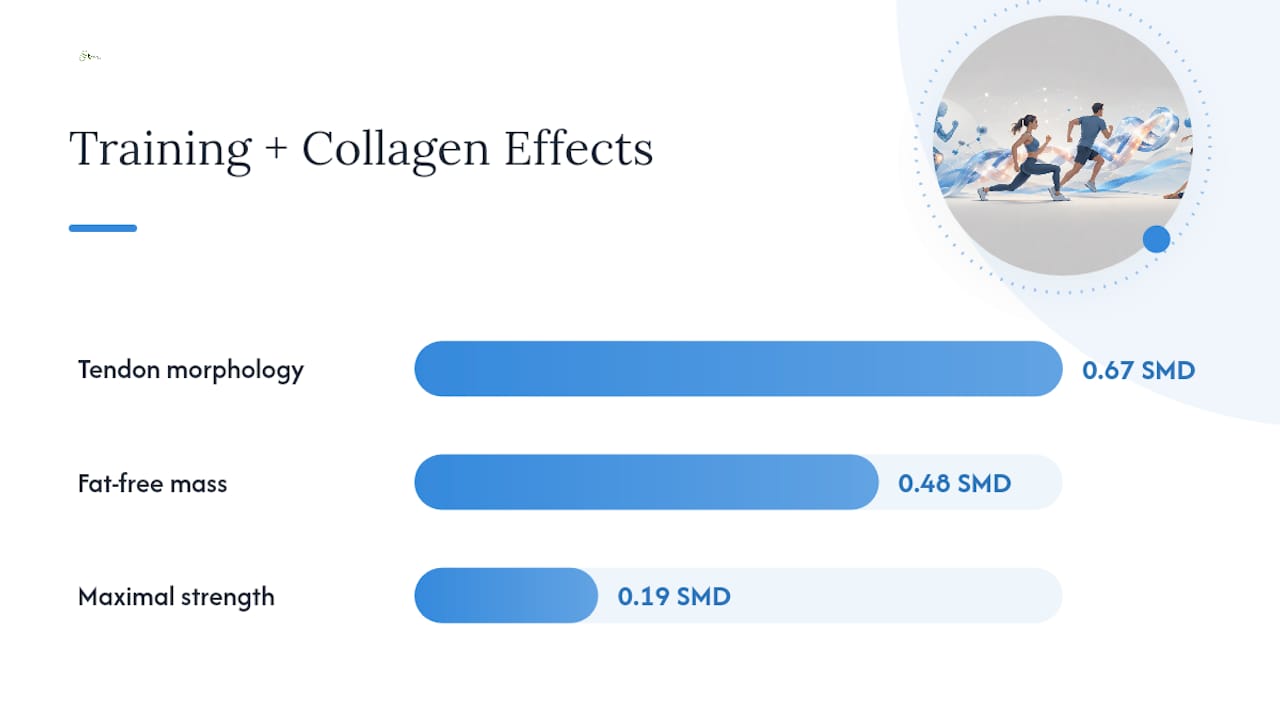
Separately, a 2024 systematic review focused on musculoskeletal outcomes. It pooled 19 studies and 768 participants and found that roughly 15 grams of collagen peptides per day, combined with structured training, produced small to moderate improvements. Tendon morphology showed the largest effect (standardized mean difference of 0.67), fat-free mass came in at 0.48, and maximal strength improved more modestly at 0.19. Those numbers matter because they tell you collagen is not doing the heavy lifting on its own. It amplifies what training already does.
Harvard Health's clinical summary lands in a more cautious spot. It acknowledges that some RCTs show real improvements in skin firmness, suppleness, and moisture, but flags a recurring problem: many trials test collagen blended with other ingredients like vitamin C, biotin, or hyaluronic acid. That makes it hard to know how much of the benefit is collagen alone versus the whole cocktail.
A newer 2025 review looking specifically at marine collagen adds a mechanistic layer. It found that hydrolyzed marine peptides can activate skin fibroblasts and increase dermal collagen density in preclinical and small human studies, giving the skin benefits a plausible biological story rather than just a statistical one. But the same review is upfront that long-term safety data is thin.
Here's the honest tally of where the evidence currently sits:
- Skin hydration and elasticity: Solid, repeated support across multiple systematic reviews, strongest after 8+ weeks.
- Muscle and tendon benefits: Real, but only in the context of resistance training, not as a standalone effect.
- Joint comfort: Modest signal in select trials, effect sizes are smaller than for skin.
- Hair growth: No robust RCT evidence at all.
- Nail strength: A handful of small, often placebo-free studies, not enough to draw firm conclusions.
- Long-term safety (beyond 6 to 12 months): Largely unstudied territory.
| Outcome | Evidence strength | Typical trial dose/duration |
|---|---|---|
| Skin hydration/elasticity | Consistent positive effect across meta-analyses | 2.5–10 g/day, ≥8 weeks |
| Muscle/tendon (with training) | Small to moderate effect, adjunct only | ~15 g/day, ≥8 weeks |
| Joint comfort | Mixed, generally modest | Varies, often 10 g/day |
| Hair growth | No controlled trial support | Not established |
| Nail strength | Weak, small uncontrolled studies | Not established |
Funding source is the wrinkle nobody likes to talk about. Several meta-analyses have run subgroup comparisons and found that industry-sponsored trials tend to report larger, more favorable effects than independently funded ones on some skin endpoints. That doesn't mean the skin data is fake. It means the size of the benefit you should expect is probably smaller than the flashiest headlines suggest.
How Researchers Measure Skin Benefits (And What The Numbers Really Mean)
Skin researchers don't just ask people how their face feels. They use instruments, and the instruments matter as much as the results.
A cutometer measures skin elasticity by suctioning a small area of skin and tracking how it snaps back. A corneometer measures hydration through the skin's electrical conductivity, since water conducts electricity and dry skin doesn't. VISIA imaging captures high-resolution photos under UV and standard light to quantify wrinkles, texture, and pigmentation changes over time. Self-report questionnaires round things out, asking participants to rate firmness, smoothness, or overall appearance.
Trials using these tools have produced some of the more compelling data points in this space:
- Marine collagen at 1,000 mg/day for 12 weeks showed measurable increases in skin hydration and elasticity scores in several of the small RCTs referenced in the 2025 marine collagen review, with fibroblast activation offered as the underlying mechanism.
- Bovine-sourced collagen peptides at 2.5 to 10 g/day for 8 to 12 weeks appear repeatedly in the pooled trials behind the 2023 meta-analysis, with wrinkle depth and hydration as the most consistently improved measures.
- Higher-dose protocols (10 to 15 g/day) used in some joint and skin crossover studies tend to run longer, often 12 weeks or more, before researchers see a measurable shift on cutometer or corneometer readings.
It's not a transformation. It's closer to skin that photographs slightly smoother under studio lighting and feels marginally more supple to the touch. It is a real, measurable shift, but it is not the "reverses aging" story that supplement marketing sometimes implies.
Pro Tip: When a collagen product's marketing cites a study, check whether that study tested the exact peptide source and dose in the product you're looking at. A brand can technically reference a real RCT while selling a formula with an entirely different collagen type or dose.
The limitations are worth sitting with. Most of these trials run 50 to 150 participants, small by pharmaceutical standards, and follow-up periods rarely extend past 12 weeks. Co-ingredients like vitamin C, zinc, or hyaluronic acid show up in a meaningful share of the formulas tested, which muddies attribution. And measurement instruments like cutometers, while objective, still carry a margin of error that can swallow a modest treatment effect. None of that invalidates the findings. It just means "collagen improves skin hydration" deserves a footnote about scale and certainty, not a blanket assumption that more is automatically better.
Where Else The Data Holds Up: Joints, Muscles, Hair, And Nails
Collagen's second-strongest evidence base, after skin, is musculoskeletal performance, and it comes with a catch: it works best as a training partner, not a substitute for lifting.
- The 2024 systematic review found that 15 g/day of collagen peptides combined with resistance training produced measurable gains in fat-free mass and tendon structure over roughly 8 or more weeks, with tendon morphology showing the biggest effect size of the outcomes measured.
- Strength improvements were present but modest, an SMD of 0.19, meaning collagen nudges strength gains rather than driving them.
- Athletes and older adults doing structured resistance training show the clearest signal in this body of research, because both groups have more room for measurable tendon and lean-mass change.
- Joint comfort research, often aimed at people with early osteoarthritis symptoms, shows a mixed but generally positive pattern. Effect sizes here run smaller than the skin data, and dosing protocols vary widely across studies, which makes pooling results harder.
- Hair growth has essentially no RCT support. Search the literature and you'll find plenty of marketing claims but no controlled trial showing collagen supplementation grows hair or slows loss.
- Nail strength research exists, but it's thin. One frequently cited study followed 25 participants without a placebo group and reported improvement, which is a promising anecdote, not proof.
If you're an athlete or someone in a structured strength program, the collagen plus training combination has the most defensible research behind it of any non-skin outcome. If you're hoping collagen alone will thicken your hair or fix brittle nails, the current research simply doesn't back that up yet.
How Collagen Supplements Work: Hydrolysis, Peptides, And Dosing
Whole collagen molecules are too large to survive digestion intact. That's why virtually every supplement on the market uses hydrolyzed collagen, also called collagen peptides, where enzymes break the protein into short chains small enough to cross into the bloodstream. The quality of that hydrolysis process affects how much of the peptide content actually becomes bioavailable, which is one reason two products listing the same gram amount on the label can perform differently in practice.

Two specific dipeptides come up repeatedly in this research: prolyl-hydroxyproline and hydroxyprolyl-glycine. Human studies have detected these fragments in blood plasma within about an hour of ingestion, and in limited cases, in skin tissue samples, which gives the "collagen supplements reach your skin" claim more than a marketing story behind it.
Dosing across the collagen research varies more than most people expect:
- Skin-focused trials commonly use 2.5 to 10 g/day, with some going up to 15 g, over 8 to 12 weeks minimum.
- Muscle and tendon trials cluster around 15 g/day, always paired with a training protocol, over 8-plus weeks.
- Joint-focused studies often use around 10 g/day, though exact protocols vary by formulation.
Peptide size and dose consistency appear to explain a meaningful share of the variation between trials, sometimes more than whether the source was marine or bovine.
Marine vs bovine collagen comes down to type and practical fit rather than one being categorically superior. Marine collagen is almost entirely Type I, the same collagen dominant in skin, and its smaller peptide size is often cited as an absorption advantage, though the human data on that specific point is still developing. Bovine collagen supplies both Type I and Type III and tends to cost less to produce at scale. If you have a fish or shellfish allergy, marine collagen is an obvious one to skip; bovine collagen carries its own consideration for anyone avoiding beef products for religious, dietary, or environmental reasons. Sustainability-minded shoppers should also know that marine collagen sourcing varies widely by manufacturer, some use byproducts from the fishing industry, others don't disclose sourcing at all.
For readers weighing type 1 vs type 2 collagen specifically: Type I dominates skin, bone, and tendon research, while Type II shows up mostly in joint cartilage studies, often at much lower doses (sometimes under 100 mg of undenatured Type II versus grams of Type I). They're not interchangeable, and a product built for skin benefits isn't necessarily doing anything for joint cartilage, and vice versa.
How To Read A Collagen Study Without Getting Fooled
Funding source is the single biggest lever on how positive a collagen study looks. Meta-analyses that run subgroup comparisons have found that industry-sponsored trials tend to report larger effects than independently funded ones on certain skin endpoints, a pattern that shows up across supplement research generally, not just collagen.
That doesn't mean industry-funded research is worthless. It means you weigh it differently. Here's a practical checklist for sizing up any collagen study you come across:
- Sample size: Anything under 30 participants deserves extra skepticism, especially for subjective outcomes like skin appearance.
- Randomization and blinding: Double-blind, placebo-controlled design is the gold standard. Open-label studies (where participants know what they're taking) inflate perceived benefit.
- Placebo type: A maltodextrin or gelatin placebo is more rigorous than no placebo at all, which some smaller nail and hair studies skip entirely.
- Funding declaration: Check whether the manufacturer funded, supplied product for, or co-authored the study. It's not disqualifying, but it should adjust your confidence.
- Measured endpoints: Objective measures (cutometer, corneometer, blood biomarkers) carry more weight than self-reported satisfaction surveys alone.
- Co-ingredients: If the tested product includes vitamin C, biotin, or hyaluronic acid alongside collagen, you can't cleanly attribute the result to collagen by itself.
Pro Tip: If a study abstract highlights percentage improvement without ever mentioning sample size or whether it was placebo-controlled, that's usually a sign the underlying design has a weak spot the marketing team would rather you not notice.
Small sample sizes, inadequate blinding, and surrogate endpoints (proxy measures that stand in for what we actually care about) are the three most common weaknesses across the collagen literature. None of them are fatal on their own. Stacked together across a handful of studies feeding into one splashy marketing claim, they add up to a case for reading past the abstract every time.
Should You Try Collagen? A Practical, Evidence-Aligned Approach
Two groups of people have the strongest research case for giving collagen a real try: adults chasing modest, measurable skin hydration and elasticity gains, and anyone already doing consistent resistance training who wants incremental tendon and lean-mass support. If neither describes you, and you're mainly hoping for hair growth or dramatic joint relief, the current evidence gives you less to work with.
If you decide to test it, here's a reasonable protocol grounded in what the trials actually used:
- Pick a dose that matches your goal. For skin, 2.5 to 10 g/day. For muscle or tendon support alongside training, closer to 15 g/day.
- Commit to 8 to 12 weeks before judging results. Nearly every positive trial in this space needed that long to show a measurable change. Quitting at three weeks means you're evaluating noise, not effect.
- Track something concrete. A simple skin-hydration log, progress photos under consistent lighting, or a lifting log for strength and tendon goals beats relying on memory alone.
- Reassess at the end of the window. If you see no change after a full 8 to 12 week trial at an evidence-aligned dose, that's a legitimate signal to stop rather than push further.
When shopping for a product, run it through this checklist: hydrolyzed peptides (not whole collagen), a clearly stated dose per serving that matches trial ranges, transparent sourcing (marine or bovine, disclosed), third-party testing for purity, minimal filler ingredients, and clear allergen labeling if it's marine-sourced.
On safety, side effects reported in trials are generally mild: bloating, mild digestive discomfort, or a fishy aftertaste with marine sources. Anyone with a fish or shellfish allergy should avoid marine collagen specifically. Registered dietitian guidance also notes that collagen is not a complete protein and shouldn't replace other protein sources in your diet. Pregnant or breastfeeding individuals, and anyone managing a chronic condition, should check with a clinician before starting, since long-term safety data beyond several months simply doesn't exist yet in the research.
If you're weighing collagen against a complete protein source for overall nutrition, it's worth comparing collagen peptides against whey protein before deciding which fits your goals.
How Nutrasmarts Helps You Verify Collagen Claims
Nutrasmarts built its ingredient database specifically so readers don't have to take a brand's word for it. Every collagen entry links back to the peer-reviewed trials and clinical citations behind the claims, including separate breakdowns for marine collagen and bovine collagen, so you can see exactly which source has evidence behind the specific benefit you're after.
A few ways to put that to use:
- Search by symptom or goal (skin hydration, joint comfort, tendon support) to see which ingredients have trial-backed evidence for that specific outcome.
- Use the free Supplement Facts Tool to check whether a product's label matches FDA formatting standards and actually discloses dose per serving clearly.
- Run a side-by-side comparison between collagen types, or between collagen and other protein sources, using the comparison tool before you buy.
None of that replaces reading the underlying research yourself. It just makes the research easier to find than digging through a manufacturer's reference list one citation at a time.
Why We Take A Measured Stance On Collagen
Nutrasmarts approaches collagen the way we approach any ingredient with a real but limited evidence base: cautious endorsement, not blanket enthusiasm. The skin hydration and elasticity data is genuinely solid across multiple systematic reviews. The muscle and tendon data works, but only as training support, not a replacement for the training itself. Everything past that, hair growth, dramatic joint reversal, long-term safety past a year, remains an open question the current literature can't answer yet.
Our read is simple: match your dose and timeline to what the trials actually tested, track your own results honestly, and treat any product claim that outruns the RCT data with skepticism. Collagen isn't a miracle ingredient, and it isn't a scam either. It's a supplement with a specific, provable job in a specific window of use.
— NutraSmarts
Sources
- Effects of Oral Collagen for Skin Anti-Aging: A Systematic Review and Meta-Analysis (2023)
- Considering collagen drinks and supplements? — Harvard Health (2023)
- Are collagen supplements worth the hype? — EatRight (Registered dietitian guidance)
FAQ
Are There Proven Benefits Of Taking Collagen?
Yes, for two specific outcomes: skin hydration and elasticity, backed by a 2023 meta-analysis of 26 RCTs, and muscle/tendon improvements when combined with resistance training, per a 2024 systematic review. Evidence for hair growth and dramatic joint reversal is much weaker.
Is Collagen Nonsense?
No, but it's not a cure-all either. The skin and musculoskeletal data hold up across multiple independent systematic reviews, though effect sizes are modest and industry-funded trials tend to report larger benefits than independently funded ones.
What Does Mayo Clinic Say About Collagen?
Major medical institutions, including Harvard Health, generally describe collagen supplements as showing modest, evidence-supported benefits for skin markers in some trials, while cautioning that many studies mix collagen with other active ingredients, making it hard to isolate collagen's exact contribution.
Is There A Downside To Taking Collagen?
Reported side effects are generally mild, including bloating or digestive discomfort, but marine collagen carries an allergy risk for anyone with a fish or shellfish sensitivity. Long-term safety data beyond several months of use is still limited, so registered dietitian guidance recommends choosing third-party tested products and checking with a clinician if you're pregnant, breastfeeding, or managing a chronic condition.