
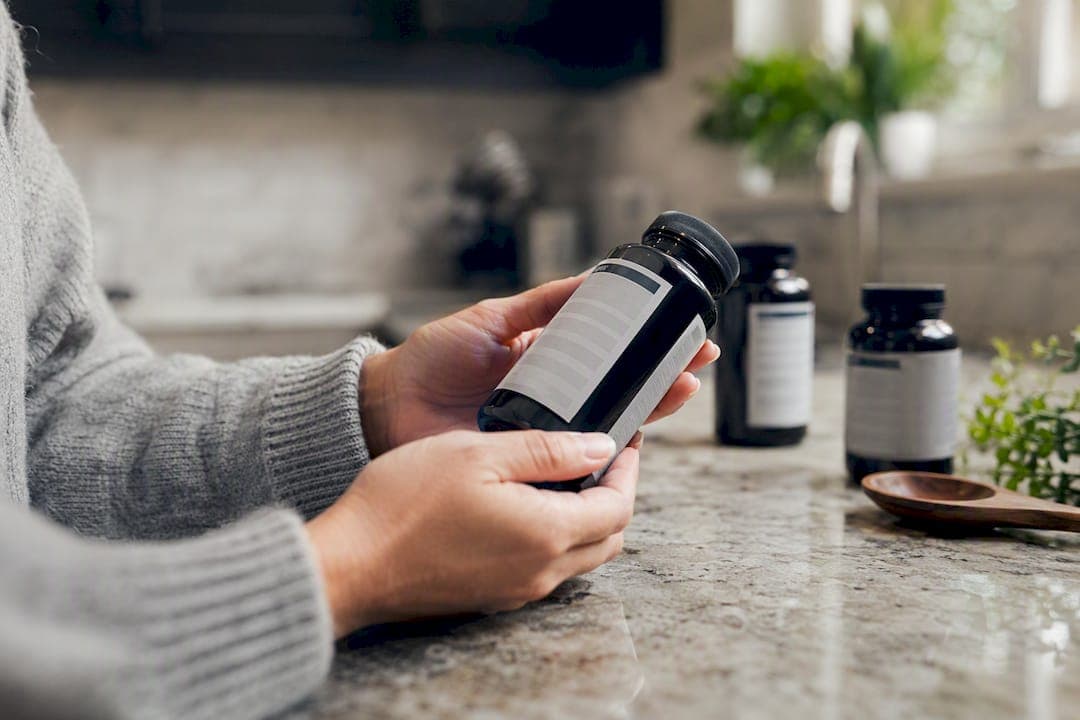
Check three things before you trust any supplement bottle: the serving size and amount per serving, whether the ingredients are fully disclosed or hidden behind a proprietary blend, and whether a third-party seal backs up what's printed. Do that, and you'll catch most of the problems that trip up even careful shoppers.
More than half of American adults take a dietary supplement regularly, yet most never open the NIH's Dietary Supplement Label Database (DSLD) to confirm what's actually inside the bottle they bought. The label itself is regulated by the FDA, but "regulated" doesn't mean every claim on the front is checked before it hits the shelf. That's on you.
Here's the checklist to save or screenshot:
- Serving size and servings per container
- Amount per serving, with units (mg, mcg, IU)
- % Daily Value, where it applies
- Whether ingredients hide inside a proprietary blend
- Other ingredients: fillers, binders, colorants
- Allergen statement (and its limits)
- Expiration date and storage instructions
- Third-party seal (USP, NSF, Informed-Sport) and manufacturer contact info
Key Takeaways
Reading a supplement label correctly comes down to checking serving size, verifying full ingredient disclosure, and confirming third-party testing before you trust any health claim.
| Point | Details |
|---|---|
| Start with serving size | Every number on the Supplement Facts panel is calculated per serving, not per bottle. |
| Watch for proprietary blends | A blend hides individual ingredient amounts behind one combined weight figure. |
| Match units carefully | Mg, mcg, and IU aren't interchangeable, and mismatched units distort potency comparisons. |
| Verify before you buy | Search the NIH DSLD or check for USP or NSF seals before trusting front-label claims. |
| Use Nutrasmarts to speed checks | Its free Supplement Facts Tool and compare feature let you verify labels and dosing in minutes. |
Where to Verify a Label Beyond This Guide
- NIH DSLD: confirm a product's actual printed label and past versions
- FDA Dietary Supplement Labeling Guide: check what claims are legally allowed
- 21 CFR Part 111: understand the manufacturing standards behind a COA
- PubMed: read the primary clinical evidence for a specific ingredient
- USP.org: verify whether a seal on your bottle is legitimate
This article is general information, not a substitute for advice from a qualified doctor. Consult a qualified healthcare professional about your own circumstances before acting on anything here.
Table of Contents
- How to Decode Supplement Ingredient Labels From the Outside In
- How Do You Read the Supplement Facts Panel Line by Line?
- Active Ingredients, Fillers, and the Allergens Hiding in Plain Sight
- Why Proprietary Blends Make Label Reading Harder
- What Quality Seals Actually Mean, and What They Don't
- Where to Verify a Product Before You Trust the Label
- The 60-Second Label Scan You Can Do in the Store
- Regulatory Differences by Supplement Type and Country
- Sources
How to Decode Supplement Ingredient Labels From the Outside In
Every legally sold dietary supplement in the US carries the same skeleton, even when the marketing on the front looks nothing alike bottle to bottle. The FDA's labeling guide spells out six required pieces: a statement of identity (what the product actually is), net quantity of contents, the Supplement Facts panel, directions for use, any required warnings, and the name and address of the manufacturer, packer, or distributor.
The statement of identity usually sits at the top of the front label, often in the largest type. Net quantity, oddly, tends to hide in small print near the bottom front, expressed as capsule count or weight. Flip the bottle and you'll find the Supplement Facts panel front and center on the back or side, with the manufacturer's contact information and any lot number or expiration date typically printed near the bottom edge or on the cap.
Two terms confuse people constantly. "Statement of identity" just means the product's common name, like "Fish Oil" or "Magnesium Glycinate," not a branded product name. "Net quantity" refers to the total contents, not the recommended dose.
Pro Tip: If you can't find a physical address for the manufacturer, only a website or a PO box, treat that as a yellow flag worth investigating before you buy.
How Do You Read the Supplement Facts Panel Line by Line?
The Supplement Facts panel looks intimidating until you break it into four steps.
- Check serving size and servings per container first. Every number below this line is calculated per serving, not per bottle or per day, so a 60-capsule bottle with a 2-capsule serving size only lasts 30 days.
- Read the amount per serving and its unit. Milligrams (mg), micrograms (mcg), and international units (IU) are not interchangeable, and mixing them up is how people accidentally double or halve a dose when comparing two products.
- Check the % Daily Value where it appears. The FDA requires %DV for nutrients with an established daily value, but many "other dietary ingredients," like herbal extracts or novel compounds, have no established DV and legally show a dagger symbol instead.
- Look for indented, or "child," ingredients. Fish oil labels commonly list EPA and DHA indented beneath the main "Fish Oil" line. Those sub-amounts tell you the actual active dose, which is often a fraction of the total fish oil weight.
Comparing potency across brands gets tricky fast when one lists 1,000 mg of turmeric and another lists 95% curcuminoids at 200 mg. The bigger number on the label isn't automatically the stronger product.
Active Ingredients, Fillers, and the Allergens Hiding in Plain Sight
The Supplement Facts panel covers active dietary ingredients. Everything else, binders, fillers, colorants, and capsule material, gets grouped into an "Other Ingredients" line below it, listed in descending order by weight the same way food ingredient lists work.
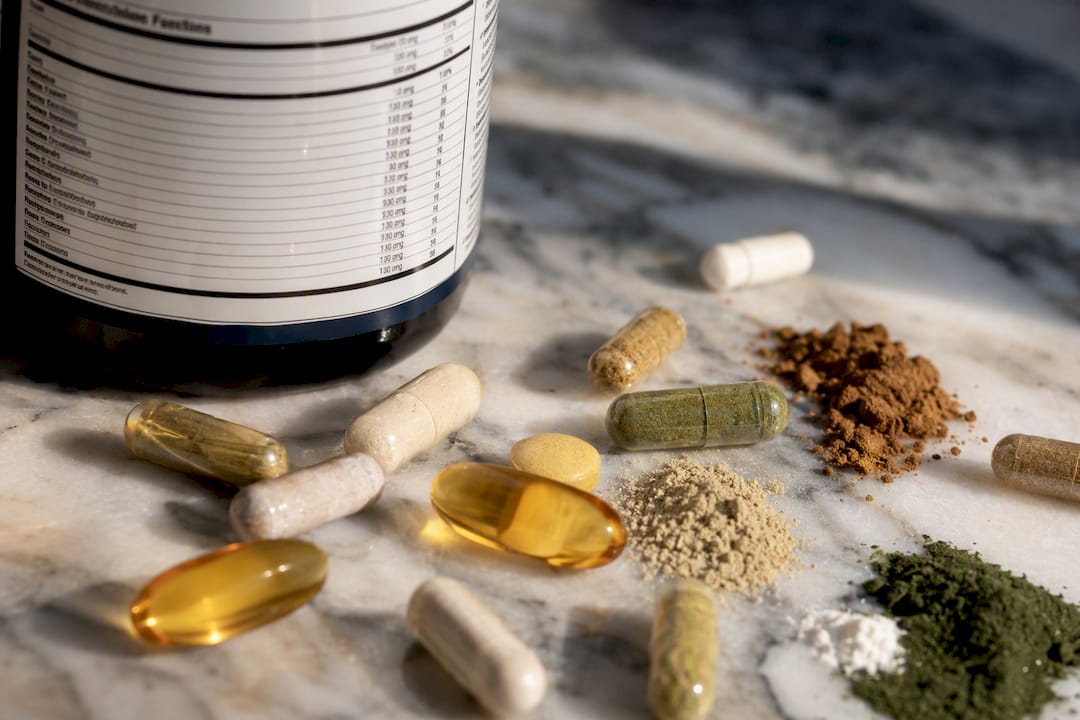
Common additives worth a second look include magnesium stearate (a lubricant that helps machines fill capsules), maltodextrin (a cheap filler and carbohydrate carrier), and titanium dioxide (a whitening agent facing increasing scrutiny in food products). None are inherently dangerous at typical doses, but if you're avoiding unnecessary additives, they're worth scanning for.
Allergen statements only cover the major recognized allergens, and cross-contamination from shared manufacturing equipment isn't always disclosed. Terms like "whole food" or "all-natural" carry no legal definition and can still sit atop a formula full of synthetic fillers, a pattern Consumer Reports has flagged repeatedly in its label investigations.
Pro Tip: Read the "Other Ingredients" line before you read the marketing claims on the front. It tells you more about formulation quality in five seconds than the whole front label combined.
Why Proprietary Blends Make Label Reading Harder
A proprietary blend lets a manufacturer list a combined total weight for several ingredients, say, "Energy Blend: 500 mg," without breaking out how much of that 500 mg is caffeine versus how much is a cheaper filler herb. It's legal. It's also the single biggest obstacle to comparing two products honestly.
When you hit a blend, here's how to respond:
- Favor competing products that disclose individual ingredient amounts instead.
- Contact the manufacturer directly and ask for a Certificate of Analysis (COA), which shows tested amounts per batch.
- Check whether a third-party seal covers the product, since testing bodies often verify blend contents even when the label doesn't break them out.
- Cross-reference dosing against published ranges from NIH or FDA resources before assuming a blend delivers a clinically relevant amount of anything.
Safe upper limits matter here too. Fat-soluble vitamins (A, D, E, K) accumulate in the body and carry real overdose risk at high doses, and several herbal ingredients interact with common medications like blood thinners. Pregnant readers, parents dosing children, and anyone on prescription medication should treat a proprietary blend as a reason to call a doctor first, not push through. Airmed Fit breaks down how to evaluate blend transparency in more detail if you want a deeper walkthrough.
Pro Tip: Request the COA before you buy, not after. Reputable manufacturers usually have one ready to send within a day.
What Quality Seals Actually Mean, and What They Don't
Three seals show up most often on credible supplement labels: USP Verified, NSF International certification, and Informed-Sport (common on sports nutrition products). Each tests something slightly different, and knowing the difference matters.
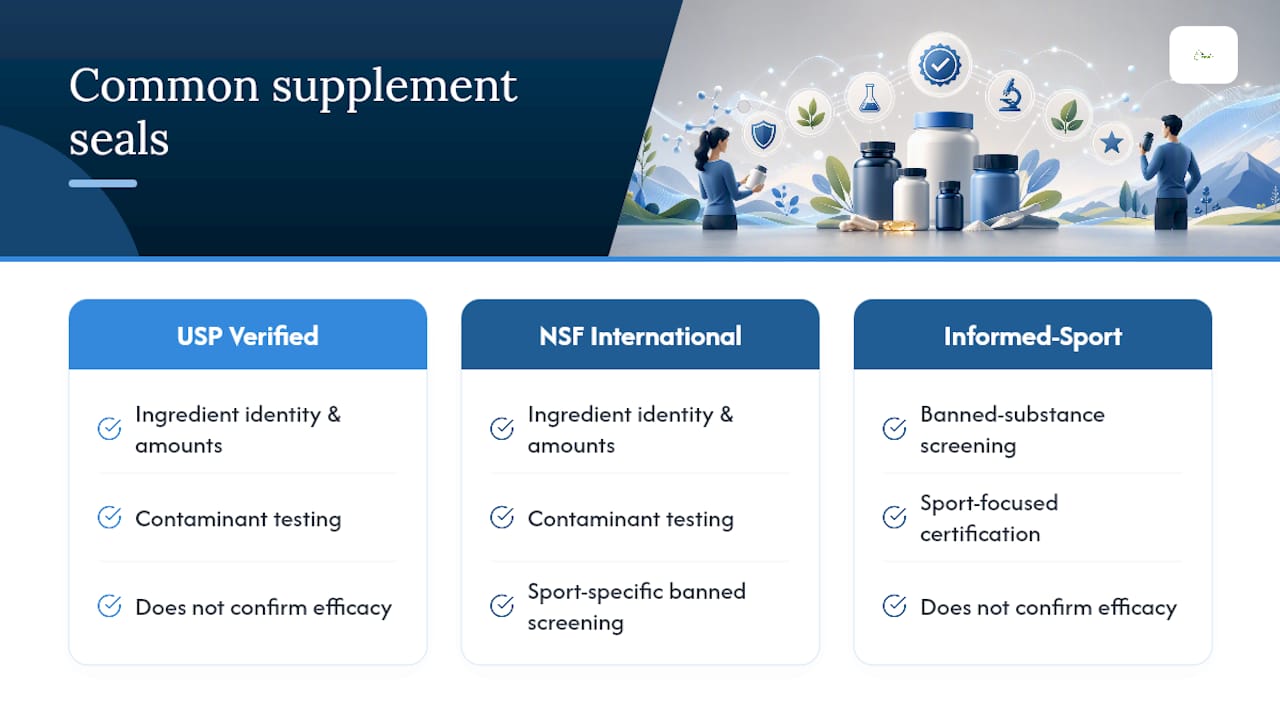
USP Verified confirms the product contains what the label says, in the stated amounts, and that it's free from harmful contaminant levels. NSF International runs similar identity and contaminant testing, with a sport-specific certification that screens for banned athletic substances. Informed-Sport focuses specifically on screening against the list of substances banned in competitive sport.
None of these seals guarantee the product actually works for your specific health goal. That's a separate question the seal was never designed to answer.
Watch for these red flags regardless of what's stamped on the front: undisclosed proprietary blends, sweeping claims like "cures" or "treats" (illegal under FDA rules for supplements), the phrase "FDA registered" used to imply approval (the FDA doesn't approve supplements before sale), and any mismatch between the Supplement Facts panel and the claims splashed across the front label. A missing lot number or manufacturer address belongs on that list too.
Where to Verify a Product Before You Trust the Label
The NIH DSLD catalogs actual label images and full printed information for more than 200,000 US supplement products, searchable by ingredient or brand name. It's the fastest way to confirm a bottle in your cabinet matches what's publicly on file, including past label versions if a formula changed.
Pair that with the FDA's own labeling guidance when a claim seems too specific for a supplement to legally make, and PubMed when you want the actual clinical evidence behind an ingredient rather than a marketing summary of it. Nutrasmarts' ingredient profiles link amounts directly to the underlying clinical citations, so you can skip the search entirely for many common ingredients.
- DSLD: confirm what's printed matches the public record
- FDA guidance: check whether a claim is legally permitted
- PubMed: dig into the actual clinical evidence
- Nutrasmarts compare tool: check two products side by side in seconds
Pro Tip: Search DSLD by brand name before you buy anything new. If the product isn't listed, that's not automatically disqualifying, but it's worth an extra five minutes of research.
The 60-Second Label Scan You Can Do in the Store
- Check the serving size and servings per container.
- Scan active ingredient amounts and confirm the units.
- Look for a proprietary blend line.
- Find the third-party seal, manufacturer contact, and lot number.
- Check for allergen or special-population warnings.
Manufacturer contact info almost always sits bottom right on the back label. If you hit a proprietary blend or missing amounts anywhere in the scan, stop and research further before buying.
Regulatory Differences by Supplement Type and Country
US dietary supplements fall under a different regulatory framework than drugs or conventional food, and that distinction shapes everything on the label. The FDA doesn't approve supplements for safety or effectiveness before they reach shelves. Manufacturers are responsible for ensuring their products are safe and that label claims are truthful, with the FDA acting after the fact if problems surface. Manufacturing itself is still governed by federal rules, specifically 21 CFR Part 111, which sets good manufacturing practice standards covering quality control, testing, and recordkeeping.
Disclosure requirements shift depending on what's inside the bottle. Botanical and herbal products often require a Latin binomial name alongside the common name. Products containing New Dietary Ingredients, ones not marketed in the US before 1994, carry additional notification requirements before sale. Sports nutrition products marketed toward athletes face heavier scrutiny around banned-substance contamination, which is why Informed-Sport certification exists specifically for that category.
Outside the US, frameworks diverge sharply. The European Union classifies many supplement ingredients under food supplement directives with different maximum dose limits than the US allows, particularly for vitamins A and D. Canada regulates supplements as Natural Health Products, requiring a specific product license number on the label. If you're buying from an international retailer or an ingredient sourced overseas, don't assume US labeling rules or dosage limits apply. Check the country of origin's own regulatory body, or stick to products manufactured and labeled for the US market where you already know the disclosure rules.
Why label literacy is the real safety net
Reading a label carefully catches problems no regulator catches for you: duplicate dosing across two products, an allergen buried in "other ingredients," a blend hiding an underdosed active compound. Nutrasmarts built its ingredient database and comparison tools around that exact gap, tying every profile back to the clinical evidence so you're not guessing at what a number on a bottle actually means for your body.
Check a Label in Minutes, Not Hours
Cross-referencing serving sizes, unit conversions, and blend disclosures by hand takes real time, and most people give up halfway through the second product. Nutrasmarts built its free Supplement Facts Tool to generate an FDA-compliant panel without a spreadsheet, and the same database powers a side-by-side compare tool so you can put two labels next to each other and see exactly where the amounts, units, and blends differ.
The features that matter for label checks: instant FDA-compliant formatting, direct links to the clinical citation behind each ingredient, and a comparison view that flags unit mismatches automatically. If you're trying to figure out which product actually delivers a clinically relevant dose, start with the metabolic health picks already screened against these same standards, or run your own comparison on the compare page before you check out anywhere else.
Sources
- Dietary Supplement Label Database (DSLD) — Office of Dietary Supplements, NIH
- Dietary Supplement Labeling Guide — Chapter I: General dietary supplement labeling — FDA
- 21 CFR Part 111 — Current Good Manufacturing Practice in Manufacturing, Packaging, Labeling, or Holding Operations for Dietary Supplements — eCFR
- How to read dietary supplement labels and interpret the USP Verified mark — USP
- How to Decode Dietary Supplement Labels — Consumer Reports