

Pregnenolone is the "mother" steroid your body makes first from cholesterol, while DHEA is a downstream prohormone made from it several steps later. Pick pregnenolone when the goal is neurosteroid or cognitive support, and DHEA when you need an androgen or estrogen precursor boost, particularly with age-related decline. Neither should go into your routine without a baseline blood test and a conversation with a clinician, since both interact with hormone-sensitive conditions and common medications.
TL;DR:
- DHEA supplementation produces more predictable effects on androgen and estrogen levels, especially in individuals with confirmed low DHEA-S from lab tests.
- Pregnenolone's primary benefit is thought to be neurosteroid activity, but its effect on DHEA levels is limited due to enzymatic regulation at CYP17A1.
- Both hormones carry hormone-sensitive cancer risks, requiring caution and consultation with a healthcare professional before use, especially with personal or family cancer history.
- The evidence for DHEA is stronger in deficiency states like adrenal insufficiency and postmenopause, while pregnenolone's research is mainly limited to neuropsychiatric conditions.
- Dosing should start low with baseline blood tests and rechecked after 6 to 12 weeks, avoiding assumptions that higher doses lead to greater benefits without laboratory confirmation.
Table of Contents
- DHEA vs. Pregnenolone: How Your Body Makes Each One
- Pregnenolone or DHEA: Side-by-Side Differences That Matter
- What the Clinical Trials Actually Show
- Which One Fits Your Symptoms and Lab Results
- Side Effects, Contraindications, and Drug Interactions
- Dosing Ranges Used in Studies and What to Monitor
- How to Trial DHEA or Pregnenolone Safely
- Where to Verify Doses and Study Citations
- Why Testing Beats Guessing With Precursor Hormones
- Research Your Next Step Before You Buy Anything
- Sources
- FAQ
DHEA vs. Pregnenolone: How Your Body Makes Each One
Every steroid hormone in your body, from cortisol to testosterone, starts as cholesterol. The conversion happens in a strict sequence, and understanding it explains why pregnenolone and DHEA behave so differently even though one turns into the other.
Cholesterol gets pulled into the mitochondria of steroid-producing cells, where the enzyme CYP11A1 converts it into pregnenolone. This step is often called the "committed step" in steroidogenesis because once cholesterol crosses this threshold, the cell is set on a hormone-production path. A protein called StAR (steroidogenic acute regulatory protein) handles the actual transport of cholesterol across the mitochondrial membrane so CYP11A1 can do its job.
From there, pregnenolone can go one of several directions. One route sends it toward progesterone and eventually cortisol or aldosterone. Another route runs it through the enzyme CYP17A1, which performs two separate reactions: first 17-alpha-hydroxylation, then a 17,20-lyase cleavage that produces DHEA. This two-step enzymatic gate matters more than most supplement marketing admits. Taking pregnenolone does not guarantee your body will push it toward DHEA, since CYP17A1 activity is tightly regulated and can send the molecule toward cortisol production instead.
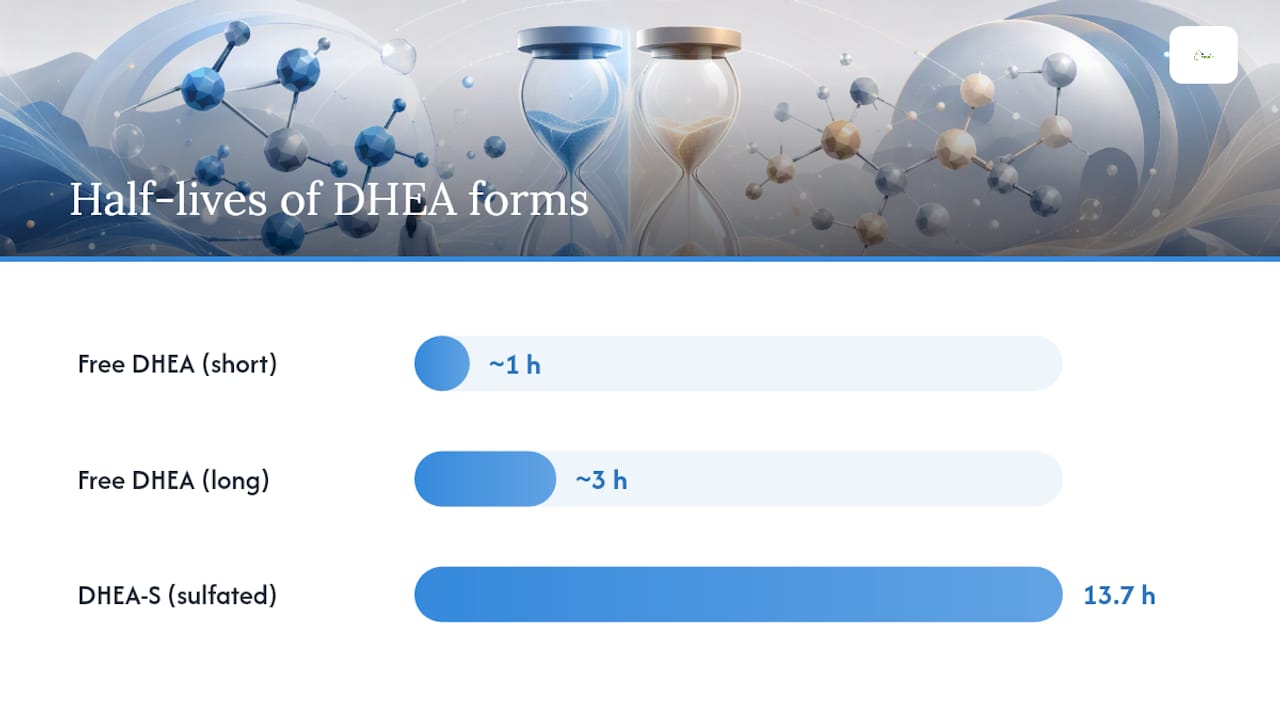
DHEA does not stay in its original form for long. Most of it gets sulfated by the enzyme SULT2A1 into DHEA-S, a more stable circulating version. This distinction shows up clearly in blood chemistry: free DHEA has a half-life of roughly 1 to 3 hours, while DHEA-S sticks around for about 13.7 hours, which is why lab panels almost always measure DHEA-S rather than DHEA itself.
Production happens in three main locations:
- Adrenal glands (specifically the zona reticularis) produce most circulating DHEA and DHEA-S in adults.
- Gonads (ovaries and testes) contribute additional DHEA and downstream sex steroids.
- The brain synthesizes both pregnenolone and DHEA locally as neurosteroids, independent of adrenal or gonadal output, which is part of why pregnenolone gets so much attention in cognitive research.
Age changes this picture dramatically. DHEA and DHEA-S peak in your 20s, then decline steadily, dropping to roughly 20% of peak levels by age 70. Researchers sometimes call this pattern "adrenopause" to distinguish it from menopause, since it tracks adrenal output rather than reproductive hormone shifts. Pregnenolone follows a similar downward trend, though it's measured far less often in routine labs, which makes tracking its decline harder for the average patient.
Pregnenolone or DHEA: Side-by-Side Differences That Matter
Once you see the biochemistry laid out, the practical differences between these two hormones become easier to map onto actual health decisions.
The biggest conceptual difference is direction of effect. Pregnenolone acts substantially through neurosteroid pathways, modulating receptors like GABA-A directly in brain tissue rather than needing to convert into another hormone first. DHEA, by contrast, mostly works as raw material. Your peripheral tissues, skin, fat, muscle, convert it locally into testosterone or estrogen depending on which enzymes are present in that tissue, a process researchers call intracrinology.
This explains a pattern that confuses a lot of people:
- Pregnenolone supplementation does not reliably raise DHEA levels, because the CYP17A1 gate controls how much gets converted versus how much stays in the cortisol pathway.
- DHEA supplementation sits closer to the sex steroid finish line, so its effects on androgen and estrogen levels tend to be more direct and more predictable.
- Side effects mirror this difference. DHEA more often produces androgenic effects (acne, oily skin) because it's closer to testosterone in the chain. Pregnenolone side effects tend to look more neurological (headache, overstimulation, sleep disruption).
If you're weighing DHEA vs. pregnenolone for a specific goal, the cascade position basically tells you what to expect. Pregnenolone is a wildcard with brain-focused upside. DHEA is a more targeted lever on androgen and estrogen status.
What the Clinical Trials Actually Show
Evidence quality is where these two hormones diverge sharply, and it's worth being honest about that gap rather than treating them as interchangeable "anti-aging" supplements.
DHEA has the larger body of randomized controlled trial evidence, particularly for two populations: adrenal insufficiency patients, whose adrenal glands cannot produce adequate DHEA on their own, and postmenopausal women, where declining ovarian and adrenal output leaves DHEA-S levels low. Results in adrenal insufficiency trials show reasonably consistent improvements in mood and well-being. Results in healthy aging populations are considerably murkier: some trials show modest benefits in bone density or sexual function, others show no measurable difference from placebo. DHEA's randomized trial literature for physical aging endpoints is genuinely larger than pregnenolone's, but "larger" doesn't mean "settled." Effects appear highly dependent on baseline DHEA-S levels, meaning someone who starts with already-normal levels is unlikely to see the same response as someone with a documented deficiency.
Trials of DHEA in adrenal insufficiency and postmenopausal populations show more consistent benefit signals than trials in otherwise healthy adults with normal baseline levels, a pattern researchers attribute partly to variable baseline hormone status across study populations.
Pregnenolone's evidence base is smaller and more concentrated in neuropsychiatric research. Because of its neurosteroid activity, researchers have studied pregnenolone as an adjunct treatment in schizophrenia, with some trials reporting improvements in cognitive symptoms and negative symptom scores. These studies are promising but limited: sample sizes tend to run small, dosing protocols vary widely between trials, and endpoints are inconsistent enough that meta-analysis is difficult. Cognitive and mood claims for pregnenolone in healthy, non-clinical populations rest on even thinner evidence than the schizophrenia research.
A few patterns cut across both hormones:
- Small sample sizes are common in both literatures, which limits how confidently results generalize to the broader population.
- Dosing protocols vary enormously between studies, sometimes by a factor of ten, making cross-trial comparison unreliable.
- Endpoints differ so much (mood scales, cognitive batteries, bone density scans, hormone panels) that "DHEA works" or "pregnenolone works" oversimplifies a genuinely mixed picture.
The practical takeaway: DHEA has clearer evidence for specific, lab-confirmed deficiency states. Pregnenolone has interesting but preliminary signals for brain-related outcomes. Neither has strong support for general anti-aging use in someone with normal baseline hormone levels.
Which One Fits Your Symptoms and Lab Results
Matching the right supplement to the right situation comes down to what your labs show and what symptoms brought you here in the first place.
- Choose DHEA when your labs show low DHEA-S alongside symptoms like reduced libido, fatigue, or concerns about bone density, particularly if you're a postmenopausal woman or an older adult with adrenal output on the low end of normal.
- Choose pregnenolone when cognitive complaints dominate and there's a plausible neurosteroid rationale, such as difficulty with focus or mood regulation that hasn't responded to more established interventions, and when you understand the evidence is still preliminary.
- Consider both together only under clinician guidance, and understand that stacking them doesn't guarantee additive benefit, since pregnenolone's conversion to DHEA depends on CYP17A1 activity your supplement dose cannot control.
- Avoid automatic stacking based on the assumption that "more precursor equals more hormone." The enzymatic gate between pregnenolone and DHEA means your body decides how much conversion actually happens, not your dosing schedule.
Baseline labs aren't optional here. Guessing at hormone status based on symptoms alone routinely leads people to supplement in the wrong direction, sometimes worsening the exact issue they were trying to fix.
Side Effects, Contraindications, and Drug Interactions
Both hormones carry real risks, and the risk profile differs enough that lumping them together does readers a disservice.
DHEA's side effects track its conversion into androgens: acne, oily skin, and androgenic hair thinning show up most often, along with menstrual cycle changes in women. Because DHEA converts into estrogen as well as testosterone, some users report breast tenderness or mood shifts. Pregnenolone's side effects lean neurological instead, headache, insomnia, and irritability or overstimulation at higher doses, consistent with its direct action on brain receptors rather than peripheral hormone conversion.
The most serious contraindication applies to both: hormone-sensitive cancers. Anyone with a personal or strong family history of breast, ovarian, uterine, or prostate cancer should not take either supplement without direct specialist guidance, since both can theoretically feed hormone-driven tumor growth. Mayo Clinic's clinical summary flags this concern specifically for DHEA, and the same caution reasonably extends to pregnenolone given its role as a DHEA precursor.
Drug interactions deserve attention too:
- Anticoagulants like warfarin can interact with DHEA, altering bleeding risk.
- Diabetes medications may need dose adjustment, since DHEA can affect insulin sensitivity.
- Antidepressants and other psychiatric medications may interact with pregnenolone given its neurosteroid activity, sometimes amplifying or blunting drug effects.
Pro Tip: Bring a full medication list, including anything psychiatric or cardiovascular, to the appointment where you discuss starting DHEA or pregnenolone. A five-minute interaction check can prevent months of confusing side effects that get blamed on the wrong cause.
On the regulatory side, both compounds are sold over the counter in the United States as dietary supplements under the Dietary Supplement Health and Education Act framework, which means neither has gone through FDA drug approval for safety or efficacy the way a prescription hormone therapy has. That doesn't make them unsafe, but it does mean the burden of due diligence, checking doses, watching for interactions, tracking labs, falls more heavily on you and your clinician than it would with a regulated pharmaceutical.
Dosing Ranges Used in Studies and What to Monitor
Trial doses give you a rough map, but they're not a prescription, since study populations and your individual physiology rarely match perfectly.
- DHEA trials commonly use 25 to 50 mg per day, a range that shows up repeatedly across adrenal insufficiency and postmenopausal studies. Doses above this range appear more often in short-term research settings and carry a higher risk of androgenic side effects.
- Pregnenolone trial doses vary far more widely, ranging from roughly 10 to 100 mg per day depending on the study and the condition being treated. This wide spread makes extrapolation risky. What worked in a schizophrenia trial at a specific dose says little about what an appropriate dose looks like for general cognitive support.
- Order baseline labs before starting either one: DHEA-S, pregnenolone (if your lab offers it), total testosterone, estradiol, and sex hormone binding globulin (SHBG). These give you a real starting point instead of a guess.
- Recheck labs at 6 to 12 weeks after starting supplementation, adjusting dose based on both lab movement and symptom changes rather than either one alone.
Starting low and reassessing beats starting at the high end of a trial dose and hoping for the best. Document any new symptoms as you go, since supraphysiologic dosing (pushing levels well above your body's natural range) is where most avoidable side effects originate.
How to Trial DHEA or Pregnenolone Safely
A structured approach protects you from the most common mistake people make with either supplement: starting without a baseline and having no way to tell if it's actually working.
- Map your symptoms and order baseline labs first. Ask for DHEA-S, pregnenolone if available, total testosterone, estradiol, and SHBG before taking a single dose. This step alone prevents the guesswork that leads most people astray.
- Make the decision alongside your clinician, and start at the low end of the studied dose range. Bring your lab results and current medication list to that conversation.
- Keep a simple symptom diary and schedule a lab recheck at 6 to 12 weeks. Track sleep, mood, energy, and any new skin or hair changes, then compare against your follow-up labs.
- Set clear stopping criteria in advance. New acne, mood changes, sleep disruption, or lab values moving outside normal range are signals to stop or reduce dose. Persistent symptoms without lab improvement after 12 weeks are a signal to escalate to specialist referral rather than increasing dose on your own.
Pro Tip: Write your stopping criteria down before you start, not after something goes wrong. Deciding "I'll stop if X happens" while you're symptom-free is a much clearer decision than trying to reason it out while you're already dealing with side effects.
Where to Verify Doses and Study Citations
Checking a supplement claim against the actual research shouldn't require a university login or an afternoon lost in database searches.
Nutrasmarts maintains study-linked ingredient profiles for both DHEA and pregnenolone, each built around PubMed-cited trials rather than marketing copy. These pages break down typical studied doses, evidence strength ratings, and known interactions in one place, so you're not piecing together conclusions from scattered forum posts.
If you're trying to figure out whether your actual symptoms point toward DHEA, pregnenolone, or something else entirely, the symptom-to-supplement search tool maps common complaints, low energy, brain fog, joint discomfort, to ingredients with documented evidence behind them. And if you're on the formulation side rather than the consumer side, the free Supplement Facts label creator helps verify that a dose on a label actually matches FDA labeling conventions, useful if you're evaluating a product before buying it.
None of this replaces a conversation with your clinician. It's a research layer that sits underneath that conversation, giving you sourced information to bring to the appointment instead of walking in with only what a product page told you.
Why Testing Beats Guessing With Precursor Hormones
The supplement industry has a habit of treating "precursor" as a synonym for "safe and predictable." Pregnenolone and DHEA prove that's not how steroidogenesis works. The enzymatic gate at CYP17A1 means pregnenolone supplementation is genuinely unpredictable in where it ends up, and that unpredictability gets glossed over in most marketing copy.
Our editorial stance at Nutrasmarts leans firmly toward lab-based decision making over unsupervised trial and error. DHEA has enough randomized trial evidence in specific deficiency states that a lab-confirmed low DHEA-S reading makes supplementation a reasonable, informed choice. Pregnenolone's neuropsychiatric research is genuinely interesting, but it's early, and treating it as a general cognitive enhancer outpaces what the current trials actually support.
What the field needs most is more rigorous, adequately powered pregnenolone trials outside psychiatric populations. Until that evidence catches up, the responsible path is testing first, starting low, and letting your own lab numbers, not a product label, guide the decision.
— NutraSmarts
Research Your Next Step Before You Buy Anything
Most supplement decisions get made backward: buy first, wonder later whether the dose or the hormone even matched what your body needed. This site prioritizes providing study citations and dosage benchmarks upfront, before any purchase decisions.

If DHEA-S came back low on your labs and you're now comparing options, the Compare Supplements tool lets you put ingredients side by side using the same evidence ratings and dosage data referenced throughout this article, rather than relying on whichever brand has the flashiest packaging. Pair that with the deficiency symptom guide if you're still not sure which hormone or nutrient gap is actually driving your symptoms. None of this substitutes for bloodwork or a clinician's judgment, but it does mean you walk into that appointment already knowing what the research says. Start by pulling up the DHEA ingredient profile and checking your symptoms against the documented evidence before you spend a dollar on either compound.
Sources
For readers who want to go deeper than this comparison, a few sources stand out by audience:
- The Sex Hormone Precursors Dehydroepiandrosterone (DHEA) and Its Sulfate Ester Form (DHEAS): Molecular Mechanisms and Actions on Human Body - PMC
- Dietary Supplements | FDA
- DHEA - Mayo Clinic
This article is general information, not a substitute for advice from a qualified doctor. Consult a qualified healthcare professional about your own circumstances before acting on anything here.
FAQ
Is DHEA or pregnenolone better?
Neither is universally "better." DHEA has stronger trial evidence for lab-confirmed deficiency states like adrenal insufficiency and postmenopausal decline, while pregnenolone shows more promise for neurosteroid and cognitive applications with thinner evidence overall.
Can you take pregnenolone and DHEA together?
Some people take both under clinician supervision, but stacking them doesn't guarantee more DHEA production, since the CYP17A1 enzyme controls how much pregnenolone actually converts. Baseline labs and medical guidance should drive that decision, not the assumption that more precursor automatically means more benefit.
Who should not take pregnenolone?
Anyone with a personal or family history of hormone-sensitive cancers (breast, ovarian, prostate), or anyone on psychiatric medication without clinician oversight, should avoid pregnenolone without specialist guidance given its neurosteroid activity and unpredictable downstream conversion.
What happens if a woman takes DHEA?
DHEA converts into both testosterone and estrogen in peripheral tissue, so women may notice androgenic effects like acne, oily skin, or menstrual cycle changes, effects Mayo Clinic documents as common side effects worth discussing with a clinician before starting, particularly for women with normal baseline DHEA-S levels.