

B vitamins are defined as water-soluble coenzymes that enable the body to convert carbohydrates, fats, and proteins into ATP, the cellular energy molecule that powers every biological function. The role of B vitamins in energy metabolism is not to supply calories directly but to act as biochemical tools that keep metabolic pathways running. Without them, the body cannot extract usable energy from food, no matter how much you eat. Understanding how each B vitamin contributes to this process is the foundation of any serious approach to sustained energy and vitality.
How do B vitamins function in energy metabolism pathways?
B vitamins act as coenzymes in glycolysis, the Krebs cycle, and the electron transport chain. Each stage of cellular respiration requires a different set of B vitamin cofactors to proceed. Remove any one of them, and the entire energy production network slows or stalls.
Here is how the major B vitamins divide the work:
- Thiamine (B1) activates the pyruvate dehydrogenase complex, the enzyme that converts pyruvate from glucose into acetyl-CoA for entry into the Krebs cycle. Without B1, carbohydrate metabolism hits a wall before it even reaches the cycle.
- Riboflavin (B2) serves as the precursor to FAD and FMN, two coenzymes that carry electrons through the electron transport chain. FAD is the molecule that directly feeds electrons into the chain to generate ATP.
- Niacin (B3) is the backbone of NAD+ and NADP+, the most critical electron carriers in the body. Niacin participates in over 400 enzymatic reactions needed for ATP production. That number reflects how central NAD+ is to nearly every metabolic process in the cell.
- Pantothenic acid (B5) is essential for synthesizing coenzyme A, the molecule that shuttles acetyl groups into the Krebs cycle and drives fatty acid oxidation. No coenzyme A means no fat burning and no Krebs cycle entry.
- Biotin (B7) activates carboxylase enzymes that metabolize fatty acids and amino acids. It is particularly important for gluconeogenesis, the process of making glucose from non-carbohydrate sources when dietary carbs are low.
- Folate (B9) and B12 work together to recycle homocysteine back into methionine, supporting DNA synthesis and the production of red blood cells that carry oxygen to metabolizing tissues.
Pro Tip: B vitamins are metabolic helpers, not fuel. Think of them as the spark plugs in an engine. The gasoline is your food. Without the spark plugs, the fuel sits unused, but adding more spark plugs to a full engine does nothing extra.
What are the effects of B vitamin deficiency on energy and fatigue?

B vitamin deficiency produces fatigue faster than most people expect, and it often goes unrecognized because the symptoms overlap with dozens of other conditions. Subclinical deficiencies are frequently missed in clinical settings because fatigue, brain fog, and low motivation do not point directly to a nutritional cause.
The numbers on B12 alone are striking. B12 deficiency affects approximately 6% of adults under 60 and over 20% of adults aged 60 and older. That means one in five older adults is walking around with a deficiency that directly limits their capacity to produce cellular energy.
The mechanism behind fatigue is not just about ATP. Elevated homocysteine from folate and B12 deficits directly correlates with increased physical fatigue and lower motivation in healthy adults, according to research from Osaka Metropolitan University published in may 2026. Homocysteine buildup is a metabolic signal that the methylation cycle is broken, and the downstream effects reach the nervous system.
Groups at highest risk include:
- Adults over 60, due to reduced intrinsic factor production and lower stomach acid needed to absorb B12
- Vegans and vegetarians, who lack dietary B12 from animal products
- People with Crohn's disease, celiac disease, or other malabsorption conditions
- Individuals taking metformin or proton pump inhibitors, both of which deplete B12
Recovery from deficiency-induced fatigue typically occurs within 2–4 weeks for most B vitamins. B12 cases involving neurological damage take considerably longer and require clinical supervision.
Pro Tip: If you have been fatigued for months and a standard blood panel came back normal, ask your doctor to test serum B12, methylmalonic acid, and homocysteine specifically. Standard panels often miss subclinical deficiency. You can also search by symptom on Nutrasmarts to identify which deficiencies match your specific presentation.
How do B vitamins differ in sources, absorption, and supplementation?
Dietary sources of B vitamins split sharply between animal and plant foods, and that divide matters for anyone managing their intake intentionally.
| B Vitamin | Best Food Sources | Absorption Notes | Supplementation Notes |
|---|---|---|---|
| B1 (Thiamine) | Pork, legumes, whole grains | Reduced by alcohol and heat | Rarely needed unless alcoholism or bariatric surgery |
| B2 (Riboflavin) | Dairy, eggs, lean meats | Light-sensitive; destroyed by UV exposure | Generally adequate from diet in omnivores |
| B3 (Niacin) | Chicken, tuna, peanuts | Tryptophan converts to niacin as backup | High-dose forms require medical supervision |
| B5 (Pantothenic acid) | Avocado, sunflower seeds, liver | Widely distributed; deficiency is rare | Rarely supplemented alone |
| B7 (Biotin) | Eggs, nuts, salmon | Raw egg whites block absorption | Popular in hair/nail supplements; evidence for energy is limited |
| B9 (Folate) | Leafy greens, legumes, fortified grains | Methylfolate form is better absorbed than folic acid | Critical during pregnancy; MTHFR gene variants affect conversion |
| B12 (Cobalamin) | Meat, fish, dairy, eggs | Requires intrinsic factor; declines with age | Methylcobalamin form preferred; active B12 is better retained |
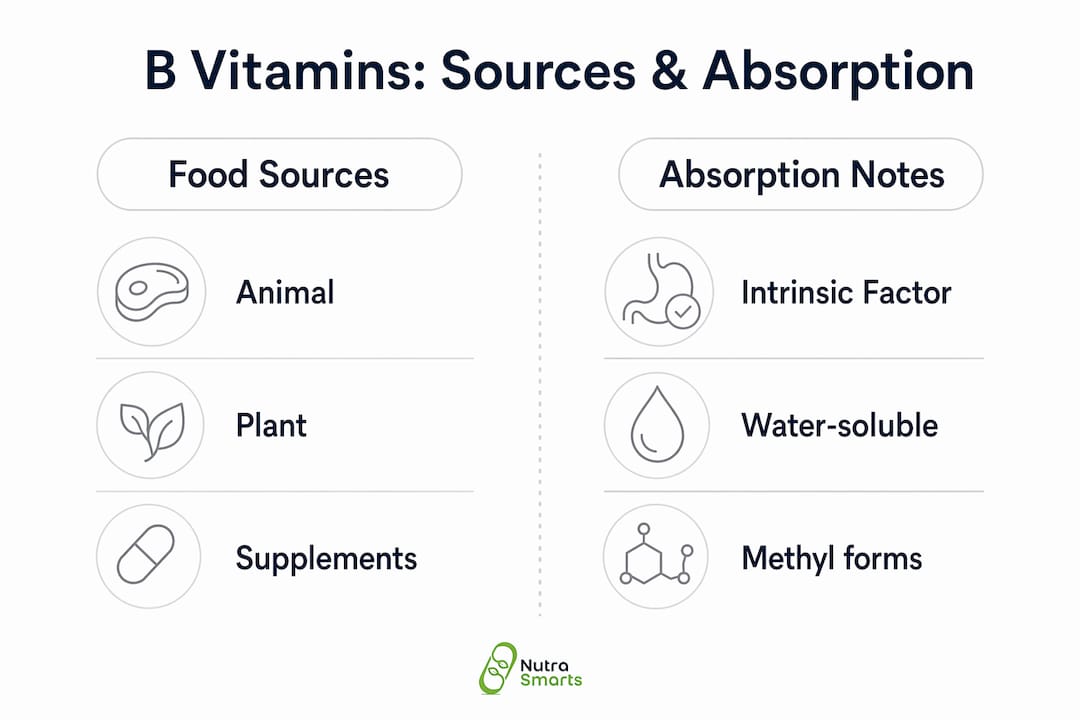
B12 absorption deserves special attention. The stomach must produce intrinsic factor, a protein that binds B12 for absorption in the small intestine. Stomach acid production declines with age, and intrinsic factor production follows. This is why B12 supplementation for older adults often requires higher doses or sublingual and injectable forms that bypass the digestive step entirely.
B vitamins are water-soluble, which means the body excretes excess amounts in urine. This makes toxicity from food sources essentially impossible. High-dose niacin supplementation is the notable exception, as it can cause flushing and, at very high doses, liver stress.
Pro Tip: If you take a B-complex supplement, look for one that uses methylfolate instead of folic acid and methylcobalamin instead of cyanocobalamin. These active forms work for people with MTHFR gene variants, which affect a meaningful portion of the population. Nutrasmarts covers the clinical differences in its B-complex ingredient profile.
How do B vitamins differ from stimulants in energy supplements?
B vitamins do not stimulate the nervous system. This distinction matters because energy drink marketing has blurred the line between metabolic support and stimulant effects for years.
Caffeine works by blocking adenosine receptors in the brain, which suppresses the sensation of fatigue and triggers adrenaline release. Caffeine provides immediate CNS stimulation that B vitamins simply cannot replicate. B vitamins work upstream, at the cellular level, enabling the metabolic reactions that produce ATP over hours and days, not minutes.
The perceived energy boost from a B-complex supplement is almost always the result of correcting an undiagnosed deficiency rather than any stimulant effect. If your B vitamin levels are already sufficient, taking more will not increase your energy output. Excess is excreted. The body does not store extra B vitamins for a later boost.
Practical points for evaluating energy supplement claims:
- If a product lists B vitamins alongside caffeine, the energy effect comes from the caffeine, not the B vitamins.
- A product with B vitamins and no stimulants will only help if you are deficient.
- "High potency" B-complex labels with 1,000% of the daily value do not deliver 10 times the energy benefit. They deliver the same benefit as 100%, with the rest excreted.
- Sustained energy from B vitamins requires consistent daily intake, not single-dose loading.
- Testing your B vitamin status before buying supplements tells you whether you actually need them.
The wellness industry benefits from the confusion between metabolic support and stimulation. Knowing the difference protects your wallet and your health decisions.
Key Takeaways
B vitamins are metabolic coenzymes, not energy sources. Deficiency is the only condition under which supplementation meaningfully improves energy, making testing and targeted intake the most effective strategy.
| Point | Details |
|---|---|
| B vitamins are coenzymes, not fuel | They enable ATP production but supply zero calories or stimulant effects. |
| Niacin drives 400+ reactions | NAD+ from B3 is the most widely used electron carrier in cellular energy production. |
| B12 deficiency is common with age | Over 20% of adults 60 and older are deficient, directly limiting energy metabolism. |
| Deficiency recovery takes 2–4 weeks | Most B vitamins restore energy within a month; B12 neurological cases take longer. |
| Active forms absorb better | Methylcobalamin and methylfolate outperform cyanocobalamin and folic acid for many people. |
What I have learned from years of watching people chase energy
Most people who come to nutrition looking for more energy are already eating enough food. The problem is not caloric intake. The problem is that their metabolic machinery is running on worn-out parts, and B vitamins are often the worn-out part nobody checked.
The biggest mistake I see is treating B-complex supplements as a substitute for diagnostic work. Someone feels tired, buys a high-dose B-complex, feels slightly better for a week, and concludes the vitamins are working. What actually happened is that they corrected a mild deficiency they never knew they had. That is a good outcome, but it is also a missed opportunity to understand the root cause and address it properly.
The research on chronic fatigue and B vitamin status keeps pointing in the same direction: subclinical insufficiency is far more common than clinical deficiency, and it produces real, measurable effects on motivation and physical output. The Osaka Metropolitan University homocysteine study published in 2026 is a good example of how even modest elevations in homocysteine, driven by folate and B12 shortfalls, translate into reduced energy in otherwise healthy adults.
My position is that biochemical literacy is the most underrated wellness skill. Knowing that B vitamins are coenzymes, not stimulants, changes how you read a supplement label. Knowing that B12 absorption declines with age changes how you plan your diet at 55 versus 35. These are not abstract facts. They are practical tools for making better decisions about your own body.
— Nutrasmarts
Nutrasmarts and science-backed energy supplement research
Nutrasmarts reviews supplements the way a clinician reads a study: by looking at the ingredient, the dose, and the evidence behind it. For anyone trying to support energy metabolism through nutrition, the best energy supplements section on Nutrasmarts covers 80 reviewed options, each evaluated against peer-reviewed research and clinical trial data.

If you want to go deeper on metabolic health specifically, the metabolic health supplement category covers 130 reviewed products with ingredient-level breakdowns. Nutrasmarts also links every ingredient to its clinical evidence, so you can see exactly what the research says before you buy.
FAQ
What is the role of B vitamins in energy metabolism?
B vitamins serve as coenzymes in glycolysis, the Krebs cycle, and the electron transport chain, enabling the body to convert carbohydrates, fats, and proteins into ATP. They do not supply energy directly but are required for every stage of cellular energy production.
Can B vitamins give you more energy if you are not deficient?
No. B vitamins are water-soluble and excess amounts are excreted in urine. If your levels are already sufficient, additional supplementation does not increase energy output or ATP production.
Which B vitamin deficiency causes the most fatigue?
B12 deficiency is the most clinically significant cause of fatigue linked to B vitamins, affecting over 20% of adults aged 60 and older. Folate deficiency also contributes through elevated homocysteine, which research links to reduced physical energy and motivation.
How long does it take to recover energy after correcting a B vitamin deficiency?
Most B vitamin deficiencies resolve within 2–4 weeks of supplementation. B12 deficiency involving neurological damage takes longer and requires clinical management beyond standard oral supplementation.
Who needs B vitamin supplements most?
Adults over 60, vegans, vegetarians, and people with malabsorption conditions such as Crohn's disease or celiac disease carry the highest risk of clinically relevant B vitamin deficiency. Deficiency risk by group on Nutrasmarts breaks this down by population with supporting clinical data.