

Kava causes mild, common side effects like dizziness, headache, and stomach upset for most people who try it, but a small number of users have developed serious, sometimes fatal liver injury. If you notice yellowing skin or eyes, dark urine, or unusual abdominal pain after taking kava, stop immediately and seek care. Both the NCCIH and the FDA flag this exact tradeoff, and it is recommended to read the fine print before you ever pour a shell.
TL;DR:
- Using traditional water-based kava preparations from roots reduces the risk of liver injury compared to solvent-extracted products, which are more toxic.
- Kava's sedative effects, including dizziness and slowed reaction times, are dose-dependent and can impair driving or operating machinery hours after consumption.
- Signs of serious liver injury include jaundice, dark urine, and severe abdominal pain, requiring immediate medical attention and discontinuation of kava.
- People with liver disease, pregnant women, breastfeeding individuals, and those on sedatives or dopaminergic medications should avoid kava entirely or consult a healthcare professional beforehand.
- Long-term, heavy use can cause skin issues, blood changes, or neurologic symptoms, but these typically reverse after stopping and are linked to higher doses over extended periods.
Table of Contents
- What Are the Most Common Kava Side Effects?
- Can Kava Actually Damage Your Liver?
- Who Should Avoid Kava, and What Interacts With It?
- Does Long-Term Kava Use Cause Lasting Damage?
- Why Do Studies Disagree About Kava's Safety?
- How Can You Reduce Your Risk Before and While Using Kava?
- How This Guide Weighed the Evidence
- A Cautious, Evidence-First Take on Kava
- Where to Find Evidence-Backed Kava Guidance
- Sources
- FAQ
What Are the Most Common Kava Side Effects?
Most people who try kava notice something mild long before anything serious shows up. Dizziness, headache, and stomach upset top the list, according to the NCCIH, and traditional water-based kava drinkers have reported mouth or tongue numbness for centuries. It's a real anesthetic effect from the kavalactones, not a sign anything's wrong. Sedation is common too, and it can slow reaction time noticeably, especially at higher doses or with concentrated extracts.
The trade-off in one line: kava's calming effect and its sedating side effect are the same mechanism. You can't reliably get one without some risk of the other.
Form matters as much as dose. A traditional aqueous kava drink behaves differently in the body than a concentrated capsule made from an ethanolic or acetone extract, and the concentrated versions tend to hit harder and faster. Because reaction time and coordination can lag for hours after a strong dose, skip driving or operating machinery until you know exactly how your body responds. This is the same caution you'd apply to a new sleep aid or antihistamine: test it on a night when nothing depends on you being sharp the next morning.
Can Kava Actually Damage Your Liver?
Yes, in rare cases, and the reports are serious enough that regulators worldwide have taken notice. The FDA's scientific memorandum on kava reviewed case series tied to liver failure, transplants, and deaths, and the World Health Organization examined 93 case reports of kava-associated liver injury during its own safety review. That's a small number set against how widely kava has been consumed for generations across the Pacific, but severity, not frequency, is why this matters.
Reporting systems that rely on people or doctors flagging problems voluntarily tend to undercount real-world harm, which means the true rate of liver injury from kava could be higher than published figures suggest.
Watch for these signs, and treat any of them as a reason to stop kava immediately:
- Yellowing of the skin or eyes (jaundice)
- Dark or tea-colored urine
- Unusual or persistent abdominal pain, especially upper right side
- Pale or clay-colored stools
- Severe, unexplained fatigue
- Unusual itching without a rash
If any of these appear, stop taking kava right away and get medical attention the same day, not "when you get a chance." Ask about liver function tests, since elevated liver enzymes can show up before symptoms feel severe. It's also worth reporting the reaction to the FDA's MedWatch program, since case reports are exactly how regulators catch patterns that individual doctors might miss.
Who Should Avoid Kava, and What Interacts With It?
Kava isn't a good fit for everyone, and some combinations carry real danger rather than just inconvenience. Pregnant and breastfeeding people should avoid it entirely, as should anyone with Parkinson's disease, since kava can interfere with dopaminergic medications used to manage the condition, according to the Merck Manual. Anyone with existing liver disease should treat kava as off the table without a doctor's direct input.
Drug interactions are where things get complicated fast. Kava can intensify the effects of sedatives like benzodiazepines and opioids, raising the risk of dangerous over-sedation. It also appears to interact with liver enzyme pathways, including CYP1A2, CYP2C19, and CYP3A, plus P-glycoprotein transport systems, which affects how a long list of prescription drugs get processed. Combining kava with acetaminophen deserves particular caution, since animal research suggests the pairing may amplify liver stress, per the FDA memo.
Before trying kava, ask your doctor or pharmacist:
- Do I have any history of liver problems, even mild or resolved ones?
- What prescription or over-the-counter medications am I currently taking, including sedatives or pain relievers?
- Am I pregnant, breastfeeding, or planning pregnancy?
- Do I have Parkinson's disease or take dopaminergic medication?
- Is upcoming surgery a factor, given kava's sedative and clotting-related effects?
Does Long-Term Kava Use Cause Lasting Damage?
Chronic, heavy kava use produces a distinctive condition called kava dermopathy, marked by dry, scaly, flaking skin that often starts on the face, scalp, or neck. It can include a temporary yellowish tint to the skin, hair, or nails, separate from the jaundice that signals liver injury. The encouraging part: dermopathy typically reverses once someone stops using kava, according to NCCIH, and severity tracks closely with dose and duration.
Other long-term signals show up less often but deserve mention:
- Blood-related changes, including reduced lymphocyte counts, reported with prolonged heavy use
- Movement and neurologic changes, such as ataxia, at very high or sustained doses
- Rare reports of rhabdomyolysis, a serious muscle-breakdown condition, in the peer-reviewed toxicity literature
None of this describes what happens after one relaxing evening with kava tea. It describes what can happen after months or years of high, regular intake, which is exactly why daily long-term use deserves more scrutiny than occasional use.
Why Do Studies Disagree About Kava's Safety?
Researchers still argue over what actually causes kava's rare liver injuries, and that disagreement matters for how you shop. Traditional aqueous preparations, made by simply mixing pounded kava root with water the way Pacific Island cultures have done for centuries, show up far less often in hepatotoxicity case reports than products made with organic solvents like ethanol or acetone. The FDA's own case-series analysis found a higher proportion of liver events tied to organic-extracted products specifically.
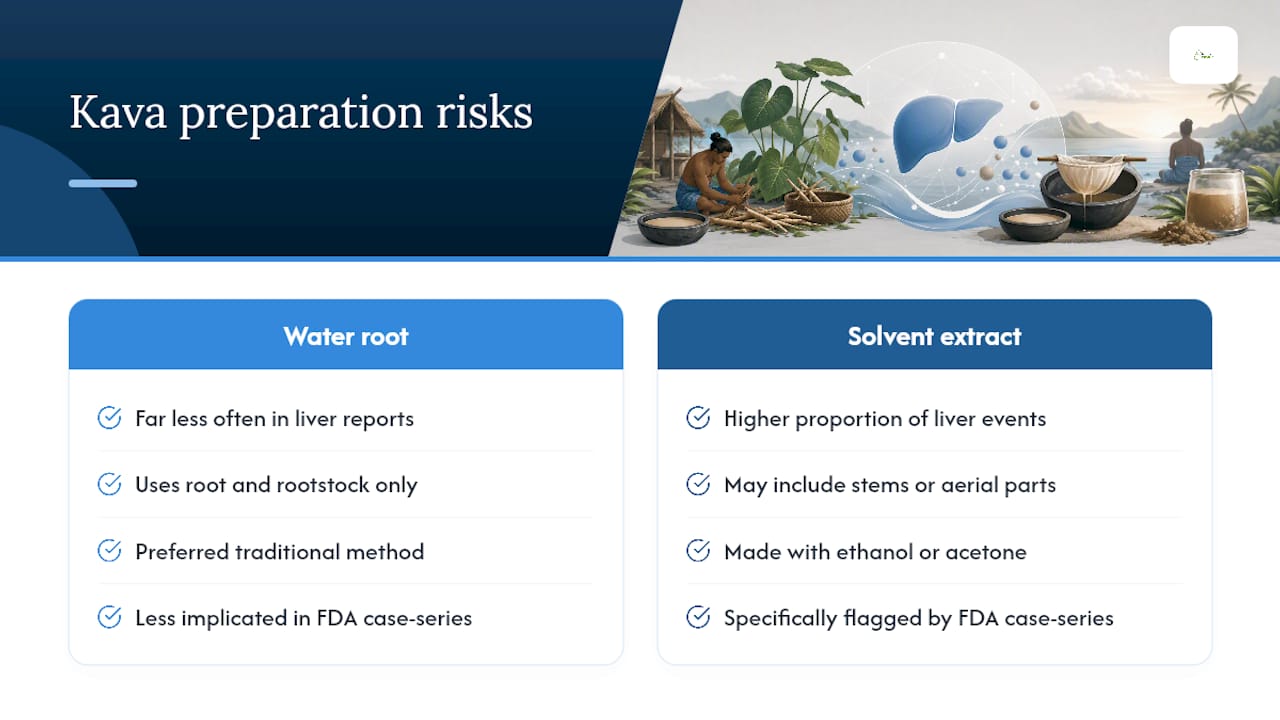
Plant part matters too. Traditional preparations use only the root and rootstock, while some commercial products have incorporated stem peelings or aerial parts that contain different, potentially more toxic alkaloid profiles. Add in contamination risk and wide variability between kava cultivars, and you get a supply chain where two bottles labeled "kava" can carry meaningfully different risk. That variability is part of why the FDA has never granted kava GRAS status as a food additive, and why some countries have imposed temporary bans.
Pro Tip: Look specifically for products labeled as made from kava root only, using traditional water-based extraction. Skip anything that lists ethanol or acetone extraction on the label unless a clinician has specifically guided you toward it.
How Can You Reduce Your Risk Before and While Using Kava?
Reducing risk starts before you ever take the first dose, not after something feels off.
- Screen yourself first. Rule out liver disease, pregnancy, breastfeeding, or Parkinson's disease, and list every medication you take, especially sedatives or acetaminophen.
- Talk to a clinician, particularly if you take prescription medication regularly or have any liver history at all.
- Choose your product carefully. Favor root-only, water-based preparations over solvent extracts, and look for labels that specify kavalactone content when available.
- Avoid daily high-dose use long-term. Occasional or short-term use carries far less documented risk than sustained heavy intake.
- Consider baseline liver testing if you plan to use kava regularly, with periodic recheck if use continues for weeks or months.
- Know your emergency signs, listed above under liver injury, and act on them same-day, not "wait and see."
How This Guide Weighed the Evidence
This guide draws on regulatory reviews, government health summaries, and peer-reviewed toxicity literature rather than any single study or anecdote.
- FDA scientific memoranda and case-series reviews
- NCCIH's public safety summary on kava
- Peer-reviewed toxicity reviews indexed on PMC
- Clinical trial and safety data summarized by MSD Manual
For dosing specifics and trial citations, Nutrasmarts maintains an evidence-linked kava ingredient page. Case reports and underreporting mean real-world risk likely exceeds what's published. Larger, better-controlled trials would sharpen these estimates considerably.
A Cautious, Evidence-First Take on Kava
Kava's common side effects are manageable and predictable. Its rare liver risk is not something to gamble on. Use the resources above, and talk to a clinician before making kava part of your routine, not after something goes wrong.
— Nutrasmarts
Where to Find Evidence-Backed Kava Guidance
If you're weighing kava against other calming options, An ingredient database has been built specifically so you're not stuck guessing between marketing claims and actual clinical evidence. The kava ingredient page breaks down dosing ranges and trial citations in one place, so you can see exactly what the research does and doesn't support before you buy anything.

If liver health monitoring is part of your plan given kava's risk profile, the liver health supplement guide covers ingredient-level evidence worth knowing. Curious how kava stacks up against other calming ingredients like GABA? Nutrasmarts' side-by-side comparison tool lets you check evidence ratings and dosing benchmarks head-to-head before you commit to anything. Start there, and you'll walk into any conversation with a doctor already knowing the right questions to ask.
This article is general information, not a substitute for advice from a qualified doctor. Consult a qualified healthcare professional about your own circumstances before acting on anything here.
Sources
- Kava: Usefulness and Safety | NCCIH
- Scientific Memorandum: Kava (FDA)
- Toxicity of Kava Kava - PMC (NIH)
FAQ
Is Kava Harder on Your Liver Than Alcohol?
Not necessarily. Alcohol's liver damage is well-documented and dose-dependent at a population scale, while kava's liver injury cases are rare but not fully explained, tied to factors like extraction method and product quality according to the FDA. Neither should be assumed "safe" for someone with existing liver disease.
Does Kava Actually Give You a Buzz?
Kava produces a relaxed, sedated feeling along with mouth or tongue numbness, rather than the stimulating buzz associated with alcohol or caffeine. The effect comes from kavalactones acting on the central nervous system, and it varies significantly by dose, form, and individual sensitivity.
What Is the Controversy With Kava?
The core controversy is whether kava's rare but serious liver injuries come from the kavalactones themselves or from how the product was made, including solvent extraction, non-root plant parts, and contamination. Regulators haven't settled the question, which is part of why the FDA hasn't granted kava GRAS status as a food additive.
Is Kava Safer Than Kratom?
The two aren't directly comparable since they carry different risk profiles. Kava's main concern is rare liver injury and skin changes with long-term use, while kratom carries separate concerns around dependence and opioid-like effects; anyone considering either should review the evidence on Nutrasmarts' ingredient database and talk to a clinician first.