
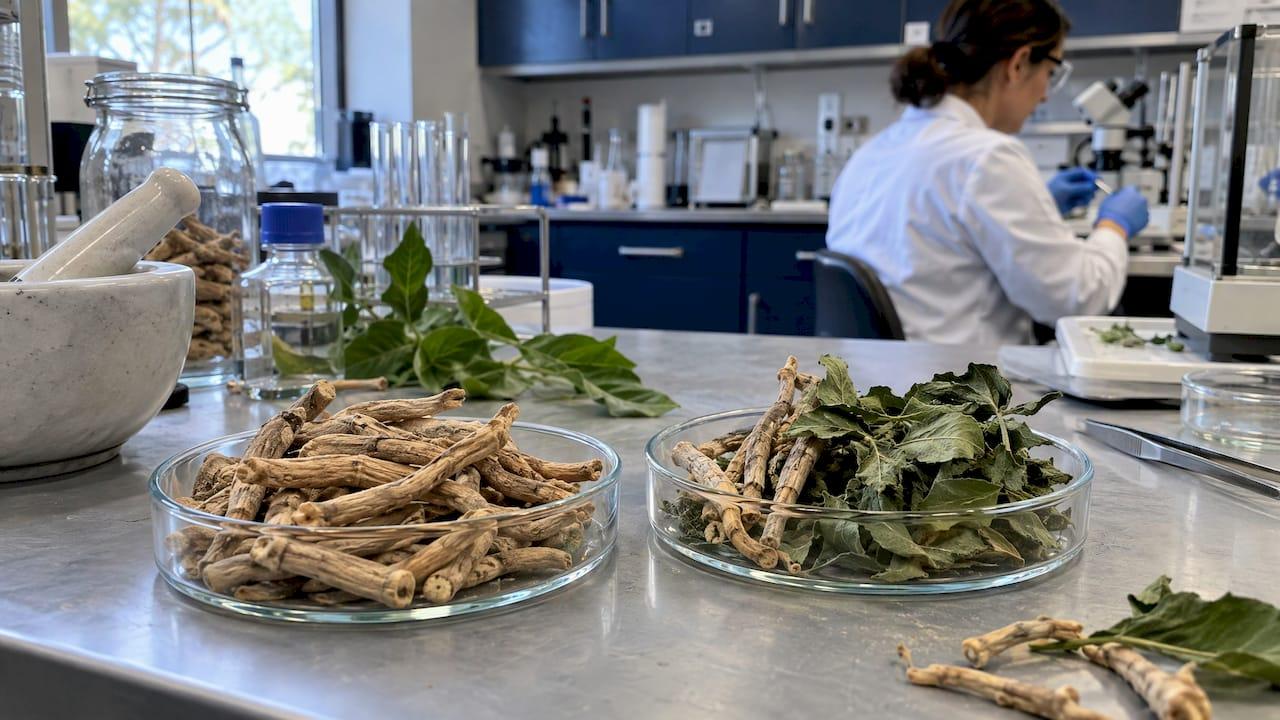
KSM-66 and Shoden are both branded ashwagandha extracts with human trials behind them, but they are built differently. KSM-66 is a root-only extract studied mostly at 300 to 600 mg a day. Shoden is a root-and-leaf extract standardized to 35% withanolide glycosides and studied at 60 to 240 mg a day. Neither trial record shows one beating the other, because no head-to-head trial exists. The better pick depends on the dose you want to take, the outcome you care about and how a label is written.
TL;DR
- Plant part: KSM-66 is made from root only. Shoden uses root and leaf.
- Standardization: Shoden is standardized to 35% withanolide glycosides. The KSM-66 sleep trial described by the NIH used an extract standardized to more than 5% withanolides.
- Dose in studies: Shoden trials used 60 to 240 mg daily. KSM-66 trials used about 250 to 600 mg daily.
- Evidence: Both have placebo-controlled trials on stress, anxiety and cortisol. No trial compares them directly, so any claim that one is "stronger" is an inference.
- Safety: The same ashwagandha cautions apply to both, including pregnancy, thyroid conditions, liver concerns and medication interactions.
Table of Contents
- What ashwagandha extracts are, and why brands differ
- KSM-66 vs. Shoden at a glance
- Root only or root and leaf: does it matter?
- What the Shoden trials found
- What the KSM-66 trials found
- Which one for sleep, which for anxiety?
- Dose and what a label should tell you
- Safety and who should be careful
- How to choose between them
- Where NutraSmarts fits
- Our view
- FAQ
- Sources
What ashwagandha extracts are, and why brands differ
Ashwagandha (Withania somnifera) is a shrub used in Ayurvedic medicine. A raw powder varies in how much of its active compounds it contains. The compounds most often tracked are withanolides, a group of steroid-like molecules in the plant. Manufacturers make extracts to get a more consistent amount of them per capsule.
KSM-66 and Shoden are two trademarked extracts. Each is made by a different company, with a different plant part and a different standardization target. That is why you cannot compare a 600 mg KSM-66 capsule with a 120 mg Shoden capsule by milligrams alone. The milligram figure describes the extract, not the amount of active compound.
If you are still deciding whether ashwagandha suits your goals, our ashwagandha ingredient profile covers benefits, dosage and research in one place. The rest of this article assumes you have narrowed it to these two extracts.
KSM-66 vs. Shoden at a glance
| KSM-66 | Shoden | |
|---|---|---|
| Plant part | Root only | Root and leaf |
| Standardization | Root extract; the NIH describes one trial extract as standardized to more than 5% withanolides | 35% withanolide glycosides, measured by HPLC |
| Extraction solvent | Not stated in the sources reviewed | 70% ethanol (ethanol:water 70:30) |
| Typical trial dose | About 250 to 600 mg per day | 60, 120 or 240 mg per day |
| Longest trial duration found | Up to 8 weeks in the NIH-described sleep trial | 60 days in the trials below |
| Head-to-head trial | None | None |
HPLC (high-performance liquid chromatography) is a lab method that measures how much of a specific compound is in an extract. It is how a label's percentage gets verified.
The plant-part and standardization data for Shoden come from ClinicalTrials.gov's description of the extract, which lists it as a dried 70% ethanolic extract of root and leaf standardized to 35% withanolide glycosides. The root-only KSM-66 detail and its 600 mg dose come from the NIH Office of Dietary Supplements fact sheet on ashwagandha.
Our own pages lay out each ingredient's evidence rating, dose range and cited trials: see KSM-66 and Shoden.
Root only or root and leaf: does it matter?
Traditional ashwagandha use centers on the root, and KSM-66 is built on that tradition. Shoden adds leaf material, which is a different source of withanolides, and then concentrates the result to 35%.
That difference in plant part shows up mostly as a difference in concentration. A capsule with 35% withanolide glycosides delivers a lot of active compound in a small amount of extract. That is why Shoden is studied at 60 to 240 mg a day while KSM-66 is studied at several hundred milligrams.
Does a higher concentration mean a bigger effect? The trials do not show that. A concentrated extract lets a formulator fit a dose into a smaller capsule or a multi-ingredient blend. It is a formulation advantage, not proof of a larger clinical result. The plant-part difference is real, but whether it changes outcomes has not been tested in a direct comparison.
What the Shoden trials found
Two placebo-controlled trials give Shoden its evidence base. Both ran for 60 days.
Lopresti et al., 2019. In this randomized, double-blind trial of 60 stressed but healthy adults, participants took 240 mg of Shoden once daily, which supplied 84 mg of withanolide glycosides per capsule. The anxiety score on the Hamilton Anxiety Rating Scale (HAM-A) fell more than with placebo (P=.040), with a 41% reduction in the Shoden group against 24% for placebo. Morning cortisol fell 23% in the Shoden group while it rose 0.5% on placebo (P<.001). Every participant completed the study and no adverse events were reported. A second stress scale, the DASS-21, came close to significance (P=.096) but did not reach it.
The authors also looked at testosterone. It rose over time in males (P=.038) but not in females, and the difference between groups was not statistically significant (P=.158), as reported in the journal version of the paper. They called for larger, more diverse and longer trials.
Mishra and Kumar, 2024. This randomized, double-blind, placebo-controlled trial enrolled 60 people who met DSM-IV criteria for generalized anxiety disorder, a formal diagnostic standard. Participants took 60 mg or 120 mg of Shoden daily. HAM-A scores dropped 59% in both groups against a 0.83% increase on placebo. Morning serum cortisol fell 66% and 67% against a 2.22% change on placebo, and perceived stress scores fell 53% and 62%.

One detail stands out: 60 mg performed about as well as 120 mg on anxiety. For a reader comparing products, that suggests a low-dose Shoden label is not under-dosed.
What the KSM-66 trials found
The NIH fact sheet summarizes KSM-66 research in detail. A 2021 systematic review it cites pooled seven studies with 491 adults, all conducted in India and lasting 6 to 8 weeks. Ashwagandha reduced stress, anxiety, sleeplessness, fatigue and serum cortisol compared with placebo. Six of the seven used extracts: three used KSM-66 root, and two used Sensoril or Shoden root-and-leaf extracts. Doses ranged from 240 to 1,250 mg a day, and benefits looked greater at 500 to 600 mg a day.
The fact sheet also describes an 8-week trial in 80 healthy adults, half of them with insomnia. They took KSM-66 root extract standardized to more than 5% withanolides, in 300 mg capsules, two per day (600 mg total). Those with insomnia improved on sleep quality, time to fall asleep, morning mental alertness and perceived anxiety compared with placebo.
The pattern is consistent: KSM-66 evidence centers on higher doses, a root-only product and stress and sleep outcomes.
Which one for sleep, which for anxiety?
Forum posts and some blogs split the two neatly: Shoden for sleep, KSM-66 for stress and cortisol. The evidence is less tidy.
- Sleep: The best-described KSM-66 sleep result is the 8-week, 600 mg trial above, where the benefit appeared in people who had insomnia. The NIH reports one sleep study using 120 mg a day of a root-and-leaf extract, and notes that in sleep studies benefits were more prominent at 600 mg a day, after at least 8 weeks, and in participants with insomnia. Our summary of a new 2026 ashwagandha sleep trial goes into what that research adds. If sleep is the goal and you want something beyond supplements, PEMF devices for sleep are another area with trial data worth reading.
- Anxiety and stress: Shoden has two placebo-controlled 60-day trials with anxiety scores and cortisol as outcomes, one in people with a diagnosed anxiety disorder. KSM-66 has trials in chronically stressed adults, and both extracts appear in the pooled reviews.
- Cortisol: Both reduced it against placebo in the studies above.
The honest summary: the data support both for stress and anxiety, and the sleep evidence is stronger for higher-dose root extract in people who have insomnia. The trials were done in different populations at different doses, so the results are not directly comparable.
Dose and what a label should tell you
The fastest way to compare two products is to look at the label for four things.
- The extract name and plant part. A branded name should be followed by what it is: root extract or root-and-leaf extract.
- The standardization. Look for a stated percentage of withanolides or withanolide glycosides. A label with no percentage tells you nothing about concentration.
- Milligrams per serving, and servings per day. A capsule may be 300 mg, but the serving may be two capsules. For example, a KSM-66 product listed at 1 g per serving of 2 veggie capsules is a 500 mg capsule taken twice, and the serving size sets your daily intake.
- Other ingredients in the formula. Blends may carry several adaptogens, which makes the ashwagandha dose harder to judge.
KSM-66 products often sit at a few hundred milligrams per serving. As one example, a 1 g KSM-66 product with 30 servings was listed at $29.97 on its maker's page. Prices change often, so treat a figure like that as a snapshot, not a benchmark. Shoden products are usually lower in milligrams per capsule because of the concentration. Comparing cost per day at the dose used in the trials is fairer than comparing price per bottle.
Use the trial doses as reference points: roughly 60 to 240 mg for Shoden and 250 to 600 mg for KSM-66, with the best-supported sleep results at the upper end of the root-extract range. Our compare tool puts ingredients side by side with their dose benchmarks and evidence ratings.
Safety and who should be careful
The cautions below apply to both extracts, because they apply to ashwagandha as a whole. The NIH fact sheet says ashwagandha appears to be well tolerated for up to about 3 months. The most common side effects are mild: loose stools, nausea and drowsiness.
The same page notes a few reports of liver-function problems, possible effects on thyroid function and interactions with some medications. It also says some experts advise against use during pregnancy and by men with hormone-sensitive prostate cancer.
If you take thyroid medication, sedatives, immunosuppressants or diabetes or blood pressure drugs, talk to your doctor or pharmacist before starting. If you have liver disease, are pregnant or breastfeeding, or have a hormone-sensitive cancer, ask your physician first. Stop and seek medical care if you develop symptoms such as yellowing of the skin or eyes, dark urine or severe abdominal pain. Our guide to ashwagandha side effects goes through these in more detail.

How to choose between them
Start with what you want to take rather than which name is better.
- Choose KSM-66 if you prefer a root-only extract and are comfortable with a daily dose of a few hundred milligrams. Its best-described sleep result is the 600 mg trial, and our KSM-66 overview covers the research in plain language.
- Choose Shoden if you want a smaller, more concentrated dose, for example to fit into a blended formula or a single small capsule. Its two 60-day trials measured anxiety and cortisol, and the 2024 trial showed a response at 60 mg.
- Consider your own response. Some people report that one works and the other does not. Individual reports are not evidence, but they remind you that trial averages do not predict a single person's result.
- Give it time. The trials above ran 60 days. Judging an extract after a week tells you little.
If your concern is a specific symptom rather than a specific extract, our supplements-by-symptom search shows which ingredients have clinical support for it.
Where NutraSmarts fits
NutraSmarts is a free database of more than 1,300 ingredient profiles with clinical trial citations, evidence ratings and dosage benchmarks, with no sign-up or paywall. You can look up each extract, search by symptom and compare ingredients side by side.
If you are a supplement formulator, the free Supplement Facts label creator builds an FDA-compliant label in your browser without a spreadsheet, which helps when you are deciding how to declare a branded extract and its dose.
For consumers, wellness coaches and researchers, the side-by-side compare guides are the quickest way to line up two extracts against the same trials.
Our view
We read ashwagandha research for a living, and the first thing we tell people about KSM-66 and Shoden is that the comparison most pages promise does not exist. No trial puts them against each other, so every "winner" is an opinion built from separate studies in different groups.
What the evidence does support is simple. Both extracts have placebo-controlled human data. They differ in plant part, concentration and the doses researchers used. Those facts are enough to choose well, and they are the facts we put on every ingredient profile, with the PubMed citations and an evidence rating that reflects what the trials show.
That is why we built the database around dose benchmarks and side-by-side comparisons, not product claims. A reader who can see the trial dose, the duration and the population can read a label for themselves. A formulator who can see the same data can declare a branded extract accurately.
NutraSmarts
FAQ
Is Shoden better than KSM-66?
No trial has compared them directly, so neither can be called better. Shoden is more concentrated and has been studied at lower doses, while KSM-66 is a root-only extract studied at higher doses. Both have placebo-controlled trials for stress and anxiety outcomes.
Does Shoden ashwagandha work?
Two 60-day placebo-controlled trials found it lowered anxiety scores and morning cortisol compared with placebo. The 2019 trial used 240 mg a day in stressed adults, and the 2024 trial used 60 mg or 120 mg in adults with generalized anxiety disorder. Both trials were small, with 60 participants each, and the authors called for larger studies.
What is the difference between ashwagandha and KSM-66?
Ashwagandha is the plant and the general name for supplements made from it. KSM-66 is one branded root extract of that plant. Other extracts, such as Shoden, use different plant parts and different standardization.
Can I take KSM-66 or Shoden every day?
The NIH says ashwagandha appears well tolerated for up to about 3 months. Mild effects such as loose stools, nausea and drowsiness are the most common. Ask your doctor first if you are pregnant, have thyroid or liver conditions, or take prescription medication.
Sources
- NIH Office of Dietary Supplements: Ashwagandha health professional fact sheet
- Shoden promotes relief from stress and anxiety (Mishra and Kumar, 2024)
- An investigation into the stress-relieving and pharmacological actions of an ashwagandha extract (Lopresti et al., 2019)
- Lopresti et al., 2019, Medicine journal full text
- ClinicalTrials.gov NCT07008300: Shoden safety, tolerability and pharmacokinetics study
- KSM-66 1 g product listing