
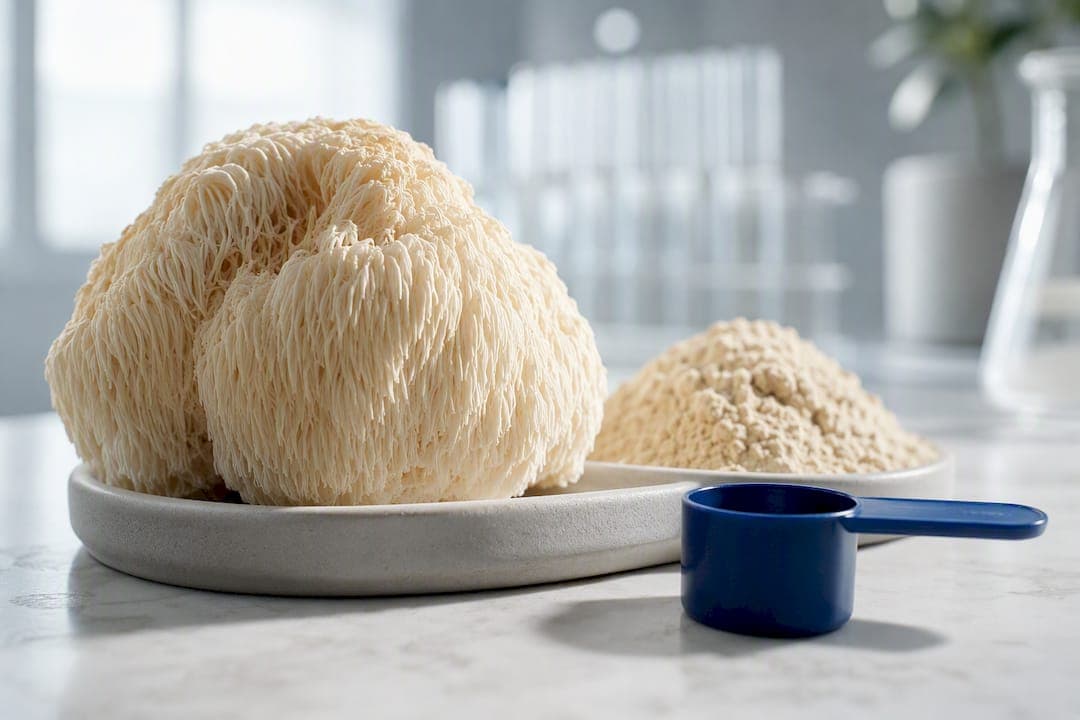
Clinical trials on lion's mane have used doses between roughly 1,000 and 3,200 mg per day, with most positive results coming from 1,800 to 3,000 mg daily taken consistently for at least four weeks. The right number for you depends on the product form: a concentrated 8:1 extract delivers far more per milligram than plain powdered fruiting body, so always check extract ratios before matching a label to a study dose. Start at a low dose and talk to a clinician first if you take blood thinners or diabetes medication.
TL;DR:
- Clinical trials typically use between 1,000 and 3,200 mg daily, with the most reliable cognitive benefits observed at 1,800 to 3,000 mg over four to 16 weeks.
- Concentrated extracts with ratios like 8:1 or 10:1 contain far more active compounds per milligram than raw powder, requiring lower doses to match study levels.
- Higher doses are more effective for older adults with cognitive decline, whereas healthy adults may see subtle benefits at lower doses around 1,800 mg.
- Starting with 500 to 1,000 mg daily, then gradually increasing, allows for safer titration and better assessment of individual response over time.
- Products should specify extraction ratios, fruiting body content, and beta-glucan percentages, with third-party testing favored for quality assurance.
Table of Contents
- What Lion's Mane Dosage Have Clinical Trials Actually Used?
- Powder vs. Extract: Why the Same Milligram Number Means Different Things
- What Dose Fits Your Specific Goal?
- How Should You Start and Increase Your Dose?
- Is Lion's Mane Safe, and What Interacts With It?
- What Does the Research Actually Support, and Where Does It Fall Short?
- How Do You Choose a Quality Lion's Mane Product?
- Our Take: Evidence Matters More Than the Marketing Around It
- Want to Check Your Product Against the Research Yourself?
- Sources
- FAQ
What Lion's Mane Dosage Have Clinical Trials Actually Used?
The clinical record on lion's mane is smaller than supplement marketing would suggest, but it is consistent on one point: the doses that produced measurable results were high and taken daily, not occasionally.
The most cited trial comes from Mori and colleagues in 2009, who gave adults aged 50 to 80 with mild cognitive impairment 3,000 mg per day of dried fruiting body powder for 16 weeks. Cognitive function scores improved during treatment and declined again after supplementation stopped, which is itself a useful data point. It suggests the effect depends on continued dosing rather than a one-time fix.
A newer trial changes the picture for younger, healthy adults. Docherty and colleagues in 2023 tested 1.8 grams per day (three 600 mg capsules) in a randomized, double-blind design. They found faster Stroop task performance within hours of a single dose, and a trend toward lower subjective stress after 28 days of daily use. The sample was small, but the acute effect is notable because most lion's mane research focuses on weeks-long outcomes, not same-day cognitive shifts.
Separately, a trial sometimes referenced as Saitsu 2019 used roughly 3,200 mg per day and reported cognitive outcome changes, sitting at the upper end of the studied range. Research on erinacine-enriched mycelium extract, associated with Li and colleagues in 2020, used a much lower gram amount, around 1,050 mg per day, because concentrated erinacine content changes the effective dose math entirely.
A few patterns hold across this research:
- Positive cognitive outcomes clustered in a higher gram-range daily dose for whole powder or standard extract.
- Trials with meaningful cognitive results ran 4 to 16 weeks, never just days, based on RCT summaries reviewing typical trial durations.
- Older adults with existing cognitive decline were studied at the higher end (3,000 mg); healthy younger adults showed effects at 1,800 mg.
- Sample sizes across these trials were modest, generally in the dozens rather than hundreds of participants.
None of these trials used identical products, which matters more than it sounds. A 3,000 mg dose of dried fruiting body powder is not the same substance as 3,000 mg of a 10:1 concentrated extract.
Powder vs. Extract: Why the Same Milligram Number Means Different Things
This is where most people miscalculate their dose without realizing it. A product label showing "3,000 mg" tells you almost nothing until you know what kind of 3,000 mg it is.
Raw fruiting body powder is the closest match to what Mori's trial used. If your product lists "lion's mane fruiting body powder" with no extraction ratio, you're likely looking at something close to a 1:1 match with clinical dosing. But many commercial products use concentrated extracts, marked with a ratio like 8:1 or 10:1, meaning 8 or 10 pounds of raw mushroom were condensed into 1 pound of extract. A Cognitive Vitality review from the Alzheimer's Drug Discovery Foundation explains that these ratios concentrate specific compound classes, not the whole mushroom evenly.
Extraction ratio math, worked out: If a label lists 500 mg of an 8:1 extract, that's roughly equivalent to 4,000 mg of raw fruiting body material in terms of concentrated content, though not a perfect one-to-one swap because extraction doesn't pull every compound at the same rate.
Extraction method also determines which compounds you're getting. Hot-water extraction concentrates beta-glucans, the immune-active polysaccharides. Alcohol extraction pulls out hericenones and erinacines, the compounds linked to nerve growth factor stimulation. A dual extract combines both processes, which is why research-grade products increasingly favor that method, according to the Alzheimer's Drug Discovery Foundation's compound analysis.

Statistic to remember: an 8:1 or 10:1 extraction ratio can mean a 500 mg capsule carries the concentrated equivalent of 4,000 to 5,000 mg of raw mushroom, so comparing raw milligram counts across products without checking the ratio is comparing the wrong numbers entirely.
A few label red flags worth flagging:
- "Mycelium on grain" products may be mostly starch filler, not fungal fruiting body, unless the label states an active compound percentage.
- No stated extraction ratio usually means the product is close to raw powder, which requires a higher gram dose to match trial results.
- Beta-glucan percentage, when listed, gives you a real anchor point for potency comparison across brands.
What Dose Fits Your Specific Goal?
Not every use case calls for the same amount, and matching your target to the evidence tier that actually supports it will save you money and set realistic expectations.
For age-related cognitive decline, the strongest evidence points to 2,000 to 3,200 mg per day, mirroring the Mori and Saitsu trial ranges, sustained for 12 to 16 weeks minimum. This is the best-supported use case in the human research, though even here the total number of trials remains small.
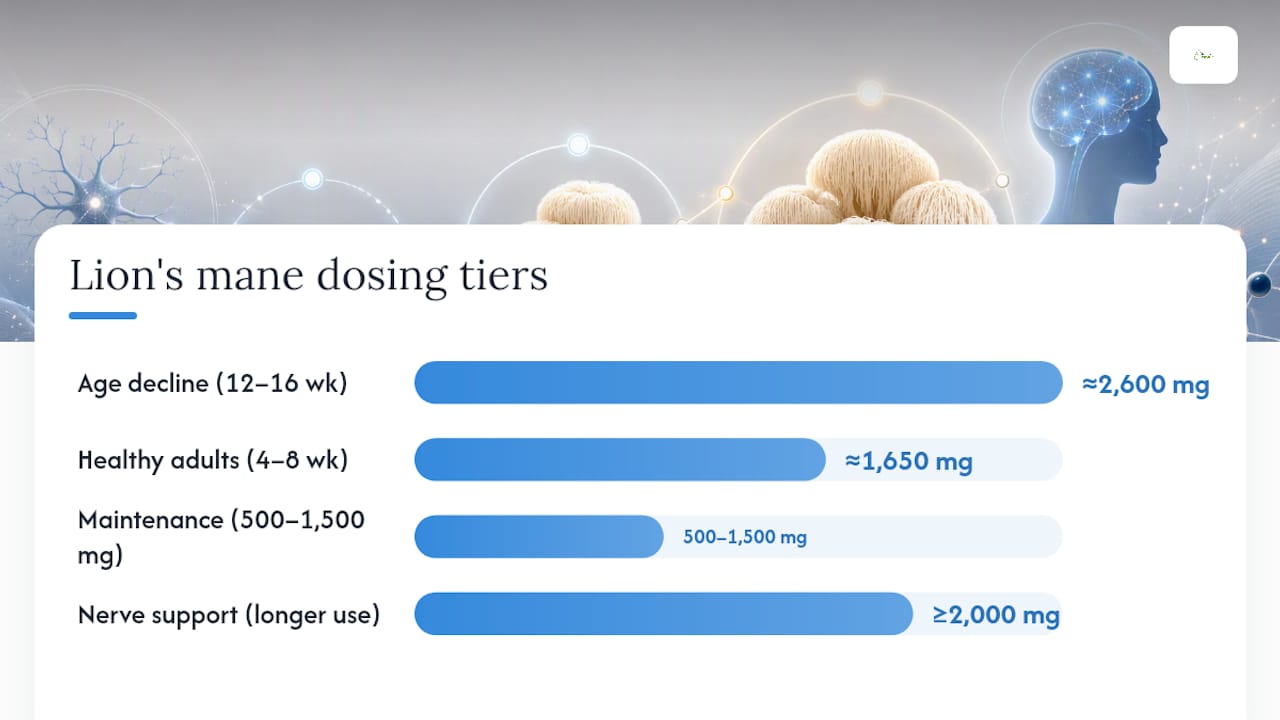
For cognitive performance and mood in healthy adults, roughly 1,500 to 1,800 mg per day aligns with the Docherty 2023 trial results, evaluated over 4 to 8 weeks. Expect subtler effects than what older adults with existing decline might notice, since a healthier baseline leaves less room for measurable improvement.
For general maintenance and antioxidant support, 500 to 1,500 mg per day is a reasonable range, adjusted down if you're using a concentrated extract rather than raw powder. This tier has the least direct trial backing and leans more on mechanistic plausibility than outcome data.
For nerve support and NGF-related goals, consider the upper clinical range, 2,000 mg or higher, sustained over a longer duration. The erinacine research from Li 2020 is promising but limited to smaller studies, so treat this as an emerging application rather than an established protocol.
Pro Tip: Match your evidence tier to your patience level. The cognitive-decline dosing range has the strongest data but requires 12 to 16 weeks before you can fairly judge results. If you want a faster read on whether lion's mane does anything for you, the Docherty-style acute effects (same-day focus changes at 1.8 g) are the quickest signal to watch for.
If you're weighing lion's mane against other nootropic options, a side-by-side comparison with Alpha-GPC breaks down mechanism differences that matter for goal-matching.
How Should You Start and Increase Your Dose?
Jumping straight to a 3,000 mg clinical dose on day one is unnecessary and makes it harder to spot how your body responds. A slow build gives you cleaner information.
- Days 1 to 14: Start at a moderate daily dose taken with food and note any digestive changes.
- Week 3 onward: If you tolerate the starting dose well, increase by 250 to 500 mg per week until you reach your goal-specific target.
- Hold at target for 8 to 12 weeks before deciding whether the supplement is working. This mirrors the duration used in trials showing measurable benefit.
- Track specific markers, not just a vague sense of "feeling different." Note focus, sleep quality, mood, and any digestive or skin changes on a simple day-by-day log.
- Watch for stop signals: unusual bruising, rash, persistent stomach upset, or any signs of allergic reaction warrant pausing and checking with a clinician before resuming.
This titration approach also protects you financially. If you build tolerance and effect gradually, you'll know your actual effective dose instead of guessing at a number pulled from a bottle that may use a completely different extraction ratio than the one used in the trials that impressed you in the first place.
Is Lion's Mane Safe, and What Interacts With It?
Lion's mane has a clean safety profile across the clinical literature so far, but "clean" doesn't mean risk-free, and the FDA context matters more than most articles admit.
Reported side effects in trials and consumer reports include abdominal discomfort, nausea, and mild skin rash, according to a review of lion's mane pros and cons. Trials using doses up to 3,000 mg per day did not report serious adverse events, which is reassuring, though trial populations were relatively small and monitored for limited durations.
The interaction concern that gets underplayed: lion's mane may have mild effects on blood clotting and blood sugar. If you take anticoagulants, antiplatelet medications, or hypoglycemic drugs for diabetes, check with your prescribing clinician before adding lion's mane, since the combination hasn't been studied in controlled trials and the theoretical interaction risk is real enough to warrant caution.
Regulatory context matters here too. The FDA does not review dietary supplements for safety or effectiveness before they reach store shelves. Supplements are regulated more like foods than drugs, meaning the burden of quality control sits largely with the manufacturer, not a premarket agency review. This is standard across the supplement industry, not unique to lion's mane, but it's a reason label transparency and third-party testing carry real weight.
Statistic worth remembering: trials dosing up to 3,000 mg per day reported no serious adverse events, but that reassurance comes from studies lasting weeks or months, not years, so long-term safety data remains genuinely limited.
If you experience a serious reaction, contact Poison Control at 800-222-1222 or seek emergency care immediately. For less urgent but concerning side effects, report them through the FDA's adverse-event reporting system and talk to your doctor before continuing or adjusting your dose.
What Does the Research Actually Support, and Where Does It Fall Short?
The honest summary: lion's mane has real human trial data behind it, but that data is thinner and more varied than the supplement aisle would suggest.
Mori's 2009 trial remains the anchor study, showing cognitive improvement in older adults at 3,000 mg per day over 16 weeks, with benefits fading after discontinuation. Docherty's 2023 work adds acute-effect evidence at a lower 1,800 mg dose in healthy adults, useful because it demonstrates same-day cognitive change, something rarely tested in mushroom supplement research. The erinacine mycelium work associated with Li 2020 opens a different angle entirely, using concentrated compound extraction rather than raw fruiting body weight.
Key limitations show up consistently across this body of work:
- Small sample sizes, typically dozens of participants rather than hundreds.
- Heterogeneous product preparations across studies, making direct dose comparisons imperfect.
- Short trial durations relative to how long people actually take supplements long-term.
- No dose-response trials that systematically test multiple doses head-to-head in the same study population.
Researchers reviewing the natural products literature note that differing preparations and small trial sizes mean there is no universally accepted optimal dose. Consumers should view lion's mane as supportive, with product quality mattering as much as the number on the label, according to a 2026 Frontiers in Natural Products commentary.
Larger, standardized-extract trials with built-in dose comparison arms would do more to settle the optimal-dose question than any single new study using yet another proprietary extract ratio.
How Do You Choose a Quality Lion's Mane Product?
The dosing math above only works if the product you buy tells you what's actually inside it. Vague labels make every calculation guesswork.
Look for products that specify extraction ratio, confirm "fruiting body" rather than just "mycelium," and list a beta-glucan percentage when possible, since that number gives you a concrete potency anchor rather than a marketing claim. Independent lab testing, shown through a certificate of analysis, is the strongest trust signal available. It confirms both potency and the absence of contaminants like heavy metals, something ingredient sourcing guides flag as a recurring quality gap in mycelium-on-grain products.
- Check for a stated extraction ratio (8:1, 10:1) rather than a vague "extract" label with no number.
- Confirm fruiting body sourcing over mycelium-on-grain, unless erinacine content is specifically documented.
- Request or look up a current certificate of analysis from a third-party lab.
- In multi-mushroom blends, calculate the actual lion's mane milligram amount per ingredient rather than trusting the blend total.
Pro Tip: If a proprietary blend hides individual mushroom amounts behind one combined total, assume the lion's mane dose is on the lower end unless the label proves otherwise. Manufacturers rarely bury the highest-cost ingredient behind a blend label.
Anyone weighing beta-glucan content specifically can cross-reference how beta-glucan measurement works across mushroom and grain sources to understand what that percentage on a label actually represents.
Our Take: Evidence Matters More Than the Marketing Around It
Lion's mane earns its reputation for a reason, but that reason is narrower than the wellness aisle suggests. The trial evidence supports meaningful cognitive benefit at specific doses over specific durations, primarily in older adults with existing decline, with promising but thinner support for healthy-adult cognition and mood. It is not a fast-acting nootropic, and anyone expecting same-day transformation from a 500 mg capsule of unspecified extract is set up for disappointment.
What actually separates a useful lion's mane regimen from a wasted purchase is precision. Precision about extraction ratio, precision about which trial dose you're actually trying to match, and precision about giving it the 8 to 16 weeks the research indicates it needs before judging results. NutraSmarts built its lion's mane ingredient profile around exactly this kind of verification, because a supplement's value lives or dies on whether the label matches the science behind the claim.
— NutraSmarts
Want to Check Your Product Against the Research Yourself?
Comparing a bottle in your hand to trial data used to mean digging through PubMed abstracts and doing extraction-ratio math on a napkin. Some ingredient databases allow searching lion's mane or many other ingredients and show clinical trial citations, extraction details, and evidence ratings side by side.
If you formulate or sell supplements yourself, the free Supplement Facts label creator generates FDA-compliant labels without spreadsheet headaches, so your extraction ratio and dosing information reaches customers clearly instead of buried in fine print. And if lion's mane is one piece of a broader cognitive support stack you're building, the cognitive supplements comparison page lays out how it stacks up against other researched options. Start by looking up your current product on NutraSmarts to see how its label claims match the evidence.
This article is general information, not a substitute for advice from a qualified doctor. Consult a qualified healthcare professional about your own circumstances before acting on anything here.
Sources
- PMC: Docherty et al. 2023
- PubMed: Mori et al. 2009
- FDA: Dietary supplements
- CNET: The pros and cons of lion's mane mushrooms
FAQ
What Is a Safe Starting Dose for Lion's Mane?
Start at 500 to 1,000 mg per day for one to two weeks, then increase by 250 to 500 mg weekly until you reach your target range, watching for digestive or skin reactions along the way.
How Much Lion's Mane Per Day Do Clinical Trials Use?
Trials have used between roughly 1,000 and 3,200 mg per day, with the strongest cognitive results coming from 1,800 to 3,000 mg per day sustained for 4 to 16 weeks.
How Long Does Lion's Mane Take to Work?
Acute effects on focus have shown up within hours in small trials, but meaningful cognitive or mood changes generally require 4 to 16 weeks of consistent daily dosing.
Does Extract Type Change the Dosage I Should Take?
Yes. Concentrated extracts with ratios like 8:1 or 10:1 pack far more potency per milligram than raw fruiting body powder, so a much lower labeled dose can match a higher clinical dose.
Can I Take Lion's Mane With Other Medications?
Check with a clinician first if you take blood thinners, antiplatelet drugs, or diabetes medication, since lion's mane may have mild effects on clotting and blood sugar that haven't been studied in combination trials.