

Assessing supplement dosage in clinical research is defined as the systematic evaluation of dose, matrix, purity, bioavailability, and intended use to establish safe and effective dosing parameters for bioactive compounds in human trials. The formal industry term for this process is clinical dosage assessment, and it differs sharply from pharmaceutical dose-finding because supplements rarely follow linear dose-response curves. Researchers who treat supplement dosing like drug dosing routinely misinterpret results or design trials that fail before they start. The frameworks covered here, including adaptive Bayesian models and Optimal Biological Dose methodology, give you the tools to avoid those failures.
How to assess supplement dosage in clinical research: key factors
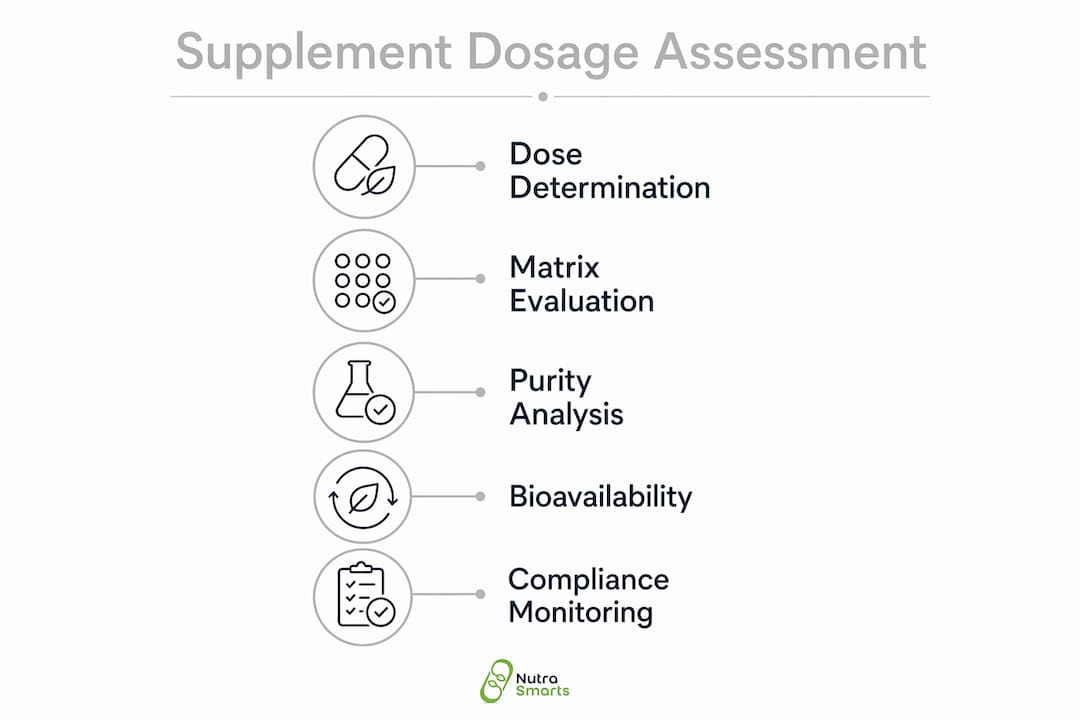
Determining supplement dosage starts with five variables: dose, matrix, purity, bioavailability, and intended use. Each one changes how a bioactive compound behaves in the body, and ignoring any of them produces unreliable results.
Dose and matrix are inseparable. Supplement delivery significantly alters systemic exposure compared to whole-food sources of the same compound. A curcumin capsule and turmeric in food deliver the same molecule at radically different plasma concentrations. That gap means you cannot extrapolate dietary intake data to set a trial dose.

Purity and chemical form determine reproducibility. A magnesium glycinate formulation and a magnesium oxide formulation carry the same elemental magnesium on a label but behave differently in absorption studies. Ingredient form and excipients directly impact clinical results and their applicability to real-world settings. Without specifying the exact salt form and excipient profile in your protocol, replication becomes impossible.
Bioavailability sets the ceiling on systemic exposure. Matrix effects significantly alter bioavailability of bioactive compounds, and poor bioavailability at high doses can increase gastrointestinal distress without producing any efficacy signal. This means a higher dose is not always a better dose. Formulation-specific pharmacokinetic data, not dietary reference values, must anchor your dose calculations. Resources like the supplement bioequivalence guide from Nutrasmarts explain how matrix and purity interact in practice.
- Confirm the exact chemical form (salt, chelate, ester) for every ingredient
- Document all excipients and their potential bioavailability effects
- Use formulation-specific pharmacokinetic data, not population dietary averages
- Specify intended use clearly: acute performance, chronic disease risk reduction, or deficiency correction
Pro Tip: Verify excipients and chemical forms before locking your protocol. A single undisclosed excipient, such as a fat-soluble carrier, can double the bioavailability of a fat-soluble vitamin and invalidate your dose rationale.
How to design clinical trial protocols for supplement dosage assessment
Endpoint selection is the most consequential decision in supplement trial design. Late-phase trial endpoint selection requires specialized infrastructure for dietary intake tracking and biomarker analysis. Choosing the wrong endpoint category produces a trial that is technically sound but scientifically uninformative.
Endpoint categories that matter
Three categories cover most supplement trials:
- Biomarker endpoints: Blood nutrient levels, inflammatory markers (CRP, IL-6), lipid panels, and oxidative stress indicators. These are objective and measurable but require certified lab infrastructure.
- Functional health outcomes: Physical performance tests, cognitive assessments, and clinical measurements like blood pressure or HbA1c. These connect biomarker changes to real-world health effects.
- Patient-reported outcomes (PROs): Validated instruments like the SF-36, PROMIS fatigue scale, or disease-specific questionnaires. PROs capture subjective experience that biomarkers miss.
Combining at least one biomarker endpoint with one validated PRO strengthens efficacy claims significantly. A trial showing both reduced CRP and improved fatigue scores is far more persuasive to regulators and clinicians than either result alone.
Safety monitoring and regulatory compliance
Safety monitoring in late-phase supplement trials detects even mild or unexpected adverse events, reinforcing consumer trust and regulatory compliance. Most adverse events in supplement trials are mild and unrelated to the intervention, but comprehensive monitoring is mandatory under Good Clinical Practice (GCP) standards. Schedule periodic safety reviews at predefined intervals, not just at trial end. Adverse event reporting must follow the same rigor applied to pharmaceutical trials, regardless of the supplement's perceived safety profile.
Multi-arm trial designs with three or four dose groups allow detailed dosage comparison but require more participants and precise protocol definition. Plan your sample size around the dose arms you need, not the participants you can easily recruit.
Pro Tip: Integrate objective biomarker endpoints with validated PROs from the start. Regulators and peer reviewers increasingly expect both, and retrofitting a PRO instrument mid-trial is costly and often invalidates the data.
Which adaptive designs work best for supplement dose optimization?
Traditional maximum tolerated dose (MTD) methods fail for most supplements. Optimal Biological Dose (OBD) is a more relevant target than MTD for bioactives, because lower doses often achieve similar efficacy with reduced toxicity risks. The OBD framework asks a different question: not "how much can participants tolerate?" but "what dose produces the best benefit-risk ratio?"
Two adaptive frameworks address this directly:
- DOSET (Dose Optimization with Simultaneous Efficacy and Toxicity evaluation): DOSET integrates safety and efficacy evaluation in an adaptive Bayesian model, updating dose recommendations as trial data accumulates. This is particularly useful for supplements where the therapeutic window is wide but the optimal dose is narrow.
- WIN-DOSE: A multi-parameter model that enables defining the best balance of efficacy and toxicity rather than focusing on maximum dose. WIN-DOSE handles non-monotonic dose-response curves, which are common in supplements like vitamin D, selenium, and omega-3 fatty acids.
- Model-Informed Drug Development (MIDD): Experts advocate moving beyond fixed-dose escalations to dynamic dose modeling that incorporates pharmacokinetics and real-time safety data. MIDD applies directly to supplement trials when formulation-specific PK data is available.
- Non-monotonic dose-response modeling: Trials that ignore non-linear dose-response curves may prematurely fail or misinterpret results. Model the full dose-response shape before selecting your dose arms.
The practical implication is clear. Adaptive designs reduce the sample size needed to find the OBD compared to fixed-dose escalation designs. They also protect participants by stopping ineffective or harmful dose arms early. See how double-blind supplement trials have applied these frameworks in real studies.
Pro Tip: Use modeling tools to simulate your dose-response curve before the trial starts. Even a simple pharmacokinetic simulation can reveal whether your planned dose range is likely to capture the OBD or miss it entirely.
How to measure supplement dosage effectiveness and ensure adherence
Compliance monitoring is where most supplement trials lose accuracy. Electronic monitoring or blood nutrient levels provide better adherence assessment than patient logs. Participants routinely self-adjust doses outside their prescription, and self-reported logs rarely capture this behavior accurately.
| Compliance method | Accuracy | Practical limitations |
|---|---|---|
| Participant self-report logs | Low | Subject to recall bias and social desirability |
| Pill count or blister pack return | Moderate | Does not confirm ingestion |
| Electronic monitoring devices | High | Cost and participant burden |
| Biomarker analysis (blood/urine) | Highest | Requires lab infrastructure and defined PK windows |
Accurate compliance monitoring via digital tracking and biomarkers is the most reliable way to avoid dose misclassification. Dose misclassification is the silent killer of supplement trials. A participant classified as receiving 1,000 mg who is actually taking 600 mg produces a false negative result that looks like a dosing failure.
Biomarker-based compliance works best when you have a validated biomarker for the compound being studied. Plasma 25-hydroxyvitamin D for vitamin D trials, red blood cell omega-3 index for fish oil studies, and plasma folate for folic acid interventions are all established options. When no direct biomarker exists, use a combination of pill count and electronic monitoring as a minimum standard.
Interpreting dose-response data requires accounting for participant tolerance changes over time. A dose that produces a measurable effect at week four may plateau by week twelve as physiological adaptation occurs. Build tolerance checkpoints into your protocol timeline.
What common challenges arise in supplement dosage assessment?
Supplement trials face structural barriers that pharmaceutical trials rarely encounter. Transparency in ingredient reporting and overcoming barriers like blinded dosing in botanical supplements are critical for improving research quality. Botanical products present the hardest blinding challenge because their color, taste, and smell often reveal the active arm to participants.
Common challenges and practical solutions:
- Blinding failures in botanical trials: Use matched placebos with similar organoleptic properties. Encapsulation in opaque capsules with added flavoring agents is the standard approach, though not always sufficient for strong-tasting botanicals.
- Recruitment and retention: Supplement trial participants often self-select based on existing supplement use, creating baseline confounding. Screen for current supplement use rigorously and set washout periods appropriate to the compound's half-life.
- Multi-supplement participants: Participants taking multiple supplements create cumulative dose risk and interaction potential. Collect a full supplement inventory at baseline and at each follow-up visit.
- Underreporting and ingredient opacity: Proprietary blends with undisclosed ingredient ratios make dose verification impossible. Require full ingredient disclosure as a condition of trial participation for any co-intervention.
- Reproducibility failures: Trials that do not report chemical forms, excipient profiles, and manufacturer lot numbers cannot be replicated. This is not a minor documentation issue. It is the reason many supplement findings fail to translate across studies.
The supplement ingredient transparency framework provides a useful checklist for what researchers should require from manufacturers before a trial begins. Detailed documentation at every stage, from raw material sourcing to final formulation, is the foundation of reproducible supplement research.
Key Takeaways
Accurate clinical dosage assessment in supplement research requires adaptive frameworks, biomarker-confirmed compliance, and full ingredient transparency to produce results that are both reproducible and clinically meaningful.
| Point | Details |
|---|---|
| Matrix drives bioavailability | Calculate doses from formulation-specific PK data, not dietary intake averages. |
| OBD outperforms MTD | Target the Optimal Biological Dose to maximize efficacy while minimizing adverse events. |
| Adaptive designs reduce sample size | DOSET and WIN-DOSE frameworks find the best dose with fewer participants than fixed escalation. |
| Biomarkers confirm compliance | Blood or urine biomarker analysis prevents dose misclassification from self-reported logs. |
| Transparency enables replication | Report chemical forms, excipients, and lot numbers so other researchers can reproduce your results. |
The case for rethinking how we dose supplements in trials
At Nutrasmarts, we have reviewed hundreds of supplement clinical trials, and the pattern is consistent. The trials that fail do not fail because the ingredient does not work. They fail because the dose was chosen without formulation-specific data, compliance was measured with a paper log, and the dose-response curve was assumed to be linear.
The shift to Optimal Biological Dose methodology is the most significant methodological advance in supplement research in the past decade. It reframes the entire question. Researchers who adopt adaptive Bayesian frameworks like DOSET stop chasing the highest tolerable dose and start finding the dose that actually works. That distinction matters enormously for supplements, where the therapeutic window is often narrow and the margin between efficacy and GI distress is measured in milligrams.
The integration of biomarker endpoints with validated patient-reported outcomes is equally important. A trial that shows a statistically significant change in a biomarker but no improvement in how participants feel is a weak result. A trial that shows both is a compelling one. The infrastructure investment required for biomarker analysis is real, but the alternative is producing data that clinicians cannot act on.
The future of supplement dosage research lies in multi-parameter modeling and real-time adaptive protocols. Researchers who build these methods into their trials now will produce findings that hold up to scrutiny, replicate across labs, and actually inform clinical practice.
— Nutrasmarts
Research tools for supplement dosage evaluation
Nutrasmarts provides researchers and healthcare professionals with direct access to the evidence base they need for clinical dosage decisions.

The Nutrasmarts ingredient database covers over 800 ingredients, each linked to peer-reviewed studies and clinical trial citations. Researchers can filter by health outcome, bioavailability data, and chemical form to identify the dose ranges used in published trials. For metabolic health studies, the metabolic health supplement reviews catalog covers 130 reviewed formulations with dosage data drawn from clinical evidence. The FDA-compliant Supplement Facts Label Creator supports accurate label generation for trial formulations, removing the spreadsheet errors that create compliance risk. These tools are free to access and built specifically for evidence-based dosage work.
FAQ
What is clinical dosage assessment for supplements?
Clinical dosage assessment is the systematic process of evaluating dose, matrix, purity, bioavailability, and intended use to establish safe and effective dosing parameters for a supplement in human trials. It differs from pharmaceutical dose-finding because supplements frequently exhibit non-linear dose-response relationships.
Why does bioavailability matter when determining supplement dosage?
Bioavailability determines how much of a supplement dose actually reaches systemic circulation. Matrix effects can dramatically alter absorption, meaning two formulations with identical labeled doses can produce very different plasma concentrations and clinical outcomes.
What is the Optimal Biological Dose in supplement research?
The Optimal Biological Dose is the dose that produces the best benefit-risk ratio, not the highest tolerable dose. It is the primary target in adaptive supplement trial designs because lower doses often achieve equivalent efficacy with fewer adverse events.
How do researchers monitor participant compliance in supplement trials?
Biomarker analysis, such as plasma nutrient levels or urinary metabolites, provides the most accurate compliance data. Electronic monitoring devices offer a practical alternative when validated biomarkers are not available for the compound being studied.
What makes supplement trials harder to blind than drug trials?
Botanical and whole-food supplements often have distinct colors, tastes, and odors that reveal the active arm to participants. Researchers address this by encapsulating products in opaque capsules and using matched placebos with similar sensory profiles, though perfect blinding remains difficult for strongly flavored botanicals.