

The most reliable early signs of magnesium deficiency are loss of appetite, nausea, fatigue, and generalized muscle weakness. As it progresses, watch for muscle cramps, tremor, and numbness or tingling in the hands and feet. Seizures, irregular heartbeat, or fainting are medical emergencies. See a clinician right away if they occur.
Common patterns to recognize:
- Early and mild: appetite loss, nausea, vomiting, fatigue, weakness
- Neuromuscular: cramps, tremor, tingling, muscle spasms
- Severe (urgent care needed): seizures, abnormal heart rhythm, fainting, personality changes
A standard blood test only reflects a small slice of your body's total magnesium, so a "normal" result doesn't rule out a real deficit. If symptoms are severe or keep getting worse, don't wait on a single lab number. Get evaluated.
TL;DR:
- Normal serum magnesium tests may not reflect actual body stores, so symptoms can persist or worsen despite a normal result.
- Neuromuscular symptoms like cramps, tremors, and tingling typically appear when serum magnesium drops below a low threshold and can escalate rapidly.
- Severe deficiencies can cause heart arrhythmias and seizures that require immediate correction and ECG monitoring for safety.
- Chronic, untreated magnesium deficiency can increase long-term risks including cardiovascular problems, insulin resistance, and muscle weakness.
- Prevalence is higher among older adults and pregnant women, who need careful evaluation and should avoid self-treatment with high-dose supplements.
Table of Contents
- Common Early Symptoms of Low Magnesium
- Muscle Cramps, Tremors, and Nerve Symptoms
- Can Low Magnesium Cause Heart Problems?
- What Causes Magnesium Deficiency?
- How Do Doctors Test for Magnesium Deficiency?
- Treating Magnesium Deficiency Safely
- Best Foods and Supplements to Raise Magnesium
- Checking Supplement Evidence Before You Buy
- Anxiety, Irritability, and Brain Fog: The Psychological Side
- What Happens If Magnesium Deficiency Goes Untreated?
- Do Symptoms Differ by Age or During Pregnancy?
- Key Takeaways
- Sources
Common Early Symptoms of Low Magnesium
The first signs of low magnesium rarely look dramatic, which is exactly why people miss them. Loss of appetite, nausea, vomiting, fatigue, and muscle weakness top the list. Magnesium is involved in more than 300 enzyme reactions, including the ones that generate cellular energy, so even a mild shortfall can leave you feeling drained without an obvious cause.
Here's the catch: none of these symptoms are unique to magnesium. Fatigue overlaps with thyroid problems, anemia, poor sleep, and simple overwork. Nausea can come from a dozen unrelated causes. That overlap is why doctors rarely diagnose deficiency from these symptoms alone.
- Persistent, unexplained fatigue that doesn't improve with rest
- Appetite changes lasting more than a few days
- Generalized weakness without a clear trigger like illness or new exercise
Pro Tip: Track how long a symptom has lasted and whether it's worsening before you assume it's magnesium. Symptoms that persist beyond a week or two, especially alongside a known risk factor like chronic diarrhea or diuretic use, are worth mentioning to a clinician.
Symptomatic deficiency in otherwise healthy people is actually uncommon, because healthy kidneys are efficient at conserving magnesium when intake dips temporarily. Real symptomatic cases usually trace back to an underlying condition or ongoing medication use.
Muscle Cramps, Tremors, and Nerve Symptoms
As magnesium depletion deepens, symptoms shift from vague to unmistakably neuromuscular. This is where the picture gets more specific.
- Muscle cramps and spasms — often in the calves or feet, sometimes progressing to fasciculations, or fine muscle twitching.
- Tremor — a fine, involuntary shake, most noticeable in the hands.
- Paresthesia — numbness or tingling, typically in the extremities.
- Tetany — involuntary muscle contractions that clinicians test for using the Chvostek sign (facial twitching when tapping near the jaw) and Trousseau sign (hand spasm when a blood pressure cuff is inflated).
- Seizures and mental status changes — generalized tonic-clonic seizures and personality changes signal a more severe deficiency requiring immediate attention.
These signs tend to cluster once serum magnesium drops below a low threshold, though lab reference ranges vary slightly by institution. Below that threshold, calcium and potassium balance often destabilizes too, which is part of why the neurologic symptoms escalate quickly.
Can Low Magnesium Cause Heart Problems?
Yes, and this is the complication that makes untreated deficiency dangerous rather than just uncomfortable. Magnesium helps regulate the electrical signals that keep your heart beating in rhythm. When levels fall too far, that regulation breaks down.
Severe hypomagnesemia can trigger ECG changes and arrhythmias that frequently resist standard antiarrhythmic treatment until magnesium itself is corrected. That's a critical detail for anyone managing a cardiac condition: the standard drug might not work if magnesium is the hidden driver.
Deficiency has also been linked to coronary artery spasm, and it can complicate treatment with digoxin, raising toxicity risk when magnesium runs low. People with kidney disease face compounded risk. Their kidneys struggle to both retain magnesium appropriately and clear it safely once levels shift, making close monitoring essential rather than optional.

What Causes Magnesium Deficiency?
Diet alone rarely explains a clinically significant deficiency in someone with healthy kidneys. Real cases usually involve one or more of these risk factors working together:
- Gastrointestinal issues: chronic diarrhea, Crohn's disease, celiac disease, or other malabsorption disorders that prevent magnesium from being absorbed
- Alcohol use disorder: alcohol increases urinary magnesium loss and often coincides with poor dietary intake
- Prolonged IV feeding: without adequate magnesium supplementation
- Medications: loop and thiazide diuretics, certain antibiotics, and long-term proton pump inhibitor use all increase magnesium loss or reduce absorption
- Chronic conditions: poorly controlled diabetes, older age, and existing kidney disease all raise baseline risk
If you fall into more than one of these categories, that combination matters more than any single factor alone.
How Do Doctors Test for Magnesium Deficiency?
The standard serum magnesium blood test is fast and widely available, but it has a real blind spot: it measures only a small fraction of your body's total magnesium, since most magnesium lives inside cells and in bone rather than in the bloodstream.
That means a normal serum result doesn't guarantee normal total-body stores. When clinicians suspect deficiency despite a normal serum reading, particularly in complex cases, they may order additional testing.
- Serum magnesium: fast, common, but limited to blood-level magnesium only
- RBC (red blood cell) magnesium: reflects intracellular stores more accurately
- 24-hour urinary magnesium: helps determine whether the kidneys are losing too much
| Test | What It Measures | Typical Use |
|---|---|---|
| Serum magnesium | Magnesium circulating in blood | First-line screening |
| RBC magnesium | Intracellular magnesium stores | Suspected deficiency with normal serum result |
| 24-hour urinary magnesium | Kidney magnesium excretion | Evaluating renal magnesium loss |
Treating Magnesium Deficiency Safely
Treatment depends heavily on severity, and clinicians rarely treat magnesium in isolation.
- Mild to moderate cases are usually managed with oral magnesium supplements and dietary changes.
- Severe or symptomatic cases, especially with cardiac symptoms or seizures, typically require IV magnesium in a monitored setting.
- Coexisting electrolyte imbalances get addressed simultaneously. Correcting low potassium or calcium often fails until magnesium itself is restored, since magnesium is required for the enzymes that regulate both minerals.
- ECG monitoring is standard practice in severe cases given the arrhythmia risk discussed earlier.
Pro Tip: More isn't automatically better. The Tolerable Upper Intake Level for supplemental magnesium sits at 350 mg per day for adults, and toxicity risk climbs sharply for anyone with impaired kidney function. Always loop in a clinician before high-dose supplementation.
Best Foods and Supplements to Raise Magnesium
Food should be your first move, not your last resort. A cup of cooked spinach delivers roughly 157 mg of magnesium, and a serving of pumpkin seeds, almonds, or black beans can each add another 80 to 150 mg. Whole grains, cashews, and dark chocolate round out a magnesium-friendly diet without any supplement at all.
When food alone isn't cutting it, supplement form matters more than most labels let on:
- Magnesium citrate: well absorbed, moderate laxative effect at higher doses
- Magnesium malate: well absorbed, generally gentler on digestion
- Magnesium oxide: cheaper but poorly absorbed, with a stronger laxative effect than organic forms like citrate or malate
- Magnesium L-threonate: marketed for cognitive support, though evidence varies by outcome and dose
Stick to the 350 mg/day upper limit for supplemental magnesium unless a clinician directs otherwise, and flag any kidney condition or interacting medication before starting a new regimen. Diuretics, certain antibiotics, and bisphosphonates can all interact with magnesium absorption or clearance.
Checking Supplement Evidence Before You Buy
Before buying a supplement, it helps to:
- Compare specific forms like magnesium citrate against alternatives for absorption and tolerability
- Treat evidence checks as a complement to medical advice, not a substitute for it, particularly if symptoms are severe
Anxiety, Irritability, and Brain Fog: The Psychological Side
Magnesium deficiency doesn't only show up in muscles and heart rhythm. It shows up in mood, and this is the piece people connect last. Magnesium plays a direct role in regulating neurotransmitters, including GABA, the brain's primary calming signal, and NMDA receptor activity, which governs excitability in the nervous system. When magnesium runs low, that regulatory system loses some of its balance.

The symptoms that follow tend to look like ordinary stress rather than a mineral problem: heightened anxiety, irritability, trouble concentrating, low mood, and in some cases what people describe as brain fog. None of this proves causation on its own. Anxiety and low mood have dozens of contributing causes, and magnesium deficiency is rarely the sole explanation.
What makes this worth taking seriously is the overlap with physical symptoms. If irritability or anxiety shows up alongside fatigue, muscle cramps, or appetite changes, that combination is more informative than any single symptom in isolation. A clinician evaluating mood symptoms with an unclear cause will often check basic metabolic and electrolyte panels partly for this reason.
This doesn't mean everyone with anxiety should assume a magnesium problem, and it doesn't mean magnesium supplements are a treatment for anxiety or depression on their own. But if you're already tracking physical symptoms of deficiency, don't dismiss the mental ones as unrelated stress. They may be part of the same picture.
What Happens If Magnesium Deficiency Goes Untreated?
Left uncorrected, magnesium deficiency doesn't stay confined to the symptoms you started with. It tends to compound, because magnesium is required for the enzymes that regulate calcium and potassium balance. Over time, that creates a cascade rather than an isolated problem.
Chronic low magnesium has been associated with an elevated risk of cardiovascular issues, since sustained magnesium depletion contributes to abnormal heart rhythm and has been linked with coronary artery spasm. Bone health can also suffer over the long term, since magnesium plays a structural role alongside calcium and vitamin D. Some research has connected chronically low magnesium status with insulin resistance, which matters most for people who already have prediabetes or type 2 diabetes, since the mineral is involved in glucose metabolism.
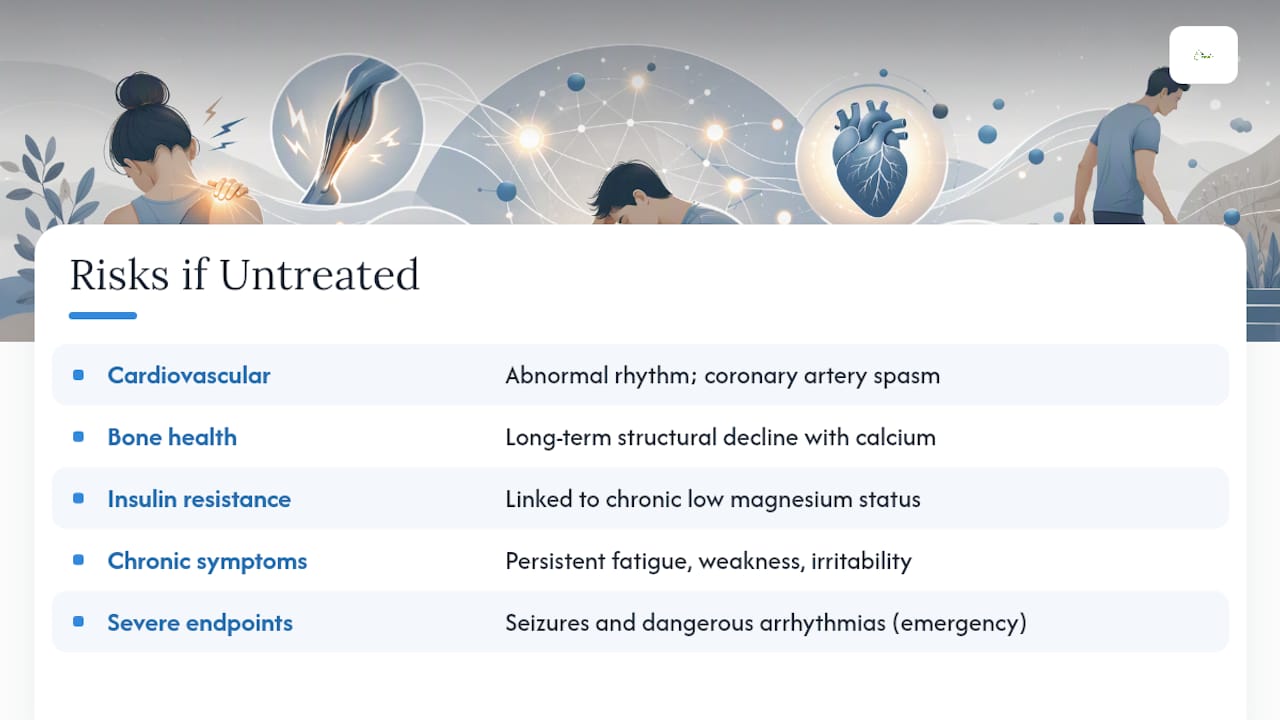
There's also a slower, quieter cost: the nonspecific symptoms, persistent fatigue, muscle weakness, irritability, tend to become the new normal. People adapt to feeling subpar rather than recognizing it as a treatable deficiency. That adaptation is part of why untreated cases can drag on for months or years before anyone connects the dots.
The severe endpoint, seizures and dangerous arrhythmias, gets the most clinical attention because it's an emergency. But the more common long-term cost is cumulative: a slow erosion of energy, mood stability, and metabolic health that's often mistaken for aging, stress, or an unrelated chronic illness. Correcting magnesium deficiency early tends to be far simpler than untangling its downstream effects later.
Do Symptoms Differ by Age or During Pregnancy?
Magnesium deficiency doesn't present identically across every life stage, and that variation matters for anyone trying to interpret their own symptoms.
Older adults face higher baseline risk for a few compounding reasons: kidney function naturally declines with age, appetite and dietary intake often drop, and chronic conditions requiring diuretics or proton pump inhibitors become more common. Symptoms in this group can be harder to catch, since fatigue and muscle weakness are frequently attributed to aging itself rather than investigated as a mineral issue.
During pregnancy, magnesium needs increase to support fetal development, and some research has associated low magnesium status with leg cramps, a common pregnancy complaint, along with elevated risk factors related to blood pressure regulation. Pregnant patients should never self-treat suspected deficiency with high-dose supplements. Any concern here belongs in a conversation with an obstetric provider, given how dosing and monitoring needs shift during pregnancy.
Children and adolescents can also become deficient, typically tied to poor dietary intake, chronic gastrointestinal conditions, or certain medications, though symptomatic deficiency is less common in this group than in older adults or people with chronic disease.
The throughline across every age group is the same: nonspecific symptoms like fatigue or muscle cramps get written off as something else entirely. Age and life stage change which explanation feels most plausible, not whether magnesium deserves a look.
Why Evidence Should Drive Every Supplement Decision
Symptom checklists are a starting point, not a diagnosis. What actually protects you is pairing careful attention to your own body with clinical testing when symptoms escalate, and checking any supplement's evidence and dosing before you rely on it. Supplements support recovery; they don't replace medical care when symptoms turn severe.
— NutraSmarts
Verify Your Magnesium Choices Before You Buy
Most magnesium products on shelves make similar claims: better absorption, faster relief, fewer side effects. Sorting fact from marketing takes more than reading a bottle label, which is exactly where Nutrasmarts fills a gap most supplement sites leave open.

The magnesium ingredient profile breaks down evidence by form, dose, and outcome, so you can compare citrate against malate or L-threonate before spending money on the wrong one. If you're formulating your own products or just want to confirm a label matches what's actually in the bottle, the Supplement Facts Tool generates FDA-compliant labels for free, no spreadsheet gymnastics required. For a broader look at what your specific symptoms might point to, the deficiency symptom guide organizes causes by symptom rather than by product. Start by pulling up the magnesium profile and checking your current supplement, or the one you're considering, against the evidence behind it.
Key Takeaways
Magnesium deficiency symptoms range from nonspecific fatigue and nausea to severe, urgent signs like seizures and arrhythmias, and serum testing alone often misses the underlying deficit.
| Point | Details |
|---|---|
| Early signs are easy to miss | Appetite loss, nausea, fatigue, and weakness overlap with many other common conditions. |
| Neuromuscular signs escalate | Cramps, tremor, and tingling can progress to tetany and seizures if untreated. |
| Cardiac risk is real | Low magnesium can trigger arrhythmias that resist standard treatment until corrected. |
| Serum tests have limits | Blood tests capture only a small fraction of total-body magnesium stores. |
| Check evidence before supplementing | Nutrasmarts's magnesium profile and Supplement Facts Tool help verify forms, doses, and label accuracy. |
Sources
- Magnesium - Consumer (NIH Office of Dietary Supplements)
- Magnesium blood test (MedlinePlus)
- Hypomagnesemia (StatPearls / NCBI Bookshelf)
- Hypomagnesemia - Merck Manual Professional Edition