

Most adults should start with 0.5 to 1 milligram of melatonin, taken 30 to 60 minutes before bed, and only move up if that dose falls short. The typical effective range tops out around 1 to 3 milligrams. Doses above 5 to 10 milligrams rarely sleep you better and raise your odds of morning grogginess. If sleep problems persist past one to two weeks, that's your cue to talk to a clinician rather than reach for a bigger bottle.
TL;DR:
- Most adults should start with 0.5 to 1 milligram of melatonin 30 to 60 minutes before bed, and only increase if that dose is insufficient.
- Doses above 3 to 5 milligrams show little to no added sleep benefit and increase the risk of morning grogginess.
- Timing of melatonin intake is more important than dose size, with 30 to 60 minutes before bedtime being optimal for sleep onset.
- Larger doses are typically used for circadian rhythm issues like jet lag, shift work, or delayed sleep phase disorder, under professional guidance.
- Melatonin supplements vary in actual content, and smaller, well-timed doses tend to be more effective than higher doses marketed for stronger effects.
Table of Contents
- Melatonin Dosage for Sleep: Why Less Usually Works Better
- When to Take Melatonin: Timing Beats Dosing
- Jet Lag, Shift Work, and Other Circadian Rhythm Problems
- Melatonin Side Effects, Interactions, and the Supplement Quality Problem
- A Stepwise Plan for Titrating Your Melatonin Dose
- Where This Dosing Guidance Comes From
- The Case for Thinking Small
- Sources
Melatonin Dosage for Sleep: Why Less Usually Works Better
The supplement aisle sells melatonin in a wide range of doses, which makes it easy to assume more is stronger and stronger is better. It isn't. Melatonin isn't a sedative like a sleeping pill. It's a hormone your brain already makes, and supplementing it works best when the dose mimics what your body produces naturally rather than overwhelming it.
That's the core logic behind NHS dosing guidance, which recommends most adults start at 0.5 to 1 milligram and stay under a 10 milligram daily ceiling. Clinicians at UC Davis Health generally advise starting at 1 milligram and adding 1 milligram a week only if needed, since most people never require more than 5 to 10 milligrams total.
Here's what the dose bands actually look like in practice:
- Microdose (0.25 to 1 mg): Mimics natural nighttime melatonin levels; often enough for mild sleep-onset trouble or circadian shifting.
- Standard effective range (1 to 3 mg): Where most adults land after titrating up from a microdose.
- High-strength shelf products (5 to 10+ mg): Widely sold, but clinical evidence doesn't show these outperform lower doses for sleep onset.
Higher doses don't reliably help you fall asleep faster, and they raise your risk of next-day drowsiness. That's the finding worth remembering before you grab the 10 milligram gummies because they were on sale. Melatonin dosage recommendations from multiple clinical sources converge on the same number: 1 to 3 milligrams covers most adults, most of the time.
When to Take Melatonin: Timing Beats Dosing
Get the timing wrong and even a well-chosen dose can backfire. Melatonin works as a circadian signal, not a knockout drug. Your body starts releasing it naturally about two hours before your normal bedtime, according to Cleveland Clinic, and supplementing works best when you sync with that window rather than fight it.
For ordinary sleep-onset trouble, take melatonin 30 to 60 minutes before the bedtime you're aiming for. Extended-release formulations behave differently. Because they release the hormone slowly over several hours, they're built to help you stay asleep rather than fall asleep fast, so taking them right before bed (not hours early) matters more than with immediate-release capsules.
Circadian phase-shifting is a different game entirely:
- Phase advance (shifting your clock earlier, useful for eastward travel): take melatonin in the early evening, before your usual bedtime.
- Phase delay (shifting your clock later, useful for westward travel): take it in the early morning instead.
- Wrong-time dosing can worsen circadian misalignment rather than fix it, since you're nudging a clock that's already trying to reset itself.
Pro Tip: Pair your dose with light management. Bright morning light after an eastward flight, and avoiding light in the evening before a westward one, does more to reset your clock than adding an extra milligram of melatonin ever will.
Jet Lag, Shift Work, and Other Circadian Rhythm Problems
Circadian disorders need a different playbook than everyday insomnia, mostly because timing carries more weight than dose size.
- Jet lag: Doses of 0.5 to 5 milligrams are used depending on the source, with lower amounts (0.5 to 1 mg) sufficient to nudge your circadian phase and higher amounts (3 to 5 mg) more commonly used for a stronger sedative push. The CDC Yellow Book notes that timing depends entirely on travel direction, and taking melatonin at the wrong circadian time can deepen misalignment instead of easing it. Most guidance limits use to a short duration, not an ongoing habit.
- Shift work and delayed sleep phase disorder: These conditions respond to precisely timed low doses more than large ones. Chronotherapy, which gradually shifts sleep timing under a clinician's guidance, often works alongside melatonin rather than instead of it.
- Non-24-hour sleep disorder and blindness-related circadian issues: These cases usually require a sleep specialist to set exact dosing and timing schedules, since the body has no light cue to anchor the internal clock.
If over-the-counter melatonin hasn't helped within a couple of weeks for any of these circadian issues, or if you're dealing with non-24 disorder specifically, loop in a sleep specialist rather than experimenting further on your own.
Melatonin Side Effects, Interactions, and the Supplement Quality Problem
Melatonin is generally well tolerated, but it isn't side-effect free. Grogginess the next morning is the complaint clinicians hear most, along with vivid dreams and occasional headaches.
Drug interactions deserve real attention:
- Blood thinners (anticoagulants) can interact with melatonin, so combining them without medical input isn't advisable.
- Some anticonvulsants may have their effectiveness altered by melatonin use.
- Sedatives and sleep medications can compound melatonin's drowsiness effect, raising fall risk, especially in older adults.
Certain groups need extra caution: pregnant or breastfeeding people, children, older adults on multiple medications, and anyone managing a chronic illness should talk to a clinician before starting, rather than after side effects show up.
Here's the number that should change how you shop: melatonin is sold as a dietary supplement, not a regulated drug, and independent lab testing has repeatedly found gaps between labeled and actual content. The NCCIH has documented this variability directly. A bottle that says 3 milligrams might not deliver 3 milligrams. That's part of why checking a product against third-party evidence, rather than trusting the label alone, matters more with melatonin than with most supplements. Nutrasmarts' melatonin ingredient dossier links the clinical trials behind these dose ranges if you want to verify a specific claim yourself.

A Stepwise Plan for Titrating Your Melatonin Dose
Skip the guesswork and follow a structure instead.
- Start at 0.5 to 1 milligram, taken 30 to 60 minutes before your target bedtime, for at least three to four nights before judging the results.
- Increase by 0.5 to 1 milligram per week only if you're not seeing improvement, working toward the 1 to 3 milligram range most adults respond to.
- Cap it around 5 milligrams without professional guidance; going beyond 10 milligrams should happen only under a clinician's direction, per Drugs guidance.
- Keep a simple nightly log: time taken, time you fell asleep, total sleep hours, and how alert you felt the next morning.
- Stop and check in with a clinician if two weeks pass with no real improvement, or if side effects or a medication interaction shows up.
Pro Tip: Melatonin does more work when it's not carrying the whole job alone. A dark, cool bedroom, dimmed screens an hour before bed, and consistent wake times reinforce the same circadian signal you're supplementing, which is why sleep hygiene and melatonin timing tend to move together in the research.
Where This Dosing Guidance Comes From
Every number in this article traces back to a clinical source, not a marketing claim. Nutrasmarts' melatonin profile compiles the peer-reviewed trials and dosage summaries referenced throughout, so you can trace a specific figure back to its study rather than take it on faith.
That same evidence-first approach runs through the Supplement Facts label tool and the broader ingredient database, which is how the dose ranges here get cross-checked against clinical sources instead of repeated from whatever a product label claims. If melatonin isn't the right fit, or you want to weigh it against alternatives, the sleep supplement comparison and melatonin versus magnesium breakdown cover adjacent options worth knowing about before you commit to one approach.
The Case for Thinking Small
The supplement industry has trained people to equate dose size with strength, and melatonin is the clearest counterexample on the shelf. The evidence points one direction: smaller, well-timed doses that mirror your body's own nighttime melatonin curve tend to outperform the mega-dose gummies stacked at the front of the store.
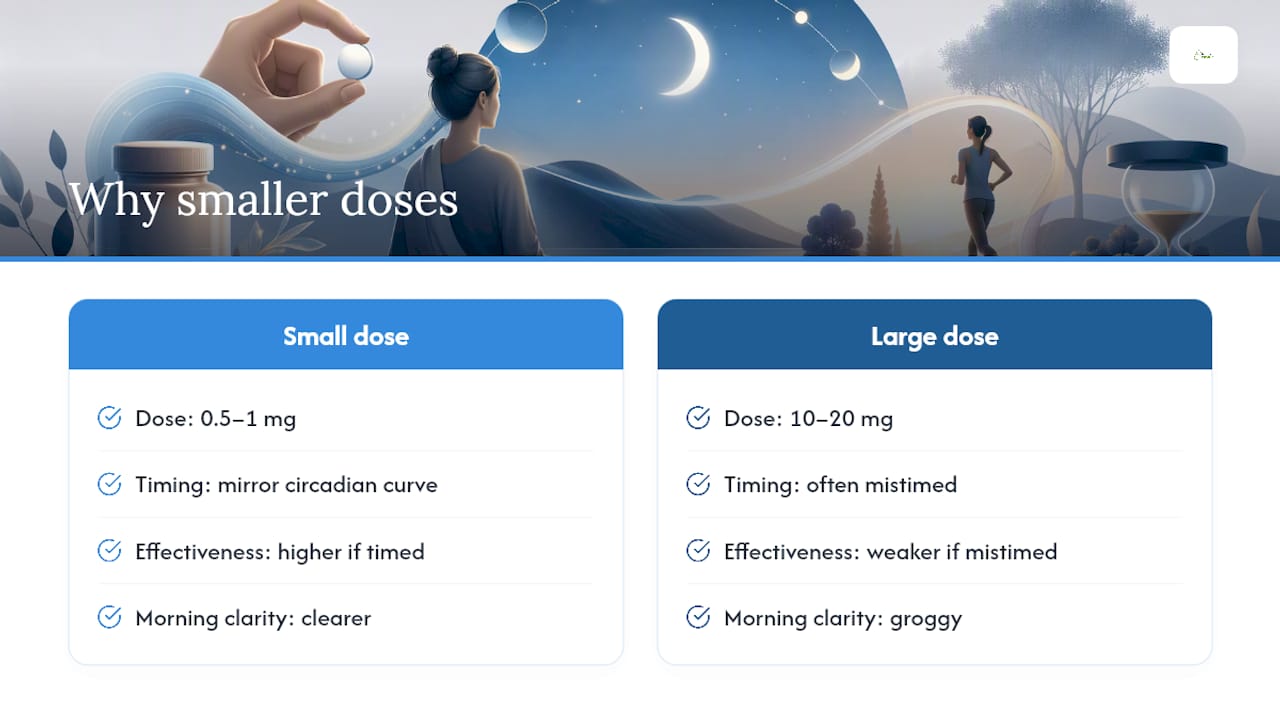
Conventional advice treats melatonin like a sedative you dial up until it works. That framing gets the mechanism backward. It's a signal, not a sedative, and signals get lost in noise when you overdose them. The gap between what's marketed (10, 15, even 20 milligrams) and what the clinical dosing literature actually supports (usually under 3 milligrams) is one of the widest disconnects in the supplement aisle.
If you take one thing from this: fix your timing before you touch your dose. A correctly timed 1 milligram dose will outperform a mistimed 5 milligram one almost every time, and it will leave you clearer headed in the morning.
— Nutrasmarts
This article is general information, not a substitute for advice from a qualified doctor. Consult a qualified healthcare professional about your own circumstances before acting on anything here.
Sources
- How and when to take melatonin — NHS
- Melatonin dose: How much should I take? — Cleveland Clinic
- Drugs
- Melatonin: What you need to know — NCCIH / NIH
- Jet lag: timing and melatonin considerations — CDC Yellow Book