

Phosphatidylserine (PS) and bacopa are not rivals so much as two different kinds of ingredient. PS is a phospholipid, a fat that is part of brain cell membranes. Bacopa monnieri is an Ayurvedic herb, taken as a standardized extract. The human trials behind them differ in size, length and results, and that is what should decide which one you read up on first. Both have mixed evidence, and the details matter more than the marketing claims on most labels.
We built our ingredient database so you can see those details side by side: the doses studied, the trial length and the evidence rating, each tied to a published study. This article does the same for this pair.
TL;DR
- PS has more than 20 small human trials, mostly up to 6 months, at doses of 100 to 500 mg a day. The trials were mostly small or weakly designed, and no meta-analyses exist.
- Bacopa has been studied mainly at 300 mg a day of standardized extract for about 12 weeks. Results are inconsistent: some trials show gains in memory tests, and a 2026 systematic review found no overall benefit.
- Timing differs: bacopa trials are built around 12 weeks, not days. PS trials run weeks to months.
- Safety: bacopa's common side effects are digestive. It has specific cautions for people on thyroid or cholinergic drugs. PS has a good safety profile in the trials reviewed.
- Together: the combination has only been tested in uncontrolled studies, so neither ingredient can be credited for the results.
Table of Contents
- What each ingredient is
- What the human trials found for phosphatidylserine
- What the human trials found for bacopa
- Side-by-side comparison
- How long each takes
- Doses and forms in the research
- Safety and who should be careful
- What about dopamine?
- Taking them together
- How to choose between them
- Our perspective
- Start with the evidence, free
- FAQ
- Sources
What each ingredient is
Phosphatidylserine sits in the membranes of brain cells. Supplement versions come from soy or sunflower, and older trials used a form from cow brain that is no longer available. Some research uses PS enriched with the omega-3 fats DHA and EPA. In the United States, one such product is sold as a prescription medical food, which is a different category from an over-the-counter capsule.
Bacopa monnieri is a creeping plant used in traditional Indian medicine. Supplements use an extract, often standardized to a percentage of bacosides, the plant compounds thought to be responsible for its effects. The Alzheimer's Drug Discovery Foundation notes that no specific bacoside dose has been shown to be especially effective, so a bacoside percentage on a label tells you less than it seems to.
Our own profiles cover each in detail: phosphatidylserine and bacopa monnieri.
What the human trials found for phosphatidylserine
The Alzheimer's Drug Discovery Foundation's review says PS may support cognitive function and protect against decline, particularly the DHA-enriched form. It also counts over 20 small clinical trials, no meta-analyses, and notes that most studies were small or poorly designed (ADDF, Phosphatidylserine).
The individual results are encouraging in places:
- A trial of 100 or 300 mg a day for six months in people with mild memory impairment found significantly better delayed verbal recall than placebo.
- A 12-week study of 300 mg a day in older adults with age-associated memory impairment reported better recognition and recall, executive function and mental flexibility, according to the same review of 21 nutrients.
- The largest trial of cow-derived PS with DHA, which used 300 mg a day in 494 patients in Italy, reported improved memory, learning, motivation and socialization over 3 to 6 months.
- A marine-source DHA-enriched PS given for 15 weeks improved some but not most cognitive measures. In it, 37% of treated patients and 28% of controls were rated clinically improved, a gap that was not statistically significant. A longer 30-week treatment did not add further gains (ADDF).
On the regulatory side, the FDA allows a qualified health claim on supplements containing high-quality soy-derived PS. The wording is deliberately limited: it says research is very limited and preliminary. The Alzheimer's Association describes this, and we cover the trial detail on our page on phosphatidylserine and memory.
What the human trials found for bacopa
Bacopa has a bigger and more mixed research record, and the three main sources read differently.
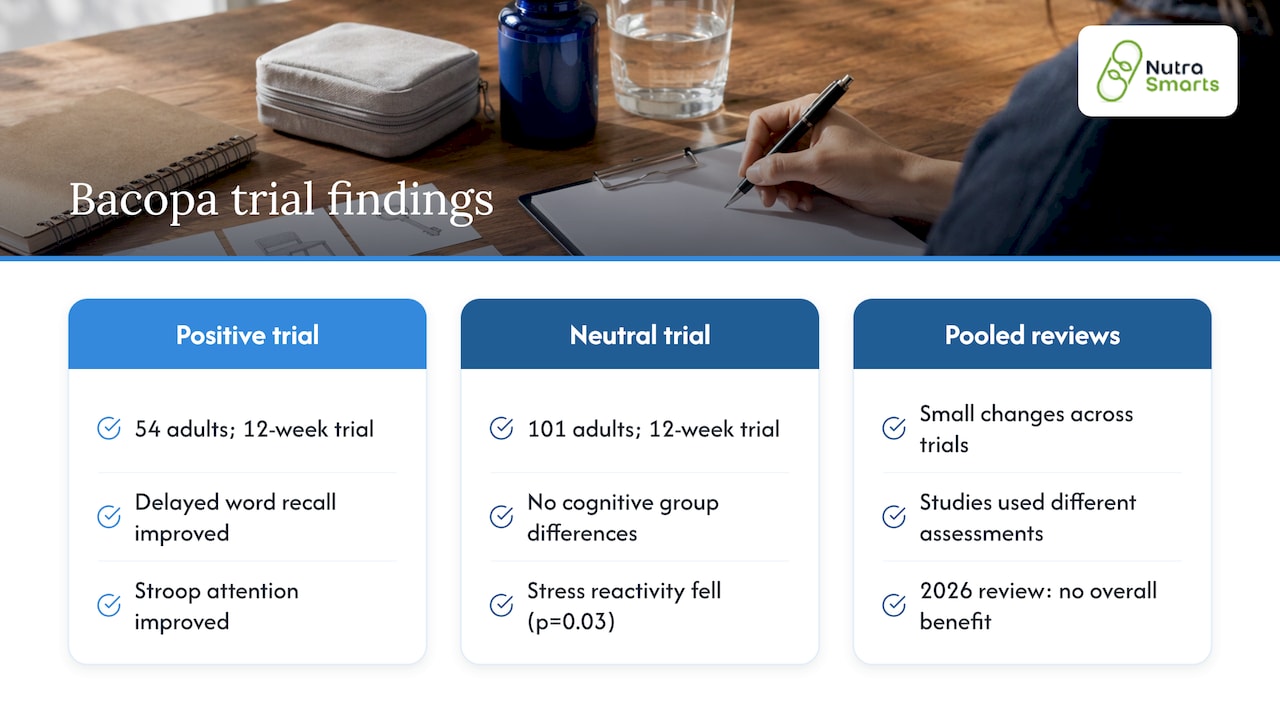
Positive signals. In a randomized trial of 54 adults aged 65 and older, 300 mg a day of standardized extract for 12 weeks improved delayed word recall and a Stroop attention test versus placebo. Depression and anxiety scores and heart rate also fell in the bacopa group. Side effects were few and mostly stomach upset (Calabrese et al.). The Alzheimer's Drug Discovery Foundation counts six systematic reviews or meta-analyses. In a meta-analysis of 11 double-blind trials, all but one reported at least one significant improvement on one test. However, no two studies improved on the same assessment, and the changes were small (ADDF, Bacopa).
Neutral or negative signals. A 12-week trial of 101 adults aged 40 to 70 with self-reported memory and attention problems found no between-group differences in verbal learning, attention or working memory at 300 mg a day. It did find larger reductions in self-reported stress reactivity (p=0.03). A systematic review published in January 2026 found no benefit on processing speed, attention, working memory or overall cognitive performance when the trials were pooled.
The Merck Manual describes the picture as small trials with modest benefit and no high-quality studies showing it improves memory or treats any disorder. The ADDF adds that no human study has examined whether bacopa protects against cognitive decline.
Honest summary: bacopa's strongest human signal may be on stress and mood-related measures, while its memory results depend on which trial and which test you look at. Our pages on bacopa and memory and honest evidence for bacopa set out each trial.
Side-by-side comparison
| Phosphatidylserine | Bacopa monnieri | |
|---|---|---|
| Type | Phospholipid in cell membranes | Herbal extract (bacosides) |
| Typical studied dose | 100 to 500 mg a day | 300 mg a day, range 250 to 600 mg |
| Typical trial length | Weeks up to 6 months | About 12 weeks |
| Strongest human signal | Delayed verbal recall, memory in older adults with mild impairment | Stress-related measures, some memory tests in older adults |
| Main caveat in the evidence | Small, often poorly designed trials, no meta-analyses | Inconsistent results, no two trials improving the same test |
| Common side effects | Well tolerated in reviewed trials | Nausea, abdominal cramps, headache |
| Meta-analyses | None identified | Several, with mixed conclusions |
Dose ranges come from the Alzheimer's Drug Discovery Foundation reviews of PS and bacopa. For a more detailed pairing of bacopa against another herb, see bacopa vs ginkgo.
How long each takes
Neither ingredient is studied as a quick fix. PS trials usually ran up to six months. The ADDF notes that in theory PS could change membrane composition within days, but effects have not been rigorously studied on that timescale.
Bacopa trials are built around 12 weeks. In one early study, memory scores did not change significantly at 5 weeks but did at 12. The two bacopa reviews that pooled data from 2012 and 2014 only included trials of 12 weeks or more. If you are trying either one, a fair evaluation means weeks, not days, with a simple record of what you are tracking, such as sleep, stress or recall, before you start.
Doses and forms in the research
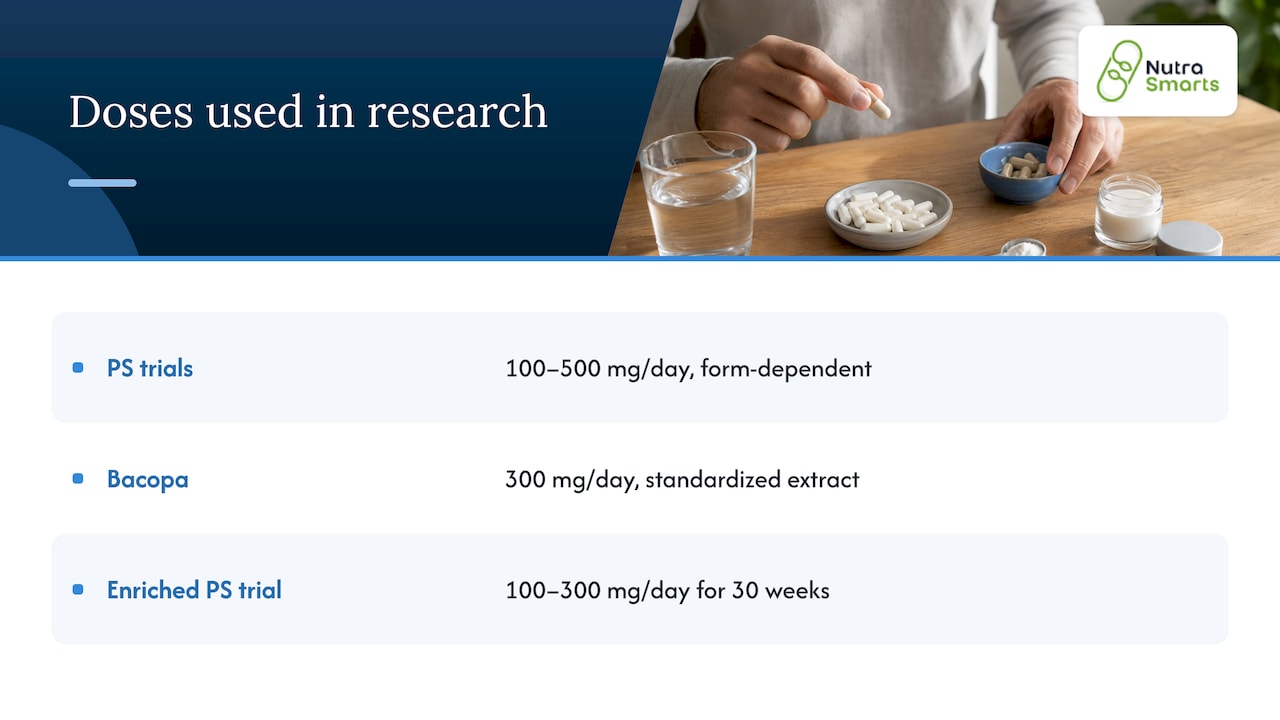
For PS, trial doses range from 100 to 500 mg a day depending on the form: soy-derived or DHA and EPA-enriched marine PS. A 30-week trial of 100 to 300 mg a day of an enriched form was well tolerated, with a 3.1 mmHg fall in resting diastolic blood pressure and a 0.7 kg weight gain (ADDF).
For bacopa, 300 mg a day of standardized extract is the usual studied dose. Extract matters: the trials used specific, characterized extracts, not raw powder. Product names such as BaCognize and BacoMind refer to branded extracts, and each has its own profile in our database.
When you compare labels, line up three things: the form (soy PS or enriched PS, standardized bacopa extract), the milligrams per serving, and whether the dose falls in the studied range. Some people use a price tracker, such as these nootropic price comparisons, to see cost per milligram once they know the dose they want.
Safety and who should be careful
Bacopa. Small trials of up to three months reported it as safe in healthy adults. The most common side effects are gastrointestinal, such as nausea and abdominal cramps. The ADDF says it may affect thyroid hormone levels and the cholinergic system, so people taking thyroid medication or cholinergic drugs, for example acetylcholinesterase inhibitors, should be cautious. It may also worsen slow heart rate, gastrointestinal obstruction, peptic ulcers, asthma or urinary tract obstruction. Some extracts may contain heavy metals such as mercury or lead depending on where the plant was grown (ADDF). If you have any of these conditions or take these medicines, talk to your doctor or pharmacist before starting.
Phosphatidylserine. The ADDF describes a good safety profile in the trials it reviewed. Because PS can come from soy, anyone with a soy allergy should check the source on the label. If you take prescription medication or have a medical condition, check with your doctor first.
What about dopamine?
A common question is whether bacopa raises or lowers dopamine. The honest answer is that most of the evidence is from animals and lab work. A 2025 review describes bacopa compounds influencing dopamine and serotonin systems and protecting dopamine-producing neurons in rodent models. That does not establish a dopamine effect in healthy people, and it should not be read as one. The human trials above measured memory, attention and stress, not dopamine.
Taking them together
Many products combine the two, so the question is fair. The evidence is limited to uncontrolled studies of one specific formula.
- A 2014 trial of 104 people with mild cognitive impairment used a daily tablet with 100 mg bacopa extract (20 mg bacosides), 30 mg soy PS, astaxanthin and vitamin E for 60 days. Scores on the ADAS-cog scale improved from 13.7 to 9.7, but the authors note that the lack of a control group makes the results exploratory.
- A 2026 open-label study of 100 patients aged 60 to 79 used the same formula for 52 weeks and reported 24% better delayed recall. The authors state that the uncontrolled design cannot give definitive evidence. Minor side effects included nausea.
No head-to-head randomized trial compares the combination with either ingredient alone, so you cannot tell from these studies which ingredient did what. Because the formula also contained astaxanthin and vitamin E, the results belong to the whole formula.
How to choose between them
- Start from your goal. If your focus is stress-related mental fatigue, bacopa's trial data speak to that. If it is delayed verbal recall in later life, the PS data are the closer match.
- Check your health profile. Thyroid medication, cholinergic drugs, slow heart rate, ulcers or asthma point to a conversation with your doctor before bacopa.
- Match the studied dose and form. Look for 300 mg of standardized bacopa extract or 100 to 300 mg of PS.
- Give it the studied time. Plan on about 12 weeks for bacopa and weeks to months for PS.
- Change one thing at a time. Taking both at once hides which one is working.
Our symptom search lets you start from what you are dealing with, and Best Supplements for Healthy Brain Aging covers the wider set of ingredients.
Our perspective
Comparing two ingredients is only useful if the comparison keeps the evidence honest. PS and bacopa each have a real research record, and each record has limits that belong in the same sentence as the benefits: small trials for PS, inconsistent test results for bacopa.
That is why every profile in our database ties its claims to PubMed-cited studies, lists clinical dosage benchmarks and gives an evidence rating. You can see the trial size, the dose and the length of study next to each other, then decide for yourself.
We designed the side-by-side ingredient comparison for exactly this question. It puts two ingredients on the same page so that the dose, duration and outcome measures are easy to line up. No sign-up or paywall stands between you and any of it.
NutraSmarts
Start with the evidence, free
If you want to compare more than two ingredients, our Best Cognitive Supplements page reviews 144 of them, and you can use the symptom-based supplement search to go from a concern to the ingredients studied for it. Everything on NutraSmarts is free to use, with no sign-up. Formulators can also build a compliant panel with our free Supplement Facts label creator.
FAQ
Is phosphatidylserine or bacopa better for memory?
Neither has a clear lead. PS has small trials showing better delayed verbal recall in older adults with mild impairment, while bacopa has mixed results, with a 2026 systematic review finding no overall benefit on cognitive tests. Which one suits you depends on your goal, your health profile and the dose and form studied.
Can I take bacopa and phosphatidylserine together?
They have been combined in uncontrolled studies of one specific formula that also contained astaxanthin and vitamin E, with minor side effects such as nausea reported. No controlled trial compares the pair with either alone. Check with your doctor if you take thyroid or cholinergic medication, since bacopa has specific cautions there.
How long does bacopa take to work?
The trials were built around 12 weeks of daily use. In one early study, no significant change appeared at 5 weeks, but improvement did at 12 weeks. Effects are not expected within days.
Does bacopa decrease dopamine?
The dopamine findings come mainly from animal and lab studies, which describe bacopa compounds influencing dopamine systems and protecting dopamine-producing neurons in rodents. The human trials measured memory, attention and stress, not dopamine, so there is no established human effect either way.
Sources
- Phosphatidylserine, Cognitive Vitality for Researchers (Alzheimer's Drug Discovery Foundation)
- Bacopa monnieri & Your Brain (Alzheimer's Drug Discovery Foundation)
- Effects of a Standardized Bacopa monnieri Extract on Cognitive Performance, Anxiety, and Depression in the Elderly
- The Effects of a Bacopa monnieri Extract (Bacumen) on cognition, PubMed
- The efficacy of nutritional phytochemical compounds in cognition, systematic review, 2026
- The effects of twenty-one nutrients and phytonutrients on cognitive function
- Alternative Treatments, Alzheimer's Association
- Bacopa, Merck Manual Professional Edition
- Cognitive effects of a dietary supplement made from extract of Bacopa monnieri, astaxanthin, phosphatidylserine and vitamin E
- Effects on Memory Tasks and Daily Life Performance of a Dietary Supplement in Amnestic Mild Cognitive Impairment, Journal of Nutraceuticals
- Bacopa monnieri: Preclinical and Clinical Evidence of Neuroactive Effects, Nutrients