
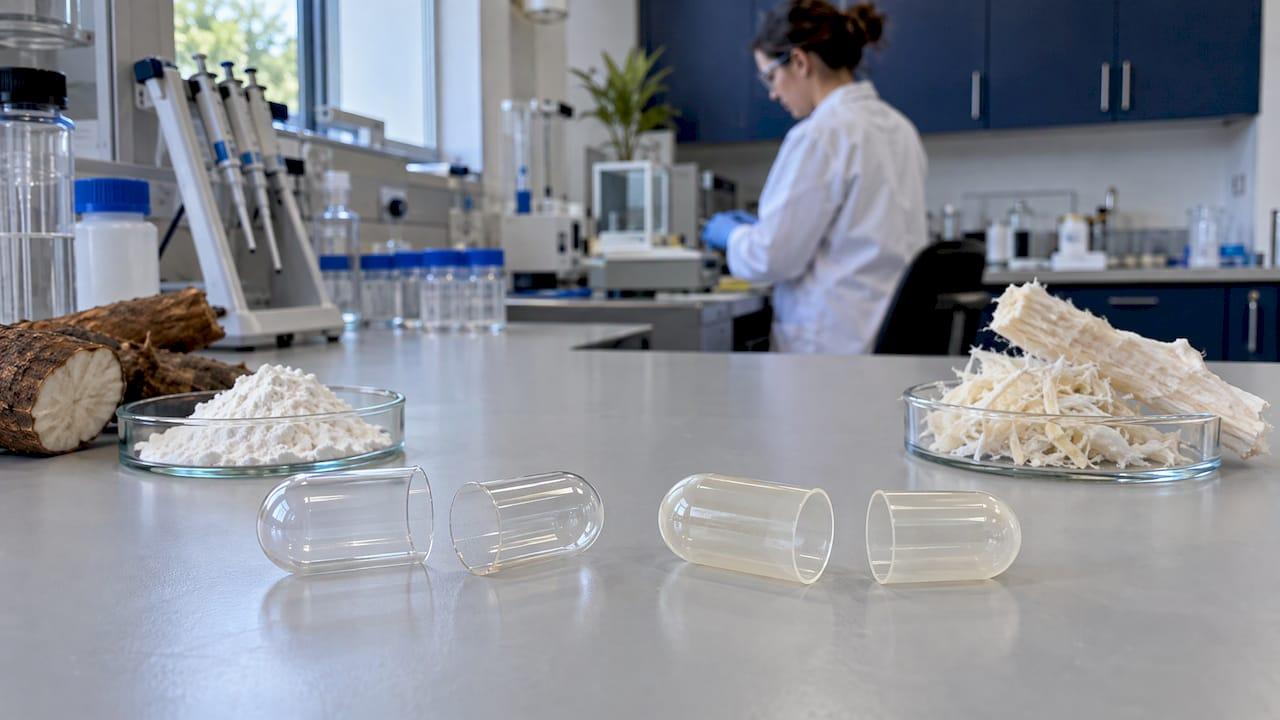
Both pullulan and HPMC (hypromellose) capsules are plant-based, so both work for vegan and vegetarian supplements. The real difference is protection. Pullulan is the stronger oxygen barrier, which suits oxygen-sensitive fills such as vitamin C, fish oils and probiotics. HPMC has lower moisture content, which suits moisture-sensitive powders. Pick by what is inside the capsule and how the bottle will be stored, not by which one sounds cleaner.
TL;DR
- Pullulan (fermented from starch) and HPMC (a cellulose derivative) are both free of animal ingredients and suit vegan products.
- Pullulan is the better oxygen barrier. An industry report says early-generation HPMC shells let oxygen through up to 50 times faster.
- HPMC shells hold less water, so they are the usual pick for moisture-sensitive or hygroscopic fills.
- Standard HPMC capsules open at varying speeds depending on the gelling aid. Check the dissolution data for your specific capsule.
- In the U.S., the capsule shell still counts as an ingredient. It belongs in the Other Ingredients list and in your batch records.
Table of Contents
- What each capsule is made from
- Side-by-side comparison
- Oxygen protection: where pullulan stands out
- Moisture: where HPMC has the edge
- Opening time and dissolution
- Matching the capsule to the supplement
- Labeling and compliance in the U.S.
- How to decide: a short checklist
- Our perspective
- Check the ingredient before you worry about the shell
- FAQ
- Sources
What each capsule is made from
Pullulan is a natural polysaccharide. It is made by fermenting a starch source, commonly tapioca, with the fungus Aureobasidium pullulans. A pharmaceutical technology primer describes pullulan capsules as tapioca-based and notes they give a high barrier to oxygen.
HPMC (hydroxypropyl methylcellulose, also called hypromellose) is a semi-synthetic polymer made from plant cellulose. Manufacturers add a gelling agent so the polymer forms a firm shell. That gelling agent matters later, because it affects how fast the capsule opens.
The same primer notes that HPMC capsules are not of animal origin and carry no risk of the BSE or TSE contamination associated with some animal-derived shells. Neither material contains gelatin, so neither is a problem for vegans, vegetarians or most religious dietary rules. If you are still deciding between plant-based shells and gelatin, our guide to gelatin vs vegetarian capsules covers that choice.

A quick note on safety status: pullulan has an FDA response letter on file. According to a USDA technical report, FDA issued a response to GRAS Notice GRN 000099 on August 1, 2002 and had no objections to pullulan's self-affirmed GRAS status.
Side-by-side comparison
| Factor | Pullulan | HPMC |
|---|---|---|
| Source | Fermented starch (often tapioca) | Plant cellulose plus a gelling agent |
| Animal-free | Yes | Yes |
| Oxygen barrier | High | Lower, especially in first- and second-generation shells |
| Moisture content | Higher than HPMC | Lower (3 to 8% in typical descriptions) |
| Opening behavior | Fast, predictable | Depends on the gelling aid and vendor |
| Best for | Oxygen-sensitive fills, probiotics, oils | Moisture-sensitive or hygroscopic powders |
| Usual cost | Generally higher | Generally lower |
The cost row reflects common market practice rather than a fixed price. Capsule prices change with volume, size and supplier, so get quotes for your own run.
Oxygen protection: where pullulan stands out
Oxygen is what degrades vitamin C, many botanical extracts, omega-3 oils and live cultures. Here the two shells part ways.
A 2018 industry report in NutraIngredients Business Review says gelatin and pullulan hard shells show equivalent, low oxygen permeability. It says first- and second-generation HPMC shells allow oxygen to pass up to 50 times faster. For oxygen-sensitive ingredients in HPMC, it recommends adding an antioxidant to the fill or using oxygen-resistant packaging such as an aluminum-foil blister.
A peer-reviewed storage study points the same way. In a 2009 study in Food Science, fish oil stored in pullulan soft capsule shells showed an essentially unchanged peroxide value over four months at 40°C and 75% relative humidity (2.03 to 2.04 meq/kg). The same oil in gelatin capsules rose from 2.02 to 2.67 meq/kg. Note that this study compared pullulan with gelatin, not with HPMC, and it used soft capsules. It supports pullulan's barrier performance rather than ranking the two plant shells directly.
Two cautions keep expectations realistic:
- Film data is not shelf-life data. You will see "300 times better" figures for pullulan film against HPMC film. That is a property of the film at a given thickness. A two-piece capsule is not a hermetic package: the cap-body joint, the bottle headspace, the desiccant and the closure all affect what the fill actually experiences.
- Packaging closes much of the gap. A well-sealed bottle, an oxygen absorber or a foil blister protects an HPMC capsule substantially.
Moisture: where HPMC has the edge
HPMC shells carry less water. PharmTech's primer puts HPMC moisture content at 3 to 8% and notes low static charge and no cross-linking reactions, which is useful for highly reactive molecules.
A peer-reviewed comparison of moisture sorption and desorption found that HPMC capsules absorb and hold less moisture than pullulan or gelatin capsules. Pullulan absorbed less than gelatin and held moisture comparably. Both plant shells protected high-, moderate- and low-hygroscopic contents from picking up outside moisture better than gelatin did.
That makes HPMC a sensible default for powders that clump, cake or degrade when exposed to water, such as some probiotics blends, effervescent-prone minerals and hygroscopic extracts. Low shell moisture also means the capsule is less likely to hand water to the fill, or take it from the fill.

Opening time and dissolution
How quickly a capsule opens in the gut matters for absorption, and here the plant shells behave differently.
- Pullulan shells open quickly and consistently. In the 2009 study above, pullulan soft shells opened in about 12 minutes after six months at 40°C and 75% relative humidity. Gelatin shells under the same conditions took more than 113 minutes.
- HPMC shells are less uniform from vendor to vendor. The 2018 industry report says the gelling aid can change opening time, with 50% release ranging from 24 minutes to over two hours in its testing. A shell with a slower gelling system is not a defect, but it is something to check if fast release matters.
If you want delayed release, HPMC is the more common platform. In a 2020 Pharmaceutics study, uncoated HPMC capsules in 0.1 M HCl disintegrated in about 5.5 minutes, so an enteric coating is needed for real gastric resistance. With the right coating, results can be reliable: in a 2022 human study of an enteric HPMC capsule, none of the capsules released content in the stomach, even with gastric residence times up to 82.5 minutes, and seven of eight disintegrated in the distal small intestine. That was one specific commercial product in eight volunteers, so it shows what is possible rather than what every HPMC capsule does.
Matching the capsule to the supplement
Start with the fill, then the storage environment.
| Your fill | Likely better fit | Why |
|---|---|---|
| Vitamin C, polyphenol or other easily oxidized extract | Pullulan | Lower oxygen permeability |
| Fish, algal or other oils (in soft or hard shells) | Pullulan | Oxygen barrier, steadier opening over storage |
| Hygroscopic powders, some herbal extracts | HPMC | Lower shell moisture, less water exchange |
| Probiotics | Depends on the strain and packaging | Oxygen and moisture both matter, so test with a desiccant |
| Delayed-release or enteric products | Enteric-coated HPMC | Established coating platforms |
| Budget-sensitive, stable fills | HPMC | Generally lower cost |
Storage conditions matter as much as the shell. One supplier's guidance suggests HPMC tolerates roughly 59° to 86°F and 35 to 70% relative humidity, with pullulan kept a little cooler and drier, at 59° to 77°F and 35 to 65%. Treat those as typical ranges rather than universal specs, and use your own supplier's data sheet. For a household reader, the practical rule is the same either way: keep capsules in the original sealed bottle, away from heat and the bathroom.
Labeling and compliance in the U.S.
If you are formulating a product, the shell is part of the finished supplement, not packaging. A few points to keep straight:
- Other Ingredients. FDA's dietary supplement Q&A explains that ingredients not listed in Supplement Facts go in the Other Ingredients list. Your capsule shell (for example, hypromellose or pullulan, plus any listed processing ingredients) belongs there.
- Identity testing. Under the DS CGMP rule, as described in FDA's Small Entity Compliance Guide, manufacturers must conduct at least one appropriate test or examination to verify the identity of any dietary ingredient. Ask your supplier for a certificate of analysis and keep it with your records.
- Master manufacturing record. The same guide summarizes 21 CFR 111.210: the record must list every component and its weight or measure, including intentional overage. Component weights should reflect the shell you actually use.
- Organic claims. A 2012 trade article in Supply Side Supplement Journal reported that organic labeling language could not be used on organic ingredients encapsulated in HPMC, which made pullulan the option for organic supplements at that time. Organic rules are updated, so confirm the current position with your certifier before you print the claim.
Writing the panel itself is easier with the right tool. Our free Supplement Facts label creator builds an FDA-format panel in your browser, so you do not have to wrestle with spreadsheets.
How to decide: a short checklist
- Name the weak point of your fill. Oxygen, moisture or neither?
- Choose the shell that protects that weak point. Oxygen means pullulan. Moisture means HPMC.
- Plan the packaging. Add a desiccant for HPMC with sensitive fills, or an oxygen absorber or foil blister for oxygen-sensitive ones.
- Ask the supplier for comparative data. Request temperature, relative humidity and test method, and request dissolution data for the exact capsule grade.
- Confirm with your real formulation in its intended bottle or blister, through a stability study.
- Document it. Record the shell in your master manufacturing record and list it under Other Ingredients.
Our perspective
Capsule debates tend to turn into marketing contests. The better question is what protects the ingredient you are actually putting inside, and that is a question about evidence.
At NutraSmarts we build every ingredient page around clinical dosage benchmarks and cited research, because a supplement is only as good as its active ingredient arriving intact and in the right amount. A capsule that keeps vitamin C from oxidizing, or keeps a hygroscopic extract dry, is part of delivering that dose. That is why we look at fill chemistry first and shell choice second.
If you are choosing a supplement, look up each ingredient in our database, check the studied dose, and then read the label's Other Ingredients list to see which shell it uses. If you are formulating, treat the shell as a documented ingredient and build the panel correctly from the start.
NutraSmarts
Check the ingredient before you worry about the shell
The shell protects a dose, but the dose has to be right first. In our free supplement ingredient database you can look up clinical dosages, mechanisms and evidence ratings for each ingredient. Our side-by-side comparison guides help you weigh similar options, and our guide to capsules, gummies and powders helps if you are still choosing a format. No sign-up is needed.

Formulators can pair the database with the free Supplement Facts label tool to move from ingredient research to a compliant panel in one workflow.
FAQ
Is pullulan better than HPMC?
Neither is better across the board. Pullulan is the stronger oxygen barrier and opens predictably, so it suits oxygen-sensitive fills. HPMC holds less moisture and usually costs less, so it suits moisture-sensitive powders and stable fills.
Are HPMC and pullulan capsules vegan?
Yes. Pullulan comes from fermented starch and HPMC from plant cellulose, and neither contains animal-derived ingredients. If the product carries a vegan claim, also check the rest of the formula and the certification for the finished product.
What are vegan capsules made of?
Most are two-piece hard shells made from hypromellose (HPMC) or pullulan, and some use starch-based materials. These replace gelatin, which is derived from animal sources such as bone or skin.
Do HPMC capsules dissolve as well as pullulan?
Standard HPMC capsules open well in many cases, but the speed depends on the gelling aid and the vendor. A 2018 industry report found 50% release times ranging from 24 minutes to over two hours. Pullulan shells tend to open faster and more consistently, so check dissolution data if timing matters.
Does the capsule shell have to appear on a supplement label?
Yes. In the U.S., ingredients not listed in Supplement Facts go in the Other Ingredients list, and that includes the capsule shell material.
Sources
- Choosing Capsules: A Primer (PharmTech)
- Formulating for the modern consumer (NutraIngredients Business Review)
- Pullulan Technical Report 2018 (USDA)
- Pullulan soft capsule storage study, Food Science, 2009
- Moisture sorption and desorption properties of gelatin, HPMC and pullulan capsules (PubMed)
- In Vitro Evaluation of Enteric-Coated HPMC Capsules (Pharmaceutics, 2020)
- In Vivo Evaluation of a Gastro-Resistant HPMC-Based Capsule (Pharmaceutics, 2022)
- Questions and Answers on Dietary Supplements (FDA)
- Small Entity Compliance Guide: Current Good Manufacturing Practice (FDA)
- Innovations in Non-Animal Capsules (Supply Side Supplement Journal)