
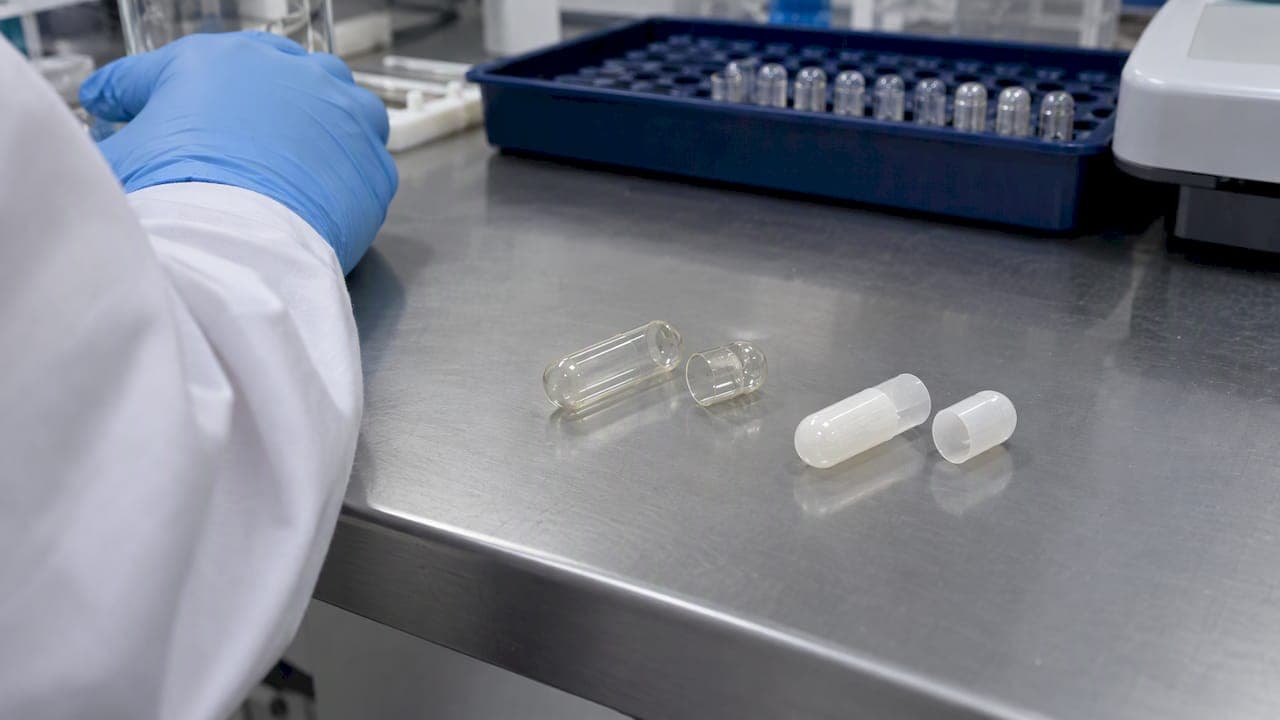
Gelatin capsules are made from animal collagen. Vegetarian capsules are made from plant cellulose, most often one called HPMC. If you avoid animal products, choose vegetarian capsules. If you don't, either shell can work, and the better pick depends on what is inside the capsule, how it is stored and what you are willing to pay. This guide covers what each shell is made of, how they differ in dissolution, stability and cost, and how to read a U.S. supplement label to see which one you are getting.
TL;DR
- Gelatin shells come from animal collagen (skin, tendons, bones, cartilage). Vegetarian shells are plant-based, usually HPMC, a modified cellulose.
- In a study comparing the two, dissolution in water was similar and there were no significant differences in absorption measures. Acidic conditions slowed the opening of HPMC shells.
- HPMC can suit moisture-sensitive fills. Gelatin is simpler to make and usually costs less, which often shows up in the price of the product.
- Your label's "Other ingredients" line tells you which shell you have. Look for gelatin or hydroxypropyl methylcellulose.
Table of Contents
- What each capsule is made from
- Gelatin vs vegetarian capsules at a glance
- Cost: why vegetarian capsules usually cost more
- Dissolution and absorption: is there a real difference?
- Stability: humidity, oxygen and the fill
- Clean label, chemistry and what "natural" means
- Are vegetarian capsules good for you? Are gelatin capsules bad?
- How to tell which shell your supplement uses
- Which capsule fits which person?
- For formulators: choosing and labeling a shell
- Our perspective
- Check the ingredient, not just the capsule
- FAQ
- Sources
What each capsule is made from
Gelatin is a natural material obtained from animal collagen, taken from skin, tendons, bones and cartilage, through acid or alkaline hydrolysis, according to a 2021 review of soft gel capsules. That is why gelatin capsules are not vegetarian or vegan by default. A paper on capsule ethics puts it simply: gelatin shells are typically of animal origin, while HPMC or starch-based shells are of vegetarian origin.
Vegetarian capsules are most often made from HPMC (hydroxypropyl methylcellulose), a chemically modified cellulose derivative. You may also see them sold as "veggie caps," "plant-based capsules" or "vegan capsules." Starch-based shells exist too, though HPMC is the one most readers meet on supplement shelves.

Can gelatin capsules be vegetarian?
Not in the usual sense. Standard gelatin comes from animal tissue, so a strict vegetarian or vegan will not count it as suitable. Some people also avoid it for religious or cultural reasons. The research on soft gels notes that dietary restrictions can stop some people from using animal-derived shells, and that vegetarians may choose not to take them. If this matters to you, don't assume. Read the label, and if the shell is not listed, check with the brand.
Why HPMC needs help to form a shell
HPMC alone does not gel effectively at low temperatures. To make hard shells, manufacturers typically add a secondary gelling agent such as kappa-carrageenan or gellan gum, as a 2025 materials study describes. This is not a flaw for the person swallowing the capsule. It explains why vegetarian capsules can differ from brand to brand, and why their cost and behavior differ from gelatin.
Gelatin vs vegetarian capsules at a glance
| Factor | Gelatin | Vegetarian (HPMC) |
|---|---|---|
| Source | Animal collagen | Plant cellulose, chemically modified |
| Suitable for vegetarians and vegans | No | Yes |
| Typical cost | Lower | Higher |
| Moisture-sensitive or reactive fills | Can interact with some fills | Often a better match |
| Oxygen protection (hard capsules) | Excellent | Different profile |
| Opening time | Well established | Can vary by manufacturer and gelling aid |
| Label wording | "Gelatin" | "Hydroxypropyl methylcellulose," "HPMC," "vegetable capsule" |
The rest of this article explains each row.
Cost: why vegetarian capsules usually cost more
Gelatin capsules are simpler and more efficient to manufacture. According to a 2020 trade article on hard capsule shells, HPMC capsules take more time and more technology, and cost four to five times more to produce. That is the cost of the shell itself, not the cost of your bottle. The shell is a small part of the total price of a supplement, so the difference you see on the shelf is usually much smaller. Still, when two products with the same active ingredient differ in price, the shell can be one reason.
A practical way to use this: compare the price per serving rather than per bottle, and compare the dose of the active ingredient. A pricier vegetarian capsule that holds a lower dose is not a better deal. You can look up the doses used in clinical trials on our ingredient database and check a product against them.
Dissolution and absorption: is there a real difference?
This is where most readers worry, and the evidence is reassuring. In the study discussed in the ethics paper, dissolution was similar in water. Acidic conditions (pH 1.2) and a potassium phosphate buffer hindered HPMC shell opening, but no significant differences in Cmax (peak blood level) or area under the curve (total exposure) were observed between the two shell types.
In plain terms: in the lab, HPMC shells opened a little less readily under some conditions, yet in the body the amount of the contents absorbed was not significantly different in that comparison.
Two caveats are worth knowing:
- Vendor variation. A 2018 industry perspective notes that HPMC capsules show variation from vendor to vendor in opening time, and that opening can be unpredictable depending on the gelling aid used. Two vegetarian capsules are not necessarily identical.
- Fill type matters. Gelatin soft gels hold oils and liquids, and the standard for testing them (USP <2040>) accepts a rupture test for soft gelatin capsules with semi-solid or liquid contents. Hard capsules, which usually hold powders, are a different product.
If you take a supplement that must work fast, such as one used for a short window before a meal, ask the brand whether it has dissolution testing on its finished capsule. Reputable brands can answer that.
Delayed-release and enteric capsules
Some vegetarian capsules are built to survive stomach acid on purpose. HPMC is combined with enteric polymers in capsules designed to resist the acidic stomach and release their contents in the intestine. This is useful for ingredients such as certain probiotics or enzymes that acid can damage. If your capsule is labeled "delayed-release" or "acid-resistant," that is a deliberate design, not a quirk of the shell. Do not open or crush these.
Stability: humidity, oxygen and the fill
The shell has to protect the ingredient inside and stay intact until you swallow it. The same trade article says HPMC shells may be a better choice for fills with very hygroscopic behavior (they pull in water) or a high risk of crosslinking, while gelatin hard capsules provide excellent protection against oxygen permeability.
Chemistry explains part of this. HPMC is nonionic, and the capsule ethics paper notes that polar or hygroscopic solvents in a fill are less likely to migrate to or interact with an HPMC shell than with gelatin.
What this means for you at home:
- Humid climates or bathrooms. Keep any capsule in a cool, dry place with the cap tight, whatever the shell. Don't store bottles above the stove or in a steamy bathroom.
- Oxygen-sensitive ingredients. Oils prone to oxidation do well in well-sealed packaging, which matters more to you than the shell alone.
- Hygroscopic powders. If a powder clumps easily, a brand may choose HPMC for it. That is a reasonable formulation decision, not a marketing trick.
Clean label, chemistry and what "natural" means
The shells are positioned differently in the market. One industry piece describes gelatin as a clean-label, recognizable ingredient, while describing HPMC as the product of an intensive chemical process with a synthetic base. Neither description tells you which shell is better for you. "Recognizable" and "plant-derived" are different values, and you get to decide which one you care about.
A fair way to decide:
- If your priority is avoiding animal products, plant-derived is the deciding factor, and HPMC meets it.
- If your priority is a short, familiar ingredient list and you eat animal products, gelatin fits.
- If you are formulating a product, your shell choice is part of your brand promise. Make sure the label says what you mean.
Are vegetarian capsules good for you? Are gelatin capsules bad?
Neither shell is a health supplement in itself. The shell is there to deliver the ingredient, and for most people it is a small, inert part of the product. We did not find a clinical comparison showing that one shell makes people healthier than the other, so we won't claim that. What we can say:
- Vegetarian capsules suit people who avoid animal products for ethical, religious or dietary reasons. That is the strongest reason to choose them.
- Gelatin capsules suit people who are comfortable with animal-derived ingredients, and they often cost less.
- Your individual reaction to any excipient (an ingredient other than the active one) is personal. If you have a known allergy or a condition that limits what you can take, ask your doctor or pharmacist to look at the full ingredient list, including the shell and any other ingredients.
If a capsule seems to cause stomach upset, the active ingredient, the dose and whether you took it on an empty stomach are more likely culprits than the shell. Try taking it with food, and talk to a clinician if symptoms persist.
How to tell which shell your supplement uses
In the United States, the "Other ingredients" list on a supplement label names additional ingredients, which can include fillers, preservatives, sweeteners, flavorings or colors, as the FDA explains. The FDA's dietary supplement Q&A gives gelatin as an example of an ingredient commonly declared there.
A quick label check:
- Turn the bottle to the Supplement Facts panel and find "Other ingredients" beneath it.
- Look for gelatin (animal-derived), hydroxypropyl methylcellulose or HPMC (vegetarian), or terms such as vegetable capsule or cellulose.
- If you see only "capsule" with no detail, or a front-label claim like "vegan" without a clear shell listed, contact the manufacturer before you buy.
- For soft gels, check the whole list too. A soft gel may use gelatin, and some are made with non-gelatin materials.
If you want a refresher on reading these panels, see our guide on how to decode supplement ingredient labels and our explainer on Supplement Facts vs Nutrition Facts.
Which capsule fits which person?
| If you... | Lean toward |
|---|---|
| Follow a vegetarian or vegan diet | Vegetarian (HPMC) |
| Avoid animal products for religious or cultural reasons | Vegetarian (HPMC), after confirming with the brand |
| Eat animal products and want the lowest price | Gelatin |
| Take a moisture-sensitive or very hygroscopic ingredient | Often HPMC, per the formulation |
| Want an acid-resistant or delayed-release design | A capsule labeled that way, often HPMC-based |
| Take an oil in a soft gel | Check the label for gelatin or a non-gelatin soft gel |
This is a starting point, not a rule. A well-made product in either shell beats a poor one in the "right" shell.
For formulators: choosing and labeling a shell
If you are developing a supplement, the shell decision touches cost, stability and marketing claims. A few points from the research above:
- Cost. The trade article's four to five times figure is for shell production. Get current quotes from your capsule supplier before you plan margins.
- Fill compatibility. Test the fill with both shells if it is hygroscopic or reactive. Run stability testing on the finished product.
- Opening time. Because HPMC opening can vary by vendor and gelling aid, qualify your supplier and ask for dissolution data.
- Claims. If you say "vegan" or "vegetarian," every part of the product has to support it, including the shell and other ingredients.
- Label. The shell goes in "Other ingredients." Our checklists on FDA label requirements for 2026 and FDA-compliant label requirements walk through the rest of the panel.
Our perspective
We built NutraSmarts because people deserve to see the evidence behind what they swallow, and that includes the parts of a product that do not get headlines. The capsule shell is a good example. It is rarely the reason a supplement works or fails, yet it decides whether a vegetarian can take the product at all.
Our view is simple: match the shell to your values and the fill, then spend your attention on the active ingredient, its dose and the quality of the evidence. In our database of 1,300+ ingredient profiles, each is tied to peer-reviewed research and clinical dosage benchmarks, so you can check whether a product's dose looks like the doses used in trials, whatever it comes wrapped in.
We also think labels should be easy to read. That is why we offer a free Supplement Facts label creator for formulators, so that "Other ingredients" and everything above it are laid out clearly.
NutraSmarts
Check the ingredient, not just the capsule
Once you know which shell you want, the next question is what is inside it. Our supplement ingredient database lists clinical dosages, mechanisms and evidence ratings, with PubMed-cited studies, and you can search supplements by symptom if you are starting from a concern rather than an ingredient. No sign-up is needed.

If you make supplements, our free Supplement Facts label creator runs in your browser and builds an FDA-compliant panel without spreadsheets.
FAQ
What are the downsides of gelatin capsules?
The main one is that they are animal-derived, so they don't suit vegetarians, vegans or people with certain religious or cultural diets. Gelatin can also interact with some reactive or very hygroscopic fills, where HPMC is often the better match, per the trade article on capsule shells. For most other people, the shell is not a problem.
Do vegetarian capsules work as well as gelatin?
In the comparison described in a peer-reviewed paper, dissolution in water was similar and absorption measures showed no significant differences, though acidic conditions slowed HPMC opening. Opening times can also vary between HPMC brands. If speed matters, ask the manufacturer about dissolution testing.
Why are vegetarian capsules more expensive?
HPMC capsules take more time and technology to make than gelatin ones. A trade source puts the shell production cost at four to five times higher. The shell is only one part of a product's price, so the gap at the shelf is usually smaller.
How can I tell if a capsule is gelatin or vegetarian?
Check the "Other ingredients" list on the label. Gelatin is commonly declared there, while vegetarian shells appear as hydroxypropyl methylcellulose, HPMC or vegetable capsule. If the shell is not listed, contact the brand.
Sources
- Gelatin and Non-Gelatin Soft Gel Capsules: A Review (2021)
- Are your capsules vegetarian or nonvegetarian (PMC, 2017)
- Challenges of Dissolution Methods Development for Soft Gelatin Capsules (PMC, 2021)
- Sustainable Shell Formulations as Alternative to the Gelatin Capsule (Wiley, 2025)
- Eye on Excipients: Gelatin versus Plant-based for Hard Capsule Shells (2020)
- Formulating for the modern consumer (2018)
- Commercially Available Enteric Empty Hard Capsules (PMC, 2022)
- Science and Our Food Supply: Examining Dietary Supplements (FDA)
- Questions and Answers on Dietary Supplements (FDA)