

If you're dealing with common sleep problems, four supplement classes have the most consistent support: melatonin for trouble falling asleep or jet lag, magnesium glycinate for muscle tension and restless legs, and L‑theanine or glycine for anxiety‑driven wakefulness or poor sleep quality. Herbal options like valerian and chamomile show weaker, mixed results, and CBD's evidence for sleep specifically is still thin.
- Melatonin: best for delayed sleep onset, jet lag, shift work
- Magnesium glycinate: best for muscle relaxation, restless legs, older adults
- L‑theanine: best for nighttime anxiety without grogginess
- Glycine: best for improving subjective sleep quality
- Valerian/chamomile/CBD: secondary options with inconsistent evidence
One rule matters more than any dose chart: talk to a clinician or pharmacist before starting, especially if you take sedatives, antidepressants, or blood thinners, or if you're pregnant, breastfeeding, or over 65. A PMC review of common sleep supplements found evidence strength varies a lot across these ingredients, so treating them as interchangeable is a mistake.
Key Takeaways
Matching a supplement class to your specific sleep symptom, starting with one ingredient, and confirming interactions with a clinician beats any generic "best sleep aid" list.
| Point | Details |
|---|---|
| Match symptom to supplement | Melatonin for onset/jet lag, magnesium glycinate for restlessness, L‑theanine or glycine for anxiety. |
| Trial one ingredient at a time | Give it one to two weeks with a sleep log before judging whether it works. |
| Watch interactions closely | Sedatives, blood thinners, and antidepressants can interact with common sleep supplements. |
| Know when to see a clinician | Chronic insomnia or suspected sleep apnea calls for CBT‑I or medical evaluation, not supplements. |
| Verify before you buy | Check third-party testing seals and confirm doses against actual label listings. |
Table of Contents
- Recommended Supplements for Sleep Issues, Explained
- Which Supplement Fits Your Specific Sleep Problem?
- Sleep Supplement Safety: Interactions and Warning Signs
- What Does the Research Actually Say?
- How to Dose and Time Sleep Supplements Correctly
- Checking Evidence and Labels Before You Buy
- Ready to Find the Right Sleep Supplement for You?
- Why Symptom Matching Beats the "Best Sleep Aid" List
- Sources
Recommended Supplements for Sleep Issues, Explained
Not every sleep supplement works the same way, and lumping them together is how people end up disappointed. Here's what the evidence actually supports for each one.
Melatonin comes in short-acting and extended-release forms. Short-acting versions (0.5 to 5 mg) taken 30 to 60 minutes before bed work best for sleep-onset trouble, jet lag, and shift work adjustment. Extended-release versions are sometimes used for staying asleep, though clinical evidence for sleep quality supplements shows weaker support for chronic insomnia, and most guidelines caution against long-term daily use without medical input.
Magnesium, particularly the glycinate form, is a common recommendation because it's gentler on digestion than magnesium oxide or citrate. Some trials on magnesium and insomnia suggest improved sleep patterns with regular use, particularly in older adults and people with restless leg symptoms, though study quality is inconsistent. NutraSmarts breaks down the magnesium glycinate evidence in more detail if you want to see the mechanism behind muscle relaxation.

L‑theanine, an amino acid found in tea, is typically dosed at 100 to 200 mg before bed. It calms nighttime anxiety without the next-day fog some sedatives cause, making it a reasonable first try for people whose racing thoughts, not physical restlessness, keep them awake.
Glycine, usually around 3 grams before bed, has shown modest improvements in subjective sleep quality in small trials. NutraSmarts covers the research behind glycine dosing if you want the specifics.
Herbal options like valerian, passionflower, and chamomile have decades of traditional use but thin, conflicting clinical data. CBD shows some promise for anxiety or pain-related sleep disruption, but dosing standards don't exist yet, and product quality varies widely.
Which Supplement Fits Your Specific Sleep Problem?
Matching the supplement to the actual symptom, rather than grabbing whatever's trending, is what separates a useful trial from a wasted month.
- Can't fall asleep at a normal hour? Melatonin, taken 30 to 60 minutes before your target bedtime, targets circadian timing directly.
- Traveling across time zones or working night shifts? Melatonin again, timed to your destination or shift schedule, is the best-supported option for this exact problem.
- Wake up with tense muscles, cramps, or restless legs? Magnesium glycinate addresses the physical restlessness that pure sedatives don't touch.
- Lying awake with a racing mind or nighttime anxiety? L‑theanine or glycine tend to help more than melatonin, since the problem isn't circadian, it's mental arousal.
- Waking up repeatedly through the night for weeks or months, or snoring heavily with gasping? That's a signal to see a clinician. Chronic insomnia responds better to cognitive behavioral therapy for insomnia (CBT‑I) than to any supplement, and loud snoring with breathing pauses warrants a sleep apnea evaluation, not a bottle of melatonin.
Trial one ingredient at a time, and give it one to two weeks before judging results. Stacking three supplements at once tells you nothing about what's actually working.
Sleep Supplement Safety: Interactions and Warning Signs
Supplements interact with prescription medications more often than people assume. Melatonin can amplify sedatives and blood thinners. Valerian shouldn't be combined with benzodiazepines or alcohol. Magnesium can interact with certain antibiotics and blood pressure medications. St. John's Wort, sometimes marketed in sleep blends, interferes with antidepressants and birth control.
The NCCIH's review of sleep supplements flags kava specifically for liver injury risk, a serious enough concern that several countries restrict its sale. Pregnant or breastfeeding people should avoid most herbal sleep aids entirely, and older adults face higher fall and confusion risk from anything with sedative properties.
- List every supplement you take in your medical chart, not just prescriptions
- Look for USP, NSF, or ConsumerLab seals confirming third-party testing
- Ask a pharmacist before combining a new supplement with existing medications
- Stop and call a doctor if you notice unusual drowsiness, confusion, or digestive distress
Pro Tip: Bring the actual supplement bottle to your next pharmacy visit. Pharmacists can check interactions in seconds, and it's free.
What Does the Research Actually Say?
Evidence quality across these supplements ranges from "reasonably solid for a specific use" to "promising but thin." Here's the honest breakdown.
| Supplement | Evidence Strength | Best Supported Use |
|---|---|---|
| Melatonin | Moderate | Sleep onset, jet lag, shift work |
| Magnesium (glycinate) | Limited but promising | Older adults, restless legs |
| L‑theanine | Small trials, consistent direction | Anxiety-related wakefulness |
| Glycine | Small trials, consistent direction | Subjective sleep quality |
| Valerian/chamomile/CBD | Mixed, inconsistent | Secondary or adjunct use |
Mayo Clinic's guidance on OTC sleep aids is blunt about this: these products may help short-term, but none are designed or proven for indefinite daily use. That's a meaningfully different message than the marketing on most supplement bottles.
How to Dose and Time Sleep Supplements Correctly
Timing matters as much as the dose itself. Take melatonin 30 to 60 minutes before your target bedtime, not right when you climb into bed. Magnesium glycinate works best taken with dinner or an hour before sleep. L‑theanine (100 to 200 mg) and glycine (about 3 grams) can both be taken 30 to 45 minutes before bed. Valerian typically needs 300 to 600 mg roughly an hour beforehand.
- Pick one supplement based on your specific symptom, not a multi-ingredient blend.
- Start at the lowest effective dose for one to two weeks.
- Keep a simple sleep log tracking time to fall asleep, wake-ups, and morning grogginess.
- Adjust dose or switch ingredients only after a full trial period, not after one bad night.
Pro Tip: Skip "sleep blend" products for your first trial. If a five-ingredient formula works, you'll have no idea which ingredient actually did it.
Checking Evidence and Labels Before You Buy
Before buying anything, check what the research actually says about the ingredient and dose you're considering. NutraSmarts' ingredient database links each entry to peer-reviewed studies and clinical trial citations, so you can see evidence ratings instead of marketing claims.
- Search by symptom to find ingredients matched to your specific sleep issue
- Compare forms (like magnesium glycinate versus citrate) before choosing a product
- Use the Supplement Facts Tool to confirm a label lists accurate doses
- Prioritize brands with third-party testing seals over flashy packaging
Ready to Find the Right Sleep Supplement for You?
Guessing which bottle to buy off a drugstore shelf wastes money and, worse, time you could spend actually sleeping better. Nutrasmarts built its symptom-based supplement search specifically so you can start from your actual problem, whether that's racing thoughts at 2 a.m. or restless legs, and see which ingredients have real clinical backing before you spend a dime. Browse the evidence-rated entries, check the dosing details against what's covered here, and pick one thing to trial instead of a cabinet full of guesses.
Why Symptom Matching Beats the "Best Sleep Aid" List
Most sleep supplement content ranks products like a leaderboard, as if one ingredient wins for everybody. That framing doesn't match the evidence. Melatonin barely helps someone whose problem is nighttime anxiety, and L‑theanine won't fix a circadian rhythm knocked sideways by a redeye flight. The mechanism has to match the complaint.
The conventional advice also underplays how often chronic, months-long insomnia gets treated with a rotating cast of supplements when CBT‑I outperforms most pharmacological approaches for that specific problem. Supplements work best on discrete, mechanism-driven issues: a shifted clock, tense muscles, a racing mind at midnight. They're a weaker tool against sleep that's been broken for a year.
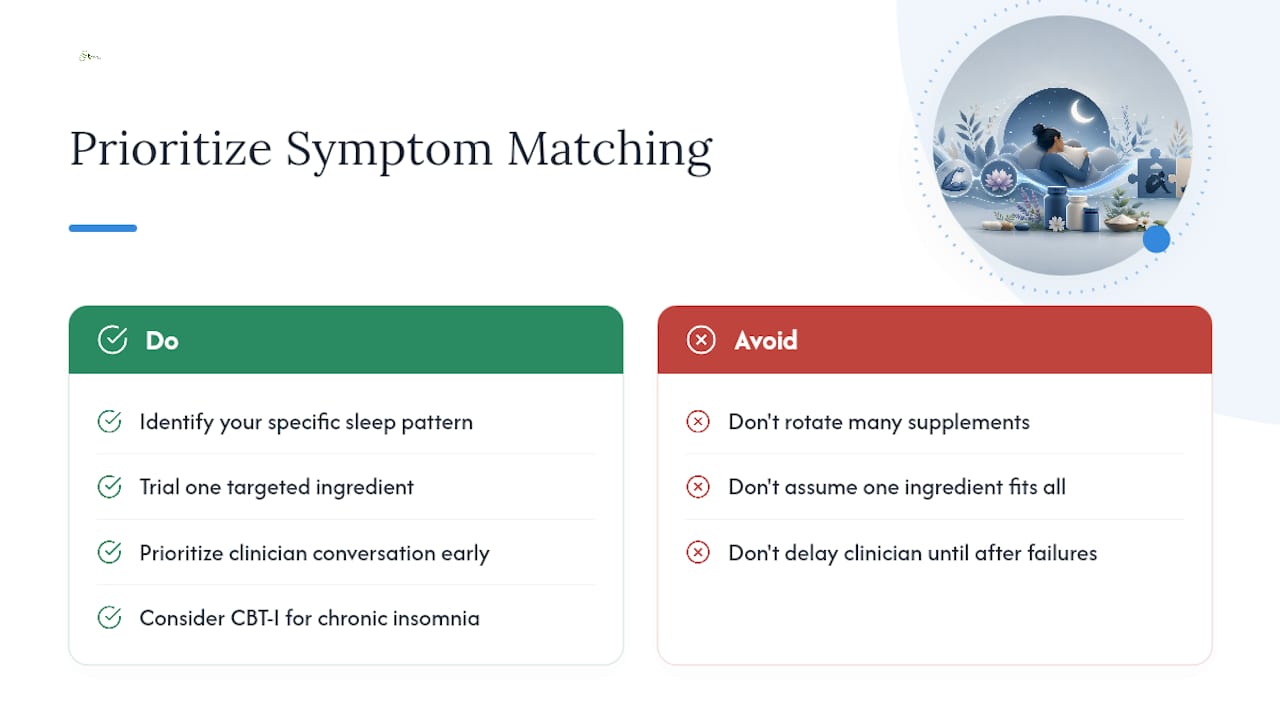
What we'd prioritize first: identify the actual pattern disrupting your sleep, trial one targeted ingredient against it, and treat a clinician conversation as step one rather than a last resort after three failed supplements.
This article is general information, not a substitute for advice from a qualified doctor. Consult a qualified healthcare professional about your own circumstances before acting on anything here.
Sources
- Current Evidence on Common Dietary Supplements for Sleep Quality — PMC (NCBI)
- Insomnia home remedies — Healthline