
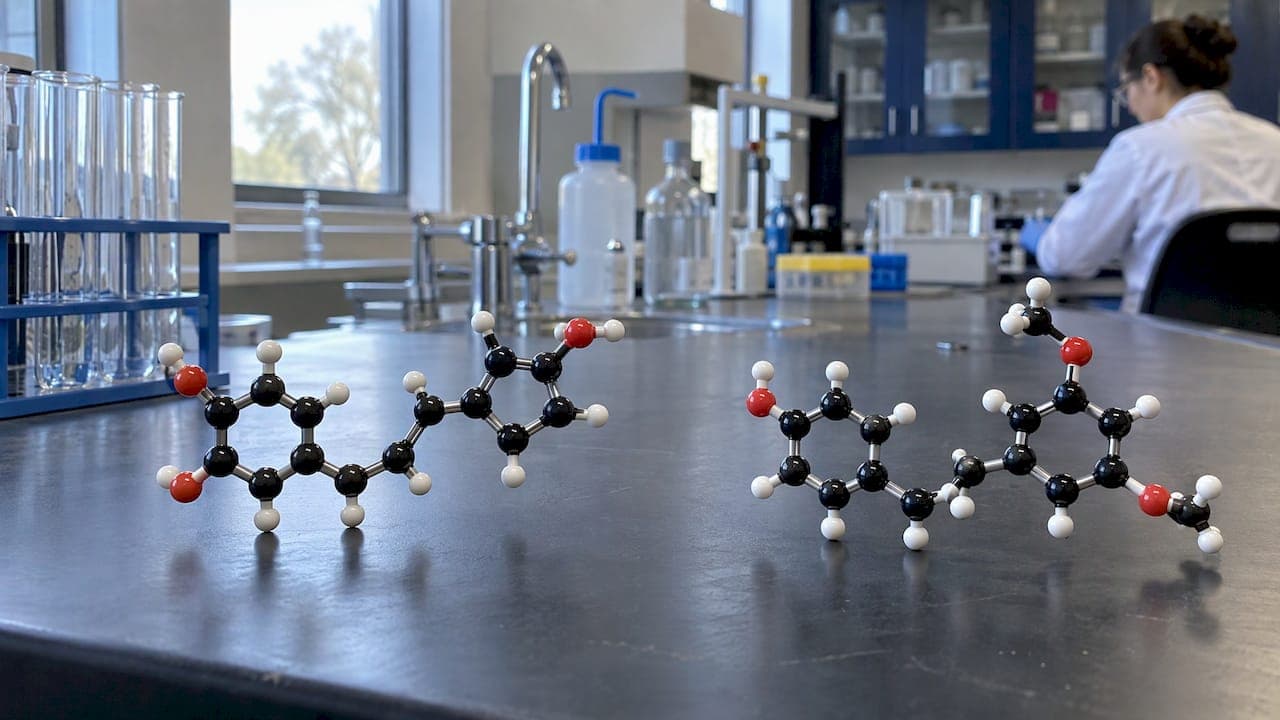
Pterostilbene is the chemical cousin of resveratrol, and it is built to be absorbed more easily. In rats, that shows up clearly in the data. In people, nobody has yet shown that pterostilbene works better. Resveratrol has far more human trials behind it, while pterostilbene has a smaller human record but a stronger absorption story. Which one suits you depends on what you want from it and how much weight you give animal data versus human data.
Below, we compare the two on structure, absorption, human evidence, brain and aging research, safety and food sources. Then we give you a simple way to choose.
TL;DR
- Both are stilbenes. Pterostilbene swaps two of resveratrol's hydroxyl groups for methoxy groups, which makes it more fat-soluble.
- In rats, oral bioavailability was about 20% for resveratrol and 80% for pterostilbene. That gap has not been confirmed in people.
- Resveratrol has far more human research, but a 2024 systematic review found no conclusive clinical evidence to recommend it in healthcare settings.
- Pterostilbene's human safety data comes from a small short-term trial at up to 250 mg/day. Direct head-to-head efficacy trials are scarce or absent.
- "Better" depends on your goal. Compare the ingredient profiles, doses and evidence ratings before you buy.
Table of Contents
- How resveratrol and pterostilbene differ chemically
- Absorption: what the rat data says, and where it stops
- What human studies show
- Brain health and healthy aging
- Safety and who should talk to a clinician first
- Food sources and what supplements add
- How to choose between them
- Our perspective
- Compare the evidence yourself
- FAQ
- Sources
How resveratrol and pterostilbene differ chemically
Resveratrol is trans-3,5,4′-trihydroxystilbene. Pterostilbene is its dimethoxy analogue, trans-3,5-dimethoxy-4′-hydroxystilbene. Both share the same C6–C2–C6 stilbene backbone, and the difference is two hydroxyl groups replaced by methoxy groups in pterostilbene.
That small swap has a practical consequence. Hydroxyl groups are quickly tagged by the body for removal, a process called conjugation. Methoxy groups are more lipophilic, meaning they dissolve better in fats and cross cell membranes more easily. This is the chemical reasoning behind pterostilbene's reputation as the "more bioavailable" cousin, as described in a safety trial paper from the U.S. National Library of Medicine's PMC archive.
Other sources differ too:
- Resveratrol is found in grape skins, red wine, peanuts, blueberries and cranberries.
- Pterostilbene is found in blueberries and in the heartwood of certain trees, and is the main bioactive compound in the resin extract known as Dragon's blood.
You can read each compound's full profile on our pages for resveratrol and pterostilbene.
Absorption: what the rat data says, and where it stops
The most quoted number in this debate comes from a rat pharmacokinetic study. Oral bioavailability was approximately 20% for resveratrol and 80% for pterostilbene, and pterostilbene also produced substantially higher plasma levels of the parent compound. That is a large difference, and it explains why so many product pages call pterostilbene the winner.
Two cautions belong right next to that number:
- It is a rat figure. The paper that quotes it does not establish that humans see the same 20% versus 80% split.
- Absorption is not effect. A compound can reach higher blood levels and still not produce a bigger benefit. A review of dietary pterostilbene found that no retrieved source established that it works better than resveratrol in people. The advantage is mostly preclinical, and direct human head-to-head efficacy trials are scarce or absent.
So when you see "pterostilbene is four times better absorbed" on a label or a blog, read it as "in rats, and probably higher in people too, but unproven." That is a fair summary of where the science stands.
Higher absorption also does not automatically mean a lower dose is the right dose. Doses in clinical trials are the best guide we have, and we cover those next.
What human studies show
The two compounds are at very different stages of human research.
Resveratrol: many trials, no firm verdict
A 2024 systematic review covered almost 200 clinical studies across at least 24 conditions. It concluded that no conclusive clinical evidence currently supports recommending resveratrol in a healthcare setting. The same review found no agreed treatment regimen for any condition or endpoint. It also noted that resveratrol was generally well tolerated at doses up to 1 gram per day, and that trials often reported changes in inflammatory or metabolic biomarkers.
That is a useful and honest picture: lots of signals on biomarkers, no settled answer on clinical outcomes, and a good tolerability record at studied doses.
Pterostilbene: a much smaller human record
The best-known human pterostilbene study was a randomized, double-blind, placebo-controlled U.S. trial. Eighty adults with elevated cholesterol received 100 mg/day, 250 mg/day, pterostilbene plus grape extract, or placebo for 6 to 8 weeks. It was designed to look at safety, and it found no significant adverse effects on liver, kidney or glucose markers and no major adverse events over that period.
That supports short-term tolerability up to 250 mg/day. It does not tell us about long-term use or higher doses.
Side by side
| Question | Resveratrol | Pterostilbene |
|---|---|---|
| Structure | Three hydroxyl groups | Two methoxy groups, one hydroxyl group |
| Oral bioavailability in rats | About 20% | About 80% |
| Human clinical research | Almost 200 studies across 24+ indications | A small number of trials, including a U.S. safety trial |
| Studied human doses | Tolerated up to 1 g/day in reviewed trials | 100 and 250 mg/day for 6 to 8 weeks |
| Head-to-head human efficacy data | Scarce or absent | Scarce or absent |
| Overall verdict from reviews | No conclusive evidence for clinical recommendation | Promising absorption data, limited human outcome data |
Our side-by-side comparison tool and ingredient database puts the same information next to the clinical dosage benchmarks, so you can see them without hunting through papers.
Brain health and healthy aging
This is where most readers get curious, because both compounds are marketed for "longevity" and cognition.
A review of their effects on brain and behavior reports that both compounds can cross the blood–brain barrier and may reduce neuroinflammation or oxidative stress. It also makes clear that much of the comparative cognition evidence comes from rodents. If you want a broader view of how brain chemistry research is read, and why animal findings need careful handling, this explainer on neurotransmitter balance and brain health is a helpful companion.
On the mechanism side, researchers have examined both compounds in relation to oxidative stress, inflammation, PPAR-alpha, AMPK, mitochondrial signaling, autophagy and sirtuin-related pathways, as summarized in a review of their biological actions. Much of that work was done in cells and animal models. Those results show what the compounds can do in a dish or a mouse, and they are the reason human trials are being run. They are not yet proof of the same effect in you.
The same applies to aging. Cellular and animal research into aging mechanisms is active across many fields, including non-supplement approaches such as red light therapy and longevity. In every case the useful question is the same: what has been shown in humans, at what dose, and for how long?
Safety and who should talk to a clinician first
In the research above, both compounds were generally well tolerated at the doses and durations studied: resveratrol up to 1 gram per day in reviewed trials, and pterostilbene up to 250 mg/day for 6 to 8 weeks. Those are the limits of the evidence we can cite, and they are good reference points for staying within studied ranges.
Some practical safe-use habits follow:
- Stay within studied doses. Do not assume that because a capsule is small, a larger dose is better. The trials above are the benchmark.
- Talk to your doctor or pharmacist first if you take prescription medication, have a chronic condition, are pregnant or breastfeeding, or are scheduled for surgery. They can check the full list of what you take.
- Check the label. Look for the amount of the active compound per serving, not just the blend name or the extract weight.
- Treat supplements as an addition, not a replacement, for treatment your clinician has prescribed.
If you are asking "why avoid resveratrol?", the honest answer is that most people do not need to avoid it, but the long-term safety of high doses is not established, so medical guidance matters if you have health conditions or take medicines.
Food sources and what supplements add
Resveratrol is found in grape skins and red wine, and also in grapes, grape juice, peanuts, blueberries and cranberries. Mayo Clinic notes that amounts in food vary widely, the amount needed for heart protection is unknown, and the body cannot absorb most resveratrol from supplements.

That last point is where pterostilbene's design becomes interesting: it is a compound built around the absorption problem. If you eat blueberries, grapes and peanuts regularly, you are already getting small amounts of related compounds along with fiber, other polyphenols and nutrients. Supplements deliver a measured amount of one compound, which is a different thing from a food-based pattern.
A related compound found in grapes is also worth a look: epsilon-viniferin, a grape resveratrol dimer, which has its own profile in our database.
How to choose between them
Start with what you want and how you weigh the evidence. These criteria cover most decisions.
1. How much do you value human data?
If you want the compound with the larger human research base, resveratrol has it. Almost 200 studies means more is known about tolerability and about which biomarkers move. If you value a stronger absorption profile and accept that human outcome evidence is still limited, pterostilbene fits that preference.

2. What is the form and purity?
Branded ingredients often come with a specification and sometimes their own studies. Our database has dedicated profiles for several, including Veri-te™ resveratrol, ResVinol® and pTeroWhite®, a 99% trans-pterostilbene. Read the profile and the cited studies to see what each ingredient has been tested for.
3. What dose is on the label?
Compare the label to studied doses: up to 1 g/day of resveratrol was well tolerated in reviewed trials, and 100 to 250 mg/day of pterostilbene was used in the U.S. safety trial. A product far outside those ranges has little human data behind it.
4. Are you stacking?
Many products combine both compounds, with grape extract or other ingredients. When you stack, add up the total of each compound across everything you take. The trial of pterostilbene plus grape extract is one of the few human combinations that has been studied.
5. What is your goal?
Someone interested in cholesterol or metabolic markers should look at the trial designs for those endpoints. Someone interested in cognition should note that comparative evidence is mostly rodent-based. Someone interested in "longevity" should note that no human trial has shown that either compound extends lifespan.
Our perspective
We built NutraSmarts because the resveratrol-versus-pterostilbene question is a perfect example of how supplement marketing gets ahead of science. "Four times more bioavailable" is a real rat finding. It is also routinely repeated as if it were a human result.
Our approach is to put the number, the species and the study side by side. Each ingredient profile in our database of 1,300+ ingredients links to the peer-reviewed research behind it, with clinical dosage benchmarks and an evidence rating that we try to keep honest. Resveratrol earns a long profile because it has been studied so much. Pterostilbene earns one because its absorption data is interesting and its human safety data is worth reading.
We think the useful comparison is not "which is better" but "better for what, at what dose, shown in whom." That is why we offer a side-by-side ingredient comparison, a symptom-based search and clinical dosage ranges on every profile. You can see where the human evidence is strong, where it is thin and where it is simply missing, and then decide for yourself.
NutraSmarts
Compare the evidence yourself
If you are deciding between the two, open the full profiles and read the citations for each. Our ingredient database lists the clinical dosage ranges, mechanisms and evidence ratings, and it is free to use with no sign-up. If you are starting from a symptom rather than an ingredient, try supplements by symptom.
If you formulate products, our free Supplement Facts label creator builds an FDA-compliant label in your browser, without spreadsheets. For a wider look at how we judge evidence, see our guide to supplements with peer-reviewed evidence and our overview of what the science says about resveratrol.
FAQ
Which is better, resveratrol or pterostilbene?
Neither has been shown to be better in people. Pterostilbene is better absorbed in rats, about 80% versus 20%, but no human head-to-head efficacy data has established that this translates into better results. Resveratrol has far more human research behind it, so the better choice depends on whether you weigh absorption or the size of the evidence base.
What is pterostilbene good for?
Research has looked at antioxidant and anti-inflammatory activity, metabolic effects and brain health, mostly in cells and animals. In humans, the main published work is a U.S. safety trial in adults with elevated cholesterol at 100 and 250 mg/day for 6 to 8 weeks. Treat it as an ingredient under study rather than a proven treatment.
What foods have the most resveratrol?
Resveratrol is found in grape skins and red wine, and also in grapes, grape juice, peanuts, blueberries and cranberries. Mayo Clinic notes that amounts vary widely between foods. The amount needed for any health benefit is not known.
Is it safe to take resveratrol or pterostilbene?
In the studies we cited, both were generally well tolerated: resveratrol up to 1 gram per day in reviewed trials and pterostilbene up to 250 mg/day for 6 to 8 weeks. Long-term safety at higher doses has not been established. Check with your doctor or pharmacist first if you take medication, are pregnant or have a medical condition.
Sources
- Resveratrol and pterostilbene: A comparative overview (Journal of Applied Pharmaceutical Science, 2019)
- Analysis of Safety from a Human Clinical Trial with Pterostilbene (PMC, 2013)
- Pharmacokinetics, oral bioavailability, and metabolic profile of resveratrol and its dimethylether analog, pterostilbene, in rats (PMC, 2011)
- New Insights into Dietary Pterostilbene: Sources, Metabolism, and Health Benefits (PMC)
- Resveratrol for the Management of Human Health: How Far Are We? (PMC, 2024)
- Effects of pterostilbene and resveratrol on brain and behavior (ScienceDirect, 2015)
- Biological actions and molecular effects of resveratrol, pterostilbene and related compounds (PMC)
- Red wine and resveratrol: Good for your heart? (Mayo Clinic)
- Seven Ways Neurotransmitter Balancing Boosts Overall Brain Health
- Red Light Therapy for Longevity: What the Evidence Supports