
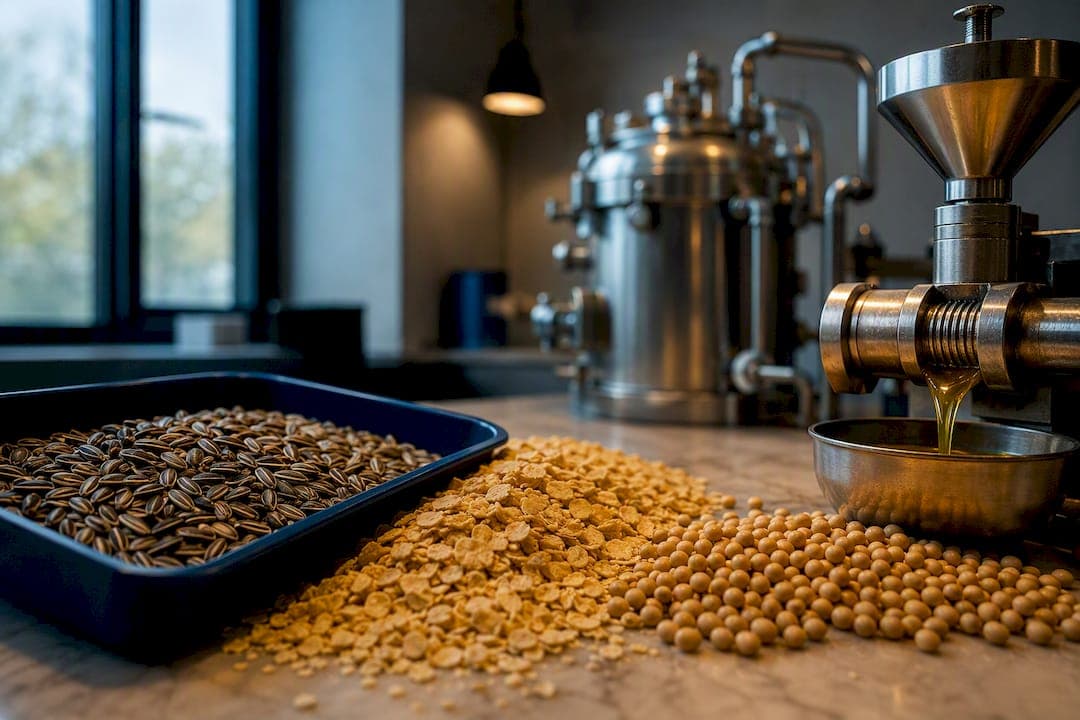
For most health-conscious buyers, sunflower lecithin is the better default choice. It comes from a non-allergen crop, typically skips solvent extraction, and carries no GMO baggage. The exceptions matter, though: soy lecithin is cheaper, works fine for people with confirmed soy tolerance, and sometimes emulsifies better in specific formulations. The evidence below explains why the choice usually tilts toward sunflower and where soy still holds up.
TL;DR:
- Sunflower lecithin is typically more nutritious due to mechanical extraction, preserving antioxidants and being non-GMO, but it costs more than soy lecithin.
- Most soy lecithin comes from GMO soy and is solvent-extracted with hexane, though safety and residue levels are regulated and generally considered safe.
- Clinical evidence supports lecithin's use for cholesterol reduction and breastfeeding-related clogged ducts, but claims about cognition and digestion lack strong proof.
- Refined soy lecithin is often tolerated by people with soy allergies because it contains minimal soy protein, but allergy risk remains for sensitive individuals.
- When choosing lecithin, prioritize source transparency, phospholipid content, and allergen status over marketing claims or origin story.
Table of Contents
- Sunflower Lecithin vs Soy Lecithin at a Glance
- What Actually Separates These Two Lecithins
- What the Evidence Actually Shows About Lecithin's Health Benefits
- Is Soy Lecithin Safe if You Have a Soy Allergy?
- How to Choose the Right Lecithin for Your Goal
- How NutraSmarts Helps You Verify Lecithin Claims
- Why Clean Label Is Winning, Even Without a Knockout Study
- Verify Before You Buy: NutraSmarts's Lecithin Research Tools
- Sources
Sunflower Lecithin vs Soy Lecithin at a Glance
Before getting into extraction chemistry and clinical evidence, here's what separates the two products on the shelf.
- Sunflower lecithin: derived from sunflower seeds, usually cold-pressed or mechanically extracted, almost always non-GMO, sold as liquid, granules, or softgels, and priced higher than soy versions.
- Soy lecithin: derived from soybeans, most often extracted with a hexane solvent during oil refining, frequently sourced from genetically modified soy unless labeled otherwise, and sold in the same liquid/granule/capsule formats at a lower price point.
- Allergen profile: sunflower carries no major allergen risk; soy lecithin is refined enough that most soy-allergic people tolerate it, but not universally.
- Clean-label signaling: sunflower lecithin markets itself on processing method (cold-press) rather than a proven nutritional edge, a distinction worth remembering when comparing labels.
If you're breastfeeding and worried about clogged ducts, sunflower is the obvious pick. If you're formulating a budget product and soy tolerance isn't a concern, soy lecithin still does the job at a fraction of the cost.
What Actually Separates These Two Lecithins
The differences between sunflower and soy lecithin start at the extraction stage, not the ingredient list. Soybean oil producers typically pull lecithin out during solvent extraction and degumming, a process that relies on hexane to strip oil from crushed soybean flakes. Sunflower lecithin producers, competing on a clean-label story, tend to use mechanical cold-pressing instead, which avoids solvent residue entirely. That single manufacturing choice explains most of the perception gap between the two products.
Neither extraction method is inherently unsafe. Hexane residue in finished soy lecithin falls well under regulatory limits in food-grade products, and solvent-extracted lecithin has been used commercially for decades. But cold-pressing does preserve more of the native minor nutrients, including vitamin E and other antioxidants that solvent processing can strip out or dilute, which is one real reason the clean-label preference isn't purely marketing.
Nutrient profile on the label matters more than the source crop. Both lecithins are mixtures of phospholipids, primarily phosphatidylcholine, phosphatidylinositol, and phosphatidylethanolamine, plus the choline that those phospholipids carry. Analytical comparisons of soybean and sunflower lecithins show measurable differences in phospholipid ratios between the two, and those differences are consistent enough that chemists use them to detect adulteration when one lecithin is cut with the other.
- Look for a stated phosphatidylcholine percentage, not just the word "lecithin."
- Check whether the label says "non-GMO" or "organic," since neither claim is guaranteed by species alone.
- Compare granule versus liquid forms; granules are usually more concentrated per gram.
- Ask whether a Certificate of Analysis (COA) is available, especially for bulk or bodybuilding-market products.
GMO status deserves its own note. "Non-GMO" on a sunflower lecithin label is often true by default, since genetically modified sunflower crops are not widely commercialized. Soy lecithin, by contrast, usually comes from genetically modified soybeans unless the product explicitly states otherwise, since the majority of the US soybean crop is GMO. That's a labeling distinction, not a safety verdict. Cost follows the same logic in reverse: soy is a high-volume commodity crop with mature extraction infrastructure, so soy lecithin is consistently the cheaper raw material, while sunflower lecithin's smaller supply chain and gentler processing push its price higher.
Pro Tip: If a product simply says "lecithin" with no source named, assume soy. Manufacturers proudly label sunflower lecithin because it costs more to source; silence usually means the cheaper ingredient.
What the Evidence Actually Shows About Lecithin's Health Benefits
Marketing claims for lecithin outrun the clinical evidence in almost every category. Here's a category-by-category read, graded honestly on how strong the science actually is.
Cognition: limited, mostly indirect evidence. Lecithin is a delivery vehicle for phosphatidylcholine and, in smaller amounts, phosphatidylserine, both of which have research tied to memory and cognitive function. But most of that research studies the isolated phospholipids at concentrated doses, not the lecithin supplement itself. Treat brain-health claims for lecithin as plausible but unproven at typical supplement doses.
Cholesterol and heart health: a real signal, but a small and dated one. Some short-term trials have shown lecithin supplementation lowering LDL cholesterol in certain contexts, and this is one of the more frequently cited benefits for both sunflower and soy versions. The catch: many of these trials are older, involve modest sample sizes, and run for weeks rather than years. That's a possible benefit, not a proven therapy, and it shouldn't replace statins or dietary changes for anyone managing diagnosed high cholesterol. Readers comparing lecithin to other cholesterol-support options can see how it stacks up against other evidence-graded supplements.
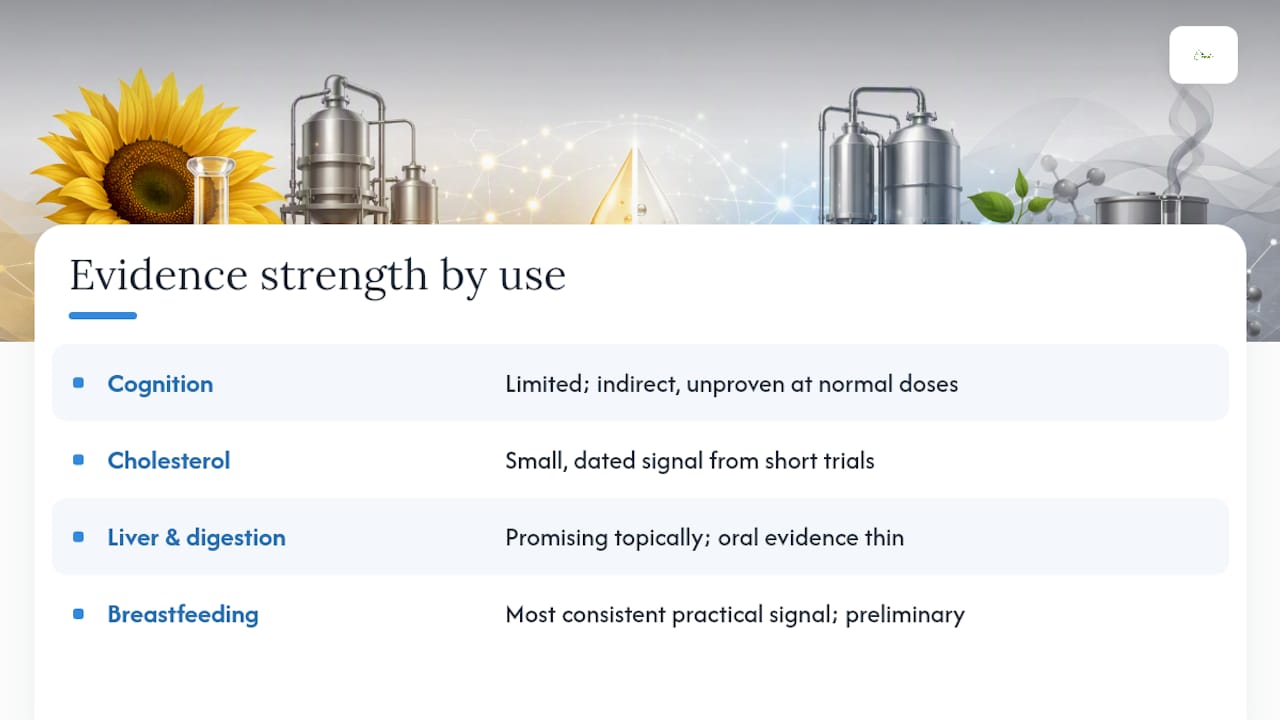
Liver and digestion: promising in a narrow application, thin everywhere else. Some clinical reviews describe phosphatidylcholine improving quality of life in ulcerative colitis when delivered topically to the colon, a very different delivery method than swallowing a lecithin capsule. Oral lecithin supplements for general digestive support or liver health carry far weaker evidence, and extrapolating from a topical GI application to a daily supplement habit is a stretch.
Breastfeeding: the most consistent practical use case, though evidence stays preliminary. Lactation consultants have long recommended lecithin, sunflower in particular, for recurrent clogged ducts and mastitis prevention, with informal doses in practice ranging from roughly 3,600 to 4,800 milligrams daily split across several doses. Sunflower lecithin's benefits for this use are more anecdotal and practice-based than confirmed by large randomized trials, but it's the application where real-world usage and reported outcomes align most closely.
Evidence strength summary: Cholesterol support and lactation use show the most consistent real-world signal; cognitive and general digestive claims remain preliminary at best.
Is Soy Lecithin Safe if You Have a Soy Allergy?
Refined soy lecithin strips out most of the soy protein during processing, which is the actual allergen, not the lipid fraction itself. That's why many people with a soy allergy tolerate refined soy lecithin without incident, even in supplement-grade doses. Tolerance isn't guaranteed, though, and a small subset of sensitized individuals may still react to trace protein residue.
- Anyone with a history of severe or anaphylactic soy allergy should talk to an allergist before trying soy lecithin in any form, food or supplement.
- Mild GI upset (nausea, bloating, loose stool) can occur with higher lecithin doses regardless of source, and it's typically dose-dependent rather than an allergic reaction.
- Hexane residue in finished soy lecithin sits under food-safety limits, but if you want to avoid solvent-extracted ingredients entirely, request a COA or choose a cold-pressed product instead.
- Pregnant or breastfeeding people, and anyone on medications that affect fat absorption or liver metabolism, should check with a clinician before starting either lecithin at supplement doses.
Parents navigating infant allergy introductions more broadly may find useful groundwork in this guide on introducing new foods safely.
How to Choose the Right Lecithin for Your Goal
Skip the marketing copy and work through this instead:
- Identify your goal first. Clogged-duct prevention points toward sunflower; budget-conscious general supplementation may point toward soy.
- Check the allergen and GMO status. If you have any soy allergy history, sunflower removes the guesswork entirely.
- Evaluate phospholipid concentration, not just the ingredient name. A product listing 30% phosphatidylcholine is doing more per serving than one that just says "lecithin."
- Compare price against transparency. A slightly more expensive sunflower product with a published COA beats a cheap soy product with no sourcing information.
Red flags worth walking away from: no stated source crop, no extraction method disclosed, and no COA available on request. These usually signal a commodity-grade ingredient repackaged without quality testing.
Pro Tip: When comparing choline content between products, don't just look at total lecithin milligrams. Check the actual choline milligrams per serving against the adequate intake guidance from NIH, since lecithin's choline density varies by phospholipid concentration.
How NutraSmarts Helps You Verify Lecithin Claims
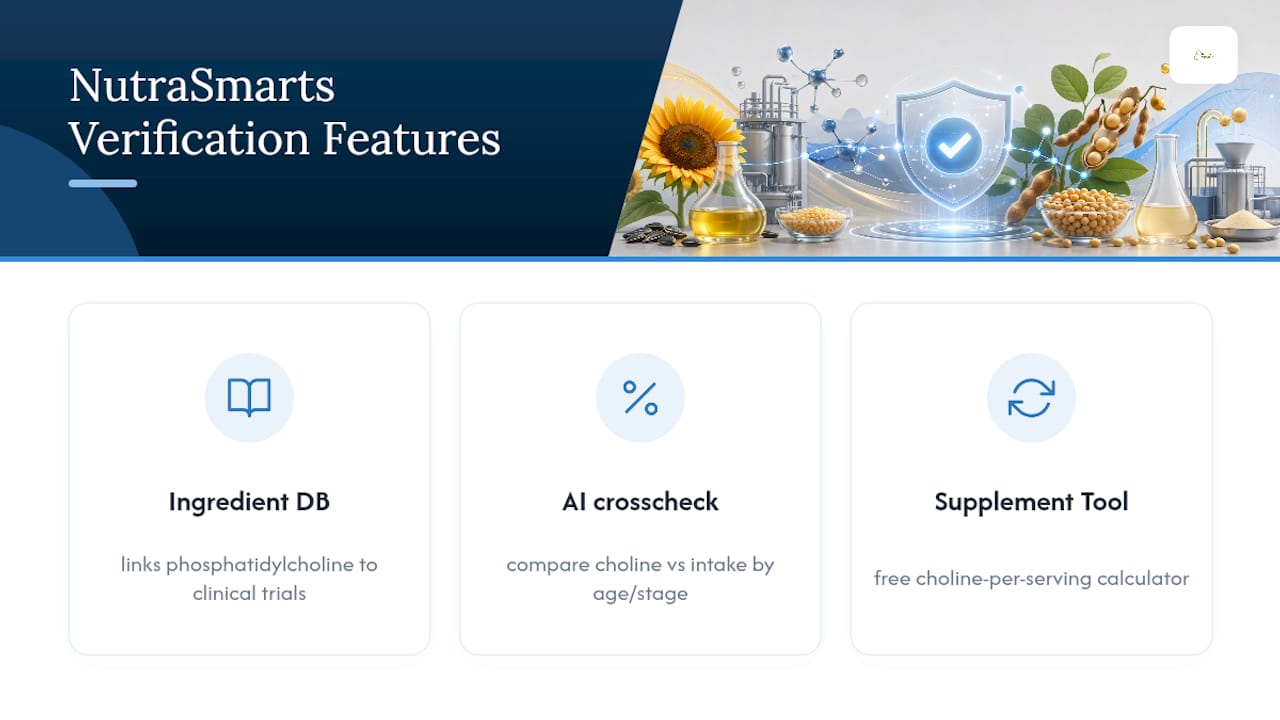
Nutrasmarts built its ingredient database specifically so readers don't have to take label claims on faith. Every phosphatidylcholine entry links back to the clinical trials behind its cognitive, liver, and cardiovascular claims, so you can judge for yourself whether a study used doses anywhere near what's in your bottle. That same database lets you cross-reference choline content against the official adequate intake values for your age and life stage.
If you formulate or just want to understand your own supplement stack better, the free Supplement Facts Tool calculates choline-per-serving math directly from lecithin source and concentration, no spreadsheet required. It's the fastest way to check whether a "high-choline" claim on a lecithin product actually holds up.
Why Clean Label Is Winning, Even Without a Knockout Study
Clean-label preference wins in the market for a reason that has little to do with superior clinical outcomes. Cold-pressing avoids solvent residue and preserves more native antioxidants, a real if modest advantage, and that's enough to justify sunflower's premium for a lot of buyers. What we'd push back on is treating that processing advantage as proof of a health benefit it hasn't demonstrated. Prioritize sourcing transparency and verified phospholipid content over origin-story marketing, and when a medical question is on the table, a clinician should have the final word.
— NutraSmarts
Verify Before You Buy: NutraSmarts's Lecithin Research Tools
Choosing between sunflower and soy lecithin comes down to verifiable details: extraction method, phospholipid percentage, and allergen status, not packaging. Tools are available to check these details directly instead of relying on marketing.
The ingredient database links every lecithin-related compound to its underlying clinical citations, so you can see exactly what a study measured and at what dose, then compare that against what's actually in your supplement. If you're managing cholesterol alongside a lecithin regimen, the metabolic health top picks page rounds up other evidence-reviewed options worth weighing. Start by running your current lecithin product's label through the free Supplement Facts Tool to see how its choline content actually measures up.
This article is general information, not a substitute for advice from a qualified doctor. Consult a qualified healthcare professional about your own circumstances before acting on anything here.
Sources
- Choline - Health Professional Fact Sheet | NIH ODS
- Sunflower lecithin benefits for heart health, digestion, and more | Healthline
- Soy allergy guidance — FARRP (University of Nebraska)
- Comparison and characterization of soybean and sunflower lecithins — Journal of Agricultural and Food Chemistry