

Vitamin K2 is defined as a fat-soluble vitamin that activates proteins critical for binding calcium to the bone matrix, making it a direct regulator of bone strength and density. Most people associate calcium and vitamin D3 with bone health, but vitamin K2 is the missing link that tells calcium where to go. Without it, calcium absorbed from food or supplements can drift into arteries instead of bones. Understanding what is vitamin K2 bone role means understanding two key proteins: osteocalcin, which anchors calcium inside bone tissue, and matrix Gla protein (MGP), which prevents arterial calcification. Both proteins are inactive without vitamin K2.
What is vitamin K2's bone role at the biochemical level?
Vitamin K2 acts as a cofactor for an enzyme called γ-glutamyl carboxylase. This enzyme carboxylates, or chemically activates, osteocalcin so it can bind calcium ions within the bone matrix. Without this activation step, osteocalcin circulates in an undercarboxylated form (ucOC) that cannot anchor calcium effectively. High ucOC levels in the blood are a recognized marker of poor bone metabolism and elevated fracture risk.

Beyond osteocalcin, vitamin K2 influences bone cells directly. The MK-4 form of K2 activates the steroid X receptor (SXR), a nuclear receptor that regulates gene expression related to osteoblast differentiation and extracellular matrix composition. Osteoblasts build new bone, so this pathway matters for long-term skeletal strength. Vitamin K2 also modulates inflammatory mediators that would otherwise accelerate bone breakdown.
Research shows that K2 improves bone formation markers more noticeably than bone resorption markers. Bone alkaline phosphatase (BAP) and total osteocalcin both rise with supplementation, while resorption markers like CTX and NTX show more modest changes. This means K2's primary strength is building bone, not just slowing its loss. Tartrate-resistant acid phosphatase (TRAP), a marker of osteoclast activity, does decrease with K2 supplementation, suggesting some antiresorptive effect as well.
- Osteocalcin carboxylation: K2 activates osteocalcin so it binds calcium inside bone tissue.
- MGP activation: K2 activates matrix Gla protein, which blocks calcium from depositing in arteries.
- SXR pathway: MK-4 triggers gene expression changes that support osteoblast activity.
- TRAP reduction: K2 supplementation modestly reduces osteoclast-driven bone breakdown.
Pro Tip: If you want an early signal that vitamin K2 is working, ask your doctor to test undercarboxylated osteocalcin (ucOC). It responds faster than a bone density scan and gives you a clearer picture of K2's metabolic effect.
What clinical evidence supports vitamin K2's benefits for bone density?
A meta-analysis of 9 studies involving 2,570 participants found that K2 supplementation significantly shifts bone biomarkers in a favorable direction. Total osteocalcin rises and undercarboxylated osteocalcin falls, both of which indicate improved calcium binding and reduced fracture risk. This is meaningful because biomarker changes appear well before any measurable shift in bone mineral density (BMD). Waiting for a DEXA scan to confirm K2's effect could mean waiting years.
Biochemical markers like osteocalcin carboxylation respond faster than bone mineral density, enabling earlier detection of vitamin K2's effectiveness. This makes ucOC a practical tool for monitoring supplementation progress without relying solely on imaging.
Clinical trials have used daily doses ranging from 50 to 375 mcg, with fracture risk reductions reported at the higher end of that range, particularly in postmenopausal women with osteoporosis. The evidence for direct BMD improvement is more mixed, partly because BMD changes slowly and trial durations vary. Where K2 consistently delivers is in biomarker improvement and, when combined with calcium and vitamin D3, in fracture outcomes.
| Outcome measured | Effect of vitamin K2 supplementation |
|---|---|
| Total osteocalcin | Increases significantly |
| Undercarboxylated osteocalcin (ucOC) | Decreases significantly |
| Bone alkaline phosphatase (BAP) | Increases (bone formation marker) |
| CTX and NTX (resorption markers) | Modest or no significant change |
| TRAP (osteoclast activity) | Modest decrease observed |
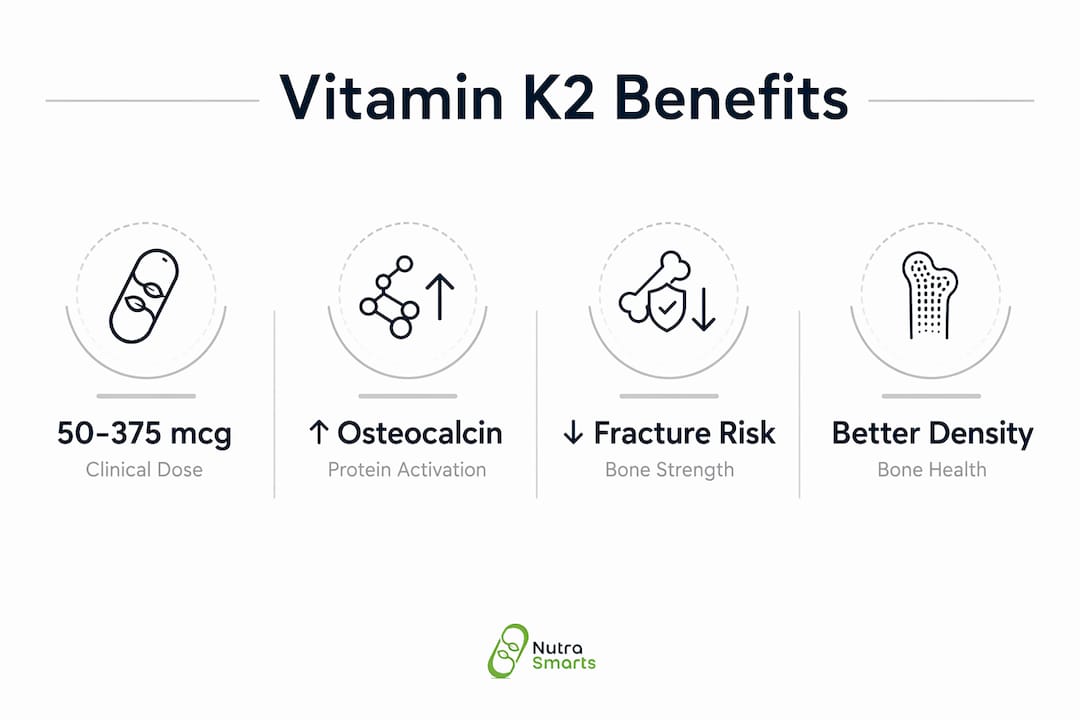
One important limitation: most trials use K2 alongside other nutrients, making it hard to isolate K2's independent effect on BMD. Researchers now treat K2 as an adjunct therapy rather than a standalone treatment for osteoporosis. That framing is accurate and useful. K2 works best as part of a broader protocol, not as a single solution.
How do vitamin K2 and vitamin D3 work together for bone health?
Vitamin D3 and K2 operate on the same calcium pathway but at different steps. Vitamin D3 enhances calcium absorption from the gut, pulling more calcium into the bloodstream. Vitamin K2 then activates the proteins that direct that calcium into bone tissue rather than soft tissue. Without K2, the extra calcium that D3 delivers has no clear destination and can accumulate in arterial walls.
This is why supplement synergy between D3 and K2 matters clinically. Taking high-dose vitamin D3 without adequate K2 may increase circulating calcium without ensuring it reaches bone. The combination improves bone mineralization and reduces the risk of soft tissue calcification, which is a concern for older adults already managing cardiovascular risk.
The practical steps for combining these nutrients effectively:
- Confirm your vitamin D3 status first. A serum 25(OH)D test tells you whether you are deficient before adding high-dose D3.
- Pair K2 with your D3 supplement. Take both with a meal that contains dietary fat, since both are fat-soluble and require fat for absorption.
- Choose MK-7 for sustained coverage. MK-7 has a longer half-life than MK-4, meaning a single daily dose maintains active K2 levels more consistently.
- Include calcium from food when possible. Dietary calcium from dairy or leafy greens works better with this nutrient pair than high-dose calcium supplements alone.
Pro Tip: Older adults absorbing less fat from meals may need to take K2 and D3 with a tablespoon of olive oil or a handful of nuts to get reliable uptake. Fat content of the meal matters more than most people realize.
For a direct comparison of how these two nutrients interact, Nutrasmarts covers the K2 and D3 relationship in detail, including dosage guidance and clinical context.
What are the best sources and forms of vitamin K2 for bones?
Vitamin K2 comes in several forms called menaquinones, labeled MK-4 through MK-13 based on side chain length. The two most studied forms for bone health are MK-4 and MK-7. MK-7 has a longer half-life and higher bioavailability than MK-4, which means it stays active in the body longer and requires a lower daily dose to maintain effective tissue levels. MK-4 acts faster but clears quickly, which is why clinical trials using MK-4 often use much higher doses (up to 45 mg daily in Japanese osteoporosis research).
Dietary sources of vitamin K2 include:
- Natto: Fermented soybeans, the richest known food source of MK-7, with a single serving delivering several hundred micrograms.
- Fermented cheeses: Gouda and Brie contain meaningful amounts of MK-8 and MK-9, though less than natto.
- Egg yolks and chicken liver: Provide MK-4 in smaller amounts.
- Fermented dairy products: Butter and certain yogurts from grass-fed animals contain trace amounts.
Most Western diets deliver far less K2 than clinical trials use. Supplementation fills that gap. Clinical studies have used doses from 50 to 375 mcg daily, with MK-7 at 90–180 mcg being the most common range for bone health outcomes. Because K2 is fat-soluble, taking it with dietary fat is not optional. Absorption drops significantly without it. Nutrasmarts profiles the fermentation-derived K2Quest MK-7 ingredient with full clinical citations for those evaluating specific supplement forms.
Key Takeaways
Vitamin K2 supports bone health by activating osteocalcin and MGP, directing calcium into bone tissue, and improving bone formation markers, with the strongest results when combined with vitamin D3 and adequate dietary fat.
| Point | Details |
|---|---|
| Core mechanism | K2 activates osteocalcin and MGP, enabling calcium to bind to bone rather than soft tissue. |
| Best clinical marker | Undercarboxylated osteocalcin (ucOC) responds faster than BMD and tracks K2's effectiveness early. |
| Optimal form | MK-7 offers longer half-life and higher bioavailability than MK-4 for daily bone health support. |
| Synergy with D3 | D3 pulls calcium into the bloodstream; K2 directs it into bone. Both are needed for full effect. |
| Absorption rule | K2 is fat-soluble. Always take it with a fat-containing meal for reliable uptake. |
What I've learned from years of tracking vitamin K2 research
The most common mistake people make with vitamin K2 is treating it like a standalone bone drug. It is not. The clinical data is clear that K2 works best as part of a nutrient stack, not in isolation. When I look at the studies showing fracture reduction, they almost always involve K2 alongside calcium and vitamin D3. Pulling K2 out of that context and expecting dramatic BMD improvements on its own sets people up for disappointment.
What I find genuinely underappreciated is the biomarker angle. Most people wait for a DEXA scan to tell them whether their bone protocol is working. That scan might happen once every two years. Undercarboxylated osteocalcin, by contrast, shifts within weeks of starting K2. That is a real feedback loop you can act on. If ucOC is not improving, you can adjust dose, check fat intake with meals, or reconsider the form of K2 you are using.
The absorption issue also gets ignored more than it should. I have seen people spend money on quality MK-7 supplements and take them with a glass of water on an empty stomach. Fat-soluble vitamins need fat. That is not a minor detail. It is the difference between a supplement that works and one that passes through unused.
My overall view: vitamin K2 belongs in any serious bone health protocol, but it needs the right partners, the right form, and the right conditions to deliver. Nutrasmarts reviews bone density supplements with full ingredient citations if you want to evaluate options against the clinical evidence.
— Nutrasmarts
Nutrasmarts and science-backed bone health support
Vitamin K2's bone benefits are well documented, but finding supplements that actually deliver the right form, dose, and nutrient combinations takes more than a label check.

Nutrasmarts reviews over 800 supplement ingredients, each linked to peer-reviewed studies and clinical trial citations. The metabolic health supplement reviews include vitamin K2 formulations evaluated for form (MK-7 vs. MK-4), dose accuracy, and synergy with calcium and vitamin D3. You can also use the bone health supplement guide to compare options side by side against the clinical benchmarks covered in this article. Every recommendation is grounded in the same research standards, not marketing claims.
FAQ
What does vitamin K2 do for bones?
Vitamin K2 activates osteocalcin, a protein that binds calcium to the bone matrix, and matrix Gla protein (MGP), which prevents calcium from depositing in arteries. Both actions directly support bone strength and cardiovascular safety.
How much vitamin K2 should I take for bone health?
Clinical trials have used daily doses ranging from 50 to 375 mcg, with MK-7 at 90–180 mcg being the most studied range for bone turnover improvements. Always take K2 with a fat-containing meal for proper absorption.
Is MK-7 better than MK-4 for bones?
MK-7 has a longer half-life and higher bioavailability than MK-4, making it more effective at lower daily doses for sustained bone health support. MK-4 is used in some clinical protocols but typically requires much higher doses.
Can I take vitamin K2 without vitamin D3?
You can, but the combination is significantly more effective. Vitamin D3 increases calcium absorption from the gut, and K2 directs that calcium into bone tissue. Without sufficient D3, K2 has less calcium to work with.
How long does vitamin K2 take to show results in bones?
Biomarkers like undercarboxylated osteocalcin can shift within weeks of starting supplementation. Measurable changes in bone mineral density typically take 12 months or longer, which is why biomarker testing is a more practical early indicator.