

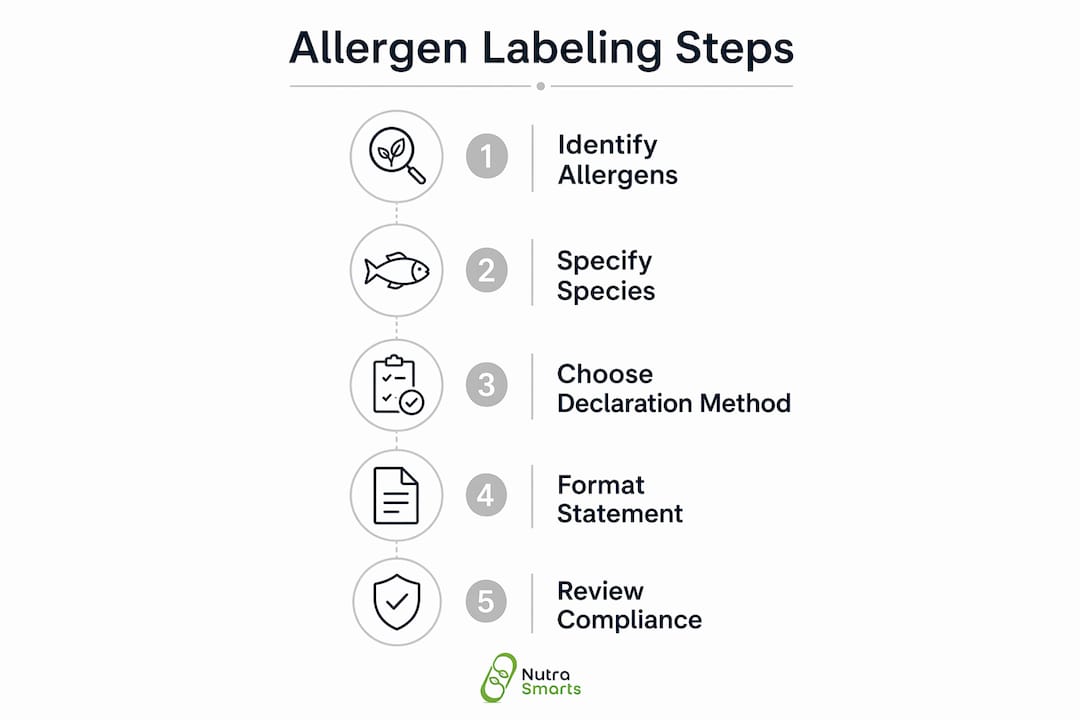
The FDA gives dietary supplement manufacturers three compliant methods to declare major food allergens on a label: parenthetically within the Supplement Facts panel directly after the ingredient name, parenthetically within the ingredient list, or in a separate "Contains" statement placed immediately adjacent to the Supplement Facts panel or ingredient list. All three are valid. What is not valid is mixing them inconsistently, using a partial "Contains" statement, or omitting species-level specificity for fish, shellfish, and tree nuts.

The regulatory foundation is the Food Allergen Labeling and Consumer Protection Act of 2004 (FALCPA), codified at section 403(w) of the Federal Food, Drug, and Cosmetic Act. FDA's Final Guidance Edition 5, issued in 2025, is the current authoritative interpretation. It does not carry the force of law on its own, but it reflects exactly how FDA enforcement staff read the statute.
The three compliant declaration methods at a glance:
- Parenthetical in Supplement Facts: List the allergen source immediately after the ingredient name, e.g., Bovine Colostrum (milk).
- Parenthetical in the ingredient list: Same logic, applied to the "Other Ingredients" line, e.g., Whey Protein Concentrate (milk).
- "Contains" statement: A standalone line listing every major allergen in the product, placed directly adjacent to the Supplement Facts panel or ingredient list. If you use this method, it must be complete. A "Contains: Milk" statement on a product that also contains soy is a compliance violation.
Consistency across the label is non-negotiable. FDA guidance is explicit: allergen declarations must be comprehensive and uniform. If milk appears parenthetically in the Supplement Facts panel, it cannot be absent from a "Contains" statement used elsewhere on the same label.
Table of Contents
- What FDA allergen labeling requirements actually say for supplements
- Practical methods for correctly labeling allergens on your supplements
- How to stay current on allergen compliance: tools and expert resources
- Nutrasmarts makes allergen-compliant label creation faster
- Key Takeaways
What FDA allergen labeling requirements actually say for supplements
The statutory requirement under section 403(w) of the FD&C Act applies to dietary supplements just as it applies to conventional foods. The nine major food allergens covered are milk, eggs, fish, crustacean shellfish, tree nuts, wheat, peanuts, soybeans, and sesame. Sesame became a major allergen effective January 1, 2023, under the FASTER Act, and its addition catches many manufacturers off guard, particularly those using sesame oil or tahini-derived excipients.
Specificity requirements are where most labels fall short. Broad terms are not enough. FDA requires species-level identification for fish (e.g., fish (salmon)), crustacean shellfish (e.g., crustacean shellfish (shrimp)), and tree nuts (e.g., tree nuts (almonds)). Writing "fish oil" without naming the species is non-compliant. Writing "tree nut blend" without specifying each nut type is non-compliant. The FDA's position is that consumers with specific fish or nut allergies cannot make safe decisions without that granularity.
The 2025 Final Guidance also clarifies two areas that supplement manufacturers frequently misread. First, highly refined oils derived from major allergens (such as highly refined peanut oil) are generally exempt from allergen declaration because the refining process removes allergenic proteins. Second, incidental additives present in a food at insignificant levels that have no technical or functional effect are also exempt. Neither exemption is automatic. Manufacturers need documentation to support either claim.
"Contains" statement placement matters. The statement must appear immediately adjacent to, or directly following, the Supplement Facts panel or ingredient list. It cannot float elsewhere on the label. If the label has both a Supplement Facts panel and a separate ingredient list, the "Contains" statement must be adjacent to one of them, and the allergen declarations in both locations must be consistent.
| Supplement Component | Allergen Declaration Method | Specificity Required? |
|---|---|---|
| Dietary ingredient (e.g., whey protein) | Parenthetical in Supplement Facts or ingredient list | Yes (e.g., milk) |
| Source ingredient (e.g., fish oil) | Parenthetical after ingredient name | Yes (species required) |
| Excipient/filler (e.g., soy lecithin) | Ingredient list or "Contains" statement | Yes (e.g., soy) |
| Flavor containing allergen | Ingredient list or "Contains" statement | Yes |
| Highly refined oil | Exempt if refining removes protein; documentation required | N/A |
| Incidental additive | Exempt if no functional effect; documentation required | N/A |
FDA's Final Guidance Edition 5 does not create new legal obligations, but it represents the agency's current enforcement thinking. Manufacturers who deviate from it without documented justification are taking a real regulatory risk.
Practical methods for correctly labeling allergens on your supplements
Getting the declaration method right is step one. Getting the execution right is where labels actually fail.
Parenthetical declarations in Supplement Facts
The cleanest approach for most supplement manufacturers is the parenthetical declaration within the Supplement Facts panel itself. Place the allergen source name in parentheses immediately after the ingredient name, before any other descriptor. The format looks like this:
- Bovine Colostrum (milk), 500 mg
- Krill Oil (crustacean shellfish (krill)), 1,000 mg
- Almond Flour (tree nuts (almonds)), 200 mg
Notice that krill requires two levels of specificity: the allergen category (crustacean shellfish) and the species (krill). That double parenthetical is correct and required.
Formatting a compliant "Contains" statement
When you use a "Contains" statement, every major allergen present anywhere in the product must appear in it. That includes allergens from excipients, coatings, capsule shells, and flavoring agents, not just the primary dietary ingredients. A common and costly mistake is listing only the headline allergens while missing soy lecithin in the coating or milk derivatives in the capsule fill.
The statement should read: Contains: Milk, Soy, Tree Nuts (Almonds). No abbreviations. No generic category names without species where specificity is required.
Single-ingredient supplements without ingredient lists
Some supplements, particularly single-ingredient powders or oils, have no separate ingredient list. FDA recommends placing the allergen declaration in the statement of identity or in a "Contains" statement positioned above the manufacturer information. A fish oil product, for example, should read Fish Oil (salmon) in the statement of identity, or carry a "Contains: Fish (Salmon)" statement in a prominent location near the front panel.
Advisory statements and cross-contact risk
"May contain" and "processed in a facility that also handles" statements are voluntary and address cross-contact risk, not intentional ingredients. FDA guidance is clear that these statements should never restate allergens already declared as intentional ingredients. If your product intentionally contains milk and you also use a "may contain milk" advisory, you are creating consumer confusion and a potential compliance flag.
Contradictory claims are a harder problem. A label that says "Peanut Free" and also carries "May Contain Peanuts" is not just confusing. FDA considers it a violation of its guidance on advisory allergen statements. Before adding any advisory statement, confirm that your manufacturing risk assessment actually supports the cross-contact claim.
Pro Tip: Audit every ingredient in your formula against the current nine-allergen list, including excipients, coatings, and processing aids. Then audit the label itself: check that every allergen appearing in the Supplement Facts panel also appears in the ingredient list and in any "Contains" statement you use. A cross-departmental review involving your formulation, regulatory, and quality teams before label release catches the inconsistencies that solo reviews miss.
Allergen labeling do's and don'ts:
- Do declare the species for fish, crustacean shellfish, and tree nuts every time.
- Do include all allergens from excipients and processing aids in your "Contains" statement.
- Do place "Contains" statements immediately adjacent to the Supplement Facts panel or ingredient list.
- Do review labels against FDA's 2025 Final Guidance before printing.
- Don't use a partial "Contains" statement that omits any allergen present in the product.
- Don't use "may contain" for allergens that are intentionally included in the formula.
- Don't use contradictory claims like "Soy Free" alongside "May Contain Soy."
- Don't rely on broad terms like "tree nuts" or "shellfish" without the specific type.
How to stay current on allergen compliance: tools and expert resources
Allergen labeling requirements have changed twice in the past three years, with sesame added in 2023 and the 2025 Final Guidance updating interpretations for highly refined oils, incidental additives, and multi-unit packaging. Staying current requires more than a one-time review of the statute.
Using FDA's official guidance documents
FDA's primary resource hub for allergen labeling is its Food Allergens guidance page, which consolidates all current guidance documents including Edition 5. Bookmark it and check it whenever you are reformulating or redesigning a label. The 2025 edition specifically addresses dietary supplement products in its Q&A format, making it more practical than the underlying statute for day-to-day label decisions.
Nutrasmarts' FDA-compliant label creation tool
Nutrasmarts' Supplement Facts Label Creator is built specifically for manufacturers who need accurate label generation without managing complex spreadsheets. The tool incorporates FDA formatting requirements directly into the label-building workflow, reducing the risk of allergen declaration errors at the output stage. For manufacturers managing multiple SKUs or frequent reformulations, that kind of systematic check matters more than any single manual review.
Nutrasmarts also maintains a database covering over 800 supplement ingredients, each linked to peer-reviewed research. When a formulator is evaluating a new ingredient that may carry allergen implications, having clinical and regulatory context in one place shortens the review cycle. The ingredient database is particularly useful when sourcing novel botanical extracts that may be processed on shared equipment with allergenic materials.
Pre-release label audit checklist
Before any label goes to print, run through these checks:
- Confirm all nine major allergens are evaluated, including sesame.
- Verify species-level specificity for fish, crustacean shellfish, and tree nuts.
- Check that "Contains" statement lists every allergen present, including from excipients.
- Confirm "Contains" statement is adjacent to Supplement Facts panel or ingredient list.
- Verify no contradictory advisory statements appear on the label.
- Cross-reference the label against FDA's 2025 Final Guidance Q&A for your specific product type.
- Document exemption justification for any highly refined oil or incidental additive claims.
| Resource | Type | Best Used For |
|---|---|---|
| FDA Final Guidance Edition 5 (2025) | Regulatory document | Interpreting labeling requirements and exemptions |
| FDA Food Allergens guidance hub | Reference portal | Staying current on regulatory updates |
| Nutrasmarts Supplement Facts Label Creator | Software tool | Generating FDA-compliant labels with built-in allergen checks |
| Nutrasmarts ingredient database (800+ ingredients) | Research database | Evaluating allergen implications of specific ingredients |
| Nutrasmarts compliance blog | Editorial resource | Practical guidance on evolving FDA requirements |
| FDA label checklist (via Nutrasmarts) | Checklist | Pre-release label audits for supplement manufacturers |
Nutrasmarts makes allergen-compliant label creation faster
Getting allergen declarations right on a supplement label is not the hardest regulatory problem you will face, but it is one of the most consequential. A missed species name or an incomplete "Contains" statement can trigger a warning letter, a voluntary recall, or worse, a serious adverse event for a consumer who trusted your label.

Nutrasmarts' Supplement Facts Label Creator is built for exactly this situation. It handles the formatting requirements that trip up manual label builds, including allergen declaration placement and the structural rules that FDA's 2025 guidance reinforces. You get a compliant label output without rebuilding your process from scratch or hiring an outside regulatory consultant for every SKU update. For manufacturers who need to move fast without cutting corners, that is a real operational advantage.
The platform's ingredient database gives you clinical and regulatory context for over 800 ingredients, so when a new botanical or excipient raises allergen questions, you are not starting from zero. Browse the supplement ingredient database to see how Nutrasmarts connects formulation decisions to compliance requirements. If you are ready to generate a label now, the Supplement Facts tool is free to use.
Key Takeaways
Correct allergen labeling on dietary supplement labels requires consistent, species-specific declarations across the Supplement Facts panel, ingredient list, and any "Contains" statement, following FDA's three approved methods under FALCPA and the 2025 Final Guidance.
| Point | Details |
|---|---|
| Three compliant declaration methods | Declare allergens parenthetically in Supplement Facts, in the ingredient list, or in a "Contains" statement adjacent to either. |
| Species specificity is mandatory | Fish, crustacean shellfish, and tree nuts require the specific species or type, not just the category name. |
| "Contains" statements must be complete | Every major allergen in the product must appear; a partial statement is a compliance violation. |
| Sesame is now a major allergen | Sesame has been a required declaration since January 1, 2023; labels must reflect this. |
| Nutrasmarts label tool reduces errors | The FDA-compliant Supplement Facts Label Creator builds allergen declaration requirements into the label workflow. |