

FDA compliant label requirements for dietary supplements are a defined set of mandatory elements, formatting rules, and disclosure obligations that every manufacturer must meet before a product reaches consumers. The FDA does not pre-approve supplement labels, which means compliance responsibility sits entirely with you. Get it wrong and you face warning letters, recalls, or misbranding charges. This article breaks down every required element, explains claim and allergen rules, and gives you practical tools to build and audit labels that hold up under scrutiny.
What core elements must appear on a compliant supplement label?
A dietary supplement label must carry specific components in specific locations. Missing even one triggers misbranding under 21 CFR. The industry term for this full set of requirements is "labeling compliance," and it covers both content and format.
The required elements are:
- Statement of identity: The phrase "Dietary Supplement" must appear on the principal display panel. This tells consumers and regulators exactly what product category they are looking at. Distributor addresses must also clarify the distributor's role with language like "Distributed by" or "Manufactured for."
- Net quantity of contents: You must state the amount in both metric and U.S. customary units. A label showing only grams without ounces is non-compliant.
- Supplement Facts panel: This is the centerpiece of product label compliance. It must list serving size, servings per container, each dietary ingredient, and the percent Daily Value (%DV) when one is established, all formatted per 21 CFR 101.36.
- Ingredient list: Every non-dietary ingredient, such as binders, fillers, and coatings, must appear in descending order of predominance by weight.
- Manufacturer identification: The name and principal place of business of the manufacturer, packer, or distributor must appear on the label.
- Allergen declarations: All nine major food allergens must be declared. More on this in a dedicated section below.
The Supplement Facts panel is where most formatting errors occur. Serving size must align with the directions for use printed elsewhere on the label. Proprietary blends require special display rules: you list the blend by name with its total weight, then list each ingredient within it in descending order, without individual weights. That detail trips up a surprising number of experienced formulators.
Pro Tip: Print a physical proof of your label at production size before finalizing artwork. Font sizes that look fine on screen often fall below FDA minimums at actual label dimensions.

How do FDA regulations govern claim language on supplement labels?
Structure/function claims are statements that describe how a nutrient or ingredient affects normal body structure or function. "Calcium builds strong bones" and "Vitamin C supports immune health" are classic examples. These claims are legal on dietary supplements, but they come with strict conditions.
The rules you must follow:
- Exact disclaimer text: Every label bearing a structure/function claim must include the verbatim FDA disclaimer: "This statement has not been evaluated by the Food and Drug Administration. This product is not intended to diagnose, treat, cure, or prevent any disease." You cannot paraphrase it.
- Font size and placement: The disclaimer must appear in type no smaller than 4.5 points and must be placed adjacent to the claim. Burying it in a footnote or separating it from the claim by unrelated text is a compliance failure.
- FDA notification: You must notify the FDA within 30 days of first marketing a product with a structure/function claim. The notification must include the specific claim text, the ingredient it references, and your brand information.
- Disease claims are prohibited: A statement like "reduces blood pressure" or "treats arthritis" crosses into drug claim territory. The FDA treats these as unauthorized drug claims, not supplement claims. The line between a structure/function claim and a disease claim is the single most litigated issue in supplement labeling.
Non-compliance here carries serious consequences. Labels missing the disclaimer or containing disease claims are among the top triggers for FDA warning letters. The DSHEA disclaimer requirement is not optional, and it is not negotiable.
Pro Tip: Plan your label layout before writing claim copy. The disclaimer must sit next to every individual claim, not just once on the panel. If you have three structure/function claims, you need three adjacent disclaimers or a single prominent one that clearly applies to all claims on the label.
What allergen labeling rules apply to supplement labels in 2026?
Allergen labeling for dietary supplements follows the same federal laws that govern food products. Two laws define the current requirements: the Food Allergen Labeling and Consumer Protection Act (FALCPA) and the Food Allergy Safety, Treatment, Education, and Research (FASTER) Act.
Here is the current list of nine major allergens and how to handle them:
- Milk — Declare in the ingredient list or in a separate "Contains" statement.
- Eggs — Same declaration options apply.
- Fish — Must specify the species (e.g., "salmon," not just "fish").
- Shellfish — Must specify the crustacean type (e.g., "shrimp," "crab").
- Tree nuts — Must specify the type (e.g., "almonds," "cashews").
- Peanuts — Declare by name.
- Wheat — Declare by name.
- Soybeans — Declare by name.
- Sesame — Added as the ninth major allergen effective january 1, 2023, under the FASTER Act.
Sesame is the most common source of current non-compliance. Many manufacturers updated their formulas years ago but never revised their labels to reflect sesame as a declared allergen. That gap is a direct misbranding violation.
The practical steps to stay current are straightforward. First, audit every formula for allergen-containing ingredients, including processing aids and excipients. Second, confirm your label declares each allergen either within the ingredient list or in a bolded "Contains" statement immediately after it. Third, label and formula alignment must be re-verified every time you reformulate, even if the change seems minor.
What are common label compliance pitfalls for supplement manufacturers?
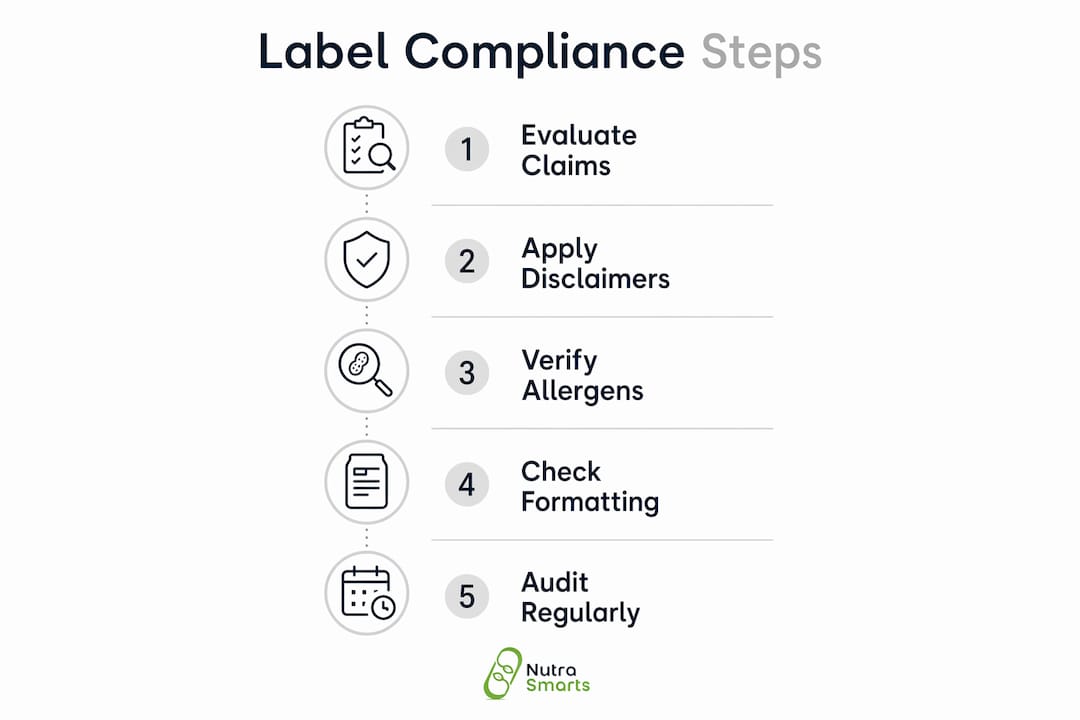
The most dangerous assumption in supplement manufacturing is that a label approved last year is still compliant today. Label compliance is dynamic. Formula changes, new allergen laws, and updated claim guidance all require label revisions.
Here is a direct comparison of the most common pitfalls versus the correct practice:
| Common Pitfall | Correct Practice |
|---|---|
| Disclaimer font below 4.5 points | Verify font size at final print dimensions, not on screen |
| Ingredients listed alphabetically | List non-dietary ingredients in descending order by weight |
| %DV calculated from outdated reference values | Use current FDA Daily Value tables from 21 CFR 101.9 |
| Sesame not declared post-2023 reformulation | Audit all excipients and processing aids for sesame content |
| Formula updated without label revision | Version-control formula and label artwork together |
| Proprietary blend weights omitted | List total blend weight with each ingredient in descending order |
Formula-to-label drift is the most underestimated risk. A manufacturer switches a magnesium source from magnesium oxide to magnesium glycinate. The label still says "magnesium oxide." That is a misbranding violation, even if the elemental magnesium amount is identical. Internal controls must link your current formula document to your current label artwork at all times.
Documentation is your legal defense. The FDA does not pre-approve labels, so your internal archive of finalized formulas, approved claims, and printed label versions is the only evidence you have if the agency challenges your product post-market. Treat that archive as a regulatory asset, not a filing formality.
Knowing when to bring in outside help matters too. If your product carries multiple structure/function claims, contains novel ingredients, or targets a specific population like children or pregnant women, a regulatory consultant review before print is worth the cost. Tools like the Nutrasmarts Supplement Facts panel tool reduce calculation errors on the panel itself, but they do not replace a full compliance review for complex products.
Pro Tip: Run a label audit against a current FDA compliance checklist every time you update a formula or add a claim. Treat it as a required step in your change-control process, not an optional review.
Key takeaways
FDA compliant label requirements for dietary supplements demand accurate content, precise formatting, and active documentation practices that must be updated every time a formula or claim changes.
| Point | Details |
|---|---|
| Supplement Facts panel is mandatory | Format per 21 CFR 101.36, with serving size aligned to directions for use. |
| Structure/function claims require disclaimers | Use exact FDA disclaimer text in 4.5-point minimum font, adjacent to every claim. |
| Sesame is now a declared allergen | Effective january 2023, sesame must be declared on all supplement labels under the FASTER Act. |
| Formula-to-label drift causes violations | Version-control your formula and label artwork together to prevent misbranding. |
| FDA does not pre-approve labels | Maintain an internal archive of formulas, claims, and label artwork as your compliance record. |
The compliance mistake that costs manufacturers the most
After working through hundreds of supplement label reviews, the pattern that causes the most regulatory exposure is not ignorance of the rules. Manufacturers generally know the rules. The real problem is treating label compliance as a one-time event rather than an ongoing process tied to product lifecycle management.
A formula change in month three of production rarely triggers an automatic label review. A new structure/function claim added to marketing copy rarely prompts a check on whether the disclaimer is correctly placed on the physical label. These gaps accumulate quietly until an FDA inspection or a third-party audit surfaces them all at once.
The disclaimer placement issue is particularly underestimated. I have seen labels where the disclaimer appears on the back panel in 4-point type, separated from the claim on the front panel by the entire product. That layout fails the adjacency requirement under 21 CFR 101.93, regardless of whether the text itself is verbatim correct. Adjacency is a formatting rule, not a content rule, and it gets missed because most label reviews focus on what the label says rather than where things appear.
The most reliable fix is version-controlled documentation that links your formula, your approved claim list, and your printed label artwork as a single compliance package. When any one element changes, the package triggers a review of all three. That process is not complicated. It is just disciplined. The manufacturers who avoid warning letters are not smarter than the ones who receive them. They are more systematic.
— Nutrasmarts
How Nutrasmarts helps you build compliant supplement labels
Getting FDA labeling right from the start saves you from costly reprints, warning letters, and reformulation cycles.

Nutrasmarts gives dietary supplement manufacturers the tools to build accurate, compliant labels without the spreadsheet chaos. The free Supplement Facts label creator generates FDA-formatted panels with correct %DV calculations, proper ingredient ordering, and serving size alignment built in. The ingredient database covers over 800 ingredients, each linked to peer-reviewed studies, so your label claims are grounded in clinical evidence from the start. Whether you are launching a new metabolic health supplement or auditing an existing line, Nutrasmarts gives you the research depth and compliance tools to move faster and with more confidence.
FAQ
What is the supplement facts panel and why is it required?
The Supplement Facts panel is a mandatory label element for all dietary supplements, formatted per 21 CFR 101.36. It lists serving size, servings per container, dietary ingredient amounts, and percent Daily Values, replacing the Nutrition Facts panel used on conventional foods.
What exact disclaimer text is required for structure/function claims?
The FDA requires this verbatim statement: "This statement has not been evaluated by the Food and Drug Administration. This product is not intended to diagnose, treat, cure, or prevent any disease." The text must appear in type no smaller than 4.5 points, adjacent to the claim.
When did sesame become a required allergen declaration on supplement labels?
Sesame became the ninth major food allergen effective january 1, 2023, under the FASTER Act. Any supplement containing sesame or sesame-derived ingredients must declare it in the ingredient list or in a "Contains" statement.
Does the FDA approve supplement labels before they go to market?
The FDA does not pre-approve dietary supplement labels. Manufacturers are responsible for compliance before distribution, and internal documentation of formulas, claims, and label artwork serves as the primary evidence of compliance if the FDA challenges a product.
What triggers an FDA warning letter for supplement labels?
Common triggers include missing or incorrectly placed DSHEA disclaimers, undeclared allergens, disease claims presented as structure/function claims, and ingredient lists that do not match the current formula. Non-compliant label examples consistently show these same patterns across FDA enforcement actions.