

Clinical trials are the gold standard for determining whether dietary supplements are safe and effective in humans. The role of clinical trials in supplements research is to generate controlled, reproducible evidence that no marketing claim, consumer review, or single-nutrient study can replace. The FDA does not pre-approve supplements for safety and effectiveness before they reach store shelves, which means clinical trial results carry the primary burden of proof. Understanding how these trials work, where they fall short, and how to read their findings critically is the difference between making an informed health decision and being misled by a label.
How do clinical trials establish supplement safety and efficacy?
Randomized controlled trials, known as RCTs, are the recognized scientific standard for testing whether a supplement produces a measurable effect in humans. An RCT assigns participants randomly to either the supplement or a placebo, and neither group knows which they received. This design eliminates the most common sources of bias: expectation effects, researcher favoritism, and population imbalances between groups.
The mechanics of a well-designed supplement RCT include four non-negotiable elements:
- Placebo control: Participants in the comparison group receive an inert substance that looks identical to the supplement, isolating the supplement's biological effect.
- Blinding: Neither participants nor researchers know who received the supplement until data collection ends, preventing conscious or unconscious influence on outcomes.
- Allocation concealment: The randomization sequence is hidden from those enrolling participants, preventing selection bias before the trial begins.
- Pre-specified endpoints: Researchers define what they are measuring and how before the trial starts, preventing post-hoc data mining for favorable results.
Trial duration is a frequently underestimated variable. Many trials are too brief or use endpoints that do not match the supplement's biological timeline, causing researchers to conclude "no effect" when the supplement simply needed more time to work. A four-week trial of magnesium for sleep quality, for example, cannot capture the cumulative neurological adaptations that may take three to six months to manifest.
Many supplement studies rely on single-nutrient observational literature or consumer perception surveys rather than full RCTs. This matters because observational data cannot establish causation. People who take omega-3 supplements may also exercise more, eat better, and sleep longer. A trial that does not control for these variables cannot attribute any health improvement to the supplement itself.

Pro Tip: When evaluating a supplement trial, search for its pre-registration record on ClinicalTrials.gov. Pre-registered trials commit to their endpoints before data collection, making it far harder to selectively report favorable results.
What challenges and limitations affect supplement clinical trials?
Supplement trials face a distinct set of obstacles that drug trials do not, and those obstacles directly shape the evidence available to you when you search for clinical trials supplement ingredients.
The core challenges include:
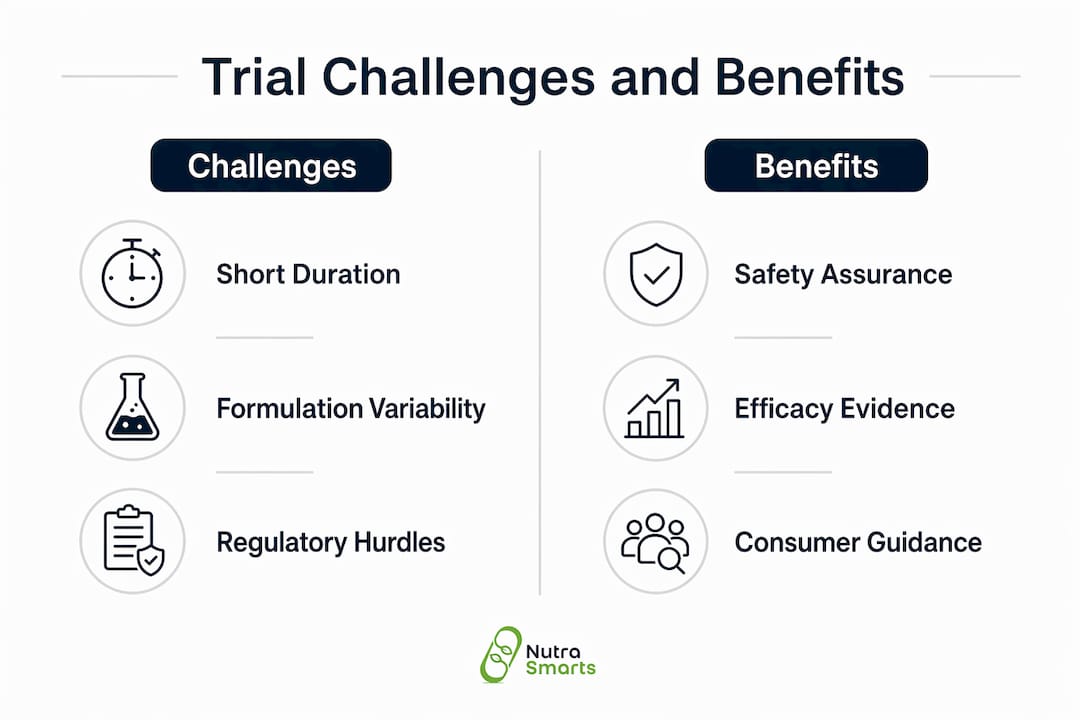
- Regulatory classification gaps: Herbal food supplements are regulated as foods, not drugs. This means they face no pre-market safety or quality assessment, which paradoxically makes running rigorous trials on them more expensive and complicated.
- GMP certification costs: Good Manufacturing Practice certification is required for supplements used in clinical trials, and the cost of achieving and maintaining it blocks many smaller manufacturers from conducting trials at all.
- Underpowered designs: Short trial durations of four to six weeks frequently fail to capture the cumulative effects of nutrients that operate through slow-acting biological pathways.
- Label inaccuracy: The formulation used in a clinical trial may not match what is sold on the shelf. Dose, standardization level, and ingredient source can all differ, making it misleading to apply trial results to a consumer product without verification.
The regulatory distinction between herbal medicinal products (HMPs) and herbal food supplements (HFS) is worth understanding directly.
| Category | Regulatory standard | Trial feasibility |
|---|---|---|
| Herbal medicinal products (HMP) | Drug-level pre-market review | Higher, due to standardized quality controls |
| Herbal food supplements (HFS) | Food-level regulation only | Lower, due to cost and quality barriers |
HMPs must meet pharmaceutical-grade quality standards before approval, which means the ingredient in a trial is reliably consistent across batches. HFS products carry no such guarantee, which introduces variability that can make trial results unreliable or impossible to replicate.
Pro Tip: Do not generalize a trial result from one brand's formulation to all products containing the same ingredient. A trial on a standardized 95% curcumin extract does not validate a generic turmeric capsule with no standardization disclosure.
How should you interpret clinical trial evidence for supplements?
Reading a supplement trial result correctly requires more than checking whether the outcome was positive or negative. The quality of the evidence determines whether the result is meaningful.
The NIH Office of Dietary Supplements maintains the Dietary Supplement Label Database, which allows you to cross-reference label claims against documented formulations. This is your first stop when checking whether a product's label matches the formulation studied in a trial. Label information is a starting point, not a conclusion.
When assessing any supplement trial, apply these filters:
- Formulation match: Does the trial use the exact dose and standardization level listed on the product you are considering? A trial using 500 mg of a specific ashwagandha extract (KSM-66) does not validate a product using a different extract at 300 mg.
- Reporting transparency: Among 75 nutrition RCTs reviewed in a 2026 analysis, only 3.3% detailed allocation concealment, 45.3% reported blinding, and 42.7% reported adherence. A trial missing these details cannot be trusted to produce an unbiased result.
- Population relevance: A trial conducted in elderly men with vitamin D deficiency does not automatically apply to healthy adults in their thirties. Match the trial population to your own profile.
- Endpoint validity: Surrogate endpoints like a blood biomarker are weaker evidence than clinical outcomes like reduced fracture rate or confirmed disease incidence.
The table below summarizes what to look for when evaluating supplement trial quality.
| Quality indicator | What to check |
|---|---|
| Pre-registration | Confirm on ClinicalTrials.gov before data collection |
| Blinding method | Double-blind preferred; single-blind acceptable for some designs |
| Allocation concealment | Must be explicitly described |
| Adherence reporting | Confirms participants actually took the supplement as directed |
| Formulation match | Dose and standardization must match the consumer product |
Understanding supplement dosage alignment between trial formulations and consumer products is one of the most overlooked factors in translating research to real-world outcomes.
What do landmark trials reveal about supplement risks and benefits?
The most instructive clinical trials are not the ones that confirmed what researchers hoped. They are the ones that delivered unexpected and sometimes alarming results.
The SELECT trial (Selenium and Vitamin E Cancer Prevention Trial) is the clearest example. Researchers expected selenium and vitamin E to reduce prostate cancer risk based on earlier observational data. Instead, vitamin E increased prostate cancer risk by 17% in healthy men. This finding directly contradicted the assumptions driving widespread vitamin E supplementation at the time. The trial enrolled over 35,000 men and ran for years, making it one of the most statistically credible supplement trials ever conducted.
The CARET trial produced a similarly counterintuitive result. Beta-carotene combined with vitamin A, both antioxidants with strong theoretical cancer-prevention rationale, increased lung cancer risk in smokers. The trial was stopped early because the harm was clear and continuing would have been unethical.
Beyond cancer risk, some supplements interact directly with cancer treatments in ways most consumers do not anticipate. St. John's wort reduces the efficacy of certain chemotherapy drugs. Turmeric and melatonin can increase bleeding risk during surgical procedures. These are not theoretical concerns. They are documented clinical findings that reinforce why supplement safety in research settings matters beyond the trial itself.
Not every landmark trial delivers bad news. Trials on folate supplementation during pregnancy have produced some of the most consistent and replicated findings in nutritional science, with clear evidence of reduced neural tube defect risk. The lesson is not that supplements are dangerous. The lesson is that assumptions without trial evidence are unreliable, and that ingredient transparency is the foundation of any credible supplement claim.
Key takeaways
Clinical trials are the only mechanism that separates supplement claims grounded in evidence from those built on assumption, and the quality of that evidence depends entirely on trial design, reporting transparency, and formulation accuracy.
| Point | Details |
|---|---|
| RCTs are the evidence standard | Only randomized controlled trials can establish causation between a supplement and a health outcome. |
| Trial design flaws are common | Missing blinding, short durations, and underpowered samples produce unreliable results that consumers often misread as valid. |
| Landmark trials revealed real risks | SELECT and CARET showed vitamin E and beta-carotene increased cancer risk, overturning widely held assumptions. |
| Label and trial formulations often differ | Always verify that the product's dose and standardization match the specific formulation studied in the trial. |
| Reporting transparency is non-negotiable | Trials lacking allocation concealment and adherence data cannot be used to draw reliable conclusions about supplement efficacy. |
Why the supplement trial conversation needs to change
At Nutrasmarts, we have spent years reviewing clinical trial data across hundreds of ingredients, and the pattern is consistent: the weakest evidence gets the loudest marketing. Trials with four-week durations, no placebo arm, and no pre-registration show up in product copy as "clinically proven." Consumers who do not know what allocation concealment means have no way to challenge that claim.
The uncomfortable reality is that the supplement industry's evidence base is genuinely uneven. Some ingredients, like folate, magnesium, and vitamin D in deficient populations, have strong, replicated trial support. Others, including many proprietary blends and trending botanicals, have almost none. The gap between those two categories is not visible on a label.
What concerns us most is not the absence of evidence for some supplements. It is the active misrepresentation of weak evidence as strong. A single pilot study with 30 participants is not the same as a multi-year RCT with thousands. Treating them as equivalent misleads consumers and undermines the credibility of supplements that do have solid backing.
The path forward requires better trial design aligned to supplement biochemistry, stricter label accuracy standards, and consumers who know how to ask the right questions before they buy. The SELECT trial and CARET trial did not make supplements look bad. They made assumptions look bad. That is exactly what rigorous science is supposed to do.
— NutraSmarts
How Nutrasmarts helps you navigate supplement evidence
Nutrasmarts was built specifically for the problem this article describes: too many supplements, too little reliable evidence, and no easy way to tell the difference.
The Nutrasmarts ingredient database covers over 800 ingredients, each linked to peer-reviewed studies and clinical trial citations so you can see exactly what the evidence says and how strong it is. For consumers focused on specific health concerns, the supplements by symptom tool organizes options by condition, from joint pain to cognitive performance, with research summaries attached. For those evaluating metabolic health options specifically, the metabolic health supplement category reviews 130 products against clinical evidence. The FDA-compliant Supplement Facts Label Creator also lets formulators and consumers verify label accuracy against research-backed formulations, closing the gap between what a trial studied and what a product actually contains.
FAQ
What is the role of clinical trials in supplement research?
Clinical trials generate controlled human evidence on whether a supplement is safe and effective at a specific dose and formulation. Without trial data, supplement claims rest on theory, animal studies, or observational data, none of which can establish causation.
Are clinical trial supplements effective for all consumers?
Not automatically. Trial results apply to the population studied, the dose used, and the specific formulation tested. A supplement proven effective in elderly deficient adults may show no benefit in healthy younger individuals.
How do I find clinical trial data for supplement ingredients?
Search ClinicalTrials.gov by ingredient name, or use the NIH Office of Dietary Supplements database to cross-reference label claims with documented research. Nutrasmarts also links each ingredient in its database directly to peer-reviewed trial citations.
Why do some supplement trials show harm instead of benefit?
Large, well-designed trials like SELECT and CARET revealed that vitamin E and beta-carotene increased cancer risk in certain populations, contradicting earlier observational assumptions. Rigorous trial design exposes effects, positive or negative, that smaller or weaker studies miss entirely.
How can I tell if a supplement trial is trustworthy?
Check for pre-registration on ClinicalTrials.gov, confirmed blinding, allocation concealment, and adherence reporting. Among reviewed nutrition RCTs, only 3.3% fully disclosed allocation concealment, making that single detail a reliable filter for trial quality.