

The most effective fatigue-fighting supplements correct a confirmed deficiency. Iron (ferritin), vitamin B12, vitamin D, and magnesium account for the majority of testable, correctable deficiency-driven fatigue cases. CoQ10 and select adaptogens like ashwagandha serve as lower-evidence adjuncts for specific populations. Before buying anything, get targeted labs.
Start with these nutrients:
- Iron/ferritin — especially for menstruating people or anyone with heavy periods, vegetarians, or frequent blood donors
- Vitamin B12 and folate — critical for methylation, red blood cell production, and neurological energy
- Vitamin D (25-OH D) — deficiency is widespread and directly linked to fatigue and muscle weakness
- Magnesium — involved in over 300 enzymatic reactions, including ATP synthesis
- CoQ10 — particularly relevant for statin users and older adults with mitochondrial concerns
Immediate next step: Ask your clinician for a CBC with differential, ferritin plus iron studies, serum B12 (with MMA or holotranscobalamin if borderline), 25-OH vitamin D, and TSH with free T4. Those five panels cover the most common correctable causes of fatigue.
Table of Contents
- Which labs should you order first to confirm deficiencies?
- Nutrient-by-nutrient evidence: what actually works and why
- When correcting a deficiency will actually improve your fatigue
- How to choose safe, effective supplement products and read labels correctly
- How quickly do supplements work, and what should you monitor?
- Symptoms and lab results that require urgent medical evaluation
- How Nutrasmarts' symptom-to-supplement tool helps you map fatigue to evidence-rated options
- Key Takeaways
- The case for measurement over intuition
- Nutrasmarts gives you the evidence layer that most supplement research is missing
- Useful sources
Which labs should you order first to confirm deficiencies?
Getting the right tests before supplementing is not optional. Fatigue has a long differential: anemia, hypothyroidism, sleep apnea, autoimmune disease, blood sugar dysregulation, and chronic infection all produce the same dragging exhaustion. Supplementing without testing means you might spend months on iron when your thyroid is the actual problem.
Priority lab panel for fatigue workup:
- CBC with differential — screens for anemia (low hemoglobin/hematocrit), macrocytosis (B12/folate deficiency), and signs of infection or inflammation
- Ferritin and iron studies (serum iron, TIBC, transferrin saturation) — ferritin is the most sensitive early marker of iron depletion; serum iron alone misses early-stage deficiency
- Serum B12 — values below 200 pg/mL are clearly deficient; the 200–400 pg/mL range is functionally ambiguous for many people
- Methylmalonic acid (MMA) and homocysteine — both elevate before serum B12 drops, making them the best functional markers for borderline cases; request these if B12 is in the gray zone
- Holotranscobalamin (holoTC) — the active fraction of B12; more sensitive than total serum B12 for early deficiency detection
- 25-OH vitamin D — the standard test for vitamin D status; values below 20 ng/mL are deficient by most clinical definitions, and many practitioners treat below 30 ng/mL
- TSH and free T4 — hypothyroidism is one of the most commonly missed causes of fatigue; add free T3 if you have cold intolerance, hair loss, or constipation alongside fatigue
- Fasting glucose and HbA1c — blood sugar dysregulation causes significant energy crashes and is often overlooked in non-diabetic patients
- Basic comprehensive metabolic panel (CMP) — checks kidney and liver function, both of which affect nutrient metabolism and supplement safety
- hsCRP — elevated chronic inflammation suppresses energy and can indicate an underlying condition that supplements will not fix
For ambiguous B12 results, push for MMA specifically. A normal serum B12 with elevated MMA confirms functional deficiency at the cellular level. The Nutrasmarts deficiency symptom guide can help you map your specific symptoms to the most relevant tests before your appointment.
Pro Tip: Schedule iron studies fasting and in the morning. Iron levels fluctuate throughout the day and drop after meals, which can produce a falsely low result that triggers unnecessary supplementation. Menstruating people should note where they are in their cycle, since ferritin can temporarily dip post-period.
Nutrient-by-nutrient evidence: what actually works and why
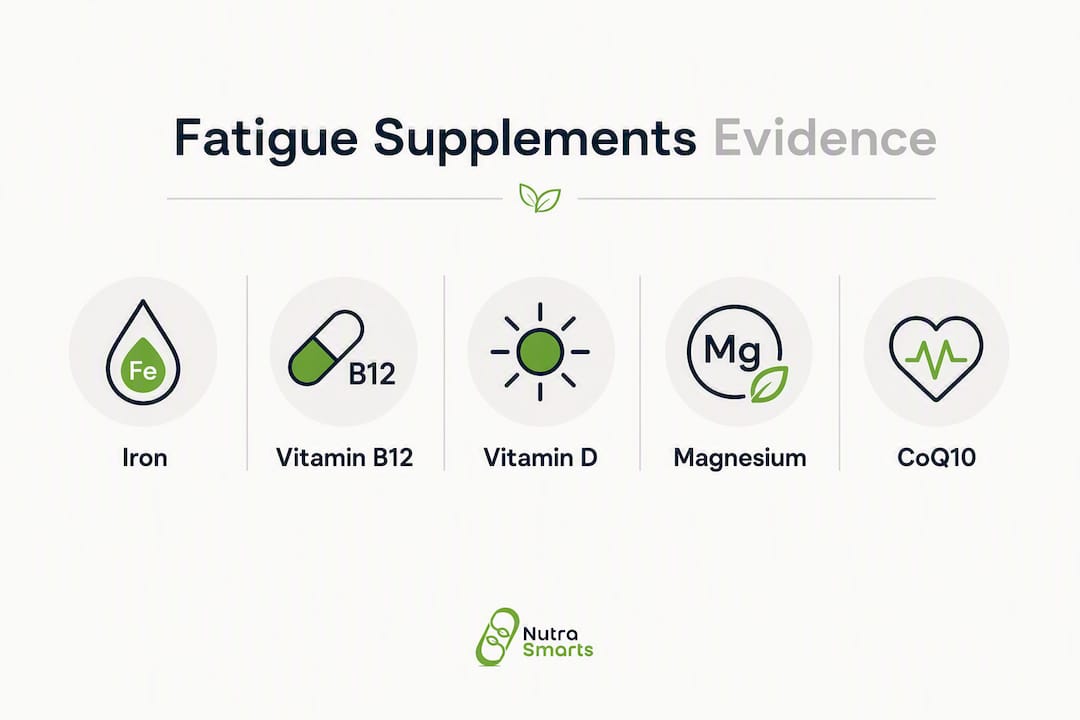
Understanding the mechanism matters. B-vitamins, iron, and magnesium act as raw materials for ATP production and only help when a deficiency exists. CoQ10 works at a different point in the chain, supporting mitochondrial electron transport. Choosing the wrong mechanism leads to failed supplementation trials and wasted money.
Iron
Iron carries oxygen in hemoglobin and myoglobin. Without adequate iron, cells cannot produce ATP efficiently, which is why iron-deficiency fatigue feels physical and cognitive at the same time. Clinical evidence shows iron supplementation reduces fatigue in non-anemic women with low ferritin, with most trials using ferritin thresholds of 30–50 ng/mL or lower as the entry criterion. The benefit is real, but so is the risk: iron overload causes organ damage, and supplementing without confirmed deficiency is genuinely dangerous.

Common forms: Ferrous bisglycinate (best GI tolerance), ferrous sulfate (most studied, cheapest), ferric iron (lower absorption). Typical starting dose: 25–100 mg elemental iron daily depending on severity; always confirm with a clinician.
Vitamin B12 and folate
B12 drives methylation and red blood cell maturation. Deficiency produces megaloblastic anemia, neurological symptoms, and profound fatigue. B12 supplementation helps when deficient, but taking high-dose B12 with normal levels produces no energy benefit. Folate and B12 work together in the methylation cycle, so a folate deficiency can mask or worsen B12-related problems. Vegans, older adults (who absorb B12 poorly due to reduced stomach acid), and people on metformin are at highest risk.

Common forms: Methylcobalamin or adenosylcobalamin (active forms, preferred over cyanocobalamin for people with MTHFR variants); 5-MTHF for folate rather than folic acid. Typical dose: 500–2,000 mcg B12 orally for deficiency; prescription injections for severe deficiency or malabsorption.
Vitamin D
Vitamin D receptors are present in nearly every tissue, including muscle and brain. Deficiency correlates strongly with fatigue, muscle weakness, and mood disruption. The NIH Office of Dietary Supplements defines deficiency as 25-OH D below 20 ng/mL and insufficiency as 20–29 ng/mL. Supplementation in deficient individuals consistently improves fatigue scores in clinical trials.
Common forms: Vitamin D3 (cholecalciferol) with vitamin K2 for cofactor support; D2 is less potent. Typical dose: 1,000–4,000 IU daily for insufficiency; higher doses (5,000+ IU) only under medical supervision with repeat labs. Upper limit per NIH guidance is 4,000 IU/day for adults without medical oversight.
Magnesium
Magnesium stabilizes the ATP molecule itself. Without it, ATP cannot be used by cells even when production is adequate. It also regulates sleep quality, muscle relaxation, and the stress response. Deficiency is common in people eating processed diets, and standard serum magnesium tests are notoriously insensitive (most magnesium is intracellular). The NIH notes that many Americans fall short of the recommended daily intake.
Common forms: Magnesium glycinate (best for sleep and tolerance), magnesium malate (preferred for muscle fatigue), magnesium citrate (widely available). Avoid magnesium oxide for fatigue; absorption is poor. Typical dose: 200–400 mg elemental magnesium daily.
B-complex
The full B-complex (B1/thiamine, B2/riboflavin, B3/niacin, B5/pantothenic acid, B6, B7/biotin, B9/folate, B12) collectively supports the Krebs cycle and electron transport chain. Deficiency in any single B vitamin creates a bottleneck in energy metabolism. A B-vitamin complex is a reasonable starting point for people with poor diet quality, high alcohol intake, or chronic stress, which depletes B vitamins rapidly.
Vitamin C and zinc
Both support mitochondrial function and immune response, and both are depleted by chronic stress. Their direct role in fatigue is secondary compared to iron or B12, but worth addressing if dietary intake is poor. Zinc deficiency specifically impairs thyroid hormone conversion, which can compound fatigue.
CoQ10 and mitochondrial adjuncts
CoQ10 is not a deficiency nutrient in the traditional sense, but meta-analysis data shows consistent fatigue score reductions with CoQ10 versus placebo in older adults, statin users, and people with chronic fatigue syndrome. Statins deplete CoQ10 by blocking the same pathway that produces it. Ubiquinol is the reduced, more bioavailable form and is preferred for people over 40 or those with absorption concerns. Ribose and creatine are lower-evidence adjuncts that support ATP regeneration in specific contexts like post-exertional fatigue.
Typical CoQ10 dose: 100–300 mg ubiquinol daily; effects build over 4–8 weeks.
Quick-reference table
| Nutrient | Test | Deficiency threshold | Common supplement forms | Starting dose range | Recheck interval |
|---|---|---|---|---|---|
| Iron | Ferritin, serum iron, TIBC | Ferritin <30–50 ng/mL | Ferrous bisglycinate, ferrous sulfate | 25–100 mg elemental iron/day | 8–12 weeks |
| Vitamin B12 | Serum B12, MMA, holoTC | B12 <200 pg/mL; elevated MMA | Methylcobalamin, adenosylcobalamin | 500–2,000 mcg/day oral | 8–12 weeks |
| Vitamin D | 25-OH vitamin D | <20 ng/mL (deficient); <30 ng/mL (insufficient) | D3 (cholecalciferol) | 1,000–4,000 IU/day | 8–12 weeks |
| Magnesium | Serum Mg (limited sensitivity) | <2 mg/dL serum; often clinical | Glycinate, malate, citrate | 200–400 mg elemental/day | 4–8 weeks |
| B-complex | Serum B12, folate, homocysteine | Varies by B vitamin | Activated B-complex (methylated forms) | Per product label | 8 weeks |
| CoQ10 | No standard clinical test | N/A (statin use, age >40 as proxy) | Ubiquinol | 100–300 mg/day | 8–12 weeks |
When correcting a deficiency will actually improve your fatigue
The single most important concept in this entire guide: supplementation benefits appear when correcting a deficiency; otherwise there is little to no benefit and potential harm from excess. Taking iron with normal ferritin does not give you more energy. It raises your risk of iron overload. The same logic applies to every nutrient on this list.
Scenarios where supplements reliably help:
- Confirmed ferritin below 30–50 ng/mL, with or without anemia (especially in menstruating people)
- Serum B12 below 200 pg/mL or elevated MMA confirming functional deficiency
- 25-OH D below 20 ng/mL, or below 30 ng/mL with symptomatic fatigue and muscle weakness
- Magnesium intake consistently below the recommended daily amount with fatigue, poor sleep, and muscle cramps
- Statin use with new-onset fatigue and muscle symptoms (CoQ10 depletion)
- Post-viral fatigue with confirmed mitochondrial stress markers
Scenarios where supplements usually won't help:
- Normal CBC, ferritin, B12, and vitamin D with fatigue that started after a period of poor sleep
- Untreated hypothyroidism (TSH elevated) — thyroid medication is the fix, not supplements
- Sleep apnea causing daytime exhaustion — no supplement corrects obstructed airflow
- Chronic stress or burnout without a measurable deficiency
- Depression or anxiety presenting as fatigue
The practical decision rule is straightforward: test, confirm, treat, then recheck. If labs are normal and fatigue persists, the next step is a conversation with your clinician about sleep, mental health, and other medical causes, not a larger supplement stack.
Key point: Vitamin D deficiency affects an estimated 41% of U.S. adults, making it one of the most prevalent correctable contributors to fatigue in the general population.
How to choose safe, effective supplement products and read labels correctly
Most supplement labels are designed to look impressive, not to be informative. A few specific skills let you cut through the noise quickly.
Label checklist:
- Check the serving size first. A product advertising "500 mg magnesium" may require four capsules to reach that dose.
- Find the elemental dose for minerals. Ferrous sulfate 325 mg contains only about 65 mg of elemental iron. The elemental amount is what matters clinically.
- Look for active forms. Methylcobalamin or adenosylcobalamin over cyanocobalamin for B12; ubiquinol over ubiquinone for CoQ10 in older adults; 5-MTHF over folic acid for folate if you have an MTHFR variant.
- Check for third-party verification. USP, NSF International, and ConsumerLab seals confirm that what is on the label is actually in the bottle at the stated dose.
- Avoid proprietary blends for therapeutic dosing. A blend that lists "Energy Matrix 450 mg" with five ingredients gives you no way to know if any single ingredient reaches an effective dose.
Common label traps:
Phrases like "supports energy" or "promotes vitality" are structure/function claims regulated by the FDA but not approved drug claims. They tell you nothing about whether the dose is therapeutic. A product can legally say "supports energy" with 10 mcg of B12 when the deficiency-correcting dose is 500–2,000 mcg.
For iron specifically, GI upset is the most common reason people stop supplementing before ferritin recovers. Ferrous bisglycinate causes significantly less nausea and constipation than ferrous sulfate at equivalent elemental doses. Magnesium glycinate has the same advantage over magnesium oxide. When GI tolerance is a concern, the form matters as much as the dose. You can read more about matching supplement form to clinical outcome before making a purchase decision.
Prescription or IV forms (IV iron, B12 injections) are indicated when oral absorption is compromised, such as in Crohn's disease, post-bariatric surgery, or pernicious anemia. These require medical supervision.
Pro Tip: Cross-check any product's elemental dose against the NIH Office of Dietary Supplements fact sheets for that nutrient before buying. Then use the Nutrasmarts Supplement Facts Tool to verify that the label is formatted correctly and that the stated dose aligns with evidence-based ranges. It takes about two minutes and catches most label errors.
How quickly do supplements work, and what should you monitor?
Setting realistic timelines prevents two common mistakes: stopping too early because you expect overnight results, and continuing too long without rechecking labs to confirm the deficiency is actually resolving.
Expected timelines by nutrient:
- B vitamins (B12, folate, B-complex): Neurological symptoms may begin improving in 2–4 weeks with oral supplementation; full recovery of nerve-related fatigue can take months in severe deficiency
- Magnesium: Sleep quality and muscle fatigue often improve within 2–6 weeks
- CoQ10: Fatigue score reductions in trials appear at 4–8 weeks; statin-related muscle fatigue may respond faster
- Iron: Subjective energy improvement typically begins around 4–6 weeks, but ferritin restoration takes 8–12 weeks of consistent supplementation
Monitoring schedule:
Recheck ferritin and iron studies after 8–12 weeks of iron supplementation. Recheck 25-OH D after 8–12 weeks at a therapeutic dose. For B12, recheck serum B12 and MMA at 8 weeks to confirm absorption and normalization. Track symptoms weekly using a simple fatigue scale (the Chalder Fatigue Scale or a personal 1–10 daily energy log works well).
Safety monitoring table:
| Nutrient | Earliest expected improvement | Recommended recheck | Key safety watch |
|---|---|---|---|
| Iron | 4–6 weeks (subjective) | 8–12 weeks (ferritin, CBC) | Stop if ferritin >100 ng/mL; watch for GI symptoms |
| Vitamin B12 | 2–4 weeks | 8 weeks (serum B12, MMA) | Generally safe; very high doses rarely cause acne or nerve symptoms |
| Vitamin D | 4–8 weeks | 8–12 weeks (25-OH D) | Upper limit 4,000 IU/day without medical supervision |
| Magnesium | 2–6 weeks | 4–8 weeks (clinical symptoms) | Loose stools at high doses; caution with kidney disease |
| CoQ10 | 4–8 weeks | 8–12 weeks (clinical symptoms) | Generally well tolerated; may lower blood pressure |
| B-complex | 2–4 weeks | 8 weeks (B12, folate, homocysteine) | B6 >100 mg/day long-term can cause peripheral neuropathy |
Safety bullets:
- Iron overload (hemochromatosis or supplementation-induced) causes liver, heart, and joint damage; never supplement iron without confirmed low ferritin and never exceed recommended doses without monitoring
- The tolerable upper intake level for iron in adults is 45 mg/day from the NIH Office of Dietary Supplements; therapeutic doses above this require clinical supervision
- Iron interacts with levothyroxine, fluoroquinolone antibiotics, and tetracyclines; separate doses by at least two hours
- Magnesium at high doses can cause diarrhea and, in people with kidney disease, dangerous hypermagnesemia; the NIH sets the tolerable upper intake for supplemental magnesium at 350 mg/day for adults
- Vitamin D toxicity (hypercalcemia) is rare at doses below 4,000 IU/day but becomes a real risk above 10,000 IU/day without monitoring
Symptoms and lab results that require urgent medical evaluation
Some fatigue is a symptom of something that supplements cannot and should not treat alone. Knowing when to stop self-managing and call a doctor is as important as knowing which supplements to take.
Go to urgent care or the emergency room immediately for:
- Syncope (fainting) or near-fainting with fatigue
- Chest pain, palpitations, or severe shortness of breath accompanying fatigue
- Rapidly progressing muscle weakness, especially if asymmetric
- Signs of active bleeding (blood in stool, heavy unexpected bleeding)
- Jaundice (yellowing of skin or eyes) with fatigue
- Unexplained weight loss of 10+ pounds over weeks to months
Schedule a prompt primary care visit (within days, not weeks) for:
- Hemoglobin below 8 g/dL on CBC
- Ferritin above 300 ng/mL with abnormal liver function tests (possible hemochromatosis or liver disease)
- TSH above 10 mIU/L or below 0.1 mIU/L
- Fasting glucose above 126 mg/dL or HbA1c above 6.5%
- Creatinine or BUN significantly outside normal range
- hsCRP markedly elevated without obvious explanation
Seek specialist evaluation for:
- Persistently low hemoglobin despite iron supplementation (hematology)
- Confirmed or suspected hemochromatosis (hematology or gastroenterology)
- Thyroid abnormalities not resolving with standard treatment (endocrinology)
- Fatigue with fever, night sweats, and lymphadenopathy (infectious disease or oncology)
Fatigue that does not respond to correcting confirmed deficiencies after 12 weeks of consistent supplementation and monitoring warrants a full medical reassessment, not a larger supplement stack.
How Nutrasmarts' symptom-to-supplement tool helps you map fatigue to evidence-rated options
Most people searching for fatigue-fighting supplements start with a symptom, not a lab result. The Nutrasmarts symptom-to-supplement search is built for exactly that starting point. You enter your symptom cluster, and the tool maps it to the most probable nutrient deficiencies, evidence-rated ingredient profiles, and suggested supplement forms with dosing ranges.
How the workflow looks in practice:
- Enter "persistent low energy + heavy periods" and the tool surfaces ferritin as the high-probability deficiency, flags iron-form options (ferrous bisglycinate over ferrous sulfate for tolerance), and links to the clinical evidence behind that recommendation
- Each ingredient profile includes peer-reviewed citations, so you can see the actual trial data rather than a marketing summary
- The side-by-side ingredient comparison tool lets you evaluate two forms of the same nutrient (ubiquinol vs ubiquinone, methylcobalamin vs cyanocobalamin) on bioavailability, evidence strength, and typical dose
Why this beats guessing:
Generic supplement stacks sold as "energy formulas" rarely contain therapeutic doses of any single nutrient. The Nutrasmarts database covers over 1,300 evidence-rated ingredient profiles, each tied to clinical trial citations. That means you can verify whether a product's dose of, say, magnesium glycinate actually matches what the trials used, rather than trusting the label's "supports energy" claim.
The tool is designed to complement clinician input, not replace it. Use it to prepare for your appointment: identify the most likely deficiencies based on your symptoms, print the relevant ingredient profiles, and bring them to your clinician alongside your lab results. That conversation goes faster and produces better outcomes than arriving with a bag of supplements and no data.
For label verification, the free Supplement Facts Tool lets you check whether a product's declared doses are formatted correctly and fall within evidence-based ranges, which is particularly useful when comparing products with similar claims.
Key Takeaways
Deficiency-driven fatigue responds to targeted supplementation only when a confirmed deficiency exists; testing first is the non-negotiable foundation of any effective supplement plan.
| Point | Details |
|---|---|
| Test before supplementing | Order CBC, ferritin, B12/MMA, 25-OH D, and TSH before starting any fatigue supplement. |
| Match supplement to mechanism | Iron corrects oxygen transport deficits; B12 addresses methylation; CoQ10 supports mitochondrial electron transport. |
| Set realistic timelines | Iron takes 8–12 weeks to restore ferritin; B vitamins and magnesium may show improvement in 2–6 weeks. |
| Monitor and recheck labs | Recheck ferritin and 25-OH D at 8–12 weeks; stop iron if ferritin exceeds 100 ng/mL. |
| Use Nutrasmarts for evidence mapping | Nutrasmarts' symptom-to-supplement tool maps fatigue symptoms to evidence-rated ingredient profiles and suggested tests. |
The case for measurement over intuition
The supplement industry has a persistent problem: it sells the feeling of doing something productive. A bottle of B12 or a "mitochondrial support" blend feels like a solution, and that feeling is powerful enough that most people never stop to ask whether their levels were actually low in the first place.
The evidence is clear on this point. Supplementing a nutrient you are not deficient in does not improve energy. It adds cost, and in the case of iron, it adds real risk. The people who benefit most from fatigue-focused supplementation are the ones who test first, identify a specific gap, and then treat that gap with a form and dose that matches the clinical evidence.
What gets underestimated is how often the answer is not a supplement at all. Sleep apnea, subclinical hypothyroidism, and blood sugar dysregulation are among the most common causes of chronic fatigue in otherwise healthy adults, and none of them respond to a supplement stack. The testing-first approach does not just make supplementation safer; it also catches the conditions that need actual medical treatment.
Nutrasmarts is built around this philosophy. The tools exist to help you move from symptom to evidence to informed decision, not to sell you the largest possible stack. Use them as part of a structured plan that includes labs and clinician collaboration, and you will get measurably better results than guessing.
Nutrasmarts gives you the evidence layer that most supplement research is missing
Sorting through supplement options for fatigue is genuinely difficult when most products make the same vague claims and most articles stop at "consider taking B12." Nutrasmarts goes further by giving you the clinical evidence behind each ingredient, the dosing ranges from actual trials, and a symptom-driven search that maps your specific fatigue pattern to the most probable deficiencies.
The supplements by symptom search lets you enter your exact symptom cluster and get back evidence-rated ingredient profiles with peer-reviewed citations, not marketing copy. If you want to verify a product you already own, the free Supplement Facts Tool checks whether the label's declared doses match evidence-based ranges and FDA formatting requirements. Both tools are free, browser-based, and built for people who want to make informed decisions rather than expensive guesses. Start with your symptoms, confirm with labs, and use Nutrasmarts to connect those two data points.
Useful sources
The following sources were used in preparing this guide. Clinicians considering higher-risk interventions such as IV iron or prescription B12 injections should consult the full-text versions of the systematic reviews and NIH fact sheets before proceeding.
- PMC: Nutrients and Fatigue — Systematic Review — Peer-reviewed review covering iron, B12, vitamin D, and magnesium in fatigue; includes trial data on non-anemic iron deficiency and safety thresholds.
- Harvard Health: Best Vitamins and Minerals for Energy — Authoritative overview of when supplementation helps versus when it does not; key source for the deficiency-versus-enhancement distinction.
- Health.com: Top Supplements to Combat Fatigue — Consumer-facing summary of B12, CoQ10, iron, magnesium, and adjunct supplements with trial context.
- WebMD: Can Supplements Improve Your Energy? — Practical safety and dosing guidance for common fatigue supplements.
- NIH Office of Dietary Supplements: Iron — Primary source for iron upper intake levels, forms, and safety guidance.
- NIH Office of Dietary Supplements: Magnesium — Primary source for magnesium tolerable upper intake and deficiency thresholds.
- NIH Office of Dietary Supplements: Vitamin B12 — Authoritative reference for B12 deficiency criteria, forms, and population risk groups.
- NIH Office of Dietary Supplements: Vitamin D — Health professional fact sheet covering 25-OH D thresholds, supplementation dosing, and upper limits.
This article is general information, not medical advice. Confirm current dosing guidelines and your individual lab thresholds with a qualified clinician or pharmacist before starting any supplement regimen.