
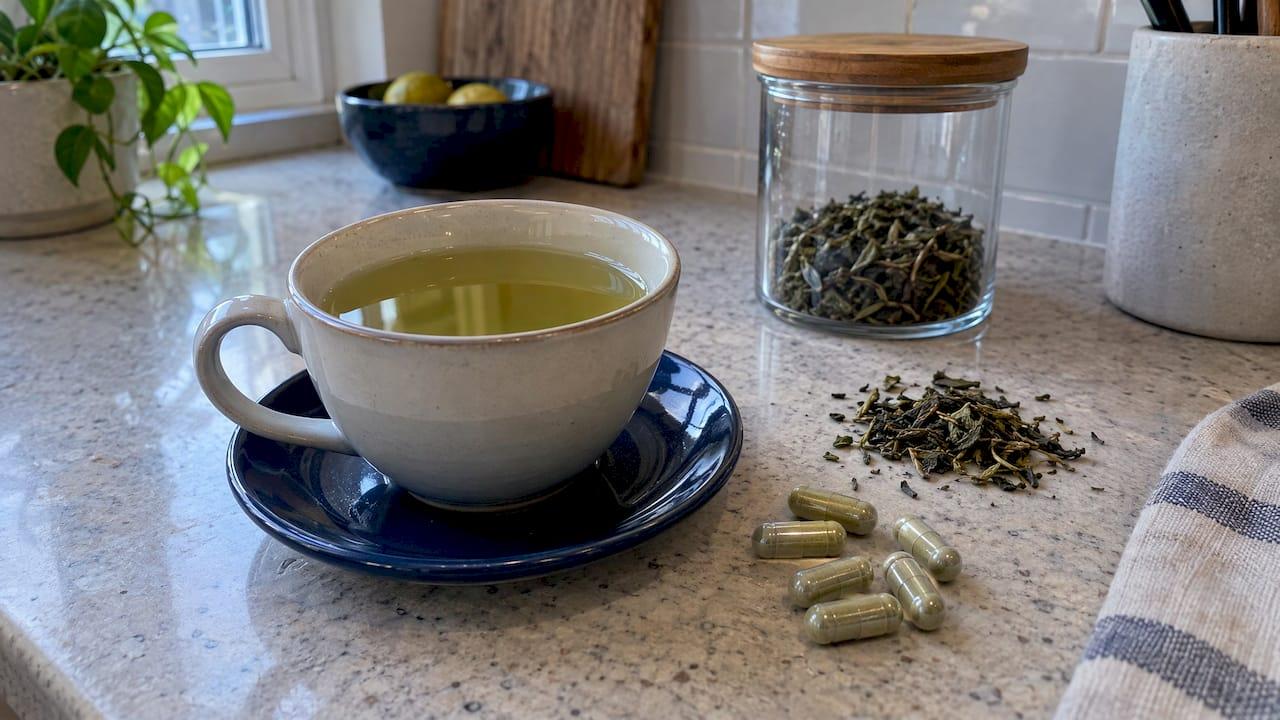
Green tea extract can cause liver injury in a small number of people. The risk comes mainly from concentrated capsules and tablets, not from brewed tea, and it rises with high EGCG doses (EGCG is the main catechin in green tea), with fasting and possibly with your genes. Injury is uncommon, but when it happens it can be serious. Knowing the numbers, the risk factors and the warning signs lets you decide with open eyes. Our EGCG ingredient profile lays out the dosage research and its evidence rating in one place.
TL;DR
- Liver injury from green tea products is uncommon, and it has been reported mainly with extracts in tablet or capsule form, not with brewed tea.
- EGCG is the catechin tied to the injury. Case reports span roughly 140 mg to about 1,000 mg a day, and intakes above 800 mg a day or long-term use carry the most concern.
- Taking extract on an empty stomach raises how much EGCG reaches your blood, which is a recognized risk factor. Take it with food.
- Dark urine, yellowing of the skin or eyes, belly pain on the upper right, unusual fatigue or nausea mean you stop and call a clinician.
- If you have a liver condition, ask your doctor before using any green tea extract.
Table of Contents
- What the evidence says about green tea extract and the liver
- How much EGCG is too much?
- What raises your risk
- Brewed tea versus concentrated extract
- Warning signs and what to do
- A checklist before you take green tea extract
- Promo: check the evidence before you buy
- Our perspective
- FAQ
- Sources
What the evidence says about green tea extract and the liver
The evidence is a mix of case reports, a few controlled trials and toxicology work. The National Center for Complementary and Integrative Health (NCCIH, part of the NIH) states that liver injury, although uncommon, has been reported in people using green tea products, primarily extracts in tablet or capsule form.
The NIH's LiverTox database, which catalogs drug and supplement liver injury, reaches a similar balance. Given how widely green tea and its extract are consumed, it describes liver injury from green tea as rare. It also advises that people who developed acute liver injury from green tea extract should avoid re-exposure and steer clear of supplements that might contain it.
A review of herbal and dietary supplement liver injury notes that green tea extract and several other products tend to cause an acute, hepatitis-like injury rather than a slow, silent one. That pattern is why symptoms matter so much, and we cover them below.
Why EGCG is the suspect
A United States Pharmacopeia (USP) review of green tea extract safety concluded that EGCG is the main constituent implicated in liver toxicity, and that toxicology studies show it can injure the liver. Researchers do not fully understand the mechanism. Proposals include mitochondrial stress from reactive oxygen species and interactions between EGCG and cytochrome P450 enzymes, the liver's main system for processing foreign compounds.
What a controlled trial found
The clearest human signal comes from a Minnesota trial in postmenopausal women. In a clinical summary of that study, women taking green tea extract were 7 times more likely to have raised ALT than those on placebo. ALT (alanine aminotransferase) is a liver enzyme that leaks into the blood when liver cells are stressed. A rise on a blood test is an early sign, often before you feel anything.
How much EGCG is too much?

There is no single line that separates safe from unsafe for everyone. The USP review found that case reports tied green tea extract liver injury to EGCG intakes from 140 mg to about 1,000 mg per day. The same review says damage may occur after high quantities (over 800 mg) or after long periods of use.
That gives you three practical points:
- 800 mg of EGCG a day is the number to stay well under. It is where the clinical concern concentrates, not a guaranteed safe ceiling below it.
- Some reports involve lower doses. Individual susceptibility varies widely, so a smaller dose is not a guarantee.
- Duration counts. Months of daily high-dose use is a different exposure from a few cups of tea.
Read the label for EGCG, not just "green tea extract"
A capsule labeled "500 mg green tea extract" tells you little. The extract might be 50% EGCG or 90%, and it might be decaffeinated or standardized to total catechins. Add up the EGCG across every product you take. Weight-loss blends, pre-workouts and "fat burner" formulas often contain green tea extract alongside a standalone green tea capsule, and the doses stack.
Our EGCG profile and green tea profile list dosage benchmarks with the clinical research behind them, so you can compare a label against the studies instead of against marketing copy. If you want to see how branded catechin extracts differ, the Phytofare and PurTea pages cover each one separately.
What raises your risk
Taking it on an empty stomach
The USP review identifies repeated bolus doses of extract while fasting as a risk factor. Taking green tea extract on an empty stomach significantly increases the bioavailability of EGCG, meaning more of it reaches your bloodstream. That is why USP's labeling requirement for powdered decaffeinated green tea extract says to take it with food.
In practice: take a capsule with a meal, not first thing with black coffee, and do not take several capsules at once on an empty stomach.
Your genes
Susceptibility differs sharply between people. NCCIH notes that people with a specific variant of a gene involved in immune function appear especially susceptible to green tea product-related liver injury. Researchers at Rutgers reported in 2022 that early signs of liver damage from high-dose extract were somewhat predicted by one gene variation. You cannot see your genotype from a label, which is a strong reason to keep doses modest and watch for symptoms. Ongoing work, including clinical trials and pharmacokinetic studies, continues to examine the genetic basis and the safety thresholds for EGCG.
Stacking products and existing liver problems
Two more situations deserve caution. First, taking several products that each contain green tea extract. Second, having a liver condition or taking other medicines or supplements that the liver also has to process. USP's cautionary label says not to use green tea extract if you have a liver problem. If that describes you, your hepatologist or primary care doctor is the person to ask before you start.
For a wider look at how supplement categories compare on liver safety, our guide to fatty liver supplements, doses and safety walks through the dosing and the evidence. Our kava case report review shows how we read case reports for another ingredient with a liver signal.
Brewed tea versus concentrated extract
A cup of brewed green tea contains far less EGCG than a high-dose capsule. Published estimates put a cup at roughly 50 to 100 mg of EGCG depending on the leaf and brewing, so reaching 800 mg from tea alone would take many cups. The injury reports in the literature concentrate on extracts, which is also the conclusion of NCCIH. A large observational analysis of liver biomarkers in adults found that green tea consumption was associated with lower odds of abnormal liver biomarkers.

So drinking green tea in moderation is a different exposure from a concentrated capsule. Matcha is made from the whole ground leaf, so it delivers more catechins per serving than steeped tea, which is a reason to treat it as a modest daily food, not as something to take in large amounts.
Warning signs and what to do
Stop taking the product and contact a doctor if you notice any of these:
- Dark, tea-colored urine
- Yellowing of the skin or the whites of the eyes (jaundice)
- Pain or discomfort in the upper right of the abdomen
- Unusual tiredness, nausea, vomiting or loss of appetite
- Pale stools or persistent itching
USP's labeling requirement for green tea extract says to discontinue use and consult a healthcare practitioner if symptoms of liver trouble develop. Tell the clinician exactly which products you took and how much. Severe symptoms, such as confusion, heavy jaundice or intense abdominal pain, call for urgent care or emergency services.
The same logic applies to any weight-loss or fat-burner product. This guide to weight loss supplement red flags covers the label warning signs worth knowing before you buy.
A checklist before you take green tea extract
- Find the EGCG amount per serving. If the label gives only "extract," you cannot judge the dose.
- Total it across products. Include weight-loss blends and pre-workouts.
- Take it with food, not fasting.
- Keep the daily total well under 800 mg of EGCG.
- Know your own risk. A liver condition, heavy alcohol use or other liver-processed medicines are reasons to talk to your doctor first.
- Know the stop signs above and act on them.
- Schedule a blood test if you plan long-term use, and ask your clinician about checking liver enzymes.
Promo: check the evidence before you buy
NutraSmarts is a free, research-backed ingredient database with 1,300+ evidence-rated profiles, clinical trial citations and dosage benchmarks, with no sign-up or paywall. You can look up EGCG, green tea and related catechin extracts, then put them side by side in the compare tool, or start from a health concern in supplements by symptom.
If you formulate products, the free browser-based Supplement Facts label creator builds FDA-compliant labels without spreadsheets, so the EGCG amount per serving is stated clearly for the people who read it.
Our perspective
Liver safety is exactly where a supplement database should earn its keep. The honest picture of green tea extract is not "toxic" and not "harmless": it is a dose, a context and a person. Case reports span a wide EGCG range, the trial signal is real, and the individual variability means no label can promise you are in the clear.
That is why we rate evidence instead of selling it, and why every profile pairs benefits with dosage benchmarks and the clinical citations behind them. When you can see the EGCG amount, the studies and the safety signals together, you can set a sensible daily total, keep it with food and recognize a problem early. Our comparison tool and symptom search exist so you can weigh ingredients on the same evidence footing, whether you are choosing a product or formulating one.
NutraSmarts
FAQ
Is it safe to take green tea extract daily?
For many people, moderate doses taken with food appear tolerated, but safety depends on the EGCG amount, how long you take it and your own susceptibility. Case reports of liver injury cover a wide range of intakes, and the concern grows above 800 mg of EGCG a day or with long-term use. If you have a liver condition, ask your doctor first.
Can drinking green tea or matcha damage your liver?
The injury reports center on concentrated extracts in capsules and tablets, not on brewed tea. A cup of tea contains much less EGCG than a high-dose capsule. Matcha is more concentrated than steeped tea because you consume the whole leaf, so keep it to moderate servings.
Why does taking it on an empty stomach matter?
Fasting increases how much EGCG your body absorbs. USP's cautionary label for green tea extract says to take it with food, and repeated bolus doses on an empty stomach are named as a risk factor.
What should I do if I think green tea extract hurt my liver?
Stop taking it and contact a healthcare practitioner. Bring the product label and tell them how long you used it. Dark urine, jaundice, severe abdominal pain or confusion need urgent medical attention.
Sources
- Green Tea: Usefulness and Safety, NCCIH
- Liver Injury from Herbal and Dietary Supplements, PMC
- USP comprehensive review of green tea extract safety, PMC
- Herbal and dietary supplement induced liver injury, PMC
- Drug-Induced Liver Injury in GI Practice, PMC
- The Safety and Efficacy of Dietary Epigallocatechin Gallate, PMC
- Liver biomarkers in adults and green tea consumption, PubMed
- Weight Loss Supplement Red Flags List