
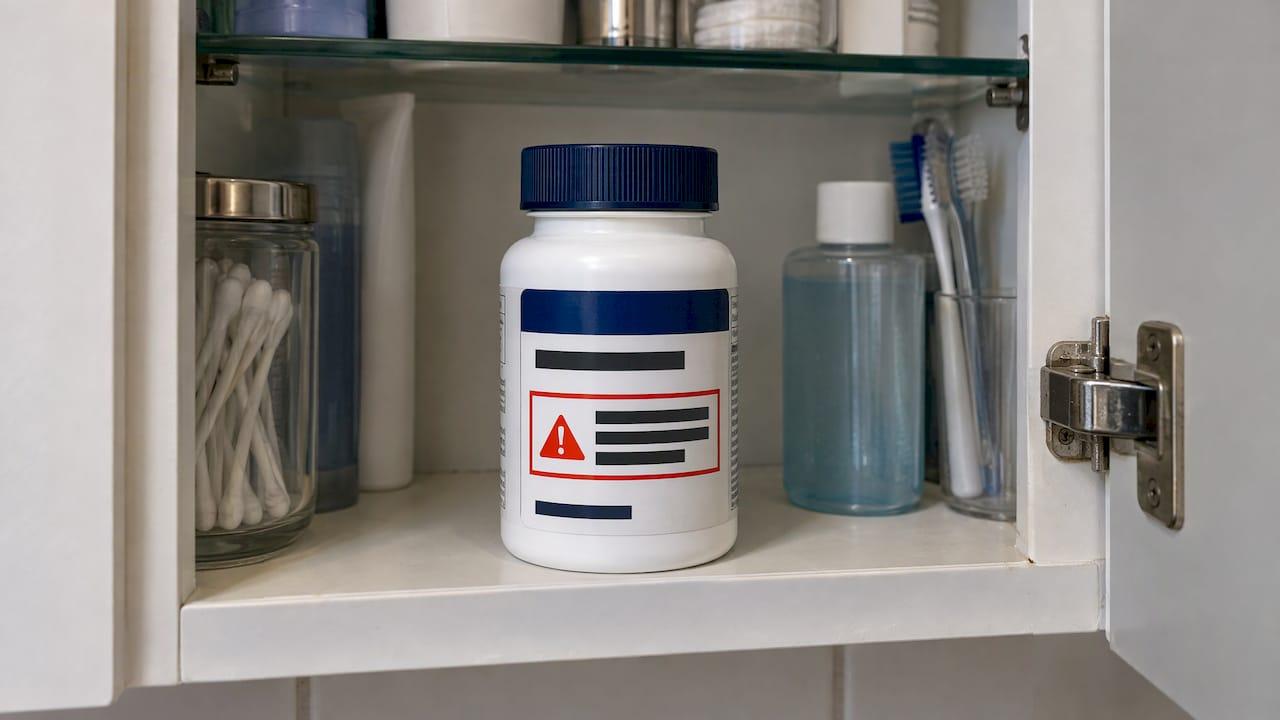
Every iron supplement sold as a tablet, capsule or caplet in the United States must carry one fixed, boxed warning: accidental overdose of iron-containing products is a leading cause of fatal poisoning in children under 6. The wording cannot be changed, and it exists because iron is one of the few nutrients that can seriously poison a small child in a single accident. This guide gives you the exact text, the products it covers, where it must appear, how to read the iron amount beside it, and what to do if a child gets into the bottle.
TL;DR
- The FDA requires the same warning, word for word, on iron-containing dietary supplements and drugs in solid oral form: tablets, capsules and caplets.
- The warning must be boxed, prominent and on the container's information panel, and on the outer package if there is one.
- The Supplement Facts panel lists elemental iron, which is a smaller number than the weight of the iron compound, so read "Iron (as ferrous sulfate)" carefully.
- Store iron like medicine: tightly closed, locked and out of reach. If a child may have swallowed some, call Poison Control at 1-800-222-1222 right away.
- Formulators: the warning is a separate label element from the Supplement Facts panel, with its own placement rules.
Table of Contents
- The exact warning text
- Which products must carry it
- Where the warning must appear on the package
- Why the warning is so blunt
- Child-resistant packaging is a separate rule
- Reading the iron amount: elemental iron versus the compound
- Storing and using iron around children
- If a child may have swallowed iron
- Our perspective
- Make the label work for you
- FAQ
- Sources
The exact warning text
The required statement is set out in the federal food labeling rule, 21 CFR 101.17(e). It reads:
WARNING: Accidental overdose of iron-containing products is a leading cause of fatal poisoning in children under 6. Keep this product out of reach of children. In case of accidental overdose, call a doctor or poison control center immediately.
Three sentences, each doing a job. The first names the hazard, the second tells you what to do before anything happens, and the third tells you what to do after.
The FDA's Dietary Supplement Labeling Guide says manufacturers may not deviate from this text. A brand cannot soften it, shorten it or reword it to sound friendlier. If you see a version that reads differently, it is not the version the rule prescribes.
Which products must carry it
The rule applies by product form, not by brand or by how much iron is inside. According to the FDA's Small Entity Compliance Guide (October 2003), the warning goes on:
- Dietary supplements that contain iron or iron salts in solid oral dosage form: tablets, capsules and caplets.
- Drug products with elemental iron or iron salts as an active ingredient in the same forms.
That includes more than single-ingredient iron pills. A prenatal multivitamin, a women's multivitamin or a children's chewable with iron in the formula falls under the same requirement when iron is added as an iron source.
The guide lists one exception: the inert iron tablets in monthly oral contraceptive packages. It also notes that liquid and powder iron products are not covered by this particular statement. That is a point about the labeling rule, not about safety. A liquid or powder iron product still contains iron, and the same storage habits apply.
For drugs, the matching rule is 21 CFR 310.518, which uses the same boxed warning for iron-containing drug products in solid oral form.
Where the warning must appear on the package
Wording is only half of compliance. Placement rules decide whether a label passes. Pulling together the FDA's labeling guide and the drug regulation, the warning must be:
- Prominent and conspicuous. It cannot be tucked into fine print where nobody will see it.
- Set off in a box using hairlines. A hairline is a very thin rule, so the statement sits inside a thin-lined box.
- On the information panel of the immediate container. That is the panel the consumer sees when reading the bottle or pouch, usually next to the Supplement Facts.
- On any labeling that contains warnings, so it is not buried when other cautions appear elsewhere.
- On the outer package when the product comes in a carton or box.
For drug products, the same boxed statement is required on the immediate container, on warning-bearing labeling and, where applicable, on the retail package.
Blister packs, pouches and sachets
Unit-dose packaging, where each serving sits in its own blister or packet, has a special instruction. The FDA's compliance guide says the warning must go on the unit-dose packaging in a way that maximizes the likelihood it stays intact until all the doses are used. Printing it several times is allowed, so that at least one complete copy survives after the first packets are torn off.
This is the detail that trips up small brands. A warning printed once on the back of a 30-pouch box is gone from the pouches themselves by day two.
A note for formulators building labels
The iron warning is separate from the Supplement Facts panel, so it has to be planned alongside it, along with the other required elements on the panel. If you are building a panel, our free Supplement Facts label creator generates the panel in your browser, and our FDA supplement label requirements checklist walks through the other required label elements. For type size and layout questions around boxed statements, see our guide to supplement label font requirements.
Why the warning is so blunt
Iron is essential, and most adults need it. The same mineral becomes dangerous in quantity. The NIH Office of Dietary Supplements states that extremely high doses, in the hundreds or thousands of milligrams, can cause organ failure, coma, convulsions and death. It also says child-proof packaging and warning labels on iron supplements have greatly reduced accidental iron poisonings in children.
A young child does not need to swallow much to be in trouble, because the dose that matters is measured per kilogram of body weight. The MSD Manual's iron poisoning entry (updated April 2025) describes the pattern clinicians use: up to 20 mg of iron per kg of body weight is not toxic, 20 to 60 mg/kg is mildly to moderately toxic, and above 60 mg/kg can cause severe symptoms. A toddler weighing about 12 kg crosses the 20 mg/kg line at around 240 mg of elemental iron. Many common iron tablets hold 65 mg, so a handful of tablets is enough to reach that range. That is a worked illustration of the arithmetic, not a guide for judging a situation at home: with a suspected ingestion, you call Poison Control, you do not calculate.

This is why the label is blunt and why it is the same on every bottle. Prevention is the whole strategy.
Child-resistant packaging is a separate rule
The warning label and child-resistant packaging are two different requirements from two different agencies, and people often blur them.
The FDA once required unit-dose packaging for iron supplements. According to the FDA's labeling guide, it revoked that regulation (21 CFR 111.5) on October 17, 2003, after a federal appeals court ruled the agency lacked authority to require it. What remains on the FDA side is the single mandatory warning plus the placement rules above.
Child-resistant packaging is handled under the Poison Prevention Packaging Act, enforced by the Consumer Product Safety Commission (CPSC). In April 2026, the CPSC announced a recall of about 356,140 units of iron-containing supplements sold under several brands, because the packaging was not child-resistant. The CPSC told consumers to keep the products out of children's reach and to contact the firm for a free child-resistant cap or storage pouch.
The lesson for a shopper: the boxed warning tells you the risk, and the cap or pouch is a second layer of defense. Both should be there. When you buy iron, check the packaging as well as the label, and keep checking recall notices from the CPSC for products you already own.
Reading the iron amount: elemental iron versus the compound
The warning is about iron overall, but the number on the Supplement Facts panel is easy to misread. Panels list the amount of elemental iron, meaning the actual iron, followed by the compound it comes from, such as ferrous sulfate, ferrous gluconate or ferrous fumarate. The compound weighs more than the iron inside it.
A DailyMed listing for a ferrous sulfate 325 mg tablet shows the pattern: the product contains 325 mg of ferrous sulfate, equal to 65 mg of elemental iron, and the panel reads "Iron (as ferrous sulfate) 65 mg" at 361% of the Daily Value. The Daily Value is the benchmark the FDA uses to express a nutrient as a percentage of a typical daily need, which is why 65 mg shows up as a number several times over 100%.
The Consumer Medicines Safety guide on confusing iron labels gives these equivalents:
| Compound on the label | Compound weight | Elemental iron |
|---|---|---|
| Ferrous sulfate | 325 mg | 65 mg |
| Ferrous gluconate | 240 mg | 27 mg |
| Ferrous fumarate | 325 mg | 106 mg |
The same source notes that this mix-up causes dosing errors, even among healthcare providers, since iron is often prescribed as ferrous sulfate while the panel lists elemental iron. Its advice is practical: ask your doctor for your dose in both forms, and confirm the number of tablets with your pharmacist.
When two labels disagree, check which number you are comparing. Our ingredient profiles for ferrous sulfate and ferrous bisglycinate show the form, dosing research and evidence notes side by side, and our iron bisglycinate vs ferrous sulfate comparison explains how the forms differ. If you are choosing between products, the best iron supplements ranking applies the same elemental-iron reading to each.

Storing and using iron around children
The label says "keep out of reach." In a real home that needs to be specific.
- Lock it up. MedlinePlus advises keeping iron products tightly closed and out of children's reach, with safety caps locked. A high shelf is not a lock. Children climb.
- Keep the original container. The cap, the warning and the Poison Control guidance are all there. Moving tablets to a pill organizer on the kitchen counter removes all three.
- Watch the purse and the nightstand. Visitors' bags, grandparents' pill boxes and prenatal vitamins by the bed are common sources of accidents.
- Treat gummies and chewables like candy hazards. Anything a child might mistake for a treat belongs out of sight and locked, whatever the flavor.
- Look at multivitamins too. If the Supplement Facts list iron, the same care applies.
If you take iron on a schedule, build the storage into the routine: take the dose, close the cap until it clicks, return the bottle to the locked place. Our article on taking iron every other day covers how dosing schedules affect absorption. If you also take calcium, the timing of each supplement matters, and a guide on when to take calcium for better absorption helps you plan the day.
If a child may have swallowed iron
Act first, and do not wait for symptoms. The label's third sentence says to call a doctor or poison control center immediately, and MedlinePlus gives the number: 1-800-222-1222. Call 911 instead if the child has collapsed, had a seizure, has trouble breathing or cannot be awakened.
Symptoms of an overdose include stomach pain, vomiting and diarrhea, but the absence of symptoms in the first hour is not a reason to wait. Have the bottle on hand when you call, so you can say the product, the iron amount per tablet and roughly how many are missing.
Do not try to make the child vomit unless Poison Control tells you to. In serious cases, hospitals treat iron poisoning with intravenous deferoxamine, according to the MSD Manual, which is another reason a fast call matters: the treatment is for the hospital, and the first step is yours.
Our perspective
Most people meet the iron warning as a box they stop reading after the first time. We think it deserves a second look, because it holds the clearest evidence-based message on any supplement shelf: a specific hazard, a specific population and a specific action.
The harder part of reading an iron label is the number. Elemental iron against compound weight is a point on which even clinicians trip, which is why we show the form, the dose benchmark and the cited studies together on each ingredient profile. Our database covers 1,300+ ingredients with PubMed-cited evidence and clinical dosage benchmarks, so a figure like 65 mg comes with context instead of standing alone.
For people who make products, the same logic applies in reverse. A compliant label is a structured document, and we built the Supplement Facts tool so you can create one in the browser, free, without wrestling with spreadsheets.
NutraSmarts
Make the label work for you
If you are reading an iron label to decide what to take, start with our deficiency guide, which lists symptoms and risk groups, or the deficiency risk by group page for pregnancy and older adults. To weigh two forms or products against each other, use the side-by-side comparison tool.
If you are bringing a product to market, our free Supplement Facts label creator is a FDA-compliant, browser-based tool with no sign-up and no paywall.
FAQ
Does every iron supplement need the warning?
Every iron-containing dietary supplement in solid oral form, meaning tablets, capsules and caplets, must carry it when iron or iron salts are in the product as an iron source. The FDA's compliance guide exempts only the inert iron tablets in monthly oral contraceptive packages. Liquid and powder products fall outside this specific statement.
Can a brand change the wording of the warning?
No. The FDA's labeling guide says manufacturers may not deviate from the prescribed text. It must also sit in a box set off by hairlines and appear prominently on the information panel of the immediate container and on the outer package if there is one.
Why does the label say 65 mg when the tablet is 325 mg?
The 325 mg is the weight of the ferrous sulfate compound, and 65 mg is the elemental iron it contains. Supplement Facts panels list elemental iron, so the two numbers describe the same tablet in different ways. Ask your doctor which form their dose refers to.
What should I do if my child ate an iron tablet?
Call Poison Control at 1-800-222-1222 right away, and call 911 if the child has collapsed, had a seizure, has trouble breathing or cannot be awakened. Keep the bottle with you for the call.
Is the warning the same as child-resistant packaging?
No. The warning is an FDA labeling requirement, while child-resistant packaging falls under the Poison Prevention Packaging Act enforced by the CPSC. A safe product has both, and you should still store it locked and out of reach.
Sources
- FDA Small Entity Compliance Guide: Label Warning Statements for Iron-Containing Supplements and Drugs
- eCFR, 21 CFR 101.17 Food labeling warning, notice, and safe handling statements
- eCFR, 21 CFR 310.518 Drug products containing iron
- FDA Dietary Supplement Labeling Guide, Chapter VIII
- NIH Office of Dietary Supplements, Iron Consumer Fact Sheet
- MedlinePlus, Iron Supplements
- MSD Manual Professional Edition, Iron Poisoning
- CPSC, April 2026 recall of iron-containing dietary supplements
- Consumer Medicines Safety, Confusing Labels on Iron Supplements
- DailyMed, Ferrous Sulfate 325 mg tablet