

The FDA disclaimer requirement for dietary supplements is defined under 21 CFR 101.93 as a mandatory, verbatim statement that must appear on every label panel bearing a structure/function claim. Any product that states it "supports immune health" or "promotes joint flexibility" must carry this exact disclosure. The requirement exists because structure/function claims describe how a nutrient affects the body, not whether it treats a disease. Without the disclaimer, consumers could reasonably confuse a supplement's marketing language with a medical claim. Understanding this distinction is the foundation of supplement labels regulations compliance for any brand operating in the U.S. market.
What is the exact FDA disclaimer text for supplements?
The FDA mandates verbatim disclaimer wording on all dietary supplement labels bearing structure/function claims. No paraphrasing, abbreviation, or creative rewording is permitted. The regulation specifies two approved versions depending on how many claims appear on the label.
For a single structure/function claim, the required text is:
- "This statement has not been evaluated by the Food and Drug Administration. This product is not intended to diagnose, treat, cure, or prevent any disease."
For labels bearing multiple structure/function claims, the FDA allows a slight grammatical variation:
- "These statements have not been evaluated by the Food and Drug Administration. This product is not intended to diagnose, treat, cure, or prevent any disease."
The shift from "This statement" to "These statements" is the only permitted modification. Brands that substitute words like "claims" for "statements," or drop the phrase "diagnose, treat, cure, or prevent," are in direct violation of 21 CFR 101.93. The precision requirement exists because the FDA treats the disclaimer as a legal boundary between supplement marketing and drug claims. Altering even one word can expose a brand to FDA warning letters and potential product seizure.
Pro Tip: Review every proof of your label against the exact regulatory text character by character. A single word substitution can trigger a warning letter that halts your product launch.
How and where must the disclaimer appear on supplement labels?
Placement is where most brands run into trouble. The FDA requires the disclaimer to appear immediately adjacent to each structure/function claim, with no intervening text, images, or design elements between the claim and the disclaimer. "Adjacent" means directly next to or directly below the claim on the same panel.

The panel-by-panel rule is one of the most misunderstood aspects of FDA guidelines for supplements. The FDA mandates the disclaimer appear on every label panel bearing a claim, not just once on the back. A disclaimer printed only on the back panel does not satisfy the requirement if a structure/function claim also appears on the front or side panel. This is a compliance failure that FDA inspectors flag regularly.
When space constraints make direct adjacency impossible, the FDA accepts a linking method:
- Place a symbol, typically an asterisk, directly after the structure/function claim on the panel.
- Place the same symbol adjacent to the full disclaimer text elsewhere on that same panel or on a nearby panel.
- The asterisk linking method must still keep the disclaimer on the same panel as the claim whenever possible.
- If the disclaimer must appear on a different panel, the symbol must clearly direct the reader to it without ambiguity.
- No intervening material should break the visual connection between the symbol and the disclaimer.
| Scenario | Compliant approach |
|---|---|
| Claim on front panel, space available | Full disclaimer text directly below the claim |
| Claim on front panel, space limited | Asterisk after claim, full disclaimer on front panel lower section |
| Claims on front and side panels | Separate disclaimer adjacent to each claim on each panel |
| Single claim on back panel only | Full disclaimer directly adjacent on the back panel |
Pro Tip: Map every structure/function claim across all label panels before finalizing your design. Treat each panel as an independent compliance unit, not part of a single document.
What are the formatting standards for the FDA disclaimer?
The FDA does not just regulate what the disclaimer says and where it goes. It also specifies exactly how it must look. Formatting rules require boldface type no smaller than one-sixteenth of an inch in letter height, which equals approximately 4.5 point font size. The disclaimer must also be visually set off from surrounding text, typically by placing it inside a box or border.
Common formatting violations that appear in FDA warning letters include:
- Font size below 4.5 points. This is the most cited mechanical error in supplement label inspections.
- Missing boldface formatting. The disclaimer must be bold throughout. Mixing bold and regular weight within the disclaimer text is non-compliant.
- No visual separation. Printing the disclaimer in the same text block as surrounding label copy, without a box or clear visual break, violates the "set off" requirement.
- Reversed color schemes that reduce legibility. White text on a dark background can satisfy the rule, but only if the contrast meets readability standards.
- Condensed or compressed fonts. Even if the point size meets the minimum, artificially compressed letterforms that reduce actual letter height below one-sixteenth of an inch are non-compliant.
| Formatting element | FDA requirement |
|---|---|
| Type style | Boldface throughout |
| Minimum letter height | 1/16 inch (approximately 4.5 points) |
| Visual treatment | Boxed or clearly set off from surrounding text |
| Font compression | Not permitted if it reduces effective letter height |
| Color contrast | Must maintain legibility |
Small containers, including travel-size packets and single-serve sachets, present a real design challenge. Labels for small containers must still meet the 4.5-point minimum. The FDA's position is that the solution is to redesign the label or reduce other content, not to shrink the disclaimer. Brands that try to squeeze the disclaimer into a smaller font to fit a compact package are creating a compliance problem, not solving a design problem.
What additional obligations come with structure/function claims?
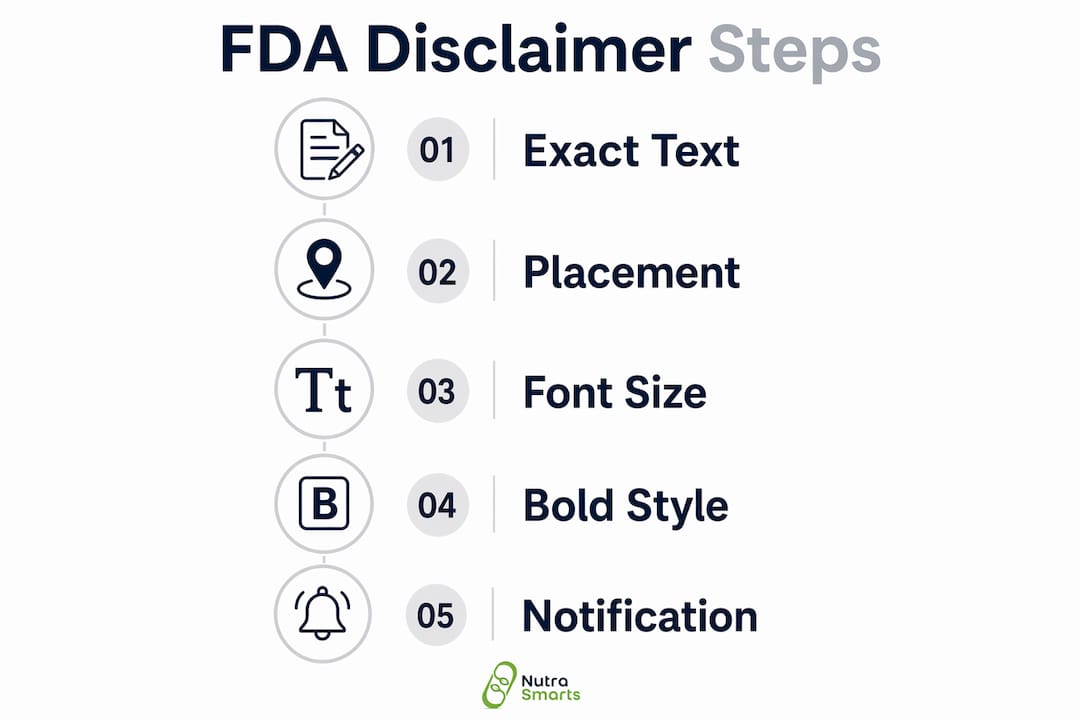
The disclaimer is one piece of a larger compliance picture. Brands making structure/function claims carry three distinct regulatory obligations under FDA guidelines for supplements, and the disclaimer alone satisfies only one of them.
- Scientific substantiation. All structure/function claims must be truthful, not misleading, and supported by credible scientific evidence before the product goes to market. The disclaimer does not substitute for this requirement. A product can carry the correct disclaimer and still be non-compliant if the underlying claim lacks substantiation.
- FDA notification within 30 days. Manufacturers must notify the FDA within 30 days of first marketing a supplement bearing a structure/function claim. The notification must include the exact claim text, manufacturer contact information, and a certification that the claim is substantiated and truthful.
- Ongoing label accuracy. If a claim changes after the initial notification, a new notification is required. Brands that update their marketing copy without re-notifying the FDA are out of compliance even if the disclaimer text remains correct.
"The disclaimer and proper labeling do not substitute for the necessity of substantiating claims with scientific evidence. All structure/function claims must be truthful, not misleading, and properly substantiated before marketing." — 21 CFR 101.93 compliance standard, as summarized by The FDA Expert
The notification process is straightforward but easy to overlook during a product launch. Many brands focus on label design and miss the 30-day window entirely. Missing this deadline is a common inspection finding that the FDA treats as a separate violation from labeling errors. The disclaimer tells consumers the product is not FDA-approved. The notification process tells the FDA the product exists. Both are required.
How to apply FDA disclaimer requirements without common pitfalls
Practical compliance comes down to process, not just knowledge. Most label issues relate to placement and formatting rather than the absence of the disclaimer text itself. Brands that know the rule still make mechanical errors because they review labels as finished artwork rather than as regulatory documents.
The most effective approach combines label design planning with a structured pre-print review:
- Plan disclaimer space before designing. Treat the disclaimer as a fixed design element from the first draft, not an afterthought added after the artwork is complete. This prevents the common scenario where a finished label has no compliant space for the required text.
- Audit every panel independently. A common error is assuming one disclaimer on the back label covers all panels. Review each panel separately and confirm that every structure/function claim on that panel has a compliant disclaimer adjacent to it.
- Use a compliance checklist at the proof stage. Non-compliance converges mostly around mechanical errors detectable during label proofing: incorrect font size, missing boldface, or misplaced disclaimers. A checklist reviewed against the physical proof catches these before printing.
- Test small container labels at actual print size. Digital proofs at screen resolution can make 4-point text look acceptable. Print a physical sample at the actual label dimensions and measure the disclaimer letter height directly.
- Document your substantiation file before launch. Keep a written record of the scientific evidence supporting each structure/function claim. This file is what you produce during an FDA inspection, and it should exist before the product ships, not after.
Pro Tip: Ask your label printer to flag any text element below 6 points during prepress review. This gives you a buffer above the 4.5-point minimum and catches formatting issues before the print run.
Key takeaways
FDA disclaimer compliance for dietary supplements requires exact wording, panel-by-panel placement, specific formatting, and a 30-day FDA notification, all of which must be in place before a product reaches market.
| Point | Details |
|---|---|
| Verbatim disclaimer text | Use the exact FDA-mandated wording; no paraphrasing or word substitution is permitted. |
| Panel-by-panel placement | Every label panel bearing a structure/function claim must carry its own adjacent disclaimer. |
| Formatting minimums | Boldface type, minimum 4.5-point letter height, and a boxed or visually set-off format are required. |
| 30-day FDA notification | Manufacturers must notify the FDA within 30 days of first marketing any product with a structure/function claim. |
| Substantiation is separate | The disclaimer does not replace the requirement to have credible scientific evidence supporting every claim. |
What we've learned from watching brands get this wrong
At Nutrasmarts, we review supplement labels regularly as part of building our ingredient database and compliance resources. The pattern we see most often is not ignorance of the disclaimer requirement. It is overconfidence in a label that "looks right" without being verified against the actual regulatory text.
The brands that get cited most frequently are not fly-by-night operations. They are established companies with professional designers who treated the disclaimer as a design element rather than a legal requirement. The box looks clean, the font looks bold, and the text is there. But the letter height is 3.8 points instead of 4.5, or the front panel claim has no adjacent disclaimer because the designer assumed the back panel covered it.
What I find most telling is that the FDA's enforcement focus has shifted toward consumer clarity, not just technical compliance. Warning letters increasingly cite situations where the disclaimer is technically present but visually buried. A disclaimer that meets the minimum size requirement but is printed in light gray on a white background is technically non-compliant on contrast grounds, and it signals to the FDA that the brand is trying to minimize the disclosure rather than communicate it.
The brands that avoid these problems treat the disclaimer as a communication tool, not a legal obstacle. They design labels where the disclaimer is readable, prominent, and clearly connected to the claims it qualifies. That approach satisfies regulators and builds consumer trust at the same time.
— NutraSmarts
Build compliant supplement labels with NutraSmarts
Getting the FDA disclaimer right is one part of a larger compliance picture that includes accurate Supplement Facts panels, ingredient transparency, and claim substantiation.

Nutrasmarts offers a free label creation tool built specifically for supplement brands navigating FDA labeling requirements. The tool generates compliant Supplement Facts panels without spreadsheets, and it incorporates the formatting standards covered in this article. For brands researching which ingredients to include, Nutrasmarts maintains a database of over 800 ingredients linked to peer-reviewed studies. Browse metabolic health supplements reviewed for clinical evidence, or explore the full supplement catalog by symptom to find products backed by science and labeled to standard.
FAQ
What is the required FDA disclaimer text for supplements?
The required text is: "This statement has not been evaluated by the Food and Drug Administration. This product is not intended to diagnose, treat, cure, or prevent any disease." For multiple claims, "This statement" changes to "These statements." No other modifications are permitted under 21 CFR 101.93.
Does one disclaimer on the back label cover the whole supplement package?
No. The FDA requires the disclaimer to appear adjacent to every structure/function claim on every panel where a claim appears. A back-panel-only disclaimer does not satisfy the requirement if claims also appear on the front or side panels.
What font size is required for the FDA supplement disclaimer?
The disclaimer must be printed in boldface type with a minimum letter height of one-sixteenth of an inch, which equals approximately 4.5 point font size. The text must also be visually set off from surrounding label content, typically inside a box or border.
Do I need to notify the FDA when I use a structure/function claim?
Yes. Manufacturers must notify the FDA within 30 days of first marketing a supplement with a structure/function claim. The notification must include the claim text, manufacturer information, and a substantiation certification.
Does the FDA disclaimer mean the FDA has reviewed my supplement?
No. The disclaimer explicitly states the product has not been evaluated by the FDA. Displaying the disclaimer correctly does not imply FDA approval or endorsement. Brands must still maintain scientific substantiation for every claim they make, independent of the disclaimer requirement.