
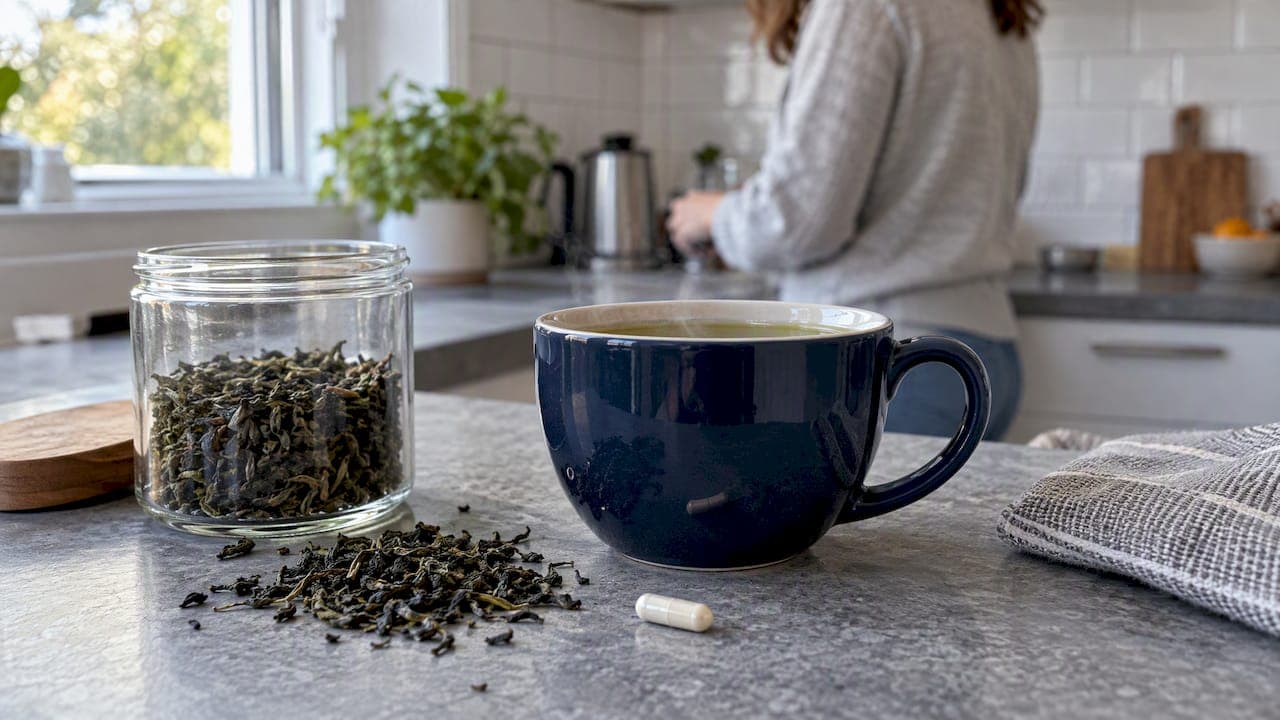
L-theanine may take the edge off short-term stress in some people, but the evidence that it treats anxiety is weak. The one randomized trial in people with diagnosed generalized anxiety disorder (GAD) found no benefit over placebo. The more encouraging results come from small studies in healthy adults facing stressful situations, and those studies are mixed. Below we go through what was tested, at what doses, what the reviews conclude, and what to ask a clinician before you try it.
TL;DR
- In the only randomized trial of L-theanine added to treatment for diagnosed GAD, anxiety scores were no better than placebo after 8 weeks.
- Small trials in healthy adults suggest 200 to 400 mg a day may ease perceived stress, but a 2026 meta-analysis found the effect modest and heavily influenced by studies at high risk of bias.
- Safety looks good in short trials, yet long-term and drug-interaction data are limited. Talk to a clinician first if you take antidepressants, sedatives or blood-pressure medicine, or if you are pregnant or nursing.
- L-theanine is not a substitute for evaluation or treatment of an anxiety disorder.
Table of Contents
- What L-theanine is and why people take it for anxiety
- The trial in diagnosed anxiety: no benefit
- Trials in healthy adults: a modest signal
- What the newest meta-analysis says
- How the evidence stacks up
- Doses researchers have tested
- Why the results are so mixed
- Safety, side effects and interactions
- Can L-theanine replace treatment?
- Our perspective
- Finding calming ingredients on NutraSmarts
- A sensible way to approach it, if you decide to try
- FAQ
- Sources
What L-theanine is and why people take it for anxiety
L-theanine is an amino acid found in tea leaves and sold as a stand-alone capsule. It became popular as a "calm without drowsiness" supplement, and most of the interest rests on small studies of stress, sleep and mood rather than on anxiety disorders. If you want the ingredient profile, including forms and dosing benchmarks, see our L-theanine research page.
Two words matter before we look at any data. "Stress" in a study usually means a score on a questionnaire, or a reaction to a lab task such as a timed mental test. "Anxiety disorder" means a clinical diagnosis. Most positive findings concern the first. Most marketing implies the second.
The trial in diagnosed anxiety: no benefit
The most relevant study for anyone with a diagnosis is a randomized trial of adjunctive L-theanine in generalized anxiety disorder. It enrolled 46 adults with DSM-5 GAD who were already on stable antidepressant treatment. Participants took L-theanine or placebo during an 8-week double-blind period within a 10-week study, with L-theanine dosed at 450 to 900 mg.
The result was clear in direction: the authors reported that the preliminary study did not support efficacy for anxiety symptoms. On the Hamilton Anxiety Rating Scale, the difference from placebo was nowhere near significant (p=0.73).
Two cautions keep this from being the last word. The trial was small, and it tested L-theanine as an add-on to antidepressants, not on its own. Still, a 2026 BMJ review of new and emerging anxiety treatments found this was the only randomized trial to have evaluated L-theanine for anxiety, classed it as "not efficacious" as a stand-alone treatment, and saw no rationale for clinical implementation. The reviewers also said one negative trial is not enough to close the question, and that future work could test it on its own.

Trials in healthy adults: a modest signal
The positive headlines come from a different kind of study. In a four-week crossover trial of 30 healthy adults with no major psychiatric illness, researchers measured stress-related symptoms and cognitive function. It is one of the studies most often cited for L-theanine and stress, and it is also a good example of the limits: a small sample, a short period and people who were not diagnosed with anxiety.
The pattern repeats across the literature:
- A 2016 systematic review found five eligible randomized trials with 104 participants in total. Doses were 200 to 400 mg a day and treatment lasted up to 8 weeks. Four of the five involved people without pre-existing mental illness, and four reported significant stress or anxiety improvements. The study that compared L-theanine with alprazolam found no significant anti-anxiety effect for either treatment.
- A 2020 systematic review found nine peer-reviewed randomized trials. It concluded that 200 to 400 mg a day may help stress or anxiety in people exposed to stressful conditions, and called for larger and longer clinical studies before any therapeutic use can be justified.
- A 2025 review describes the anxiety and stress findings as inconclusive. Studies are generally small and use non-standardized methods and outcomes, so rigorous human evidence remains limited. Its authors argue that this is exactly why marketing claims run ahead of the data.
What the newest meta-analysis says
The largest pooled look so far is a 2026 systematic review and meta-analysis of 31 randomized trials and 1,168 participants, covering both healthy and clinical groups. Its findings are worth reading slowly:
- It found a modest acute stress reduction, with a standardized mean difference of 0.31. The authors noted this result was largely influenced by studies at high risk of bias.
- Effects on anxiety were inconsistent and generally not significant. The reported exception was one study of psychotic anxiety using 400 mg a day for 8 weeks, a single study that cannot carry a general conclusion.
- No serious adverse events were reported.
A standardized mean difference of 0.31 is conventionally read as small. And when the studies behind it are the weaker ones, the honest reading is "possible small effect on acute stress, not yet reliable."
How the evidence stacks up
| Question | What the research shows | How firm it is |
|---|---|---|
| Does it treat diagnosed GAD? | One 46-person add-on trial found no benefit over placebo | Small, but negative; reviewers see no basis for clinical use |
| Does it ease stress in healthy adults? | Some small trials positive; pooled effect modest | Limited by small samples and risk of bias |
| Does it reduce anxiety scores generally? | Inconsistent, mostly non-significant in the 2026 meta-analysis | Weak |
| Is it safe short term? | No serious adverse events reported in trials | Reasonable, but long-term data are thin |
A 2026 review of human trials in Frontiers in Nutrition makes the same distinction. It stresses that the strongest evidence is for coping with stressful situations and for sleep, not for treating an anxiety disorder.
Doses researchers have tested
Doses vary by goal, which is part of why the studies are hard to compare. The Frontiers review summarizes commonly studied amounts as 100 to 400 mg in healthy adults, 200 to 400 mg a day for stress-related outcomes, and 200 to 450 mg a day for sleep quality. The GAD trial went higher, at 450 to 900 mg, and still found nothing.

That last point is useful. If a higher dose in a diagnosed population did not beat placebo, taking more is not a reliable fix. The trials suggesting benefit used 200 to 400 mg a day for up to 8 weeks, so there is no evidence about years of daily use.
When you compare products, check how much L-theanine one serving actually delivers, since labels sometimes list a blend. Branded forms such as Suntheanine and AlphaWave L-Theanine have their own profiles on our site, with the studies tied to each. Keep in mind that branded research does not mean the brand works better for anxiety; it means that form was the one tested in a given study.
Why the results are so mixed
Several things explain the mismatch between enthusiasm and data.
Different populations. Healthy volunteers under mild, short-lived stress behave differently from people with a chronic disorder. A result in the first group does not transfer to the second.
Small samples. Many of the trials have a few dozen participants. Small trials swing widely, and positive ones are more likely to be published and cited.
Inconsistent outcomes. One study measures a trait anxiety questionnaire, another heart rate during a task, another sleep. The 2025 review points to these non-standardized methods as a core problem.
Short duration. Eight weeks is the longest typical treatment period. Anxiety disorders are usually chronic.
Placebo response. Anxiety scores fall on placebo in most trials. A supplement has to beat that, and in the one clinical trial, it did not.
Safety, side effects and interactions
Short clinical trials generally reported no excess of adverse events compared with placebo. The BMJ review noted no significant difference in the anxiety trial and no significant signal in a broader psychiatric meta-analysis, and the 2026 meta-analysis reported no serious adverse events.
That is reassuring, but it is not the same as "proven safe for everyone." Long-term safety and rigorous interaction data are limited. The U.S. National Center for Complementary and Integrative Health warns that supplements can cause side effects and interact with medicines, and that safety depends on your medicines, health, age and pregnancy status. Its point that "natural" does not guarantee safety applies here as much as anywhere.
Speak with a pharmacist or prescriber before starting if any of these apply:
- You take an antidepressant, a sedative or another medicine for anxiety or sleep. Overlapping effects are plausible, and the data to rule them out are thin.
- You take blood-pressure medication.
- You are pregnant or nursing.
- You have a medical condition or take other prescription drugs.
Can L-theanine replace treatment?
No, and the research gives no basis for it. The BMJ review's verdict is that it is not efficacious as a stand-alone anxiety treatment. NCCIH advises discussing any supplement with your health care professionals, checking for medication interactions, and not using an unproven product to postpone evaluation or replace proven care.
If you have persistent worry, panic, trouble sleeping, or anxiety that interferes with work or relationships, see a primary care clinician or a mental health professional. Do not stop prescribed medication to try a supplement. A doctor can also check for causes that supplements cannot fix, such as thyroid problems, or nutrient deficiencies. Our deficiency symptom guide can help you prepare questions for that visit, though it does not diagnose anything.
Our perspective
We build NutraSmarts around one rule: an ingredient's rating should follow its clinical trials, not its popularity. L-theanine is a good test of that rule. It is widely loved, reasonably safe in short studies, and has a plausible role in acute stress and sleep. It does not have trial support as an anxiety treatment, and we would rather say that plainly than stretch the data.
So when we rate it, we separate three claims: helping you feel calmer during a stressful stretch (some support, modest), improving sleep quality (some support at 200 to 450 mg), and treating an anxiety disorder (no support so far). If you are choosing among calming ingredients, compare them on the same footing. Our side-by-side pages on GABA versus L-theanine and L-theanine versus ashwagandha show dosages and trial counts next to each other, and our write-up on magnesium for anxiety applies the same standard to another popular option.
If a product promises to cure anxiety, the evidence does not back it. If it offers a gentle, low-risk experiment at a studied dose, with your clinician in the loop, that is a fair claim.
— NutraSmarts
Finding calming ingredients on NutraSmarts
If you want to see what else has been studied for stress and worry, browse our supplements by symptom pages, where anxiety is one of the concerns you can search. Every ingredient profile cites its clinical trials and gives an honest evidence rating, with no sign-up or paywall. For a broader view, our guide to evidence-based ingredients for stress management puts several options side by side.
A sensible way to approach it, if you decide to try
This is not medical advice, and it assumes your clinician has no objection. If you and your clinician agree a trial is reasonable, the research suggests a few practical habits:
- Stay in the studied range. The trials suggesting benefit used 200 to 400 mg a day. Higher doses were not shown to work better.
- Change one thing at a time. If you start L-theanine alongside a new medicine or a big change in caffeine, you cannot tell what did what.
- Track something specific. Rate your stress or sleep on a simple 1 to 10 scale each day for a few weeks. Without a baseline, placebo effects are hard to separate from real change.
- Set an end date for the experiment. The longest trials ran about 8 weeks. If you notice nothing by then, it is reasonable to stop.
- Read the label. Look for the amount of L-theanine per serving, and be wary of proprietary blends that hide the dose.
If you pair it with caffeine, as tea drinkers do naturally, you are in a different research area, which we cover in our comparison with taurine. And if you are weighing it against an amino acid with a different role, see when L-theanine or L-tyrosine help.
FAQ
Does L-theanine help anxiety?
Possibly for short-term stress, but not reliably for anxiety itself. A 2026 meta-analysis found a modest effect on acute stress, largely driven by studies at high risk of bias, and inconsistent, mostly non-significant effects on anxiety. In the only trial in diagnosed GAD, it did not beat placebo.
Is there scientific evidence for L-theanine?
Yes, there is research, but it is limited. The 2026 meta-analysis pooled 31 randomized trials and 1,168 participants. Most trials are small and short, and reviewers repeatedly call for larger, longer studies before drawing firm conclusions.
Is L-theanine similar to Xanax?
No. Alprazolam (Xanax) is a prescription benzodiazepine with established anti-anxiety effects. In the one small trial that compared L-theanine with alprazolam, neither showed a significant anti-anxiety effect, so that study cannot be read as showing they are equivalent. Never swap or stop a prescribed medicine without your prescriber.
What is the downside of taking L-theanine?
Short trials report no serious adverse events, so the main downsides are unknowns: limited long-term safety data and limited interaction data. NCCIH advises checking with a health professional first, especially if you take medicines, are pregnant or nursing, or have a medical condition. Another downside is opportunity cost, if it delays proper evaluation of an anxiety disorder.
What dose of L-theanine have studies used?
Most stress-related trials used 200 to 400 mg a day for up to 8 weeks. Sleep studies used 200 to 450 mg a day, and the negative GAD trial used 450 to 900 mg. Nobody has established an ideal dose for anxiety.
Sources
- L-theanine in the adjunctive treatment of generalized anxiety disorder (PubMed)
- Cognitive and affective effects of L-Theanine: a systematic review and meta-analysis (2026)
- New and emerging treatments for anxiety disorders (BMJ, 2026)
- Theanine consumption, stress and anxiety in human clinical trials (2016 review)
- The Effects of Green Tea Amino Acid L-Theanine Consumption on the Ability to Manage Stress and Anxiety (2020)
- L-theanine: From tea leaf to trending supplement (2025 review)
- Effects of L-theanine on cognition, mood and sleep (Frontiers in Nutrition, 2026)
- Effects of L-Theanine Administration on Stress-Related Symptoms and Cognitive Functions in Healthy Adults
- Anxiety and Complementary Health Approaches (NCCIH)
- Are You Considering a Complementary Health Approach? (NCCIH)