

If your ingredient wasn't marketed as a dietary supplement in the U.S. before October 15, 1994, and it doesn't meet the unaltered-food exception, you need a new dietary ingredient notification before you sell it. Filing is required at least 75 days before interstate commerce begins, and the manufacturer or distributor bears the burden. Your first move: confirm NDI status, then start building your identity and safety dossier promptly.
TL;DR:
- An ingredient not marketed as a dietary supplement before October 15, 1994, needs a premarket notification unless it qualifies as an unaltered food.
- Filing must be done at least 75 days before sale, and the notification should include detailed identity, manufacturing process, safety evidence, and intended use.
- Most rejections stem from vague ingredient specifications, incomplete safety studies, or mismatched data, which delays approval and market entry.
- Submissions are now recommended through FDA's online COSM portal, with amendments resetting the review clock and risking delays if not carefully managed.
- Building the safety and identity evidence early in product development improves approval chances and reduces costly re-filings.
Table of Contents
- What Counts as a New Dietary Ingredient, and When Must You Notify FDA?
- What Goes Into an NDIN: Identity, Specs, and Safety Evidence
- How Do You Submit an NDIN, and What's the Filing Timeline?
- What Mistakes Cause NDIN Rejections and Delays?
- How Nutrasmarts Helps You Assemble an NDIN Dossier
- Where to Find FDA's Official NDIN Resources
- Our Take: Stop Treating the NDIN Process Like a Formality
- Sources
- FAQ
What Counts as a New Dietary Ingredient, and When Must You Notify FDA?
A new dietary ingredient is any dietary ingredient that was not sold in the U.S. as a dietary supplement before October 15, 1994. That date comes straight from the Dietary Supplement Health and Education Act (DSHEA), and it's the line FDA uses to decide whether your ingredient needs fresh safety scrutiny or gets to ride on a grandfather clause.
If your ingredient clears that bar, section 413(a)(2) of the FD&C Act requires a premarket notification at least 75 days before you introduce it into interstate commerce. There's one carve-out: if the ingredient "has been present in the food supply as an article used for food" in a form that hasn't been chemically altered, no notification is required. Whole dried chamomile flower brewed as tea likely qualifies. Chamomile extract concentrated through a novel solvent process almost certainly does not, because the extraction process itself counts as alteration.
Responsibility for filing sits with whoever manufactures or distributes the NDI, or a supplement containing it. Skip the notification when one is required, and the product is legally adulterated under 21 U.S.C. 342(f), regardless of how safe the ingredient actually is.
Before you build a dossier, settle three questions:
- Was this exact ingredient, in this exact form, sold as a supplement before October 15, 1994?
- Has it been chemically altered from a food-supply form (extraction, fermentation, synthesis, particle-size reduction)?
- Are you the first company bringing this specific ingredient to market, or has someone already filed?
What Goes Into an NDIN: Identity, Specs, and Safety Evidence
FDA's notification checklist breaks into four buckets, and skipping any one of them is the fastest way to get a deficiency letter.
- Identity. State the official name (Latin binomial for botanicals), describe the manufacturing process step by step, and attach a specification sheet covering purity, strength, and impurity limits.
- Conditions of use. Specify the level of the ingredient in the finished product, the intended daily intake, and how the label will instruct people to use it.
- Safety evidence. Lay out the basis for concluding the ingredient is reasonably expected to be safe. This can include history of safe use, published human or animal studies, or adverse event data, but every referenced article needs a full-text reprint attached, translated into English if the original isn't.
- Administrative details. Include a signature, current contact information for the filer, and a clear chain connecting each cited study back to the specific identity and dose you're notifying.
The FDA fact sheet on NDIN essentials lays out exactly this structure, and it's worth printing out and checking off line by line before submission, not after.
Pro Tip: Don't separate your identity section from your safety section. FDA reviewers repeatedly flag notifications where the safety studies used a different extract ratio, particle size, or manufacturing process than the one described in the identity section. If your studies used a 4:1 extract and your product uses a 10:1 extract, say so and explain why the safety data still applies.

How Do You Submit an NDIN, and What's the Filing Timeline?
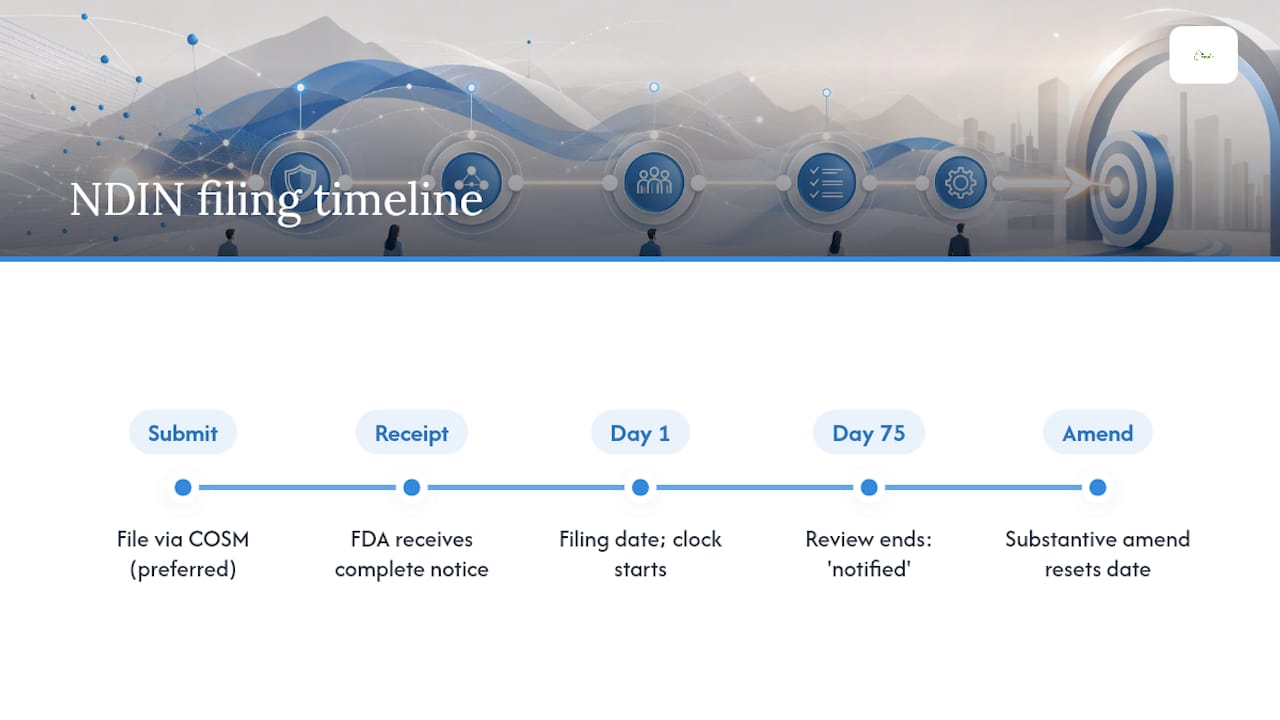
FDA now recommends filing through the Centralized Online Submission Module, known as COSM, rather than mailing paper copies. The COSM ePortal gets you faster acknowledgment and lets you track status online instead of waiting on a letter, and FDA publishes a step-by-step guide for using it.
Your filing date is the day FDA receives a complete notification, and that date starts the clock on the 75-day review window. Here's where manufacturers get tripped up: if you amend the notification with new safety data, a changed manufacturing process, or a different dose after filing, FDA can treat that as a substantive amendment. That resets your filing date and restarts the 75-day clock from scratch.
If you're still submitting on paper, follow up immediately by email to NDITeam@fda.hhs.gov with the subject line "NDIN Written Submission." Skipping that step is a common reason paper filings sit unacknowledged for weeks longer than they should.
One distinction trips up almost everyone new to this process: a "notified" status from FDA is not an approval. It means the agency reviewed your submission within the 75 days and didn't raise an objection. FDA doesn't "approve" dietary supplements the way it approves drugs, and treating a notified letter as an endorsement on your label or marketing materials can create its own compliance problem.
What Mistakes Cause NDIN Rejections and Delays?
Most NDIN deficiencies trace back to the same handful of gaps, and they're avoidable if you know where reviewers look first.
- Vague identity specifications that don't nail down purity thresholds or impurity limits
- Missing or incomplete impurity and contaminant profiles for the actual manufacturing process used
- Safety studies submitted without full-text reprints, or foreign-language studies without translations
- A mismatch between the exposure level used in cited studies and the actual conditions of use in your product
- Bulk submission of tangentially related studies instead of a tight, targeted safety narrative
When FDA finds gaps, the agency typically responds with an information request, a courtesy letter flagging missing elements, or in more serious cases, a formal objection. Any of these can push your product launch back by months, especially if the response triggers a filing-date reset.
The fix isn't submitting more paper. It's tightening the link between your identity data and your safety data so a reviewer can trace, line by line, how the studies you cited actually support the dose and form you're notifying. Skip supplementary studies that don't match your exact extract or dose.
Pro Tip: If your ingredient sits anywhere near a novel extraction method, unusual dosage form, or a botanical with limited traditional use in the U.S., bring in outside toxicology or regulatory counsel before you file, not after you get a deficiency letter. The cost of a second opinion is nearly always lower than the cost of a filing-date reset.
How Nutrasmarts Helps You Assemble an NDIN Dossier
Building the safety and identity sections of an NDIN means chasing down primary studies, verifying dose consistency, and formatting a label that matches what you told FDA. A number of tools are built around exactly that workload.
- The ingredient database links each of its 1,300+ profiles to clinical trial citations, so you can pull primary studies and clinical dosage benchmarks instead of hunting through scattered reference lists.
- The side-by-side comparison tool lets you check how your proposed dose and form line up against similar ingredients already documented, useful groundwork before you draft your safety narrative.
- The free Supplement Facts label creator generates a compliant panel that mirrors the level-in-product figures your NDIN describes, so your label and your filing don't drift apart. Pair it with a Supplement Facts panel walkthrough if you want the formatting rules spelled out step by step.
None of these tools file the notification for you. They cut the hours spent chasing citations and reformatting specs so your regulatory team can focus on the parts of the dossier that actually require judgment.
Where to Find FDA's Official NDIN Resources
Four resources anchor every NDIN filing decision. The background page explains the legal definition and cutoff date. The April 2024 draft guidance offers FDA's current thinking on borderline cases. 21 CFR 190.6 is the binding regulation itself. And the public NDIN list on FDA's site shows how the agency has responded to similar ingredients before, which is the closest thing to precedent this process offers.
Our Take: Stop Treating the NDIN Process Like a Formality
Too many compliance teams treat the new dietary ingredient notification as paperwork to knock out after formulation is locked. That order of operations backfires constantly. The safety evidence you can gather depends entirely on the exact identity specs, dose, and manufacturing process you choose, so working backward from a finished product to justify a notification almost guarantees gaps between your studies and your actual formula.
The conventional advice, "hire a consultant to write the notification," undersells the real bottleneck. Consultants can draft clean prose, but they can't manufacture history-of-use data or impurity testing that was never generated. The teams that move fastest through FDA review are the ones that build identity specifications and safety documentation in parallel, from the earliest formulation decisions, rather than reverse-engineering a justification later.
If you take one thing from this: verify NDI status before you finalize your manufacturing process, not after. A dose or extraction method chosen without regard to what safety evidence exists is the single most common reason notifications stall, get amended, and lose their original filing date.
— Nutrasmarts
This article is general information, not a substitute for advice from a qualified lawyer. Consult a qualified legal professional about your own circumstances before acting on anything here.
Sources
- New Dietary Ingredients in Dietary Supplements - Background for Industry
- 21 CFR Part 190 — New Dietary Ingredient Notification regulation (NDIN)
FAQ
What Is a New Dietary Ingredient?
A new dietary ingredient is any dietary ingredient not sold as a U.S. dietary supplement before October 15, 1994. If it doesn't meet the unaltered food-supply exception, it needs a premarket notification before it goes to market.
Why Was DSHEA Passed?
The Dietary Supplement Health and Education Act of 1994 created a regulatory framework distinguishing dietary supplements from conventional drugs and food additives, giving them a lighter-touch premarket pathway while still requiring safety notification for genuinely new ingredients. It's the law that established the October 15, 1994 cutoff date still used in every NDIN filing today.
What Supplements Have Been Recalled?
FDA recalls typically target products with undeclared drug ingredients, contamination, or ingredients lacking a required new dietary ingredient notification. The specific list changes constantly, so check FDA's recall database directly rather than relying on any static list.
What Is the FDA Disclaimer Required on Supplement Labels?
Products making structure/function claims must carry the statement that the claim hasn't been evaluated by FDA and the product isn't intended to diagnose, treat, cure, or prevent any disease. This disclaimer requirement is separate from the NDIN process but often applies to the same products, and our disclaimer requirement guide breaks down exactly when it applies.