

Updating existing supplement labels for FDA compliance is not optional, and the consequences of getting it wrong range from warning letters to product recalls. Every dietary supplement sold in the United States must carry a statement of identity, a properly formatted Supplement Facts panel, a complete ingredient list, allergen declarations, and the name and address of the manufacturer or distributor. The FDA Dietary Supplement Labeling Guide is the foundational reference for this process, covering requirements under the Dietary Supplement Health and Education Act of 1994 (DSHEA) and 21 CFR Part 101. The label owner bears full legal responsibility for every claim and every element on the label.
Before you revise a single panel, verify these elements are present and current:
- Statement of identity including the term "dietary supplement" on the principal display panel
- Supplement Facts panel formatted per 21 CFR 101.36, with correct Daily Values and font sizes
- Complete other ingredient list in descending order of predominance by weight
- Major food allergen declarations, including sesame (mandatory since january 2023)
- Structure/function claim disclaimer if any such claims appear
- Net quantity of contents on the principal display panel
- Manufacturer, packer, or distributor name and place of business
- Domestic adverse event reporting contact information
What FDA actually requires on every supplement label
The FDA's labeling requirements for dietary supplements are more granular than most manufacturers expect. Each element has specific placement, type size, and formatting rules, and a violation of any one of them can trigger an inspection finding.
Statement of identity. The label must identify the product as a "dietary supplement" on the principal display panel, in bold type, sized proportionally to the most prominent text on the front panel. The word "dietary" may be replaced with a description of the ingredient type, such as "herbal supplement" or "calcium supplement," but the term "supplement" must remain. Brand names do not substitute for the statement of identity.
Supplement Facts panel. Governed by 21 CFR 101.36, the panel must list serving size, servings per container, calories, and all dietary ingredients with their quantities per serving and percentage of Daily Value where established. The heading "Supplement Facts" is mandatory. Font sizes have minimum thresholds: the heading must be larger than the body text, and no nutrient line may fall below 6-point type on standard packages. Errors in Daily Value percentages or nutrient ordering are among the most common inspection triggers.
Ingredient listing and allergen declarations. Ingredients not listed in the Supplement Facts panel must appear in an "Other Ingredients" list, in descending order by weight. The nine major food allergens, including sesame added under the FASTER Act, must be declared either in the ingredient list or in a separate "Contains" statement.
Claims and disclaimers. Structure/function claims are permitted but require a two-part disclaimer: "This statement has not been evaluated by the Food and Drug Administration. This product is not intended to diagnose, treat, cure, or prevent any disease." Health claims require prior FDA authorization. Nutrient content claims must meet defined criteria under 21 CFR Part 101.
Net quantity and business information. Net quantity of contents goes on the principal display panel. The name and address of the manufacturer, packer, or distributor appears on the information panel, along with domestic contact information for adverse event reporting.
Recent FDA rule changes you need to account for now
Several regulatory updates from the past few years directly affect what a compliant label must say in 2026. Missing any of these when you revise a label creates a new compliance gap even if the rest of the panel is accurate.
- Vitamin D and potassium: The 2016 Nutrition Facts rule revision, which phased in for supplements, updated the Daily Values for vitamin D (from 400 IU to 20 mcg) and potassium (from 3,500 mg to 4,700 mg). Labels still using the old reference values are out of compliance.
- Added sugars: Supplements containing added sugars must now declare them on a separate line in the Supplement Facts panel.
- Sesame allergen: The FASTER Act made sesame the ninth major food allergen, with mandatory declaration required since january 1, 2023. Any label printed before that date and still in circulation needs review.
- Structure/function disclaimer placement: In december 2025, FDA issued guidance easing enforcement of the requirement to repeat the disclaimer on every label panel where a structure/function claim appears. The disclaimer remains mandatory, but duplicative placement on every panel is no longer strictly enforced. Labels should still carry the disclaimer prominently.
- Front-of-package labeling: FDA has proposed front-of-package nutrition labeling rules for conventional foods, but dietary supplements are currently excluded from that proposal. Monitor the Federal Register for any extension to supplements.
Pro Tip: Set a calendar alert for the Federal Register's annual 21 CFR Part 101 update cycle. New rules publish with effective dates, and missing a compliance window is one of the most preventable enforcement risks.
Legal responsibilities and compliance risks you cannot delegate
FDA does not pre-approve dietary supplement labels. The manufacturer or brand owner carries full legal responsibility for every element on the label, from the accuracy of nutrient quantities to the substantiation behind every claim. That responsibility does not transfer to a contract manufacturer, a label designer, or a third-party distributor.
The most common compliance failures are not exotic. They include:
- Label drift after reformulation, where the physical label no longer matches the current product specification
- Incorrect or missing allergen declarations, particularly for sesame
- Structure/function claims without the required disclaimer
- Supplement Facts panel errors such as wrong Daily Values, incorrect font sizes, or missing nutrients
- Claims on websites and e-commerce listings that are not consistent with the physical label
FDA treats e-commerce product listings as labeling. A claim on a product detail page carries the same legal weight as a claim on the physical package. Brands that update their physical labels but leave outdated claims on Amazon listings or their own websites remain exposed.
Email chain approvals do not satisfy audit standards. When FDA inspectors request documentation of a label change, they expect structured, queryable records with timestamps and named reviewers, not a thread of forwarded messages. Informal approval processes are one of the most cited gaps in label compliance audits.
Step-by-step process for updating supplement labels
A structured label revision workflow reduces the risk of introducing new errors while correcting old ones. Here is a practical sequence aligned with FDA expectations.
-
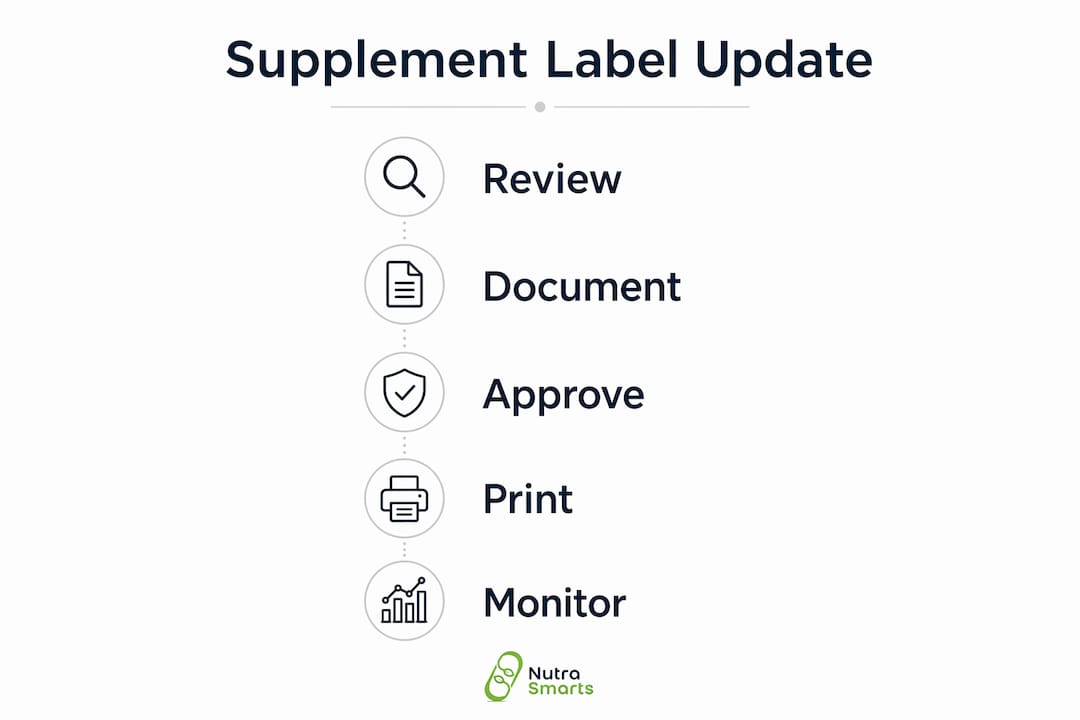
Audit the current label portfolio. Compare every active label against current 21 CFR Part 101 requirements and the FDA Dietary Supplement Labeling Guide. Flag every element that does not match current rules or the current product formulation. A supplement label audit is the logical starting point.
-
Identify all triggers for revision. Label updates are required when formulations change, when new regulations take effect, when claims are added or modified, or when allergen status changes. Treat each trigger as a separate documented event.
-
Draft revised label text. Write new label copy tied directly to the current product specification. Verify every nutrient quantity against the current certificate of analysis. Confirm that all claims have substantiation on file before they appear on the label.
-
Design artwork to FDA format standards. Apply correct font sizes, type contrast, panel placement, and spacing per 21 CFR 101.36. The Supplement Facts panel must follow the mandated layout exactly, including the "Supplement Facts" heading and the correct order of nutrients.
-
Run a structured multi-department review. Regulatory, Legal, Design, and Quality Assurance each need a documented sign-off with timestamps. A multi-role approval checkpoint is the standard that FDA inspectors expect to see.
-
Compare the final artwork to the approved master. Automated side-by-side verification tools catch errors that human reviewers miss, including Unicode character issues, formatting deviations, allergen omissions, and barcode readability problems.
-
Notify FDA for new structure/function claims. Any new structure/function claim must be submitted to FDA no later than 30 days after the product first goes to market with that claim.
-
Deploy updated labels and destroy old stock. Document the destruction of obsolete labels with dates and quantities. Physical inventory of old labels in a production facility is a direct inspection risk.
-
Update all online listings and marketing materials. Every product detail page, website description, and digital ad must reflect the updated label claims and disclaimers.
-
Schedule the next review cycle. Build a recurring label review into your compliance calendar, triggered at minimum by any formulation change and annually against the current regulatory baseline.
Pro Tip: Link every label version to the product specification it was approved against. When a reformulation happens, the label review is automatically triggered because the specification it was tied to no longer matches.

How to maintain compliance after the label goes live
Post-update compliance is where most brands lose ground. The label that passed review on day one can drift out of compliance within months if there is no system keeping it anchored to the current product and current regulations.
- Maintain a version-controlled system of record that links each label to the formulation version it covers
- Document every review and approval action with timestamps and reviewer identity, stored in a structured format that survives an FDA inspection
- Use automated compliance gating to block production runs that use non-approved label versions
- Keep a claims library that tracks every structure/function claim, its substantiation file, and its FDA notification date
- Monitor all marketing channels, including social media and e-commerce listings, for claims that have drifted from the approved label
- Schedule a full portfolio audit at least once per year, or immediately after any significant regulatory change
- Maintain documented proof of obsolete label destruction, including dates and quantities, as part of your audit trail
Label changes must be systematically compared to approved masters across all versions, with deviation assessments and version control. Brands that skip this step after a label update often discover the error only when an inspector does.
FDA format and placement rules that trip up label revisions
Format errors are among the most common FDA inspection findings for dietary supplements. When you revise a label, these placement and sizing rules apply regardless of whether the content itself changed.
The Supplement Facts panel must appear on the information panel, which is the label surface immediately to the right of the principal display panel. If the information panel lacks sufficient space, the panel may appear on any other panel except the principal display panel, provided it is conspicuous. On packages with less than 12 square inches of total surface area, certain elements may be omitted, but the label must still carry the name and address of the manufacturer and a statement directing consumers to contact the company for nutrition information.

Type size minimums are not suggestions. The "Supplement Facts" heading must be larger than the body text within the panel. Individual nutrient lines must be no smaller than 6-point type on standard packages, with a 4.5-point minimum allowed on small or intermediate packages under specific conditions defined in 21 CFR 101.36. The font requirements for supplement labels are more specific than most designers realize, and a label that passes visual review can still fail on a point measurement.
The statement of identity must appear on the principal display panel in lines parallel to the base of the package. Net quantity of contents also belongs on the principal display panel, in the lower 30% of the panel, in a type size proportional to the panel area.
Handling Non-GMO, Organic, and allergen claims during a label update
Third-party certification claims introduce a layer of compliance that sits outside FDA's direct jurisdiction but carries real legal exposure. When you update a label that carries a Non-GMO Project Verified seal, a USDA Organic certification, or a specific allergen-free claim, each of those claims requires its own verification step before the revised label goes to print.
Non-GMO Project Verified status is tied to a specific product formulation and supplier list. A reformulation, even a minor one, can void the certification if the new ingredient source has not been evaluated. Contact the certifying body before the label revision is finalized, not after.
USDA Organic certification operates similarly. The certified organic percentage must be accurate on the label, and any change to organic ingredient sourcing requires recertification before the claim can continue. Labeling a product "certified organic" after a supplier change without updated certification is a federal violation.
Allergen-free claims, such as "gluten-free" or "dairy-free," must be substantiated by current testing or supplier documentation. The FASTER Act added sesame to the mandatory allergen declaration list, but it did not change the rules for voluntary "free-from" claims. Those claims still require substantiation and carry liability if they are inaccurate.
Ensuring imported supplement labels meet FDA requirements
FDA's labeling rules apply equally to domestic and imported dietary supplements. A product manufactured in another country and imported for sale in the United States must carry a fully compliant English-language label before it enters commerce. The FDA Dietary Supplement Labeling Guide states explicitly that label approval is not required to import or distribute a supplement, but full compliance with 21 CFR Part 101 is still mandatory.
For imported products, the importer of record typically bears responsibility for label compliance. That means the importer must verify that the foreign manufacturer's label meets all U.S. requirements, including correct nutrient declarations in U.S. units, English-language ingredient lists, and proper allergen declarations. Relying on the foreign manufacturer's home-country label without independent verification is a common and costly mistake.
When a foreign label requires translation, the translation must be accurate and complete. Partial translations or bilingual labels where the English text omits required elements are non-compliant. If the product is also sold in other markets, maintain separate label versions for each market rather than attempting a single label that satisfies multiple regulatory regimes.
Where to verify ingredient names and nomenclature
Ingredient nomenclature errors are a frequent source of compliance failures, particularly for botanical ingredients with multiple common names. FDA requires that ingredients be listed by their common or usual name, and for botanicals, that typically means the standardized name recognized in references such as the Herbs of Commerce published by the American Herbal Products Association.
For vitamins and minerals, use the names and forms specified in 21 CFR Part 101. Vitamin E, for example, must be declared in milligrams of alpha-tocopherol, not in International Units, under the updated Daily Value rules. Vitamin D must be declared in micrograms, not IU, on labels compliant with the 2016 rule revision.
Nutrasmarts maintains a database of over 800 ingredients, each linked to peer-reviewed studies, which can support ingredient identification and claims substantiation during a label revision. For regulatory nomenclature verification, the FDA's own guidance documents and the United States Pharmacopeia (USP) are the primary authoritative references. The USP dietary supplement verification program also provides ingredient identity standards that align with FDA expectations.
Post-update monitoring and what FDA enforcement looks like
A label update is not the end of the compliance process. FDA monitors the market through inspections, consumer complaints, and its own surveillance sampling. Warning letters, the most common enforcement tool, are publicly posted and typically cite specific label violations with a demand for corrective action within a defined timeframe.
Recalls for labeling violations fall into two categories: voluntary recalls initiated by the manufacturer and FDA-requested recalls. Misbranding, which includes false or misleading label statements, undeclared allergens, and unauthorized health claims, is the most common basis for a labeling-related recall. The cost of a recall, including product retrieval, destruction, and regulatory response, far exceeds the cost of a thorough label review before production.
After a label update, build a monitoring cadence into your compliance program. Review FDA warning letters in the dietary supplement category quarterly. They are public documents and serve as a real-time signal of what FDA is currently prioritizing in enforcement. When a warning letter cites a violation that resembles something on your label, treat it as a trigger for an immediate internal review, not a future agenda item.
Key Takeaways
Updating supplement labels for FDA compliance requires synchronizing formulation data, regulatory requirements, and documented approval workflows before any revised label reaches production.
| Point | Details |
|---|---|
| FDA does not pre-approve labels | The label owner bears full legal responsibility for every element, claim, and format detail. |
| Sesame is now a mandatory allergen | Labels printed before january 2023 must be reviewed for the FASTER Act sesame declaration. |
| Disclaimer placement eased in December 2025 | FDA reduced enforcement of repeated disclaimers on every panel, but the disclaimer itself remains mandatory. |
| Email approvals fail audit standards | Structured, timestamped, multi-role sign-off records are what FDA inspectors expect to find. |
| E-commerce listings count as labeling | Claims on product detail pages carry the same compliance obligations as the physical label. |
Build your next label with the right tools
Nutrasmarts offers a free Supplement Facts label creator built to FDA formatting specifications, so you can generate a compliant panel without managing a spreadsheet or guessing at type size minimums. The tool reflects current Daily Values and nutrient ordering requirements, which is the fastest way to catch panel errors before they reach a designer or a printer.
For manufacturers updating labels across a product line, the Nutrasmarts ingredient database covers over 800 ingredients with peer-reviewed citations, supporting both nomenclature verification and claims substantiation. If you are reviewing metabolic health supplements or any other category for a label revision cycle, having ingredient-level research at hand shortens the substantiation step considerably.