

DHA and EPA, the two long-chain omega-3 fatty acids found in fatty fish and fish oil supplements, are not optional nutrients for the brain. They are structural components of neuronal membranes, regulators of inflammation, and active participants in synaptic signaling. The role of omega-3 in brain function spans every life stage, from fetal neurodevelopment through cognitive aging, and the clinical evidence behind these effects has grown considerably sharper in recent years.
Here is what the science actually shows:
- DHA makes up approximately 30–40% of total fatty acids in brain gray matter, making it the dominant structural lipid in neuronal tissue.
- EPA is present in smaller concentrations but drives anti-inflammatory signaling and supports cerebrovascular health.
- Systematic reviews and meta-analyses confirm omega-3 improves cognitive domains including attention, memory, language, and visuospatial skills.
- Benefits are most consistent in people with low baseline omega-3 levels or mild cognitive impairment, not necessarily in well-nourished healthy adults.
- Life stage matters: DHA accumulates rapidly in the fetal brain during the third trimester and the first 18 months of life, and adequate intake in older adults correlates with larger brain volumes.
- Daily intake above 500 mg of total n-3 polyunsaturated fatty acids (PUFAs), with up to 420 mg from EPA specifically, shows the most consistent executive function benefits within 12 months.
- Long-term supplementation is generally safe and well-tolerated with very low risk of adverse effects.
- Both the federal government and the American Heart Association recommend eating two servings of fatty fish per week, such as salmon or mackerel.
How DHA and EPA integrate into brain structure and function
The brain is roughly 60% lipid by dry weight, and omega-3 PUFAs account for a substantial portion of that. DHA, in particular, concentrates in the gray matter of the cerebral cortex, where it shapes neuronal membrane fluidity and governs how efficiently receptors and ion channels operate. Without adequate DHA, membranes stiffen, receptor sensitivity drops, and neurotransmitter release slows.
EPA's role is structurally different. It makes up less than 1% of total brain fatty acids, but its influence on cerebrovascular tone and neuroinflammation is disproportionate to that small share. EPA modulates the production of eicosanoids, signaling molecules that regulate blood vessel diameter and immune cell activity in the brain.
- Membrane fluidity: DHA's unique molecular shape keeps phospholipid bilayers flexible, which is critical for fast synaptic transmission.
- Neurotransmitter support: Higher DHA levels correlate with increased release of dopamine and serotonin at synaptic junctions.
- Brain development: DHA accumulates rapidly in the fetal brain during the third trimester and the first 18 months of life, which is why it is included in infant formula.
- Neuroprotection: Higher EPA and DHA levels in red blood cells correlate with larger total brain and hippocampal volumes, a finding that points toward protection against age-related atrophy.
- White matter integrity: Supplementation studies have found improvements in white matter microstructural integrity alongside gains in executive function.
- BDNF production: Omega-3s support neurogenesis by increasing brain-derived neurotrophic factor (BDNF), a protein that promotes the growth and survival of neurons.
Pro Tip: If you are evaluating an omega-3 supplement for brain health specifically, look for products that report both EPA and DHA content separately on the label. A product listing only "fish oil" without specifying the fatty acid breakdown tells you very little about its neurological relevance.
Clinical evidence for omega-3's effects on cognitive domains
The clinical picture is more nuanced than most supplement marketing suggests. A systematic review and meta-analysis found that omega-3 supplementation significantly improves attention, language, memory, and visuospatial functions across study populations. But the magnitude of those improvements varies considerably depending on who is being studied and at what dose.
The table below summarizes key findings from major trials and reviews.
| Study type | Population | Key finding |
|---|---|---|
| Systematic review (RCTs) | Mixed ages | Omega-3 improves learning, memory, and brain blood flow |
| Dose-response meta-analysis | Middle-aged and older adults without dementia | Executive function benefits peak at >500 mg/day n-3 PUFA and up to 420 mg/day EPA within 12 months |
| Longitudinal MRI study | Women only | Higher omega-3 index correlates with larger brain and hippocampal volumes |
| RCT subgroup analysis | Adults with low baseline DHA | Fish oil improved executive function vs. placebo; no effect in those with adequate levels |
| RCT (6-month DHA) | Healthy adults with sufficient omega-3 | No cognitive improvement, suggesting a threshold effect |
The threshold effect is one of the most clinically relevant findings in this literature. Several trials found no cognitive benefit in participants who already had adequate omega-3 levels, while subgroup analyses of the same studies found clear benefits in those with low baseline levels. This pattern holds across executive function, working memory, and verbal memory outcomes.
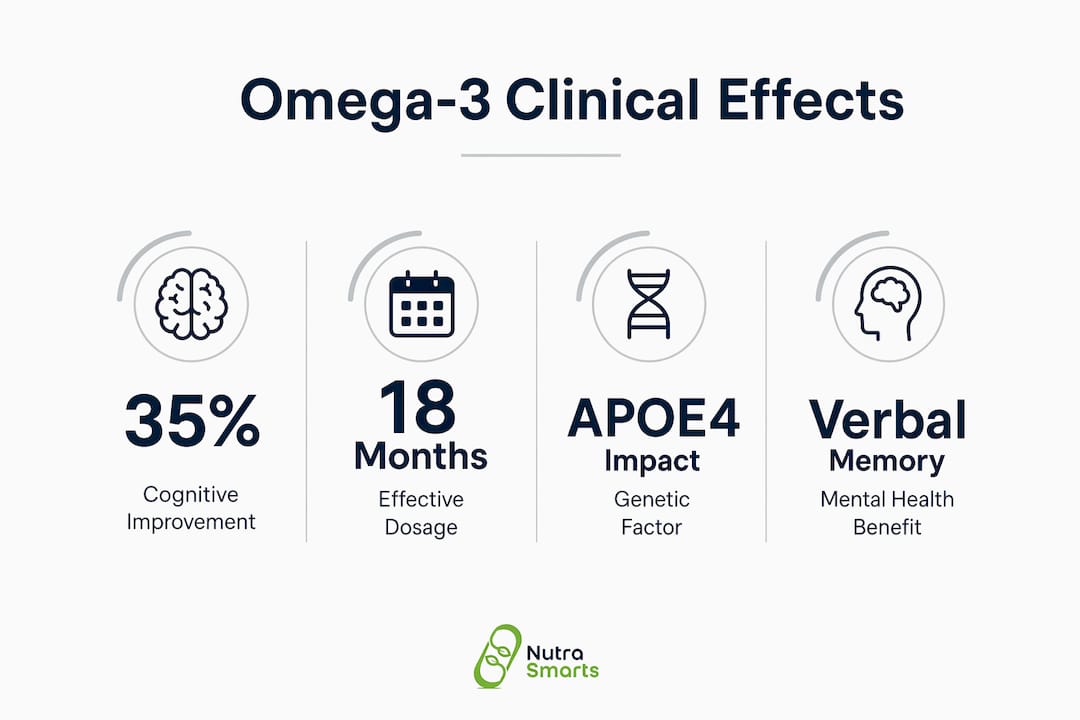
Genetic factors add another layer of complexity. The APOE4 allele, which is the strongest known genetic risk factor for Alzheimer's disease, appears to reduce how efficiently the brain absorbs and utilizes DHA. Carriers of APOE4 may show reduced DHA and EPA concentrations in cerebrospinal fluid even after supplementation, possibly because of decreased brain uptake or increased utilization. This does not mean supplementation is futile for APOE4 carriers, but it does mean the response may differ from the general population.
Mental health outcomes also appear in the clinical record. Studies have found that omega-3 supplementation improves verbal memory in people without active depressive episodes, and that EPA in particular has documented antidepressant properties. Mild cognitive impairment is another area where the evidence leans positive, with several trials showing that supplementation slows decline rather than reversing it outright.

What mechanisms explain omega-3's cognitive benefits?
The cognitive effects of DHA and EPA are not a single mechanism. They work through at least three overlapping pathways, each of which has been studied in clinical and preclinical settings.
- Cerebral blood flow: Omega-3 supplementation increases hemoglobin oxygen saturation and total hemoglobin concentrations in the brain, suggesting improved circulation and nutrient delivery to active neural tissue.
- Anti-inflammatory signaling: EPA and DHA suppress pro-inflammatory cytokines including interleukin-6 (IL-6) and tumor necrosis factor-alpha (TNF-α), both of which are elevated in neuroinflammatory conditions linked to cognitive decline.
- Specialized pro-resolving mediators: Beyond simply blocking inflammation, omega-3s trigger the production of resolvins and protectins, molecules that actively resolve existing neuroinflammation rather than just preventing new inflammation from starting.
- Synaptic plasticity: Through BDNF upregulation, omega-3s support the formation of new synaptic connections, which underlies learning and memory consolidation.
- Oxidative stress reduction: DHA and EPA reduce reactive oxygen species in neuronal tissue, which is particularly relevant in the frontal cortex, the brain region most vulnerable to oxidative damage and most closely tied to executive function.
- Amyloid-beta reduction: Epidemiological and preclinical data suggest n-3 PUFAs may reduce the accumulation of amyloid-beta, the protein fragment that aggregates in Alzheimer's disease.
The frontal cortex connection is worth pausing on. Research suggests that vulnerability to oxidative stress in the brain follows a gradient from the spinal cord upward, with the frontal cortex at the most vulnerable end. Since executive function is primarily a frontal cortex operation, this may explain why omega-3 supplementation most consistently benefits executive function rather than other cognitive domains. It is not that other domains are unaffected; it is that the frontal cortex has the most to gain from reduced oxidative load.
Dosage and duration: what the evidence actually recommends
Getting the dose right matters more than most people realize. A dose-response meta-analysis of middle-aged and older adults without dementia found that executive function benefits follow a clear upward trend during the first 12 months of supplementation, with the effect peaking at a daily intake above 500 mg of total n-3 PUFAs and up to 420 mg of EPA specifically. Beyond those thresholds, the curve flattens or reverses.
- Minimum effective threshold: More than 500 mg/day of total n-3 PUFAs for executive function benefits.
- EPA ceiling: Benefits from EPA peak at approximately 420 mg/day; higher doses do not appear to add cognitive returns.
- Duration: The beneficial trend builds over the first 12 months, then levels off. Short interventions of 6 weeks to 3 months often show no significant effect on cognition.
- Baseline status matters: People with very low blood DHA+EPA levels (below 4% in erythrocytes) may not respond as strongly to supplementation, possibly because habitual long-term exposure to n-3 PUFAs is a prerequisite for the neural adaptations that supplementation accelerates.
- FDA guidance: The FDA recommends consuming up to 3 g of omega-3 daily from all sources, with dietary supplements delivering up to 2 g per day.
- Food first: The American Heart Association and Harvard Health both recommend two servings of fatty fish per week. Whole fish may offer synergistic benefits over isolated supplements, including cardiovascular protection from omega-3s working alongside other nutrients in the food matrix.
- Safety: Long-term omega-3 supplementation is well-tolerated with very low risk of adverse effects across the clinical literature.
Pro Tip: Before starting a high-dose omega-3 supplement, ask your doctor about an omega-3 index test. This blood test measures EPA and DHA as a percentage of total red blood cell fatty acids and gives you a precise baseline. Supplementing without knowing your starting point is guesswork.
Omega-3 across the lifespan: effects from prenatal to aging
The brain's relationship with omega-3 fatty acids is not static. It changes in character and urgency at each life stage, and the clinical implications shift accordingly.

Prenatal and early infancy. DHA accumulates most rapidly in the fetal brain during the third trimester and the first 18 months of life. Maternal DHA intake directly affects fetal brain DHA levels, which is why DHA is included in prenatal vitamins and infant formula. Deficiency during this window has been linked to impaired visual acuity and delayed cognitive development.
Childhood and adolescence. The brain continues developing through the mid-20s. Omega-3 intake during childhood supports attention and learning, and some trials have found improvements in reading and working memory in children supplemented with EPA and DHA. The evidence here is less consistent than in adults, partly because children's baseline diets and omega-3 status vary widely across studies.
Adulthood. In healthy adults with adequate omega-3 levels, supplementation often shows no measurable cognitive benefit, which reflects the threshold effect described earlier. The exception is adults under significant cognitive stress, those who are socially isolated, or those eating diets very low in fatty fish. For this group, supplementation can meaningfully improve memory and mental clarity.
Aging. This is where the evidence is strongest and the stakes are highest. Older adults with higher omega-3 index scores show larger hippocampal volumes, slower rates of cognitive decline, and better executive function. The neuroprotective effects of adequate EPA and DHA appear to operate partly by preserving brain volume and white matter integrity over time, not by acutely boosting performance.
How omega-3 interacts with other nutrients, medications, and genetics
Omega-3 fatty acids do not operate in isolation. Their cognitive effects are shaped by what else is in the diet, what medications a person takes, and what genes they carry.
Nutrient interactions. DHA and EPA work alongside folate for neural health, vitamin D, and magnesium in supporting neurological function. Folate, in particular, is involved in methylation pathways that regulate gene expression in the brain, and low folate status can blunt the cognitive benefits of omega-3 supplementation. Vitamin E acts as an antioxidant that protects DHA from oxidative degradation, so a diet low in vitamin E may reduce the effective availability of DHA in neural tissue.
Medication interactions. High-dose omega-3 supplementation has a mild anticoagulant effect, which can interact with blood thinners like warfarin or antiplatelet drugs like aspirin. Anyone on anticoagulation therapy should discuss omega-3 dosing with their physician before supplementing above dietary levels.
Genetic factors. The APOE4 allele reduces the brain's ability to absorb and utilize DHA, as noted earlier. Beyond APOE4, variants in the FADS1 and FADS2 genes affect how efficiently the body converts the plant-based omega-3 ALA (found in flaxseed and walnuts) into the long-chain DHA and EPA the brain actually uses. People with less efficient FADS variants get far less cognitive benefit from ALA-rich plant sources and need preformed DHA and EPA from fish or algal oil directly.
Nutrasmarts' perspective on omega-3 research and supplementation
Nutrasmarts maintains a database of over 800 ingredients, each linked to peer-reviewed studies and clinical trial citations, and omega-3 fatty acids are among the most extensively documented entries. What that depth of research reveals is that the gap between "omega-3 is good for the brain" and "omega-3 supplementation will improve your cognition" is real and clinically significant.
- Personalized baseline testing is the most underused tool in omega-3 supplementation. Knowing your omega-3 index before you start tells you whether you are in the population likely to benefit or the population already at threshold. Nutrasmarts' research tools connect users to proactive wellness strategies that include biomarker monitoring as a starting point.
- Supplement quality varies widely. Fish oil oxidizes easily, and rancid oil delivers degraded fatty acids with potentially pro-inflammatory byproducts. Look for products that carry third-party oxidation testing (TOTOX scores) and that store the oil in dark, nitrogen-flushed capsules.
- Algal oil is a clinically valid alternative to fish-derived omega-3, particularly for people who avoid fish. Algae is the original source of DHA in the marine food chain, and algal oil delivers preformed DHA without the oxidation risk of fish oil. Nutrasmarts covers the fish oil vs. algal oil comparison in detail for readers weighing their options.
- Whole food sources remain the gold standard. Fatty fish like salmon, mackerel, and sardines deliver DHA and EPA alongside astaxanthin, selenium, and other compounds that may amplify the anti-inflammatory effect. Isolated supplements are useful when dietary intake is insufficient, but they are not a direct substitute.
- Duration is non-negotiable. Nutrasmarts' review of the clinical literature consistently finds that trials shorter than six months rarely detect significant cognitive effects. If you start supplementing, commit to at least six months before evaluating results.

Nutrasmarts' science-backed supplement database lets you search omega-3 by cognitive target, cross-reference clinical trial evidence, and identify the dose ranges that appear in the strongest studies. If you are looking for a broader view of supplements that support brain and metabolic health, the top metabolic health picks page reviews 130 formulations with the same evidence-first approach.
What the evidence adds up to on omega-3 and brain health
DHA and EPA are genuinely important for brain structure and function across the entire lifespan, from fetal neurodevelopment through cognitive aging. The clinical evidence is strongest for executive function in middle-aged and older adults, particularly those with low baseline omega-3 levels, and for neuroprotection measured by brain volume preservation over time.
- Structural role: DHA makes up a substantial portion of fatty acids in brain gray matter and is irreplaceable for membrane integrity and synaptic function.
- Cognitive benefits: Systematic reviews confirm improvements in attention, memory, language, and visuospatial skills, with executive function showing the most consistent dose-response relationship.
- Mental health: EPA has documented antidepressant properties, and omega-3 supplementation supports verbal memory in people with mild cognitive impairment.
- Recommended intake: More than 500 mg/day of total n-3 PUFAs, with up to 420 mg from EPA, over at least 6–12 months for measurable cognitive effects.
- Food first: Two servings of fatty fish per week remains the most evidence-backed dietary recommendation for brain health and omega-3 status.
- Supplement when needed: Supplementation is most beneficial for people with low dietary intake, confirmed low omega-3 index scores, or specific life stages (pregnancy, aging) where demand is elevated.
- Consult your provider: Anyone on blood thinners, carrying the APOE4 allele, or managing a diagnosed cognitive condition should discuss omega-3 dosing with a healthcare provider before supplementing.
The research on omega-3 and cognitive health is not finished. Heterogeneity in trial designs, population differences, and the challenge of measuring subtle cognitive changes over time mean that definitive population-wide recommendations are still evolving. What is clear is that adequate omega-3 intake, whether from food or a quality supplement, is one of the most evidence-supported nutritional strategies for maintaining brain health across a lifetime.
Key Takeaways
DHA and EPA are structural and functional essentials for the brain, with the strongest cognitive benefits appearing in people with low baseline omega-3 levels who supplement for at least 6–12 months at doses above 500 mg/day of total n-3 PUFAs.
| Point | Details |
|---|---|
| DHA dominates brain gray matter | DHA makes up approximately 30–40% of total fatty acids in brain gray matter, directly shaping membrane function and neurotransmission. |
| Dose and duration both matter | Executive function benefits peak at more than 500 mg/day n-3 PUFA and up to 420 mg/day EPA, within the first 12 months of supplementation. |
| Threshold effect is real | Supplementation benefits are most pronounced in people with low baseline omega-3 levels; those already at adequate levels often see no measurable cognitive gain. |
| Genetics shape individual response | APOE4 carriers and those with FADS gene variants absorb and utilize DHA differently, which affects how much cognitive benefit supplementation delivers. |
| Whole fish outperforms isolated supplements | Fatty fish delivers DHA and EPA alongside other compounds that may amplify anti-inflammatory effects, making it the preferred source when dietary intake allows. |