

Six supplements have real clinical evidence behind them for lowering blood pressure: magnesium, omega-3 fish oil, CoQ10, garlic, potassium, and vitamin C. Riboflavin and calcium help in narrower situations, mainly when you're deficient. None of them replace a prescription antihypertensive, and a few popular "natural" ingredients do the opposite of what you'd want, raising blood pressure instead of lowering it.
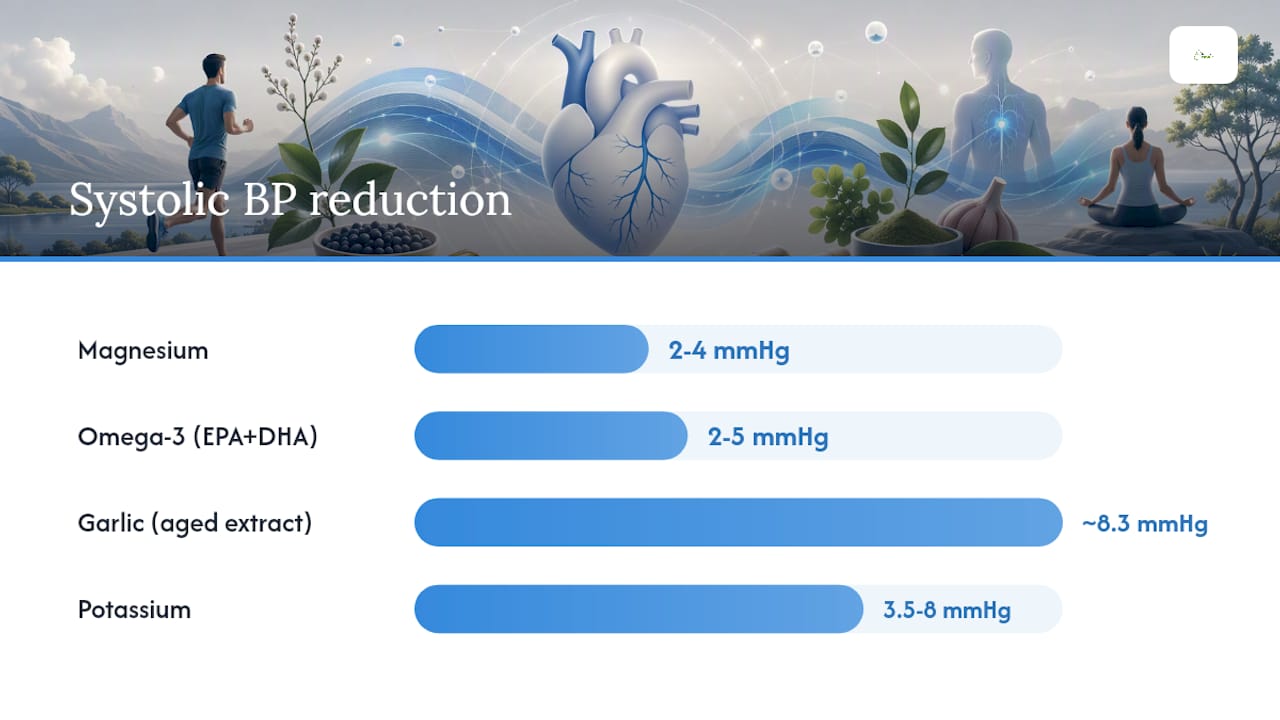
Here's the rough shape of what the evidence shows for average systolic reduction:
- Magnesium: about 2 to 4 mmHg, at daily doses around 240 to 368 mg
- Omega-3 (EPA+DHA): roughly 2 to 5 mmHg, with bigger effects at 3 to 4 grams a day
- Garlic (aged extract): the most dramatic average drop in pooled trials, around 8.3 mmHg systolic
- CoQ10: inconsistent across trials, sometimes larger in people who start with low CoQ10 levels
- Potassium: variable, 3.5 to 8 mmHg depending on how much sodium is already in your diet
Before trying any of these, there's one non-negotiable step: talk to your clinician if you take prescription blood pressure medication, a potassium-sparing diuretic, an anticoagulant, or if you have kidney disease. Several of these supplements amplify the effect of blood pressure drugs, and a stacked effect can tip you into dangerously low blood pressure or, in the case of potassium, dangerous heart rhythm problems.
A systematic review of 163 studies found that only four supplements, coenzyme Q10, fish oil, garlic, and vitamin C, met inclusion criteria for a plausible blood-pressure benefit, while four others, ephedra, bitter orange, ginseng, and licorice, were consistently linked to raising blood pressure instead.
The Linus Pauling Institute reaches a similar conclusion from a different angle: potassium, magnesium, vitamin C, riboflavin, calcium, and vitamin D all have randomized trial data behind them, but the institute is blunt that food sources beat pills for potassium specifically, and that third-party testing matters once you decide to supplement.
Key Takeaways
Magnesium, omega-3s, CoQ10, garlic, potassium, and vitamin C have the strongest trial-backed evidence for modestly lowering blood pressure, while ephedra, bitter orange, ginseng, and licorice reliably raise it.
| Point | Details |
|---|---|
| Six supplements lead the evidence | Magnesium, omega-3s, CoQ10, garlic, potassium, and vitamin C show repeatable results across randomized trials. |
| Garlic shows the largest average effect | Aged garlic extract lowered systolic pressure by about 8.3 mmHg in pooled analyses. |
| Four ingredients raise blood pressure | Ephedra, bitter orange, ginseng, and licorice carry consistent evidence for increasing blood pressure. |
| Interactions can be dangerous | Potassium and magnesium require caution with kidney disease, potassium-sparing diuretics, and certain blood pressure drugs. |
| Verify before you buy | Choose products with USP, NSF, or ConsumerLab certification and confirm label accuracy with a tool like the Nutrasmarts Supplement Facts Tool. |
Table of Contents
- Supplements for High Blood Pressure: What the Evidence Shows for Each
- Which Supplements and Herbs Raise Blood Pressure?
- How Do You Add These Supplements Safely?
- How Should You Weigh the Evidence Behind Each Supplement?
- Why Nutrasmarts Prioritizes Trial Data Over Marketing Claims
- Frequently Asked Questions
- Sources
Supplements for High Blood Pressure: What the Evidence Shows for Each
Not all six evidence-backed supplements work the same way, at the same dose, or on the same timeline. Some act within hours. Others need two months of daily use before you'll notice anything on a home cuff. Here's what the research actually says, ingredient by ingredient.
Magnesium
Magnesium relaxes blood vessel walls and helps regulate the ion transport that keeps blood pressure in a normal range. Meta-analyses pooling multiple randomized trials show a typical systolic reduction of 2 to 4 mmHg at doses between 240 and 368 mg per day, usually reached after four to twelve weeks of consistent use.
- Evidence strength: moderate, backed by multiple pooled RCTs
- Common side effects: loose stools, especially with magnesium oxide
- Drug interactions: can amplify the effect of calcium channel blockers; caution with certain antibiotics
- Best-use case: people with a diagnosed or suspected magnesium deficiency, common in anyone on long-term diuretics
Pro Tip: Magnesium glycinate absorbs better and causes far less gastrointestinal upset than magnesium oxide, which is the cheap form found in most drugstore multivitamins. If a magnesium supplement gave you diarrhea in the past, the form was probably the problem, not the mineral itself.
Omega-3 fatty acids (fish oil)
The effectiveness of fish oil for hypertension comes down to EPA and DHA content, not just "fish oil" as a category. Trials show a dose-dependent relationship: more combined EPA and DHA produces a bigger drop in blood pressure, up to a point.
- Evidence strength: strong, consistent across many randomized trials
- Studied dose: 2 to 4 grams of combined EPA+DHA daily
- Typical reduction: 2 to 5 mmHg systolic, 1 to 3 mmHg diastolic
- Side effects: fishy aftertaste, mild GI upset, increased bleeding risk at high doses
- Drug interactions: additive effect with blood thinners like warfarin
- Best-use case: adults with mild hypertension who also have elevated triglycerides, since fish oil helps both
Potassium
Potassium works by helping the kidneys excrete more sodium and by easing tension in blood vessel walls. The Linus Pauling Institute's review of randomized trials found reductions as large as 3.5 to 8 mmHg systolic, with the biggest benefit showing up in people eating high-sodium diets to begin with.

Food should be the first move here, not a pill. Bananas, potatoes, beans, and leafy greens deliver potassium alongside fiber and other nutrients that supplements can't replicate. Supplemental potassium carries real risk for a specific group of people: anyone with reduced kidney function or anyone taking a potassium-sparing diuretic (like spironolactone) or an ACE inhibitor. In those cases, extra potassium can push blood levels high enough to cause a dangerous heart arrhythmia, and it should only be used under direct medical supervision.
Coenzyme Q10 (CoQ10)
CoQ10 supports the mitochondria that power the smooth muscle cells lining blood vessels, and some researchers think its blood-pressure effect stems from that cellular energy support rather than a direct vascular action, as detailed in this Coenzyme Q10 Lab Test for Energy Support. Trial results vary more here than with magnesium or omega-3s, which is part of why the same systematic review classifies CoQ10 evidence as promising but inconsistent.
- Evidence strength: mixed to moderate
- Studied dose: 100 to 200 mg daily, split into two doses for better absorption
- Time to effect: typically 8 to 12 weeks
- Side effects: generally mild, occasional stomach upset or headache
- Drug interactions: may reduce the effectiveness of warfarin
- Best-use case: adults over 50, since natural CoQ10 production declines with age, and people on statins, which also lower CoQ10 levels
Anyone curious about the mechanism can dig into how low CoQ10 affects heart health or compare ubiquinol against standard CoQ10 before choosing a product, since the reduced form (ubiquinol) tends to absorb more easily in older adults.
Vitamin C
Vitamin C's blood pressure benefit likely comes from its antioxidant effect on the blood vessel lining, which improves how easily vessels dilate. Pooled trials summarized by the Linus Pauling Institute used a median dose around 500 mg per day for about eight weeks and found modest reductions in both normotensive and hypertensive adults, though results varied enough across studies that the institute calls the evidence heterogeneous rather than definitive.
- Evidence strength: moderate but inconsistent across trials
- Side effects: mild GI upset at high doses, kidney stone risk in susceptible people
- Drug interactions: minimal, generally considered low risk alongside standard antihypertensives
- Best-use case: adults with low dietary vitamin C intake or smokers, whose vitamin C needs run higher
Garlic (aged garlic extract)
Garlic produced the single largest average effect size of any supplement in this list. Pooled analyses found aged garlic extract lowered systolic blood pressure by around 8.3 mmHg and diastolic by about 5.5 mmHg in hypertensive adults, an effect size that rivals some prescription medications in mild cases.
- Studied dose: 600 to 1,500 mg of aged garlic extract daily
- Time to effect: 6 to 8 weeks minimum for consistent daily dosing to show results
- Side effects: garlic breath and body odor, occasional heartburn
- Drug interactions: significant bleeding risk when combined with anticoagulants or antiplatelet drugs; caution before surgery
- Best-use case: hypertensive adults not on blood thinners who want a food-derived option with the strongest average effect size in this group
Riboflavin (vitamin B2)
Riboflavin's blood pressure connection is narrower than the others on this list. It matters most for people with a specific genetic variant in the MTHFR gene that affects how the body processes folate, and evidence for benefit outside that group is thin. The Linus Pauling Institute includes it in its RCT summary largely for this genetically targeted subgroup rather than as a general recommendation.
Calcium
Calcium's role is situational too. Trial data shows a modest benefit mainly in people with low dietary calcium intake or during pregnancy, where calcium supplementation has more consistent support for preventing hypertensive complications. Outside of a documented deficiency, extra calcium doesn't reliably move blood pressure in adults who are already getting enough from diet.
Vitamin D
Vitamin D's story is a lesson in why "deficiency correction" and "general supplementation" are two different questions. Pooled trials show no consistent overall effect on blood pressure across the general population, but subgroups who started out deficient in vitamin D saw real benefit. If you're considering vitamin D specifically for blood pressure, get your 25(OH)D level tested first. Supplementing when you're already sufficient is unlikely to move the needle.
| Ingredient | Evidence Strength | Studied Dose | Typical SBP Reduction | Time to Effect | Main Safety Issues |
|---|---|---|---|---|---|
| Magnesium | Moderate | 240 to 368 mg/day | 2 to 4 mmHg | 4 to 12 weeks | GI upset (oxide form) |
| Omega-3 (EPA+DHA) | Strong | 2 to 4 g/day | 2 to 5 mmHg | Several weeks | Bleeding risk at high dose |
| Garlic (aged extract) | Strong | 600 to 1,500 mg/day | ~8.3 mmHg | 6 to 8 weeks | Bleeding risk with anticoagulants |
| Potassium | Moderate to strong | Food-first; supplements only if directed | 3.5 to 8 mmHg | Weeks | Dangerous with kidney disease, K-sparing drugs |
| CoQ10 | Mixed | 100 to 200 mg/day | Variable, sometimes larger | 8 to 12 weeks | May reduce warfarin effect |
| Vitamin C | Moderate, mixed | ~500 mg/day | Modest, inconsistent | ~8 weeks | Kidney stones at high dose |
| Riboflavin | Weak, situational | Varies by trial | Meaningful only in MTHFR carriers | Weeks | Minimal |
| Calcium | Weak, situational | Diet-dependent | Modest if deficient | Weeks | Minimal if food-based |
| Vitamin D | Mixed, subgroup only | Based on deficiency correction | None overall; benefit if deficient | Months | Test levels first |
A quick beetroot note belongs here too, even though it's not on the required list. Dietary nitrates from beetroot juice work faster than anything else in this article, dropping systolic pressure 3 to 6 mmHg within hours, but the effect fades within half a day and some people develop tolerance with continuous use. It's a short-acting tool, not a daily foundation the way magnesium or garlic can be.
Timing and form turn out to matter as much as the ingredient itself. Garlic needs weeks of steady dosing before it does anything measurable, beetroot works in hours and disappears just as fast, and magnesium's role in hypertension depends heavily on which form you buy, since glycinate and citrate absorb far better than the oxide form stocked on most pharmacy shelves.
Which Supplements and Herbs Raise Blood Pressure?
A handful of popular "natural" ingredients do the opposite of what most people buying them expect. The same systematic review that identified the six beneficial supplements above also flagged several with consistent evidence for raising blood pressure.
- Ephedra: a sympathomimetic stimulant strong enough that the FDA banned it after it was linked to cardiac events and strokes
- Bitter orange (synephrine): chemically similar to ephedra and often substituted into "ephedra-free" fat burners with a comparable stimulant effect on the heart and vessels
- Ginseng (Siberian and Asian varieties): can raise blood pressure and interact unpredictably with stimulant medications and blood thinners
- Licorice root: contains glycyrrhizin, a compound that triggers sodium retention and potassium loss through a hormonal pathway, which raises blood pressure directly
- High-dose caffeine and guarana: common in pre-workout blends, capable of spiking blood pressure acutely, especially stacked with other stimulants
- Yohimbe: a stimulant extract linked to rapid heart rate and blood pressure spikes, sometimes marketed for weight loss or libido
Licorice's mechanism is worth understanding on its own: glycyrrhizin mimics a hormone that tells the kidneys to hold onto sodium and dump potassium, which raises blood pressure through fluid retention rather than any effect on the blood vessels themselves.
The tricky part is that many of these hide inside "proprietary blends," a labeling loophole that lets manufacturers list a combined weight for several ingredients without disclosing how much of each is actually in the capsule. If you see "proprietary blend" on a Supplement Facts panel next to words like thermogenic, energy complex, or herbal stimulant matrix, treat it as a red flag until you can verify the individual ingredient amounts.
A short checklist before you buy anything marketed for weight loss, energy, or pre-workout use: stop and read the full ingredient list for ephedra, bitter orange, synephrine, ginseng, licorice, yohimbe, or high caffeine content. If you take any hormone-sensitive medication or a stimulant-based prescription, check with your provider before starting. And skip pre-workout blends that hide their stimulant dosing behind a proprietary blend label entirely.
How Do You Add These Supplements Safely?
Adding a blood pressure supplement isn't a "grab the bottle and go" decision if you're already managing hypertension with medication. Here's a sequence that keeps you safe while still letting you find out if something actually works for you.
- Gather your current medication list, including dosages, and note whether any are ACE inhibitors, ARBs, diuretics, beta-blockers, or calcium channel blockers.
- Check your kidney function and potassium status with your clinician, especially before adding potassium or magnesium.
- Start one new supplement at a time. Adding three at once makes it impossible to know what's actually working, or what's causing a side effect.
- Record a baseline blood pressure using a home cuff, averaged over three readings on two separate days.
- Monitor twice daily for two to four weeks after starting, morning and evening, seated, after five minutes of rest.
- Follow up with your clinician with your readings in hand, especially if you're on prescription therapy.
| Medication Class | Notable Supplement Interaction |
|---|---|
| ACE inhibitors / ARBs | Potassium can accumulate to dangerous levels when combined |
| Diuretics (potassium-sparing) | Potassium and magnesium supplements raise arrhythmia risk |
| Beta-blockers | CoQ10 and magnesium may have additive blood-pressure-lowering effects |
| Calcium channel blockers | Magnesium can compound the blood-pressure-lowering effect |
| Anticoagulants / antiplatelets | Fish oil and garlic both raise bleeding risk when combined |
Watch for dizziness, lightheadedness, fainting, an unusually large drop or rise in your readings, or heart palpitations. Any of those means stop the supplement and call your clinician rather than waiting out the next dose.
Quality control matters just as much as dosing. Supplements aren't tested by the FDA for potency before they hit shelves, which means the label and the capsule don't always match. Look for a third-party testing seal from USP, NSF, or ConsumerLab before you buy, and cross-check the actual label against clinical dosing using a tool like the NutraSmarts Supplement Facts Tool, which lets you verify a product's stated amounts against FDA labeling standards.
Pro Tip: Bring your home blood pressure log to your next appointment, even if nothing seems to have changed. A flat trend line is data too, and it tells your clinician the supplement isn't doing anything, which is just as useful as finding one that works.
Before your next visit, reconcile your full supplement list with your prescriptions, note the exact dose and brand of each supplement, and mention anything new even if you assume it's harmless. Report any unusual symptom immediately rather than waiting for a scheduled follow-up.
How Should You Weigh the Evidence Behind Each Supplement?
Not every study carries the same weight, and this article leans hardest on meta-analyses and randomized controlled trials, the two study types least likely to be skewed by chance or bias. Observational studies get used mainly for safety signals, like flagging that licorice raises blood pressure, rather than for proving a benefit.
The labels used throughout, strong, moderate, mixed, and weak, aren't arbitrary. "Strong" means multiple RCTs and at least one meta-analysis point the same direction with a consistent effect size, which is where omega-3s and garlic land. "Mixed" means trials disagree on whether there's an effect at all, which describes CoQ10 and vitamin D. "Weak" means the evidence applies to a narrow subgroup, like riboflavin's benefit being mostly limited to people with a specific MTHFR genetic variant.
Even the supplements with the strongest evidence in this article produce modest reductions, typically 2 to 8 mmHg systolic. They complement blood pressure management. They don't substitute for it.
Nutrasmarts builds its ingredient database around this same hierarchy, pulling from peer-reviewed studies and clinical trial citations across more than 1,300 evidence-rated profiles so you can see the actual research behind a claim instead of taking a bottle's marketing copy at face value. If you're trying to verify whether a specific product delivers what its label promises, the Supplement Facts Tool checks label accuracy directly, and the deficiency symptom guide helps you figure out whether a nutrient gap might be part of your blood pressure picture in the first place.
Why Nutrasmarts Prioritizes Trial Data Over Marketing Claims
We built Nutrasmarts because too many supplement claims trace back to a single small study, a manufacturer's internal testing, or nothing at all. This article only recommends ingredients with repeatable results across multiple randomized trials, and it flags the ones with genuine safety concerns just as clearly as the ones that help. That balance matters more in blood pressure than almost anywhere else in supplementation, since the downside of getting it wrong isn't a wasted purchase. It's a dangerous interaction with a medication you're already taking.
If you want to go deeper than this article on any single ingredient, from CoQ10 dosing to which magnesium form suits your gut, the ingredient database has the full citation trail behind each entry.
Frequently Asked Questions
What is the best supplement for high blood pressure? No single supplement outperforms the rest across every study, but garlic (aged garlic extract) produced the largest average systolic reduction in pooled trials, around 8.3 mmHg. Magnesium and omega-3 fish oil have the most consistent evidence overall.
Can I take magnesium and fish oil together for blood pressure? Yes, most people can combine them safely, since they work through different mechanisms and neither carries a major interaction with the other. Check with your clinician first if you're also on a calcium channel blocker or a blood thinner, since both supplements can add to those drugs' effects.
How long does it take for supplements to lower blood pressure? It varies by ingredient. Beetroot nitrates act within hours but fade quickly. Magnesium and CoQ10 typically need 4 to 12 weeks of daily use. Garlic needs at least 6 to 8 weeks of consistent dosing before you'll see a measurable change.
Are herbal remedies for hypertension safe to combine with prescription medication? Not automatically. Garlic and fish oil raise bleeding risk with anticoagulants, potassium and magnesium can be dangerous with certain diuretics and ACE inhibitors, and stimulant herbs like ginseng or bitter orange can counteract blood pressure medication entirely. Always review your full supplement list with your clinician.
Do calcium supplements actually affect blood pressure? Only modestly, and mainly in people with low dietary calcium intake or during pregnancy. If you already get enough calcium from food, extra calcium supplementation is unlikely to change your readings.
When should I stop taking a blood pressure supplement? Stop and call your clinician if you notice dizziness, fainting, unusually low or high readings, or heart palpitations after starting something new. Any supplement that isn't producing a measurable change after eight to twelve weeks of consistent use probably isn't worth continuing.
This article is general information, not a substitute for advice from a qualified doctor. Consult a qualified healthcare professional about your own circumstances before acting on anything here.
Sources
- Dietary Supplements and Hypertension: Potential Benefits and Precautions - PMC
- High Blood Pressure | Linus Pauling Institute
- Supplements to Lower Blood Pressure: Evidence | Cardilog
- 11 Supplements That May Help Lower Blood Pressure
- Doi