

Third-party testing for supplements is an independent evaluation that verifies a product's label accuracy, ingredient potency, and purity before it reaches you. Under the Dietary Supplement Health and Education Act (DSHEA) of 1994, supplements require no FDA pre-market approval for safety or efficacy. That regulatory gap means any company can sell a capsule with almost no external oversight. Third-party testing fills that gap by putting products through independent lab scrutiny that manufacturers cannot control or manipulate.
Why third-party testing matters for supplements
Independent verification matters because the supplement market operates largely on the honor system. The FDA can act after a product causes harm, but it does not review formulas before they hit store shelves. That structure places the burden of proof on you, the consumer, not the manufacturer.

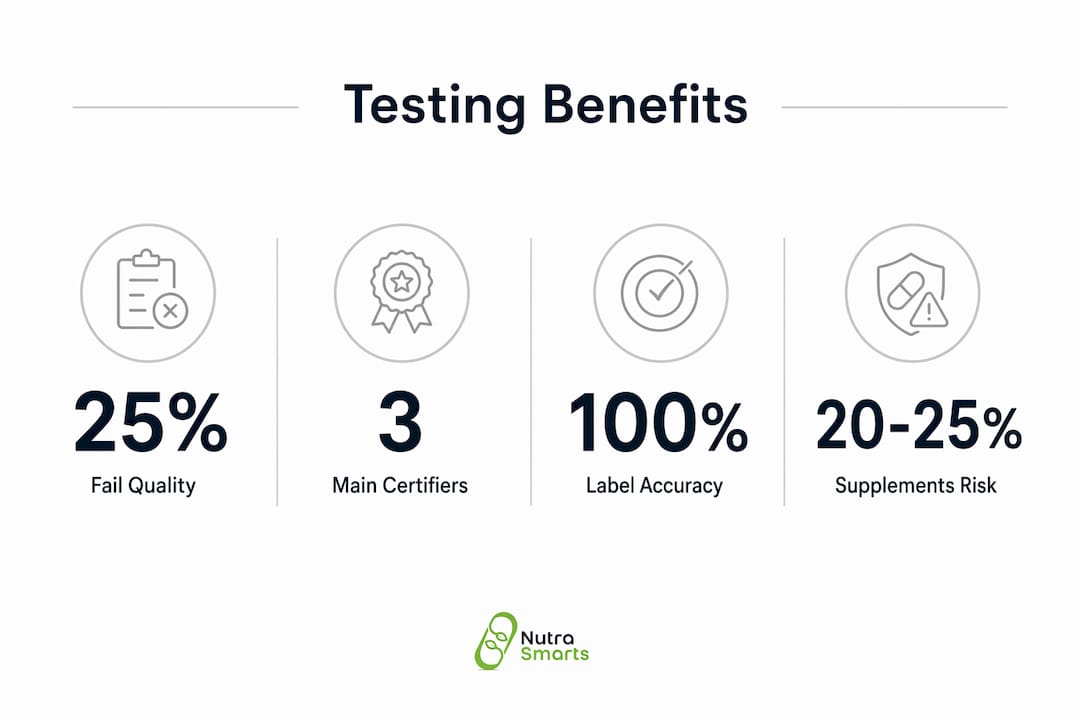
Approximately 20–25% of supplements tested fail basic quality checks, and 25% fail to contain the labeled amount of ingredients. One in four products you pick up may not deliver what the label promises. That statistic alone makes independent verification a practical necessity, not a marketing bonus.
Organizations like USP (United States Pharmacopeia), NSF International, and ConsumerLab conduct this type of testing. Each operates independently from the brands they evaluate. Their findings carry weight precisely because no manufacturer can buy a favorable result.
What does third-party testing actually verify?
Third-party labs examine several distinct quality dimensions. Each one addresses a different way a supplement can fail you.
- Ingredient identity. Labs confirm the product contains the actual compound listed, not a cheaper substitute. Herbal supplements are especially vulnerable to substitution, where a lower-cost plant species replaces the labeled one.
- Potency. Testing measures whether active ingredient amounts fall within acceptable ranges of the label claim. A magnesium supplement listing 400 mg per serving should deliver close to that amount, not 180 mg.
- Purity and contaminant screening. Labs screen for heavy metals (lead, arsenic, cadmium, mercury), pesticide residues, and undeclared pharmaceutical drugs. Heavy metal contamination has been repeatedly detected in protein powders, herbal supplements, and mineral products.
- Label accuracy. Testing checks that all listed ingredients, allergens, and fillers are correctly disclosed. An undisclosed allergen is not just a labeling error. It is a health risk.
- Dissolution testing. Some programs test whether a tablet or capsule breaks down properly in the body. A supplement that does not dissolve cannot be absorbed, making it functionally useless regardless of what it contains.
Pro Tip: When you see a third-party seal, look up the specific program on the certifying organization's website. Most publish searchable databases of certified products so you can confirm the seal is current and legitimate.
Are all third-party certifications the same?
They are not, and this distinction is where most consumers get misled. The phrase "third-party tested" has no legal definition in the United States. A brand can print it on a label after paying for a single heavy metals screen on one batch. That is technically third-party testing. It is also nearly meaningless.
Third-party testing programs vary widely: some focus solely on contaminant screening, while others perform comprehensive label verification including potency and ingredient identity. No single industry standard governs what the phrase must cover.
The table below shows how common certification programs differ in scope:
| Certification | Contaminant screening | Potency testing | Ingredient identity | Ongoing batch testing |
|---|---|---|---|---|
| USP Verified | Yes | Yes | Yes | Yes |
| NSF Certified for Sport | Yes | Yes | Yes | Yes |
| Informed Sport | Yes | Yes | Yes | Yes |
| GMP certification | Process only | No | No | No |
| Generic "lab tested" claim | Varies | Rarely | Rarely | Rarely |
GMP (Good Manufacturing Practice) certification verifies manufacturing processes but does not guarantee product-specific content accuracy. A facility can follow GMP perfectly and still produce a product with the wrong ingredient amounts. Third-party content testing provides the actual label match confirmation that GMP alone cannot.
Pro Tip: Prioritize seals from NSF International, USP, or Informed Sport over vague "lab tested" claims. These programs publish their testing criteria publicly and require ongoing batch verification, not just a one-time screen.
What risks does third-party testing help reduce?
The contamination and mislabeling problem in supplements is not theoretical. It is documented at scale. Over 700 dietary supplements sold in the United States were found to contain undeclared pharmaceutical ingredients between 2007 and 2016, according to a 2020 study published in JAMA Network Open. That figure covers only the products that were caught and reported.
"Third-party testing reduces consumer uncertainty around label accuracy and contamination, but it doesn't guarantee suitability for individual health goals."
The categories most frequently implicated include weight loss supplements, sexual enhancement products, and muscle-building formulas. These are also among the most heavily marketed categories, which means the products with the loudest claims often carry the highest contamination risk.
The risks break down into three practical categories:
| Risk type | Common examples | Who is most affected |
|---|---|---|
| Undeclared pharmaceuticals | Sildenafil in "natural" libido products, stimulants in fat burners | General consumers, athletes subject to drug testing |
| Heavy metal contamination | Lead in calcium supplements, arsenic in rice protein | Frequent supplement users, children |
| Potency mislabeling | Vitamin D capsules at 30% of stated dose | Anyone relying on supplements to correct a deficiency |
Manufacturers also benefit from independent testing. Third-party lab data forms a legally defensible record that protects brands during contamination disputes and shifts liability accountability back to the supply chain. A brand that tests independently and documents results is in a far stronger legal position than one that relies solely on supplier certificates.
What third-party testing does not guarantee
Third-party certification tells you what is in the bottle. It does not tell you whether that ingredient will work for you. Third-party testing verifies quality, not clinical efficacy. A certified product can still be the wrong dose, the wrong form, or simply an ingredient that lacks strong evidence for your specific health goal.
Consider magnesium as an example. A supplement can pass every quality test with perfect scores and still deliver the wrong form of magnesium for your needs. Magnesium oxide is highly pure and easy to certify. It is also poorly absorbed compared to magnesium glycinate or malate. Certification says nothing about that distinction.
The limits of what third-party testing covers include:
- Clinical effectiveness. A certified supplement may still lack peer-reviewed evidence for its intended use. Supplement quality testing cannot substitute for clinical trials, and a highly tested product may still lack evidence for intended health effects.
- Individual suitability. Testing does not account for your health history, medications, or existing nutrient levels. A supplement that is safe for the general population may still interact with a prescription drug you take.
- Allergen reactions. Testing confirms listed allergens are disclosed accurately. It cannot predict whether you will react to an ingredient that is not classified as a major allergen.
- Long-term safety. A product certified today reflects one batch at one point in time. Formulas can change. Ongoing certification programs address this better than one-time testing, but no certification is permanent.
The right approach combines certification status with personal research on ingredient dosages and clinical evidence. A seal from NSF or USP is a strong starting point. It is not a finish line.
Key takeaways
Third-party testing is the most reliable tool available for verifying supplement label accuracy and purity, but it confirms what is in the bottle, not whether that ingredient will work for your specific health goals.
| Point | Details |
|---|---|
| Regulatory gap is real | DSHEA 1994 requires no FDA pre-market approval, making independent testing the primary consumer safeguard. |
| Failure rates are high | Approximately 20–25% of supplements fail basic quality checks, including correct ingredient amounts. |
| Not all seals are equal | USP, NSF, and Informed Sport run comprehensive programs; generic "lab tested" claims may cover only one contaminant type. |
| GMP is not enough | GMP certifies manufacturing processes, not actual product content. Third-party content testing fills that gap. |
| Testing has limits | Certification confirms purity and potency, not clinical effectiveness or individual suitability for your health needs. |
The seal is a starting point, not the whole story
The most common mistake I see is treating a third-party seal as the final word on a supplement's value. Consumers spot the NSF or USP logo and stop asking questions. That is understandable. Those seals represent real rigor. But they answer a narrow question: is this product what it claims to be? They do not answer whether it is what you need.
The supplement industry has improved meaningfully on transparency over the past decade. Certification programs have expanded. More brands submit to ongoing batch testing rather than one-time screens. That progress is real. But the gap between "certified pure" and "clinically effective for your situation" remains wide, and most marketing language deliberately blurs that line.
What I find most useful is treating certification as a filter, not a recommendation. A product without a credible seal gets removed from consideration immediately. Among certified products, the real evaluation begins: What does the clinical evidence say about this ingredient at this dose? Does the form match what studies actually used? Is the dose within the range shown to produce effects?
A supplement label audit can reveal gaps between what a label claims and what the research supports. That kind of scrutiny, combined with third-party certification, is the standard worth holding products to. Anything less is just trusting marketing.
— Nutrasmarts
How Nutrasmarts helps you go beyond the seal
Third-party certification tells you a product is clean. Nutrasmarts tells you whether it is worth taking.
Nutrasmarts maintains a database of over 800 ingredients, each linked to peer-reviewed studies and clinical trial citations. You can search by health concern, from joint pain to brain fog, and see which ingredients have actual evidence behind them at the doses that matter. The platform also lets you compare supplements side by side using verified ingredient data, so you are not relying on label claims alone. For those evaluating metabolic health supplements, Nutrasmarts has reviewed 130 options with science-backed criteria. Certification is the floor. Nutrasmarts helps you find what stands above it.
FAQ
What is third-party testing for supplements?
Third-party testing is an independent laboratory evaluation that verifies a supplement's ingredient identity, potency, and purity without involvement from the manufacturer. It fills the regulatory gap created by DSHEA 1994, which requires no FDA pre-market approval for dietary supplements.
Does a third-party seal mean a supplement is effective?
No. Third-party certification confirms what is in the bottle, not whether the ingredient works for your health goals. A certified product can still use an ineffective dose or a poorly absorbed form of an ingredient.
Which third-party certifications are most credible?
USP Verified, NSF Certified for Sport, and Informed Sport are the most rigorous programs. They test for contaminants, potency, and ingredient identity, and they require ongoing batch testing rather than a single one-time screen.
Is GMP certification the same as third-party testing?
No. GMP certification verifies that a manufacturer follows proper production processes. It does not confirm that the finished product contains the correct ingredients at the correct amounts. Third-party content testing provides that product-level verification.
How do I know if a "third-party tested" claim is legitimate?
Look for the specific certifying organization named on the label, then search that organization's public database to confirm the product is currently listed. A vague "lab tested" claim with no named organization or verifiable record is not meaningful third-party certification.